Families now find schools by asking AI tools and search engines full questions, then reading the written answer that comes back. Your school shows up in those answers when your website, Google Business Profile, reviews, and social posts clearly say who you serve and where. Getting found is only half the job, though. Families still choose a school because a real person followed up, welcomed them, and made them feel like they belonged.

That was the heart of How Families Find Schools Now, a webinar with Ashley MacQuarrie, VP of Marketing; Jesse Foss, Content Strategist, Enrollment Marketing; and Kerry Selfinger, Content Strategist, Enrollment Marketing, all from Grow Schools. You can watch the full recording here.

What do AI search terms like AEO and GEO mean?

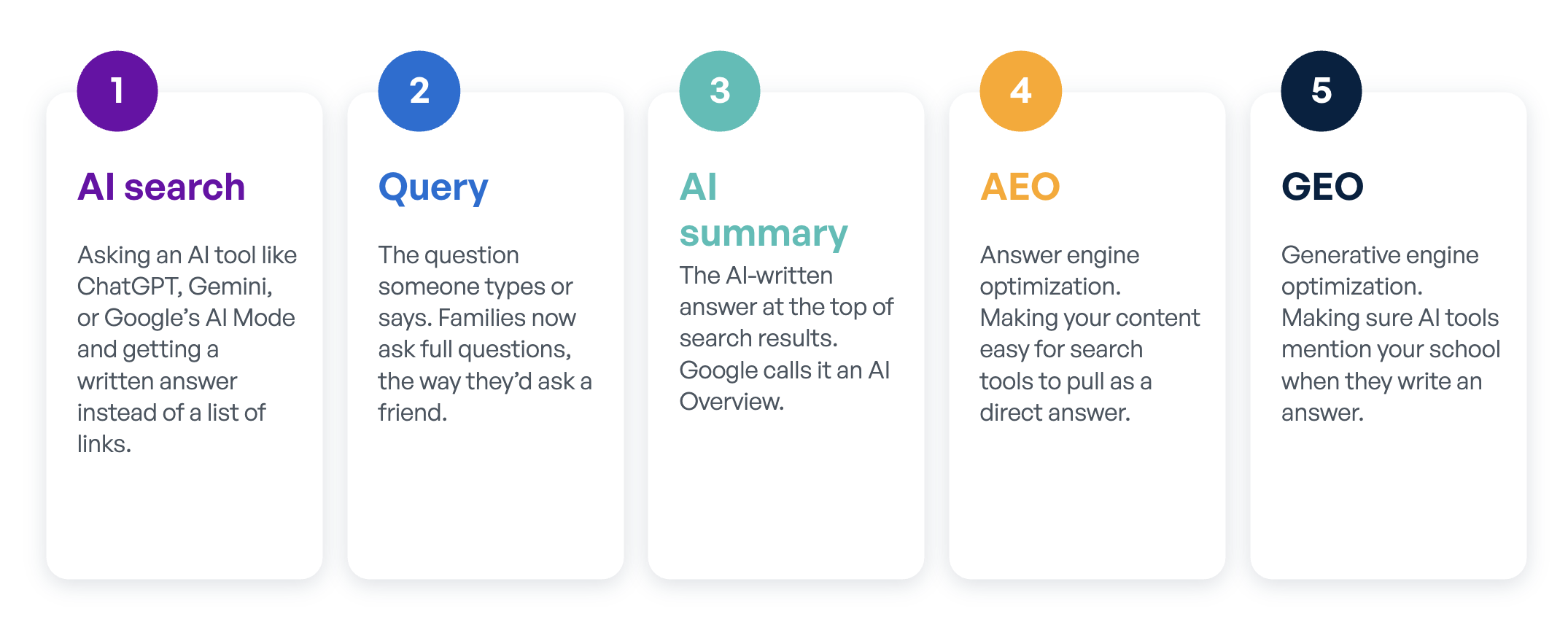
AEO and GEO are newer cousins of SEO. All three are about getting your school in front of families who are searching, but each one aims for a different spot on the screen.
Screenshot 2026 10 20 At 9 44 29 Am

The short version: SEO gets you on the list. AEO and GEO get you into the answer.

That difference matters more every year. When an AI summary appears, the top-ranked link gets nearly 60% fewer clicks, according to an Ahrefs study of 300,000 keywords (Search Engine Land). If your school isn’t one of the sources inside the summary, many families never scroll down to your link.

How do families find schools now?

Word of mouth still matters, but it has moved online. Families who once relied on school fairs, flyers, and conversations at pickup now read reviews, search Google, and ask AI tools. And they don’t type keywords anymore. They ask the way they’d ask a friend:

  • “What are the best charter schools near me?”
  • “Which schools near me still have openings for 6th grade this fall?”
  • “My daughter is shy and gets lost in big classes. What smaller schools would suit her?”
  • “Do any charter schools near me offer a bus and after-school care?”

The more specific the question, the more your school’s details matter: grades, location, class sizes, transportation, and enrollment dates.

Where does AI get information about my school?

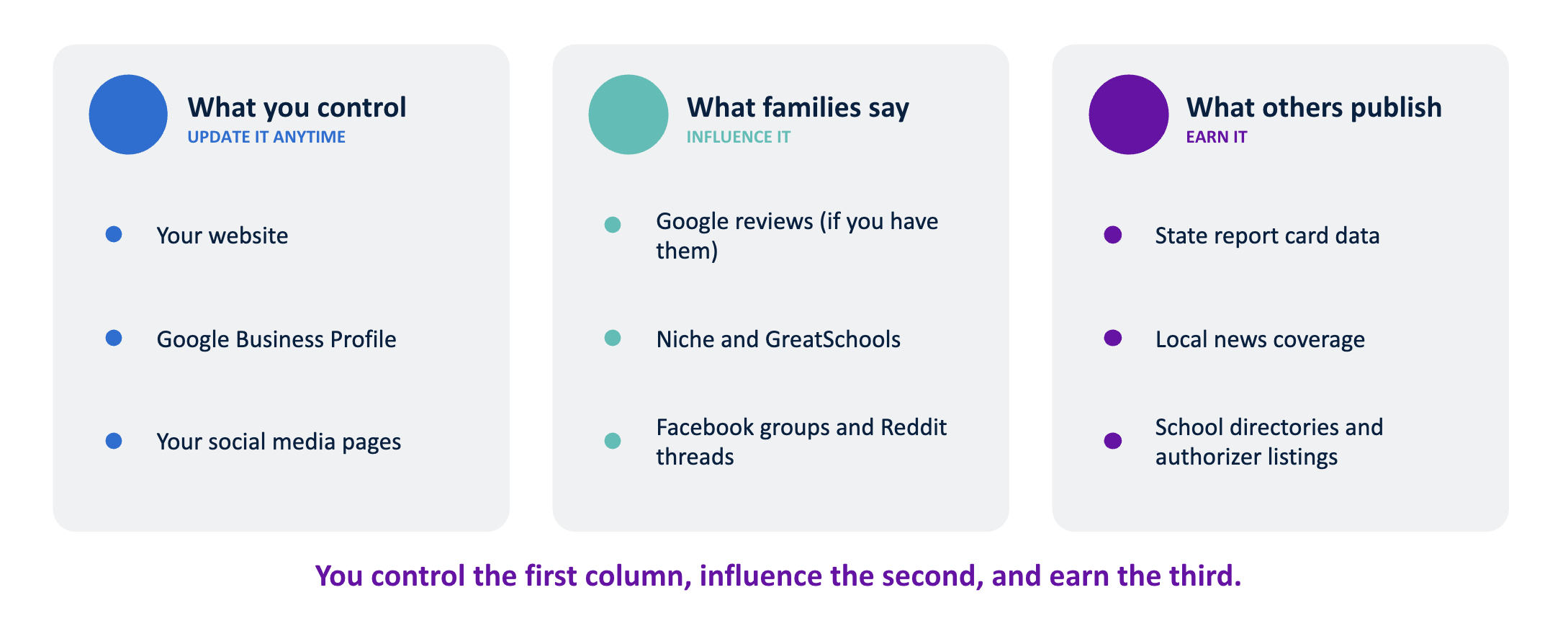
AI tools build their answers from what’s already public online, and Jesse sorted those sources into three groups.
Screenshot 2026 10 20 At 9 44 53 Am

You control the first column, influence the second, and earn the third.

How can my school show up in AI search results?

Start with what you control, then work outward. Jesse’s checklist:

  1. Complete your Google Business Profile with accurate hours, grades, photos, and an enrollment link.
  2. Answer real family questions on your website, in plain words.
  3. Add schema markup to your site so search tools can read it.
  4. Ask happy families and caregivers for Google reviews, and reply to the ones you get.
  5. Claim your Niche and GreatSchools profiles.
  6. Check your directory and authorizer listings.
  7. Get listed on partner and community websites, and share school news with local outlets.

Then test it. Ask ChatGPT or Google the question a family near you would ask, like “What’s a good school for my 3rd grader near [your city]?” If your school shows up, check that the details are right. If it doesn’t, your Google Business Profile, reviews, and website FAQ are the fastest places to start. Repeat the test every few months.

What can’t AI do for school enrollment?

AI can draft website copy, social posts, newsletters, and FAQ answers. It can help surface your school in search results. It can’t add your voice, fact-check your dates and deadlines, or know what your families worry about. And it can’t write back to the family who filled out your inquiry form at 9 p.m. As Kerry put it, getting found is step one. Being chosen is something else.

Kerry walked through what being chosen takes: following up fast, making each family feel welcome, and building word of mouth.

Why do families go quiet after a school tour?

A quiet family usually got busy. They didn’t say no. Kerry pointed to four common reasons:

  • They’re comparison shopping. Most families tour several schools.
  • They’re stuck. It’s an emotional decision, and sometimes a financial one.
  • The family is split. One parent or caregiver is sold, and the other isn’t yet.
  • The timing doesn’t match. They toured in October but won’t enroll until next fall.

Silence isn’t an answer. It’s a signal.

How do you re-engage a family that went quiet?

Build a system, not a memory. Kerry recommends six touches over 45 days:

  1. Day 1: A personal note
  2. Day 7: Something useful
  3. Day 14: A new channel, like a text instead of an email
  4. Day 21: A current family’s voice
  5. Day 30: A low-pressure check-in
  6. Day 45: “We’re here when you’re ready”

Every touch gives something or asks for something small. Never “just checking in.” After the full sequence, move the family to long-term nurture with newsletters and event invites. Many families come back a year later.

What do families look for on a school tour?

The tour starts before they walk in. Your Google Business Profile is the first impression, so keep the hours, address, contact info, and photos current. During the visit, brief every teacher and let the whole school be part of it. A real classroom beats a polished, empty showcase. Then follow up within 24 hours and mention something specific from the visit.

How do you turn current families into school ambassadors?

Your most powerful channel is already in the carpool lane. Find the families who are already talking about you. Make a specific, well-timed ask, like a pre-written text right after re-enrollment or a big event. Tell the referred family who sent them, and tell the ambassador how it went. When families repost your content, write it for their followers, not yours.

Want help putting this into practice?

If you’d like a partner for the whole journey, Kids to Fill Your School is a partnership to grow your school’s enrollment. You get a team of school marketing experts, all-inclusive pricing, and you keep everything we create together.

Sources

If you want to buy your school building someday, the most useful thing you can do today is start planning earlier than feels necessary. Buying, building, or moving takes longer than most leaders expect, and the schools that land in the right space usually gave themselves room to get there.

Why ownership appeals to school leaders

Owning your building can make your school a beacon of stability in your community. It also gives you autonomy over your facility, so you can make improvements and expand as your school grows.

Ownership brings its own work, too. Owners handle emergency heating, ventilation, and air conditioning (HVAC) repairs, periodic roof inspections, snow removal, landscaping, and major renovations every decade or so. Nonprofit schools also don’t see the tax benefits from owning real estate that for-profit owners do. Knowing this up front helps you decide whether buying, a long-term lease, or staying put fits your school best.

Drawing on a chalkboard with dollar signs and bar graph

Start with your budget

Before you tour a single property, get your numbers. A realistic figure shapes every conversation you’ll have with architects, brokers, and renovation companies, and it keeps your project team on the same page from day one.

When a financial institution prequalifies a school, it looks at existing reserves, public subsidies, private donations, public or private foundation grants, operating revenue, and charter term. Lenders want to see that your charter has been renewed for the long term.

A helpful guardrail: over the longer term, investors are unlikely to finance a project that would require you to spend more than 20% of your operating revenue on rent or repaying debt. They want to see at least 80% of your revenue going back into instruction and your academic programs. For example, a school with $6 million in annual revenue that can safely set aside 15% (about $900,000 a year) may be able to budget around $9 million for a facility project. Your school’s situation will be different, but the example gives you a ballpark to start from.

Location matters as well. Most states fund schools with a per-student formula, so a school in a high-cost city will have a harder time affording a building than a school with similar enrollment in a town where land costs less.

Give your school building purchase more time than you think

Plan at least a year ahead. Any building project means moving staff, students, furniture, and equipment, and it will likely take longer and cost more than the first estimate. Look at how long similar projects have taken, build in flexibility, and time your move so it disrupts learning as little as possible.

The Money to Buy Your School timelines give you a sense of scale. Staying in your current space under a lease averages six to seven months. Moving to a new forever home averages nine to 11 months. Building a forever home averages 13 months or more.

The Buy Your School guide breaks a facility project into five stages: plan, fund, acquire, design, and construct. Planning covers space programming, features, budget, timeline, and charter approvals. Acquiring a site can involve requirements and restrictions, use permits, and land prep. Design brings in team selection, general contractor bidding, and building permits, along with a choice between one big move or a phased approach.

Get your school ready now

You can start preparing long before you’re ready to buy. Conduct a building audit each year to see how well your current facility meets your needs. Think about future costs, including maintenance, energy efficiency, and your growth plans. Review your lease agreements and other contracts so you know when they expire.

school science lab

Then sketch out your ideal space. Go back to your mission and ask what your building has to include to carry it out. How many classrooms will you need? How many bathrooms? How much hallway and office space? If you serve students who use mobility devices, or your programs depend on science labs or a performance space, put those needs on the list early.

If the numbers are tight, you have options. Phasing construction or renovation can help you manage costs, and renting out unused space or repurposing existing facilities can bring in funds.

Know what lenders and landlords look for

Whether you pursue a bank loan, a bond, or a lease, the people financing your project will focus on four things. They’ll want to see sustainable enrollment, backed by current numbers, a waitlist, and demand in your local market. They’ll look for experienced leadership and academic performance that holds up against nearby schools, your district, and your state. They’ll review your financials to make sure you can make payments while still funding a quality academic program. They’ll also look at governance, including your relationship with your authorizer and an active board that provides strong oversight.

Getting these pieces in order ahead of time makes the approval process smoother, whichever path you choose.

Your school has to pay for things long before the money to cover them shows up. You hire staff before you have students, sign a lease before you have enrollment, and market your school before families and caregivers have heard of it. State per-pupil funding, which eventually carries most of your operating costs, doesn’t start flowing until students are enrolled and attending.

That stretch between spending and receiving is the cash gap. According to Start Your School: The Charter School Founder’s Guide, the schools that get through it are the ones that understand it clearly in advance and build a funding plan that accounts for it. Much of that plan comes down to one habit: build your cash flow projections around when money actually arrives, not when it’s awarded or promised.

Know When Each Funding Source Pays

Charter school funding comes from several places, and each one runs on its own clock.

State funding is typically your largest source. It’s administered through your state education agency, it lags enrollment, and it’s disbursed on a schedule that doesn’t always line up with when your bills are due. Some states also offer local or county funding, which varies widely by jurisdiction.

Federal grants such as Title I, Title II, and special education funds come through state agencies, and most of them are reimbursement-based. Charter Schools Program (CSP) grants, the federal start-up grants for new charter schools, are competitive and worth pursuing. Enterprise programs like the National School Lunch Program and before- and after-school programs generate their own revenue. Philanthropic support from foundations and individual donors is often easier to find in your start-up years, and it tends to taper as your school becomes established.

Once you’ve listed your sources, put a realistic arrival date next to each one. As the Start Your School guide puts it, the timing of each source matters as much as the amount.

Plan for the Reimbursement Wait

Grants are valuable, and the U.S. Department of Education, states, and private foundations all offer them. Most, though, are reimbursement grants. You spend first, submit your documentation, and then wait, sometimes for months and sometimes for more than a year.

The Start Your School guide offers a simple example: a $200,000 grant doesn’t help you make payroll in month two if the reimbursement won’t arrive until month seven. Your expenses are real in the meantime, and your cash balance keeps shrinking. If you’re counting on a reimbursement grant, you’ll need separate money to make the purchases in the first place. Without it, grant dollars you’ve already won can sit out of reach.

Bridge the Gap With Funding That Fits the Timing

When state payments and grant reimbursements lag behind your bills, operational funding can carry you across. The Fund Your School guide lists what to look for. The strongest options advance state payments you’re already owed, months before they’re disbursed. Their costs are transparent and fixed, so a delayed state payment doesn’t bring a surprise. A structure that works like a line of credit means you pay only for what you use.

Speed and experience count, too. A partner who requires a six-month underwriting process won’t help when you need to make payroll in three weeks, and one who understands the per-pupil timing lag and the reimbursement grant problem will give you better counsel. Money to Run Your School was built for this situation, advancing state payments to provide operating capital before per-pupil funding arrives.

Charter School Cash Flow Article (2)

Set Two Targets From Your First Budget

The Start Your School guide recommends setting two financial targets as explicit goals from your first budget cycle.

Your fund balance is the running total of every surplus and deficit since your school was founded. It’s a primary indicator of financial viability, so work with your financial advisor and board to set a target, then keep it visible and tracked.

Your cash balance tells a different story. A school can have a healthy fund balance and still struggle to make payroll. As a baseline, plan to keep at least 90 days of cash on hand, roughly 25% of your annual operating expenses. That cushion lets you keep operating without disruption when a payment is delayed or enrollment fluctuates.

Working capital, the difference between your current assets and your current liabilities, ties the two together. It shows whether you can meet your short-term obligations, and in the start-up years, managing it is the central financial challenge.

Build Your Projections on Conservative Numbers

Pre-opening costs can easily reach hundreds of thousands of dollars before students arrive. They typically include salaries for leaders hired before opening, facility deposits and early lease payments, build-out or renovation, technology, curriculum and materials, and enrollment marketing.

Model your first year against realistic enrollment. A budget built on 400 students when you’re likely to open with 250 isn’t a plan. It’s a liability. Build your base case on conservative enrollment, set a best case above it, and keep a contingency plan ready in case enrollment comes in below your base.

The same care applies once you’re growing. Cash flow problems that come from expanding too quickly, or from a growth plan your finances can’t yet support, are among the leading causes of charter school closure.

Charter School Cash Flow Article (1)

Forecast Forward All Year

Once your budget is set, the Fund Your School guide recommends keeping it static and capturing changes through forecasting. Update your projections as new information arrives, forecast through fiscal year-end, and compare forecast to budget at every reporting cycle. Over time, you’ll see exactly where your assumptions held and where they didn’t.

Pressure-test those assumptions with a few scenarios: enrollment that hits target, enrollment that misses by 10%, and a key funding source that doesn’t come through. Thinking through the risks before they arrive is the difference between a managed challenge and a financial crisis.

Experienced charter school leaders featured in The Charter School Growth Guide boil all of this down to a short list: treat your budget as a living document, plan for the worst-case scenario, know how you’ll pay for everything, and above all, never miss payroll. Nothing undermines trust with your staff faster than a late or inaccurate paycheck.