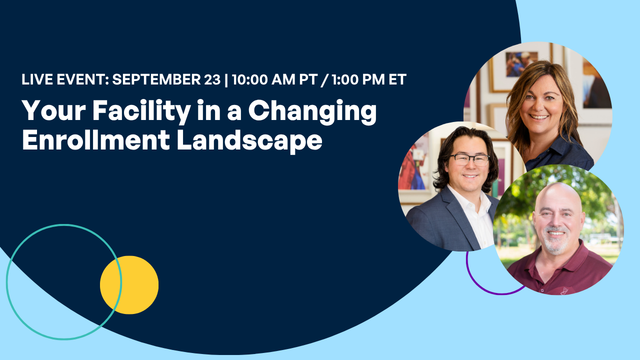
On September 23, 2026, Grow Schools hosted a webinar on considering enrollment and facilities decisions together. Ashley McQuarrie hosted; Mary Dillon and Michael So covered the frameworks and timelines; Steve Casenza, CEO of Palm Beach Maritime Academy, joined live to share his school’s move from leasing to ownership.
The session covered three things: why charter enrollment trends make facility planning urgent right now, the frameworks to evaluate a facility decision (financial guardrails, timeline expectations, and a build-versus-move-versus-stay framework), and a real school’s experience.
Why does charter enrollment growth affect your facility plans?
Over the past six years:
- Charter school enrollment grew by more than 500,000 students, a 15 percent increase.
- Traditional district enrollment fell by nearly 2 million students, a 4.4 percent decline.
Some schools are outgrowing buildings that fit comfortably two years ago. Others are watching enrollment slip and having a very different conversation about right-sizing. Either way, the facility conversation can’t wait until the numbers force it.
How do enrollment, funding, and facility fit together?
They’re one system, not three separate problems. A facility decision changes what you can enroll, which changes your funding, which changes what facility moves you can afford. Mary’s guardrails for testing any facility decision: keep rent or lease costs at or below 20 percent of revenue, and keep net income plus facility costs at 120 percent or more of your projected payment.
The School of Arts and Enterprise in Pomona, California worked with Grow Schools across all three programs, Money to Run Your School, Money to Buy Your School, and Kids to Fill Your School, to move from a maturing loan they couldn’t refinance to owning their building outright.
How long does each facility path take?
Michael’s timelines, based on typical Grow Schools projects:
- Build your forever home: about 13 months on average; zoning and scope can stretch this to two or three years.
- Move, with improvements: about 9 to 11 months, converting an existing building, office, or church to fit your school.
- Move, as-is: about 5 to 6 months for a like-for-like move into a building already approved for school use.
- Stay, with a modified lease: about 4 to 5 months to renegotiate terms that fit your budget and growth.
- Stay, with your lease as-is: about 4 to 5 months, when your current terms already work and you’re changing to a landlord who understands charter schools.
Modular buildings make sense for short-term capacity needs, typically leases under five years; they’re not a fit for labs or kitchens.
What should you look for in a lease renewal?
- Term flexibility, plus early termination or contraction rights if enrollment shifts.
- Predictable rent escalations, with relief timed to your low cash-flow periods.
- Landlord-funded capital improvements in exchange for a longer term.
- Expansion rights (right of first refusal on adjacent space) or contraction rights, depending on your trajectory.
- Clear language covering all school activities, and terms for what happens if your charter isn’t renewed.
What’s driving construction costs up right now?
Construction costs are up about 6.8 percent over the past year, driven mainly by tariffs on aluminum and steel. HVAC and electrical equipment have the longest lead times, as data centers are absorbing much of the capacity for switchgear and transformers. Finishes, flooring, paint, and sitework have stayed largely flat. A reasonable planning assumption: 5 to 7 percent cost escalation per year, a 15 to 20 percent contingency, and ordering major equipment 18 to 36 months out where possible.
Palm Beach Maritime Academy’s Story
Palm Beach Maritime Academy is a 100 percent Title I school that’s won Best Public School in Palm Beach County seven years running. While the surrounding district lost thousands of students this year, Palm Beach Maritime’s enrollment grew 2 percent. Steve credited a lot of that to moving fast: a facility plan that had stalled for two to three years under a bond-funding approach came together in three months once Grow Schools became the school’s landlord. The school is now converting an adjacent retail space into a showcase for its marine science and STEM programs, adding room for 80 to 90 more students.
Missed the live webinar? You can watch it on-demand here.
Want to share?