
Families now find schools by asking AI tools and search engines full questions, then reading the written answer that comes back. Your school shows up in those answers when your website, Google Business Profile, reviews, and social posts clearly say who you serve and where. Getting found is only half the job, though. Families still choose a school because a real person followed up, welcomed them, and made them feel like they belonged.
That was the heart of How Families Find Schools Now, a webinar with Ashley MacQuarrie, VP of Marketing; Jesse Foss, Content Strategist, Enrollment Marketing; and Kerry Selfinger, Content Strategist, Enrollment Marketing, all from Grow Schools. You can watch the full recording here.
What do AI search terms like AEO and GEO mean?
AEO and GEO are newer cousins of SEO. All three are about getting your school in front of families who are searching, but each one aims for a different spot on the screen.
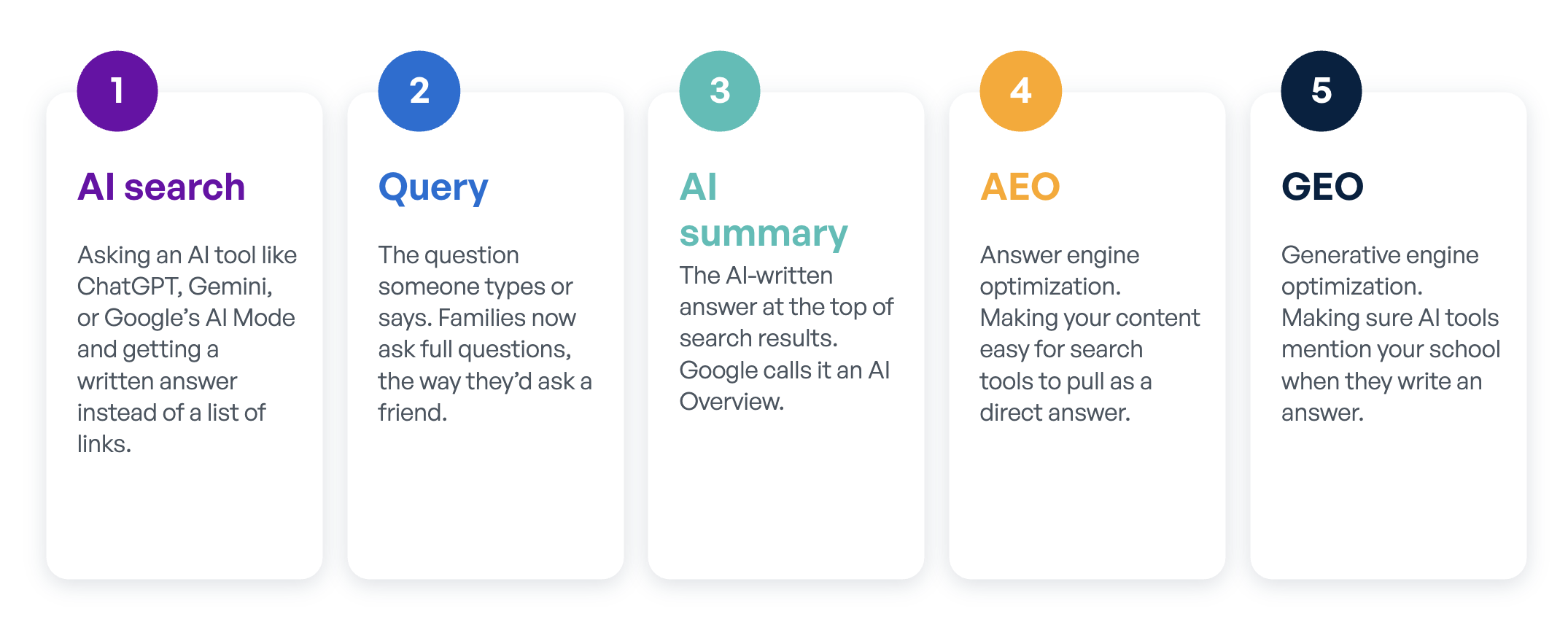
The short version: SEO gets you on the list. AEO and GEO get you into the answer.
That difference matters more every year. When an AI summary appears, the top-ranked link gets nearly 60% fewer clicks, according to an Ahrefs study of 300,000 keywords (Search Engine Land). If your school isn’t one of the sources inside the summary, many families never scroll down to your link.
How do families find schools now?
Word of mouth still matters, but it has moved online. Families who once relied on school fairs, flyers, and conversations at pickup now read reviews, search Google, and ask AI tools. And they don’t type keywords anymore. They ask the way they’d ask a friend:
- “What are the best charter schools near me?”
- “Which schools near me still have openings for 6th grade this fall?”
- “My daughter is shy and gets lost in big classes. What smaller schools would suit her?”
- “Do any charter schools near me offer a bus and after-school care?”
The more specific the question, the more your school’s details matter: grades, location, class sizes, transportation, and enrollment dates.
Where does AI get information about my school?
AI tools build their answers from what’s already public online, and Jesse sorted those sources into three groups.
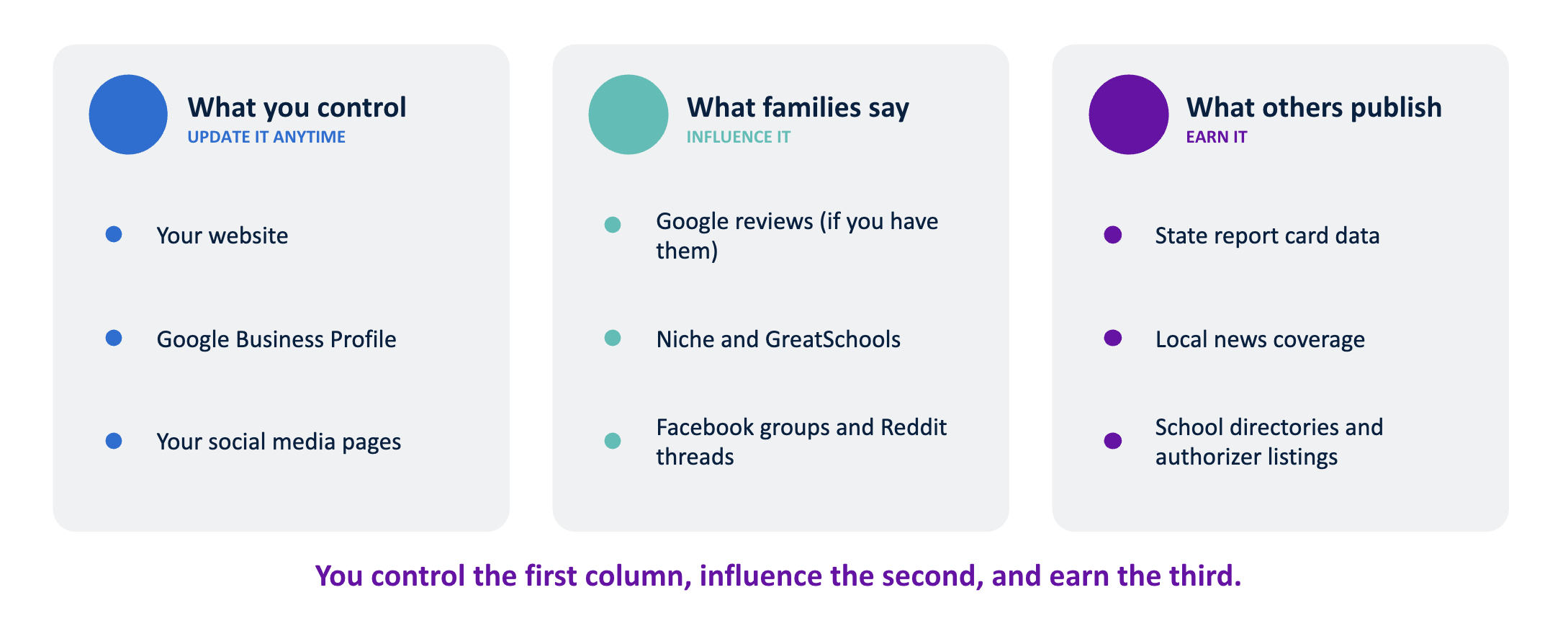
You control the first column, influence the second, and earn the third.
How can my school show up in AI search results?
Start with what you control, then work outward. Jesse’s checklist:
- Complete your Google Business Profile with accurate hours, grades, photos, and an enrollment link.
- Answer real family questions on your website, in plain words.
- Add schema markup to your site so search tools can read it.
- Ask happy families and caregivers for Google reviews, and reply to the ones you get.
- Claim your Niche and GreatSchools profiles.
- Check your directory and authorizer listings.
- Get listed on partner and community websites, and share school news with local outlets.
Then test it. Ask ChatGPT or Google the question a family near you would ask, like “What’s a good school for my 3rd grader near [your city]?” If your school shows up, check that the details are right. If it doesn’t, your Google Business Profile, reviews, and website FAQ are the fastest places to start. Repeat the test every few months.
What can’t AI do for school enrollment?
AI can draft website copy, social posts, newsletters, and FAQ answers. It can help surface your school in search results. It can’t add your voice, fact-check your dates and deadlines, or know what your families worry about. And it can’t write back to the family who filled out your inquiry form at 9 p.m. As Kerry put it, getting found is step one. Being chosen is something else.
Kerry walked through what being chosen takes: following up fast, making each family feel welcome, and building word of mouth.
Why do families go quiet after a school tour?
A quiet family usually got busy. They didn’t say no. Kerry pointed to four common reasons:
- They’re comparison shopping. Most families tour several schools.
- They’re stuck. It’s an emotional decision, and sometimes a financial one.
- The family is split. One parent or caregiver is sold, and the other isn’t yet.
- The timing doesn’t match. They toured in October but won’t enroll until next fall.
Silence isn’t an answer. It’s a signal.
How do you re-engage a family that went quiet?
Build a system, not a memory. Kerry recommends six touches over 45 days:
- Day 1: A personal note
- Day 7: Something useful
- Day 14: A new channel, like a text instead of an email
- Day 21: A current family’s voice
- Day 30: A low-pressure check-in
- Day 45: “We’re here when you’re ready”
Every touch gives something or asks for something small. Never “just checking in.” After the full sequence, move the family to long-term nurture with newsletters and event invites. Many families come back a year later.
What do families look for on a school tour?
The tour starts before they walk in. Your Google Business Profile is the first impression, so keep the hours, address, contact info, and photos current. During the visit, brief every teacher and let the whole school be part of it. A real classroom beats a polished, empty showcase. Then follow up within 24 hours and mention something specific from the visit.
How do you turn current families into school ambassadors?
Your most powerful channel is already in the carpool lane. Find the families who are already talking about you. Make a specific, well-timed ask, like a pre-written text right after re-enrollment or a big event. Tell the referred family who sent them, and tell the ambassador how it went. When families repost your content, write it for their followers, not yours.
Want help putting this into practice?
If you’d like a partner for the whole journey, Kids to Fill Your School is a partnership to grow your school’s enrollment. You get a team of school marketing experts, all-inclusive pricing, and you keep everything we create together.
Sources
- Google zero-click searches study, Search Engine Land (June 2026)
- Kerry Selfinger, Turning Happy Families into School Ambassadors, Grow Schools
- Kerry Selfinger, Tuesday Tips: Re-Engaging Families Who Went Quiet, Grow Schools
- Kerry Selfinger, What Families Look for When They Tour Your School, Grow Schools
Want to share?