Enrollment is the engine. It drives your revenue, which determines what you can afford from a facilities standpoint, which shapes how many students you can serve, which feeds back into enrollment. Everything connects. And when enrollment is healthy, the whole system has momentum. When it struggles, everything feels it.

Here’s what to consider when approaching enrollment strategically.

Start With Your True Enrollment Ceiling

Before you spend a dollar on marketing or recruitment, you need to know your actual capacity. Not your aspirational capacity—your real one.

That means mapping out every seat by grade and by program. It means accounting for your physical space — yes, including whether there’s an unused closet under a staircase somewhere — and your staffing limitations. You can’t recruit to a number you haven’t defined, and you can’t define it honestly without doing this work first.

I see schools skip this step regularly, and it costs them. They start spending on advertising without knowing what they’re actually recruiting toward. That’s not a marketing problem. That’s a strategy problem.

Enrollment The Engine That Drives Everything Else

Your Biggest Enrollment Lever Is Already in Your Building

Retention can be undervalued in enrollment conversations. The families you already have are your single biggest enrollment lever. Keeping them is almost always less expensive than replacing them.

Think about it this way: if a family leaves your school unhappy, you’ve potentially lost not just one student but siblings, cousins, neighbors, and those they would have told about your school. Word of mouth works both directions. And every student you lose means you have to recruit a replacement before you can even start counting toward growth.

So before you focus on filling the bucket, fix the leak. Where are you losing students year over year? Is there a specific grade transition where families consistently don’t return? A particular program gap that’s driving middle schoolers away? These patterns are telling you something, and if you ignore them, no amount of recruitment will get you to your growth goals sustainably.

Dr. Dozier Brown shared something in our webinar that stuck with me — Sacramento Valley Charter is losing seventh- and eighth-graders specifically because of facility limitations. No athletic field. No real basketball court. That’s a retention problem with a facilities root cause. You can’t market your way out of that. You have to fix the underlying issue.

Project Forward, Not Just This Year

Enrollment isn’t a one-year problem, and it shouldn’t be treated like one. I’d encourage every charter leader to look at their enrollment data not just for this coming school year, but two and three years out.

Here’s why this matters practically. Say you had an unusually large kindergarten class a few years ago — maybe during a COVID enrollment surge. That cohort is now moving through your grades. When they graduate or age out of your grade span, you’ll have a much larger replacement need than a typical year. If you haven’t planned for that, it can look like a sudden enrollment crisis when it was actually completely predictable.

I’ve seen this surprise schools that had been otherwise well-managed. They weren’t thinking about the shape of their enrollment over time — just the number they needed to hit each fall.

Look at your wait list trends. Look at your retention rates by grade. Look at population shifts in your community — new housing developments, schools closing nearby, demographic changes. These are the signals that tell you where your enrollment is actually headed, and they give you the lead time to respond thoughtfully instead of reactively.

Enrollment The Engine That Drives Everything Else (3)

Plan Your Recruitment to Match Your Reality

Once you know your capacity, your retention rate, your trajectory, and your realistic goals, your recruitment strategy becomes much more focused. You’re not just trying to get families in the door — you’re trying to get the right number of the right families at the right time.

A school of 250 students that wants to grow to 300 isn’t just recruiting 50 students. If they’re losing 55 students annually to normal attrition and graduation, they need to recruit 105 just to hit their net growth target. If they don’t know that number, they’re not setting a marketing budget. They’re guessing.

That planning step — understanding what you actually need to recruit — is what allows you to set a meaningful budget, target the right families, and measure whether your efforts are working. Without it, you’re spending on hope.

The Three Phases of Growth

As you think about where your school is right now, I’d encourage you to place yourself in one of three phases.

In the foundation building phase, you’re establishing financial stability, building enrollment from the ground up, and optimizing what you already have. Growth is the goal but stability is the immediate priority.

In the strategic positioning phase, your enrollment is solid, your finances are strong, and you’re starting to evaluate what’s next — whether that’s a new facility, a program expansion, or a second site.

In the growth execution phase, you’re actively expanding — enrollment, facilities, or both — with the financial and operational foundation to support it.

Knowing which phase you’re in shapes every decision. It tells you where to put your energy, where to put your budget, and what success looks like right now versus two years from now.

One More Thing

I’ll close with this: the schools I’ve seen struggle most are the ones that treat enrollment as a seasonal campaign. They turn it on in January when the lottery opens and turn it off when seats are filled. The schools that thrive treat it as an always-on strategic function — building awareness year-round, nurturing wait lists, staying connected to families even before they’re ready to enroll.

About the Author

Ashley Macquarrie

Ashley MacQuarrie is VP of Marketing at Grow Schools, where she leads the enrollment marketing team helping charter schools achieve sustainable growth.


As spring approaches, many schools find themselves under pressure to meet enrollment targets. If you’re feeling a bit behind, don’t panic! In this post, we’ll explore five actionable strategies to help school leaders enhance their enrollment efforts during this critical period. Whether you’re facing a top-of-funnel issue or struggling with conversion, these tips will guide you in making a positive impact before the school year ends.

Understanding Your Enrollment Challenges

Before diving into strategies, it’s crucial to identify the specific challenges your school is facing. Are you struggling with attracting new families, or is it a matter of converting inquiries into enrollments? For instance, do families visit your school but fail to complete their applications? Understanding the root of your enrollment issues is the first step toward taking effective action.

Assessing Your Enrollment Landscape

  1. Identify the Problem: Determine if your challenges stem from attracting new families or retaining current ones.
  2. Engage Your Community: Survey existing families to gauge their intent to return. This insight is invaluable for planning your next steps.
Spring Enrollment Strategies For Schools 5 Essential Tips To Boost Your Numbers

1. Revamp Your Open House Strategy

Open houses are a great opportunity to showcase your school, but timing and approach matter. In spring, families are closer to making decisions, so tailor your open house to address their specific concerns rather than delivering a broad sales pitch.

Key Tips for Spring Open Houses

  1. Focus on Specific Questions: Provide answers to concerns like classroom dynamics, teacher interactions, and cultural fit.
  2. Involve Current Families: Leverage testimonials from existing families and staff to create a welcoming atmosphere.
  3. Interactive Tours: Allow potential students and parents to see the campus and meet teachers in a more personal setting.

2. Prioritize Communication with Prospective Families

With limited time before the school year wraps up, ensuring continuous communication with prospective families is key to keeping them engaged.

Effective Communication Strategies

  1. Summer Communication Plan: Start early by planning a communication sequence for families who have already applied. This helps maintain their interest and reduces the risk of no-shows on the first day of school.
  2. Personal Follow-ups: Instead of generic emails, have administrators or staff reach out personally to families who have shown interest. This can foster a stronger connection and encourage commitment.
Spring Enrollment Strategies For Schools 5 Essential Tips To Boost Your Numbers (3)

3. Enhance Referral Programs

Word-of-mouth referrals are one of the most effective ways to attract new students. Encourage your current families to share their experiences and recommend your school to others.

Implementing a Referral Strategy

  1. Create Shareable Content: Provide families with easy-to-share posts or flyers about your school.
  2. Incentives for Referrals: Consider offering incentives for families who refer new students, creating a win-win situation for both parties.

4. Engage on Social Media During the Summer

Many schools mistakenly view summer as a downtime. However, this is a crucial period to keep your school in the minds of prospective families.

Summer Engagement Tactics

  1. Show Behind-the-Scenes Content: Share updates on school preparations, introducing new teachers and showcasing classroom setups.
  2. Create Anticipation: Use social media to build excitement for the upcoming school year, highlighting special events and initiatives.
Spring Enrollment Strategies For Schools 5 Essential Tips To Boost Your Numbers (2)

5. Plan Ahead for Fall Marketing

Don’t wait until the school year starts to plan your fall marketing efforts. Use the summer to lay the groundwork for a successful enrollment push in the fall.

Fall Planning Essentials

  1. Identify Marketing Opportunities: Research local school fairs and community events where you can engage with prospective families.
  2. Prepare Your Outreach: Develop promotional materials in advance to ensure you’re ready to go when the school year starts.

Conclusion

Spring is a critical time for schools to boost enrollment numbers. By understanding your challenges, revamping your open house strategy, prioritizing communication, enhancing referral programs, engaging with families over the summer, and planning for fall marketing, you can set your school up for success. Remember, urgency doesn’t equate to desperation; be strategic in your approach.

Frequently Asked Questions

What should schools do if they are behind on enrollment targets?

To address enrollment challenges, schools should first identify their specific issues, whether it’s attracting new families or converting interested ones. Engaging with existing families for feedback and improving communication can significantly help.

How can open houses be more effective during spring?

Spring open houses should focus on addressing specific concerns families might have, providing more detailed information about teachers, culture, and campus life. Involving current families in the process can enhance authenticity and trust.

What is the importance of referral programs for schools?

Referral programs leverage the experiences of current families to attract new students. They can be incredibly effective in building trust and community engagement, often leading to higher enrollment rates.

About the Author

Ashley Macquarrie

Ashley MacQuarrie is VP of Marketing at Grow Schools, where she leads the enrollment marketing team helping charter schools achieve sustainable growth.

Sometimes the financial conversations nobody wants to have are usually the most important ones. Budgets, cash ratios, debt service, reserves — these aren’t glamorous topics. But they are the difference between a school that survives a rough patch and one that doesn’t.

At Grow Schools’ recent School Success Trifecta webinar, I talked about financial health not just as a compliance exercise, but as a genuine leadership tool. Here’s what I want every charter leader to take away.

The Numbers That Actually Matter

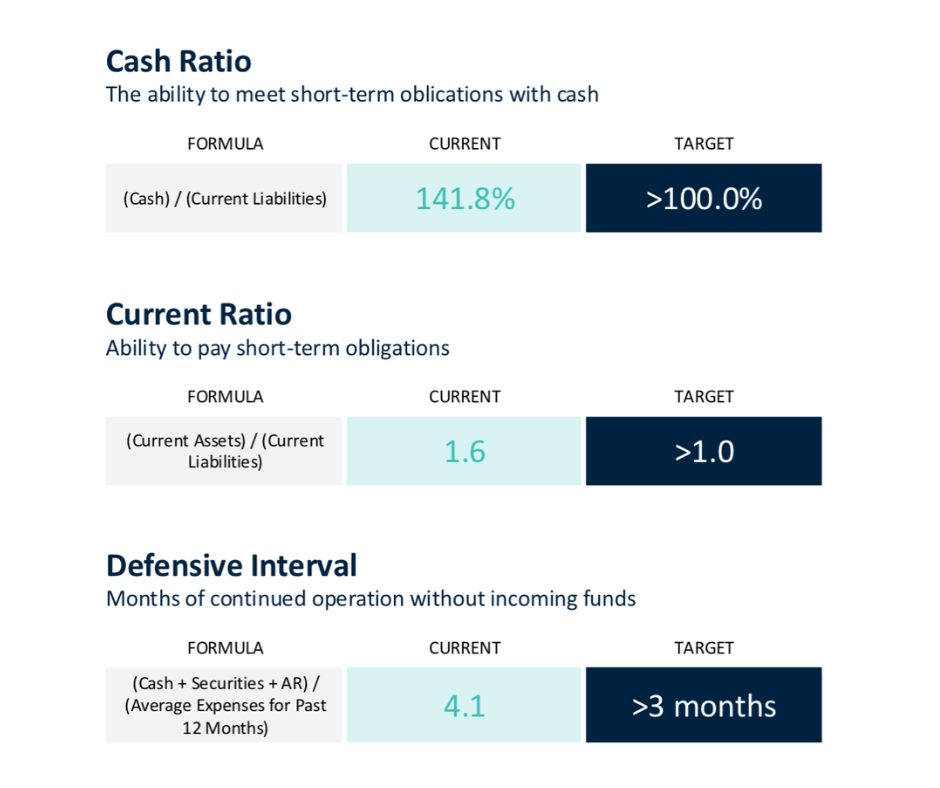
When I assess a school’s financial health, I focus on a few key indicators. The most important is your defensive interval — essentially, if no more money came in starting today, how long could you keep the lights on and make payroll? The industry standard is at least 3 months. If you’re below that, you’re operating without a safety net.

The Financial Foundation Your Charter School Needs To Grow

I also look at your cash ratio and how your expenses track against revenue throughout the year. In California, it’s common for expenses to outpace revenue for much of the school year. That’s not necessarily alarming — but it means you need to know when your cash crunch months are coming and plan for them. One school we worked with was caught off guard when delayed grants and tax credits collided with winter break. A short-term cash flow solution helped them through it, but the better outcome is never being surprised in the first place.

Multi-Year Budgeting Changes Everything

One of the most impactful shifts a charter leader can make is expanding from an annual budget to a multi-year budget. Most states require you to submit budget projections anyway — but there’s a difference between doing it as a compliance exercise and actually using it as a management tool.

When your board can see the financial picture across two or three years, decisions look different. That staff raises you’re considering? Across a single year, it might look manageable. Across three years, it might raise serious sustainability questions. A one-time stipend might be the smarter move. These are the kinds of conversations multi-year budgeting makes possible.

It also gives you a framework for growth planning. If you’re thinking about expanding your enrollment or your facility footprint, you need to be able to model what that looks like over time — not just in the year you make the investment.

The Financial Foundation Your Charter School Needs To Grow (2)

Signs You’re Ready to Grow

Growth readiness isn’t just about enthusiasm or wait lists. It’s about financial position. Here’s what I look for:

  1. You have adequate cash flow to weather the costs that come with growth. Adding students means adding teachers, and depending on your state, you may need to spend before the funding catches up. You need runway for that.
  2. Your facility costs are proportionate. Charter schools generally shouldn’t spend more than 15% of annual revenue on rent or debt service. If you’re above that, expansion will only make it harder.
  3. You’re retaining the students you already have. This one surprises people, but retention is your single biggest enrollment lever. It’s far less expensive to keep a family than to replace one.
The Financial Foundation Your Charter School Needs To Grow (3)

Don’t Go It Alone

Trying to lead a facilities project without experienced partners is one of the most common and costly errors in this space. At my own charter school in Colorado, we were fortunate to be included in a bond measure that funded a significant construction project. We partnered with an architect, a contractor, and an owner’s rep — and we even invited someone from our authorizer to sit on our RFP process. They felt ownership. They stayed informed. And the project went smoothly because the right people were at the table from the beginning.

There’s never a perfect time to grow. But there is a right way to do it — and it starts with knowing your numbers, building your reserves, and finding partners who’ve done it before.

About the Author

Unknown

Kristin Nowak is an experienced consultant and former charter school leader with extensive experience supporting charter schools across California, Colorado, Nevada, Tennessee, and Texas since 2014. As Executive Vice President of Strategic Management at Charter School Management Corporation (CSMC), Kristin leads the organization’s sales, business development, marketing, and expansion efforts, helping to grow CSMC’s impact and reach within the charter school sector.  With a strong background as a former charter leader, educator, and administrator, as well as a management consultant, Kristin leverages her financial and strategic expertise to guide schools through complex fiscal challenges and regulatory requirements. 

Kristin holds a BS in Business Administration/Finance from the University of Southern California (USC), as well as an MA in Education from USC’s Rossier School of Education. She received her Administrator’s Certification through Johns Hopkins graduate certificate program and has also completed graduate-level work at Harvard’s Graduate School of Education.

Kristin’s education, leadership experience, and strategic vision make her uniquely qualified to drive growth and innovation in the charter school finance and operations space.

If there’s one thing I hear consistently from charter school leaders across the country, it’s this: they’re overwhelmed. Between board meetings, parent calls, staffing challenges, and budget pressures, finding time to think strategically feels almost impossible. But here’s what I’ve learned from working with schools in every stage of growth — the ones that thrive are the ones that make time for it anyway.

That’s something I think about every day: how enrollment, facilities, and funding don’t just coexist — they actively fuel each other. Understanding that relationship can change the way you lead your school.

It’s Not “Build It and They Will Come”

There’s a myth in the charter world that if you build or expand your facility, students will follow. In my experience, it’s quite the opposite. Enrollment has to lead. When you grow your enrollment strategically, your revenue increases. When your revenue increases, your affordability for facilities improves. When your facilities improve, your appeal in the community grows. And that drives more enrollment. It’s a cycle — and once you’re in it, it builds on itself.

But you have to start somewhere. And that starting point is almost always enrollment.

How Enrollment Facilities And Funding Fuel Charter School Growth (3)

What We’re Seeing on the Ground

After returning from the California Charter Schools Association conference in Long Beach, a few themes stood out clearly. Declining enrollment is hitting schools that never built strong wait lists or invested in consistent marketing. When the dip comes — and it always comes eventually — they have nowhere to turn. They’re reacting instead of responding.

The schools I worry about are the ones watching their wait lists shrink year over year and not sounding the alarm early enough. By the time enrollment drops significantly, the financial impact is immediate and the recovery is slow.

How Enrollment Facilities And Funding Fuel Charter School Growth (2)

Where Are You in the Cycle?

The first step is honest self-assessment. Are you still building enrollment? Then your focus should be on marketing, filling seats, and proving demand. Are you stable with strong cash reserves and a wait list? Then it’s time to start exploring facility options. Are you somewhere in between, weathering some attrition and trying to stabilize? Then efficiency is your priority — getting more out of what you already have before you take on anything new.

No matter where you are, one thing is true: you can never start planning too early. Facilities projects that used to take eighteen months now routinely take two or more years. The time to start thinking about your next move is before you need it.

The growth cycle is real. Once you understand how these three elements feed each other, you’ll never look at your school’s strategy the same way again.​

About the Author

Ryan Eldridge Grow Schools

As a leading member of the Client Services Team, Ryan finds great purpose in creating new and lasting relationships with schools. Inclusion, building community, and equity are Ryan’s driving principles, which he puts into practice in service to schools daily. He is dedicated to understanding the challenges school leaders face and providing solutions that align with each of their visions.


I hear it constantly from school leaders: “We’re posting regularly on Facebook and Instagram, but we’re not seeing any connection to enrollment. Is social media actually worth our time?”

It’s a fair question. Schools invest hours creating content, managing platforms, and trying to stay current with algorithm changes and new features. When that effort doesn’t translate into obvious enrollment results, it’s natural to wonder if you’re just shouting into the void.

Here’s the truth that might surprise you: social media isn’t supposed to directly drive enrollment. Understanding what it actually does—and doesn’t do—changes everything about how you approach it.

The Social Media Reality: Awareness, Not Conversion

Let me start with something that might sound controversial: no platform is driving qualified leads by itself in 2026.

Facebook used to be the answer. Instagram was the hot new thing. Everyone’s asking about TikTok. The truth? They’re awareness tools, not lead generators.

Anecdotally, yes, sometimes people discover your school on social media, fill out an inquiry form, and eventually enroll. But not in the volume needed to fill your school. Social media helps you get noticed—it gets you on families’ radar and keeps you there. But your website, your tours, the actual experience families have when they visit your school—those are what convert interest into enrollment.

Think about it this way: paid advertising gets you in front of new families (discovery), and organic content builds trust with those families once they find you (credibility). Both matter, but neither completes the enrollment journey alone.

Stop Posting Into The Void What Social Media Actually Does For School Enrollment (2)

Who’s Actually Following You (And Why That Matters)

Here’s another reality check: most of your social media followers are already part of your school community. They’re current families, staff, alumni, and local community members who already know you.

This isn’t a problem—it’s an opportunity. Your social media serves a critical retention and advocacy function. When you consistently post content that reminds families why they chose your school, celebrates your community, and reinforces that sense of belonging, you’re building retention and turning enrolled families into ambassadors.

Happy families tell their friends. They share your posts. They recommend you when neighbors ask about schools. This organic advocacy builds a stronger enrollment pipeline than any paid campaign could create alone.

But here’s the key: this only works if you’re actually posting content worth sharing—content that makes families feel proud to be part of your community.

Paid vs. Organic: Why You Need Both

Schools often ask whether they should focus on organic content or paid advertising. The answer is both, because they serve different purposes.

Organic Content: Building Credibility Organic content is what shows up on your feed when someone looks at your page. It also appears in followers’ feeds and can be shared by people who engage with it.

When prospective families hear about your school—maybe from a neighbor or a Google search—they’re going to check out your social media. If they see nothing recent, or if your page looks inactive, they’ll wonder if your school is struggling. If they see regular posts showing field trips, classroom activities, community events, and engaged families, they’ll see evidence that you’re a thriving, active school.

Organic content builds trust and credibility. It shows you’re real, active, and invested in your community.

Stop Posting Into The Void What Social Media Actually Does For School Enrollment

Paid Advertising: Reaching New Families

But organic content alone won’t help people discover you. That’s where paid advertising comes in.

Paid ads—which don’t have to be expensive—allow you to reach people who don’t know you exist yet. You can target specific geographic areas, demographics, and interests to get in front of families actively looking for schools or who match your ideal family profile.

Even modest budgets ($5-10 per day to boost posts, or $50-100 per month for more sophisticated campaigns) can dramatically extend your reach beyond your current follower base.

The key is understanding that paid ads drive discovery while organic content builds credibility once families find you. You need both working together.

The Underutilized Power of Community Partnerships

One of the most effective social media strategies schools overlook is leveraging community partnerships.

You probably already partner with local organizations—libraries, rec centers, youth sports leagues, Boys & Girls Clubs, cultural organizations. When you post about these partnerships, tag those organizations. When you highlight a student athlete, tag their team.

Why does this matter? Because their audiences become your audiences. When you tag a partner organization and they share your content, you reach families in their networks who might never have discovered your school otherwise.

This strategy costs nothing but attention and intention. Yet it can exponentially extend your reach beyond your current follower base.

Stop Posting Into The Void What Social Media Actually Does For School Enrollment (3)

Social Media as Strategic Awareness

Social media isn’t about going viral or racking up followers. It’s about strategic awareness that feeds your enrollment funnel while building community with current families who become your best advocates.

When you understand that social media creates awareness (not direct conversion), balance community-building with enrollment calls-to-action, and track metrics that actually connect to enrollment outcomes, these platforms stop feeling like time sinks and start supporting your actual goals.

About the Author

Ashley Macquarrie

Ashley MacQuarrie is VP of Marketing at Grow Schools, where she leads the enrollment marketing team helping charter schools achieve sustainable growth.