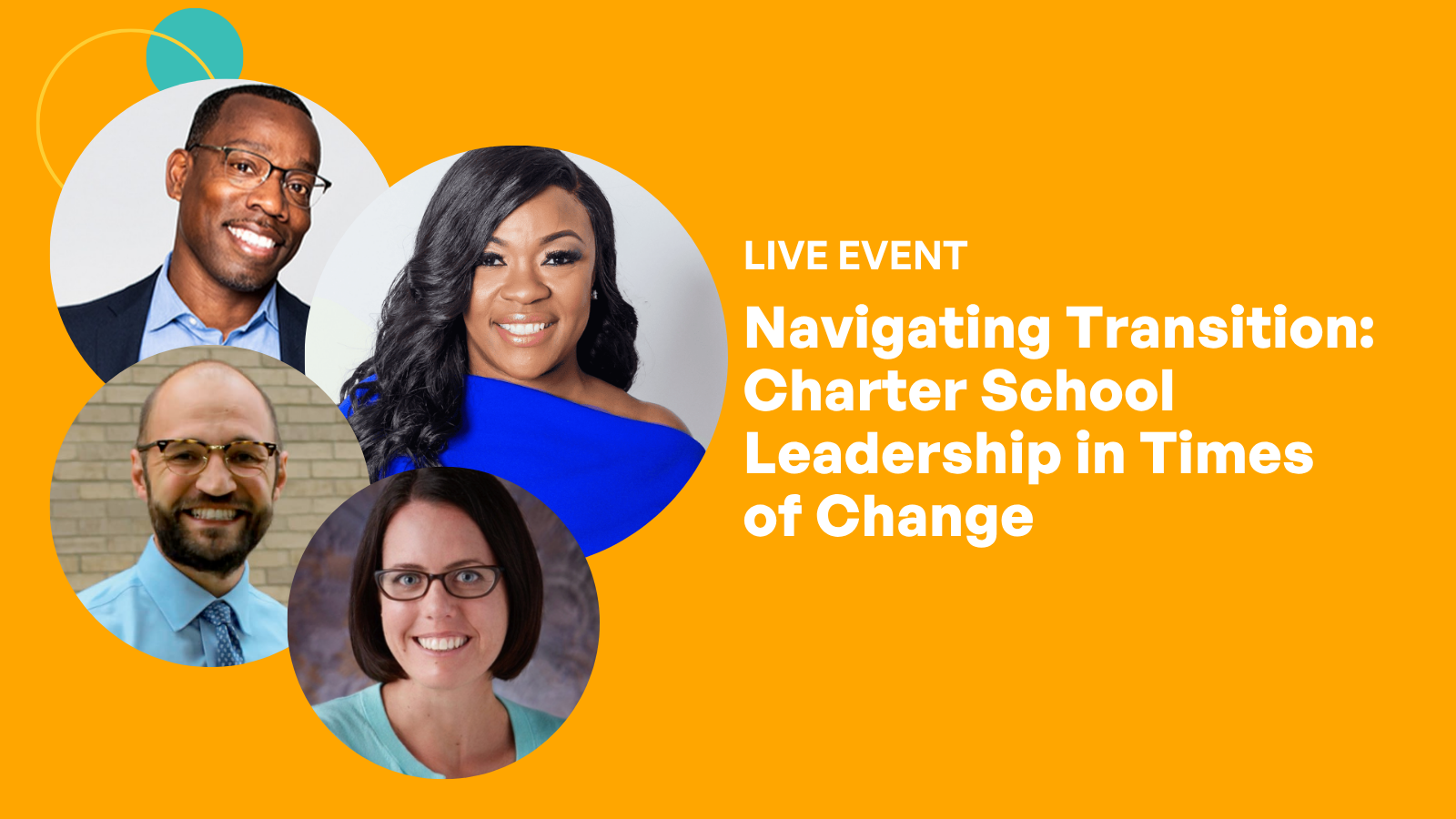
Leading a charter school through major transitions—whether facility expansions, enrollment challenges, or budget constraints—requires both courage and clarity. In our recent panel discussion, Navigating Transition: Charter School Leadership in Times of Change, four experienced school leaders shared honest, practical insights about making strategic decisions during uncertain times.
Know When It’s Time to Make a Move
Every school leader faces that pivotal moment when they realize maintaining the status quo is no longer an option. For our panelists, those moments looked very different:
Jonathon Marowelli from Jackson Preparatory and Early College in Michigan noticed a troubling pattern: “We had this slow decline in enrollment. You can blame COVID for a couple years, and then at a certain point, you have to get realistic with yourself and say, what’s going on here?” His solution was a significant investment in marketing, which resulted in 15% enrollment growth.
Dr. Curtis Palmore of United Charter High Schools in New York City faced a different challenge. Post-COVID enrollment dips meant his schools were overstaffed, requiring what he called “rightsizing”—a difficult but necessary reduction in force to ensure long-term sustainability.
For Dr. Tandria Callins of Language and Literacy Academy for Learning in Florida, the catalyst was completely external. After six years of renting and preparing to purchase their building, the previous owners exercised their right of refusal, forcing the school to relocate 330 students and 100 staff members with just months to plan.
Christin Barkas of Kiddinu Academy in San Diego faced the opposite problem: demand exceeding capacity, with over 400 kids on their waitlist and more siblings than could fit into existing classrooms.
Protect Your Mission Above All Else
When facing difficult financial decisions, every panelist emphasized the same principle: protect your core mission first.
Jonathon put it clearly: “When you’re facing budget constraints, what helped is still having the image of who we are as our grounding. Being a whole school early college dual enrollment was never even an option to not do that. That’s our commitment to our kids.”
Dr. Palmore recommended looking beyond the obvious cuts: “Doing a deep dive into what we call the OTPS or other than personnel spending. We found small pockets of money where we’re just like, we don’t even use this system anymore. Why are we paying for this?”
Dr. Callins faced the painful decision of laying off nine staff members when enrollment dropped due to their campus split. More recently, she converted some salaried positions to hourly and cut administrative positions to weather potential federal funding cuts. But she never compromised on the specialized services that define her school’s mission.
The Power of Community Communication
Keeping stakeholders aligned during transitions requires intentional communication strategies. The panelists shared several approaches:
Board Alignment: Jonathan emphasized the importance of annual board training, especially as membership turns over. Kristen created a facilities committee that met regularly before board meetings, ensuring key members were informed and aligned before major decisions.
Dr. Palmore established working groups that meet before board meetings: “I go into the board meetings with several individuals who already know the ins and outs that can essentially back me up when we’re unpacking the things that we’re doing.”
Parent Engagement: Christin’s strategy of creating a district parent leadership team proved invaluable. “Having that trusted group that have their ear to the community, we were really looking for parents who had a broader impact and a lot of connections” helped her stay ahead of community concerns.
Dr. Callins emphasized transparency and involvement: “In order for anyone to support an organization, they have to know what the mission and vision is. We repeated it—the students know the mission and vision.”
Recruitment Strategies That Actually Work
With enrollment challenges affecting schools nationwide, our panelists shared their most effective recruitment approaches:
The clear winner across all schools? Word-of-mouth referrals. But that doesn’t mean digital marketing isn’t important.
Dr. Callins runs a comprehensive marketing operation including YouTube, Google, and Facebook ads, plus billboard advertisements—resulting in a waitlist of 350 students. She monitors data quarterly, adjusting keywords and targeting based on performance.
Jonathan noted an interesting dynamic: “Very few people say social media. But when we started doing the ad spend on social media, that’s when we started getting more applications. I think it was a combination of the two—’I remember my friend said their kid goes there and they had a great experience, and I saw an advertisement for it that reminded me to look into it.'”
Dr. Palmore added two strategies that delivered strong ROI: canvassing in specific neighborhoods and intentional direct mail with QR codes using a company called Vanguard, which became their third biggest source of return on investment.
Christin emphasized the importance of activating parent advocates, even having parents volunteer to distribute flyers at high-traffic businesses and speak to other families in their home language—Arabic, Chaldean, and Spanish.
Know When to Act (And When to Wait)
Timing major transitions requires balancing urgency with readiness. The panelists offered several indicators:
Kristen’s perspective: “For us, it was the demand—the community demand meant it’s time to make some changes. The other component was just facility availability. In a competitive market, you’ve got to strike while the iron’s hot.”
Dr. Palmore’s warning signal: Projections showing that continuing business as usual would deplete their healthy surplus within six to seven years. That prompted immediate action on recruitment and rightsizing.
Dr. Callins’ reflection: “You’ll know when the timing is right. You may not know it while you’re doing it because sometimes you second guess yourself. But as I reflect, last year when we were split in two campuses was in my mind one of our most challenging years. However, we received our highest improvement rating and our first $400,000 surplus.”
Jonathon added a forward-looking perspective: “When you start to see the momentum of a growing enrollment or a need in the community that’s on the rise or isn’t being filled, when do you want to make changes? You want to make changes three years ago. You want to be ready.”
Final Wisdom for Leaders in Transition
Each panelist offered one piece of advice for school leaders navigating major transitions:
Christin: “Surround yourself with key individuals who you feel you can be transparent with and activate your leadership team—parents, board members, and teacher leaders who have their eyes and ears on what’s happening.”
Jonathon: “Keep coming back to those grounding questions. Have people around you who are on board with the same mission and vision. Things that seem like they’re taking the longest often feel like they were short periods of your life in hindsight.”
Dr. Callins: “Stay true to the mission and vision. Surround yourself with a strong network of supportive people. You’re a leader for a reason. You’ve made it this far—believe in yourself and be confident. A denial is just a delay. Don’t give up.”
Dr. Palmore: “Take care of yourself. Whatever things you do to ensure that you have stability—continue to do that throughout this ordeal. Compartmentalize so you can still keep that vision around the work you have to do every single day. And delegate, delegate, delegate.”