Should States Support Public Charter School Facilities Funding?
Editor’s Note: This article was originally published here on July 31, 2019 by EdWeek and written by Andrew Ujufusa. We think it’s vital to keep tabs on the pulse of all things related to charter schools, including informational resources, and how to support school choice, charter school growth, and the advancement of the charter school movement as a whole. We hope you find this—and any other article we curate—both interesting and valuable.
If Charter Schools Build It, Will States Help Pay For It?
By Andrew Ujifusa on July 31, 2019 4:34 PM
Most states have policies on the books to provide some kind of funding support for the facilities that charter schools use. But dive deeper into what’s on the books, and the number and types of policies can vary significantly from state to state.
That’s one relatively straightforward conclusion to draw from a new report from the National Alliance for Public Charter Schools published earlier this month. ”State Policy Snapshot: Facilities Funding for Public Charter Schools“ says that 30 states and the District of Columbia have a policy covering at least one of the following funding issues charters deal with:
Providing a per-pupil facilities allowance to charter schools;
Creating a charter school facility grant program;
Ensuring that charter schools have equal access to all existing state facilities programs and revenues for district-run public schools in a state;
Providing a charter school facility loan program;
Providing charter schools with access to local property tax dollars generated for facilities.
In addition, 20 states and the District of Columbia have more than one such policy on the books. However, no jurisdiction has all five policies listed above, according to the alliance. And not every state’s policy, such a grant or loan program, actually gets funded.
Need some of that report’s data in visual form? Check out the interactive map here.
Questions about charter school facilities raise several issues and can prove particularly divisive.
Supporters believe that as public schools, charters shouldn’t face particular hardships when it comes to issues like paying for space. And some charters, particularly those that aren’t part of big established networks or are just getting off the ground, do face major hurdles when it comes to finding and paying for their locations. As one Portland, Ore., charter founder told Education Week back in 2013, ”We have to meet all of these code requirements that older schools [and private schools] may not have to comply with because we’re a new school, which makes even the consideration of most spaces impossible and difficult.”
However, others argue that comparing charter schools’ facilities access to the bonds and other financial tools used by traditional district-run schools oversimplifies how the traditional public schools actually get their facilities. Skeptics have also cited the instance of a charter school suing its management company, Imagine Schools, which also rented a facility to the school, over allegations that Imagine charged the school excessive rent. A similar case played out in Los Angeles in 2013 that ended with two founders of a charter school getting sentenced to prison and community service.
One additional policy areas charters are exploring? Opportunity Zones. As we wrote earlier this week, these zones were established by the 2017 tax law and are designed to provide tax benefits to investors who put money into designated distressed communities. Supporters of Opportunity Zones believe charters could be big beneficiaries by linking up with these investors, possibly in conjunction with other groups and institutions seeking space, to help with facilities and other costs.
A February presentation on Opportunity Zones hosted by the alliance notes that the structure of the zones “rewards patient capital” (since the tax incentives hinge on long-term investments) and “takes equity capital off the sidelines and puts it to work in low-income communities.”
The alliance’s July report on state policies says this about the general landscape and trends for this issue:
One of the biggest challenges to the continued expansion of charter schools is the fact that many charter school laws place the ultimate burden of obtaining and paying for facilities on charter schools themselves. As a result, charter school leaders struggle to find suitable and affordable facilities to house their growing numbers of students.
States play an important role in determining the options available to help fund charter school facilities. Increasingly, states are enacting and updating state policies to help offset the cost of leasing, purchasing, and maintaining charter school facilities.
Read the full alliance report on those policies below:
The Ultimate Guide to Charter School Facility Financing:
Thinking about a new facility for your charter school or enhancing your current one? This guide shares straightforward and actionable advice on facilities planning, financing options, getting approved, choosing a partner, and much more! Download it here.
What Were Your Biggest Charter School Challenges in 2019?
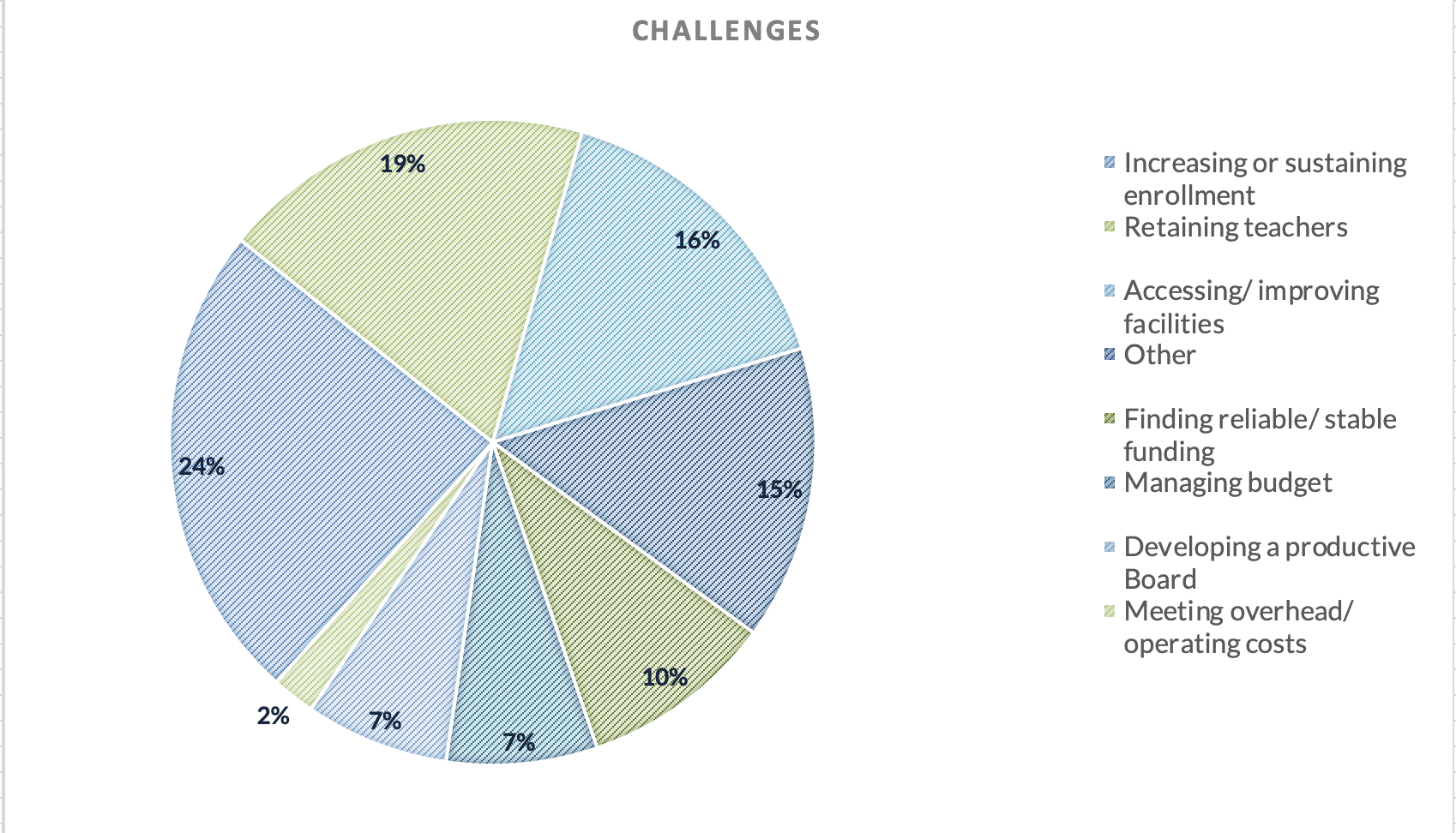
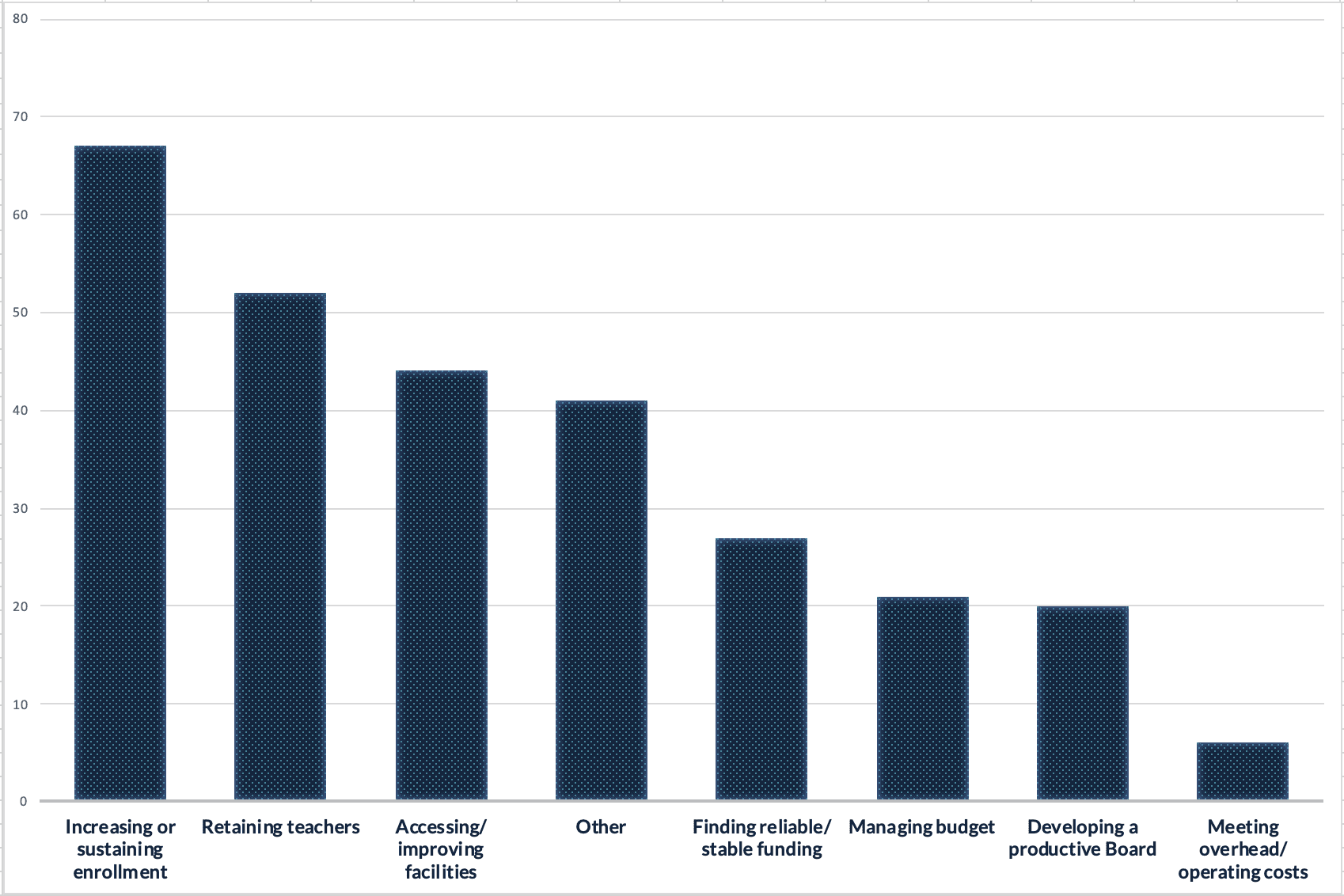
This year, at the National Charter Schools Conference, we asked the visitors to our Charter School Capital booth one simple question…”What is the biggest challenge that charter schools face?”. We had 248 respondents from states all across the nation, and while not an enormous number to provide clear statistical significance, we did find the results interesting and thought you might too. In this post, we’re sharing the results of our survey with you.
Overall Highlights:
24% of respondents said that increasing or sustaining enrollment was a top challenge
19% said that retaining teachers was their biggest challenge
16% of respondents said that accessing/improving facilities was their top challenge
Leverage a full suite of best-in-class digital and traditional marketing services to attract more families to your school! Charter School Capital’s Enrollment Marketing Program is designed to positively impact your charter school’s viability by boosting enrollment numbers through targeted marketing efforts
Notable Highlights, State Specific:
More than 1/3 of our California respondents said increasing or sustaining enrollment was their greatest challenge
In Michigan, retaining teachers was the leading challenge by a wide margin (20 of 31 respondents)
The leading challenge in Florida, according to our respondents was accessing/improving facilities
More than half of the Texas respondents shared that increasing or sustaining enrollment was their greatest challenge. (11 of 18)
Note: Other state responses were spread across the categories with no notable leader and were therefore not called out here.
Achieve long-term stability with our customized charter school facilities financing options which are designed to meet your school’s unique needs. Charter School Capital offers stable and flexible facilities financing product. This is a long-term lease that allows schools to access funding through all stages of growth. As a long-term partner, our team works closely with you as we explore budgetary and financial options to assist you in achieving your facilities goals.
Since the company’s inception in 2007, Charter School Capital has been committed to the success of charter schools. We help schools access, leverage, and sustain the resources charter schools need to thrive, allowing them to focus on what matters most – educating students. Our extensive toolbox of innovative and customizable solutions are designed exclusively for charter schools. This wide range of products and services has been developed to address the diverse set of challenges charter leaders face Our depth of experience working with charter school leaders and our knowledge of how to address charter school financial and operational needs have allowed us to provide over $2 billion in support of 600 charter schools that have educated over 1,027,000 students across the country. For more information on how we can support your charter school, contact us. We’d love to work with you!
Editor’s Note: This post was originally published here on July 23, 2019 by The 74 and written by Sonia Park, the executive director of the Diverse Charter Schools Coalition. We think it’s vital to keep tabs on the pulse of all things related to charter schools, including informational resources, and how to support school choice, charter school growth, and the advancement of the charter school movement as a whole. We hope you find this—and any other article we curate—both interesting and valuable.
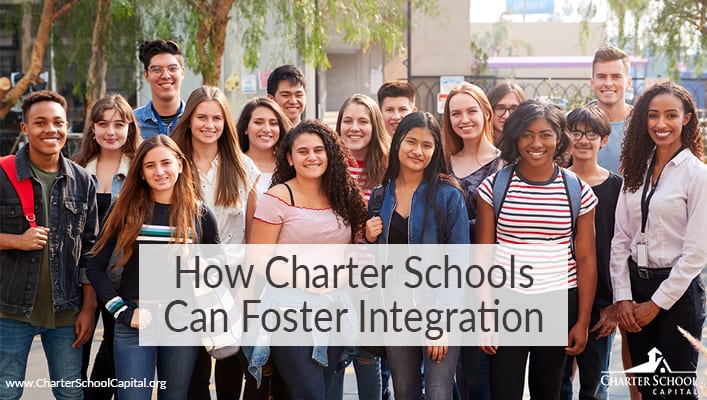
Charter Schools Can Be an Important New Tool for Fostering Integration. Our New Coalition Is Working to Make That Happen
It’s been almost 50 years since Kamala Harris stepped onto a school bus and out of her racially redlined neighborhood amid the desegregation of the Berkeley, California, schools. Five decades later, the question of who goes to school where remains pivotal to kids’ and families’ lives and to the communities we build in this country.
In those years, much has changed. School segregation has gotten worse. Yet our understanding of the issue has changed for the better, and the evolving picture of public schooling offers new solutions. One important, and overlooked, element is charter schools, which are numerous in many places where segregation is common. Charter schools, independently managed public schools, are offering new approaches to this decades-old issue.
America’s painful history with segregation was injected anew into America’s dinner-table conversations after Harris’s exchange with Joe Biden at the second Democratic presidential debate. Finding solutions to this persistent problem remains fundamental to justice and opportunity in this country — and in an increasingly diverse nation, it’s more pressing than ever. Desegregation in America’s schools peaked in 1988; since then, the proportion of schools that are intensely segregated — more than 90 percent nonwhite — has tripled. This, in a country where most public school students are children of color.
But evidence shows that racial and socioeconomic integration offer benefits not just to children of color and low-income students but to all, ranging from test scores to college attendance to critical thinking skills. Scholar Richard Kahlenberg wrote after the debate, “If we want to break the cycle of poverty, few interventions are as important as efforts to give children a chance to attend high-quality integrated schools.”
High-quality public charter schools are among the new tools we have to advance desegregation and deepen our understanding of successful diversity.
Public schooling in 2019 looks far different than it did in Harris’s day – in part because charter schools have opened in places where there are large numbers of low-income students and students of color. Our student bodies are more diverse; so are the choices their families can make.
Charter schools are open to whoever chooses them, and some reflect the highly segregated neighborhoods in which they exist. As a consequence, some have criticized charters for supposedly worsening segregation, though that confuses correlation with causation. (There is also a vast difference between being placed in a school based on your zip code and choosing a school because it’s culturally affirming.) Charters offer choice to families that haven’t had that in the past.
The Diverse Charter Schools Coalition is proud to have assembled charter leaders determined to work with school boards and to recruit intensively to make their schools a force for diversity of all kinds and at all levels. We’re a small but rapidly growing alliance representing more than 175 schools nationwide that have a vision of what education should look like in today’s society — encompassing families, students, staff and leadership. We are determined to take on not just learning gaps but also an empathy gap that is far too clear.
It takes expertise and planning to create such schools successfully. Intentional diversity goes far beyond simply enrolling students of different races, wealth levels and other socioeconomic markers; it embraces a deepening understanding of an inclusive school community. Too often, desegregation means only that students attend school in the same building — often experiencing separate and unequal education under the same roof. We’re working to help schools not just attain diverse enrollment, staff and leadership, but foster inspiring communities where students can form bonds that cross boundaries, learn from one another and together develop a vision for their world.
We’re seeking to grow the number of these schools, in part by recruiting and preparing future leaders with a clear vision for new diverse-by-design charter schools. Our fellows are matched with a host school, exposed to exemplary models, given access to experts and resources, offered a tailored residency and provided with individualized learning. Leaders of our member schools receive coaching and support, which we plan to expand to district leaders as well.
America is a different and more diverse place than it was when Harris started school, yet our schools are just as segregated. We need to use every tool possible to change that, and charter schools must be part of that.
Since the company’s inception in 2007, Charter School Capital has been committed to the success of charter schools. We help schools access, leverage, and sustain the resources charter schools need to thrive, allowing them to focus on what matters most – educating students. Our depth of experience working with charter school leaders and our knowledge of how to address charter school financial and operational needs have allowed us to provide over $2 billion in support of 600 charter schools that have educated over 1,027,000 students across the country. For more information on how we can support your charter school, contact us. We’d love to work with you!
This year, for our 3rd annual Richard Dewey Awards, we were so honored to have received such amazing, touching, inspirational submissions. Close to 75 stories about how teachers have made a difference were shared with us. The caliber of submissions made selecting our three winners a very challenging task for our panel of judges.
And the 2019 Dewey Awards go to…
In no particular order, here are the winning stories that will receive the $1000 grants that will be given to a charter school of their choosing! Read these three heartwarming stories about teachers who have truly impacted the lives of their students.
Teacher: Joshua Curry Subject: History and Social Studies School: Options Charter School Noblesville, State: Indiana Submission from: Conner Reiff
“How has Joshua Curry impacted my life?
Prologue
To answer this question, allow me to review the two previous years of my life. I had been told that I had ADHD, but in 6th grade, I had actually become seriously ill with Narcolepsy with Cataplexy. I was put on homebound restrictions through my previous school for almost two years. Having to do online work was not fun and sometimes I fell asleep halfway through my work! Sometimes I fell asleep for weeks at a time! I was put into a clinical trial for a medication where I had to frequently fly to California. Then I had to be seen by the top research doctor at Stanford University because I was still sleeping so much. It was there that I was also diagnosed with Klein-Levin Syndrome, a very rare sleep disorder. I have no idea how, but I somehow survived through those painful two years on an online school and traveling. After successful medical interventions, my homebound instructor suggested Options Charter School in Noblesville, Indiana. Today I am a successful student at Noblesville Options Charter School. Let me tell you about one of my teachers, who has made it his mission to ensure my success in school.
—————————————————————————
Actual Story
The school I am at now, Options Charter School, has put me on a brighter path by inspiring the student in me to wake up (no pun intended) and to be free. Regardless of my disorders, I am able to function at school and complete my work every day, sometimes with no homework at all!
The one teacher who helped me through a lot of this was my social studies teacher, Joshua Curry. He had some secondhand experience with Narcolepsy and it came from a surprising source! My family and I attended the Center for Courageous Kids in Scottsville, Kentucky. There I met other children who have narcolepsy including one of Josh’s school friends named Nick who had a daughter with the same type of narcolepsy as me! Nick tutored Josh on every possible important thing for a narcoleptic like me. He taught him the wants, needs, and level of care needed to help. Josh then suggested extended time for assignments, minimal homework, and that the goal was to help me succeed with whatever it took. Over a short period of time, Josh became not just a teacher, but my best friend and someone who cared for me. He came to my awards ceremony for the community project I had done. He even spoke at the ceremony despite his nervousness toward the thought of public speaking! He even drove me back to school afterward and bought me a giant-sized Dr. Pepper when we stopped at Speedway! We laughed all the way back! It was the best day of my life!
Josh has always had my back and he gives me somewhat ridiculous deadlines for school assignments. When I bring this up, he would say, “Just take the two weeks, Connor. Besides, it’s only just in case you fall asleep.” We would both laugh for a while after that and then I would go on to my next class. Every day at school I wish one thing for myself, “I wish to be in Josh’s classroom all day, every day!”
The reason that I like his classroom so much is because when I was undergoing treatment, I read a lot of historical articles, books, and movies. In the classroom, he makes history relevant and interactive. He uses constant hilarious dark humor that keeps my mind engaged. He engages the students by demonstrating that he is an authority about each topic. It makes me ask questions about the sequence of history.“History is not wrong unless you record it wrong” is one of his favorite quotes. He has many books in his classroom for different perspectives and time periods. This allows me to gain historical knowledge and draw my own conclusions.
There isn’t a teacher more deserving of being recognized than Josh Curry. Often times, charter school teachers are not recognized for helping individual students and for the good that they do in the world. Thank you for the opportunity to nominate Josh Curry. He is most deserving of this national honor!”
Teacher: Betty Williams
Subject: Academic, 2nd Grade
School: Frostproof Elementary School
State: Florida
Submission by: Mary Milton
“In loving memory of Mrs. Betty Williams:
As a first grade student, I hated school. I couldn’t read in first grade and everyone knew it. My first-grade teacher told me that I wouldn’t amount to anything because I couldn’t read and she wasn’t very pleasant or patient with me. I didn’t want to go to school. That all changed when I started second grade and had Mrs. Betty Williams as a teacher. Mrs. Williams was an older woman that had taught for years. She had a sense of calm that every student should encounter in a classroom. Mrs. Williams genuinely cared for her students and took the time to know each of us.
I remember the day I cried to her about not being able to read. She told me that I may not be able to read today, but she promised I would be able to read. Mrs. Williams patiently worked with me, she met with my mom and tried different strategies to help me read. One day, she moved my seat closer to the front of the room. I was able to see the board a little more clearly, but still not perfectly. I had never told anyone that things were blurry to me, but Mrs. Williams noticed that I was squinting and trying to figure out words on the board, that is why she moved me closer. When she requested a meeting with my mom I thought she was going to tell my mom the same thing my first-grade teacher told me. Instead, she told my mom that she thought I should have my eyes checked. We were a very low-income family and my mom told her she didn’t know if she could afford to take me to the eye doctor, but would try to get me in as soon as possible.
Mrs. Williams gave my mom her eye doctor’s name and told my mom to take me there and she would take care of the bill. I remember the doctor telling my mom that I needed glasses, I was far-sighted and had astigmatism. I was so proud when my glasses came in and begged my mom to take me by Mrs. Williams’s house so I could show her my glasses and tell her that trees had leaves now, not just blurry blobs. She didn’t mind that we stopped by her home after work and was so happy to see me smiling with my glasses on. Mrs. Williams continued to work with me on reading and I stayed in contact with her after her retirement. Her caring personality, her patience, and her observant eyes helped me believe in myself, taught me how to read, allowed me to see, and inspired me to become a teacher.”
Teacher: Chantal Haskell
Subject: Drama, Strings, Choir
School: Greenville Technical Charter High School
State: South Carolina
Submission by: Savannah Cannon
On my first day of freshman year, I was scared out of my mind. I didn’t really want to go to Drama Class, because I knew I would be the only freshman in Drama 2. I came inside and sat down on the third row. I was encouraged to come sit on the front row with my six other classmates and reluctantly agreed. We instantly started introductions, but Ms. Haskell didn’t do it like any of my other freshmen teachers would. We were asked about our summers, and Haskell showed us pictures from her wedding. We started improv, and I quickly became very aware of the energy in the room. My upperclassman classmates were performing scenes about babies in blenders and crazy things I had no idea how to react to. But Haskell quickly showed me that we were a family and that our family liked to have a lot of laughs.
Within only a couple weeks, I became more and more comfortable in Drama 2 class. With Haskell leading us, it wasn’t only about learning or getting the grade. It was about teaching us things that we would never forget. It was about making friends and gaining relationships I could treasure forever. Every project had a different twist and turn that scared me at first, but always came back, in the end, to teach me a bigger lesson.
Ms. Haskell wasn’t only teaching us inside of her classroom either. Haskell is the only teacher I have ever met that was brave enough to open up her own home to her students. Over Christmas break, when she should have been thanking God that she didn’t have to deal with us hooligans, she invited us to come bake cookies and spend time together. Haskell was not just a teacher that we sometimes talked to because we felt like we needed to, Haskell was someone I knew I could always come to for advice about anyone or anything.
Only about a month into the school year, auditions were held for Alice in Wonderland. I performed some little monologue about a school play and I loved every little second of my two minutes, but I was scared out of my mind. Only a couple of days later, I received callbacks for the show. I ended up playing the Red Queen, but what Haskell told me just a short 12 hours later would change everything I thought about myself. Before class, she pulled me to the side and told me that she believed I had really good talent and that if I kept working, she knew I would do big things. That statement has stuck with me for over two years now, and I don’t think I’ll ever forget it.
Haskell has continued to teach me things throughout my high school experience. She has worked harder than any teacher I have ever seen. She has given up her after school time four, if not all five days of the week. She has Musical Theatre class on Tuesdays and Thursdays, holds an acapella club for her students on Wednesdays, and stays after school on Mondays so that I can have meetings for our annual Murder Mystery Dinner, and so other kids can rehearse lines. She puts in more commitment inside and outside of the classroom than any teacher. She might leave our building with hours of work to do, but you can always count on her to have it done the next day when we return.
When I was having a tough time handling school, sports, friends, and family, Haskell was the only adult I knew I could come to. She never judged me, never looked down upon me. She only gave me the greatest advice and endless support. But most importantly, she just kept on telling me she loved me.
In my opinion, being a teacher is about sacrifice. Sacrificing your time, your effort, and probably sometimes your sanity. Only the best teachers truly care about their students the way that Haskell does. She is always there for a laugh, but she is also always there for a hug and to be a shoulder to cry on. Haskell is the kind of teacher that you cry about on graduation day because you’re not really sure what you’re going to do without their smile, support, and advice every day when you’re gone. Someday, when I become a teacher, I hope to have just as much passion for my kids as Haskell does for hers.
Thank you again to all of those who shared your amazing submissions, we were so very inspired reading (watching) them all!
Our Esteemed Submission Review Panel:
Darlene Chambers – A national leader in education reform, Dr. Darlene Chambers is the Senior Vice President for Programs & Services at the National Charter Schools Institute, and a review alum from both 2017 and 2018.
Janet Johnson – Chief Growth Officer at Charter School Capital and internal teacher/ inspiration officer herself (though she’s too humble to admit it), Janet is a review alum since 2017.
Amanda List – Amanda is a principal of AList Consulting and served as Texas Charter School Association’s first director of advocacy. Amanda has extensive state government affairs and public charter school experience including strong ties to the Texas Capitol and the Texas Education Agency. We welcome Amanda as a first time review panelist for the 2019 Dewey Awards.
Juana Garcia – With more than 25 years of experience in education, Juana is the Founder of three Montessori Charter Schools and has served as a Magnet Lead Teacher, the Educational Excellence School Advisory Council Chair and United Way Ambassador. We welcome Juana as a first time review panelist for the 2019 Dewey Awards.
If you missed this year’s submission window, but still want to share your story and honor a special teacher outside the awards program, post it on social and tag @GrowCharters and use hashtags #WeLoveCharter Schools and #DeweyAwards and we’ll share it on our social platforms.
Since the company’s inception in 2007, Charter School Capital has been committed to the success of charter schools. We help schools access, leverage, and sustain the resources charter schools need to thrive, allowing them to focus on what matters most – educating students. Our depth of experience working with charter school leaders and our knowledge of how to address charter school financial and operational needs have allowed us to provide over $2 billion in support of 600 charter schools that have educated over 1,027,000 students across the country. For more information on how we can support your charter school, contact us. We’d love to work with you!
Preparing Your Charter School Board to Govern For Growth
For this CHARTER EDtalk, Michelle Lohner, Sr. Account Manager at Charter School Capital, was joined by BoardOnTrack’s Director of Leadership & Governance Training, Mike Mizzoni to discuss how a charter school board can best govern for growth. Mike shares his expertise on why charter school boards should be governing for growth, what that means, planning your board so that evolves over time, setting board priorities, and choosing the right people on the board to effectively navigate every stage of your charter school’s growth.
To hear all of Mike’s tips and guidance, please watch the video below or read the complete transcript below.
VIDEO TRANSCRIPT:
Michelle Lohner: Hi, I’m Michelle Lohner with Charter School Capital, senior account manager, and have Mike Mizzoni here with us today, director of leadership and governance training from BoardOnTrack.
Mike Mizzoni: Happy to be here. Thanks so much.
Lohner: Thank you so much, Mike. So, really I know so many things we want to talk about, but we’ve been hearing a lot about having boards prepared for growth. Can you tell me a little bit? What does that mean?
Mizzoni: Yeah. We’re going around and promoting what we call this notion of governing for growth, and it’s a message that our company BoardOnTrack is really promoting, because we work with charter school boards around the country, and what we’ve found is that there are so many students who need the kind of programming that charter school offer, so we see schools with wait lists that are twice the size of their enrollment. We have schools that are actively looking to expand into other geographic locations, or to expand into new grades that they can serve, or new schools together.
What we’ve found is that as organizations go to evolve and to expand to the number of students that they can serve again either by growing into a new physical location or by expanding their grade levels that the governance that the board provides of the organization doesn’t always keep pace with the organization itself, and so what we’re doing is we’re really trying to promote this idea that boards need to be very methodical, intentional, about not just promoting the strategic direction of the organization, but also improving their own governance capabilities as well in some of the key areas of board governance.
Lohner: That’s actually really interesting that you mentioned that because like you said schools are growing. The board may or may not be keeping up with that, so how would you suggest that they do that? What does that look like?
Mizzoni: Yeah, so what we try and get boards to focus on are what we call the five Ps of good board governance, and so really these are the five key areas that good boards need to do well, and so these are the five areas that we say especially if you’re an organization that’s governing for growth that you need to keep your eye on. What we would call those are like I said the five Ps. They’re your priorities, your people, your process, your performance, and your progress. So quickly what we mean by that, when it comes to your priorities is making sure that the organization, the school leadership, and the board, are fully aligned on the direction that they’re headed, what it is that we’re trying to accomplish, what’s our vision of excellence look like for the organization.
With the people we’re talking about making sure that you’ve got the right people on your governance team, so the right board members with the right backgrounds, skills, demographics. Also, your officer positions and the leadership of the school, so your CEO, your school leader, and their designees, so those senior staff members. Those are all people who are involved in governing the organization.
Next thing is the process, so the way the board goes about doing its work, so complying with things like the Open Meeting Law, and your state’s authorizers requirements, things like your meeting, schedule. Little things like whether your meetings last for too long. We feel really strongly that good board meetings don’t need to last longer than two hours, and anything longer than that quickly leads to burn out of good board members.
So the way you do your work needs to change and evolve. When we talk about performance we’re talking holding each other accountable on your board to the performance metrics you’ve set for each other, but then also for the organization as a whole, and holding your CEO accountable. So one of the things we look for is how you evaluate and support your CEO at the end of the year.
And then, lastly when we talk about progress we’re talking about whether the board itself makes progress in these areas, so in its governance capabilities is the board improving its own capabilities, so things like watching CHARTER EDtalks, and getting professional development for your board is what we would look like there.
Lohner: That’s interesting. There’s like you said the five Ps that they need to focus on but how do they make sure that they focus on the right priorities, because there’s so many things that are coming their way that they need to give attention to as a board member.
Mizzoni: Yeah, that’s exactly right, and so when we talk about priorities, the first of those Ps, it really is making sure that everybody on the team knows exactly where they’re headed. One of the metaphors that I like to use is that this charter school board that we’re on is sort of an adventure that we’ve all elected to go on, and at some point we all got together and pointed at the mountaintop that we’re looking to head to, and with the nature of charter school governance, [inaudible 00:04:22] we tend to see three to five year charter renewal cycles.
The reality is if this group of individuals is going to get to where we’ve all agreed that we need to go we need to have clear priorities year by year that allow us to get there. And so, when it comes to governing for growth if we as a team, as a governing board, and our school leadership are not totally in sync as to where it is that we’re trying to head then we quickly find people pulling different directions. Leadership really starts at the top and if there’s misalignment as to where our priorities are then that trickles down throughout the organization.
Lohner: That makes sense. How can a board make sure, you talked a lot about the different priorities, but make sure that they have the right people to govern at each stage of this growth?
Mizzoni: Yeah, that’s one of the biggest challenges for sure when we travel around the country and talk to governing boards. One of the things that they have the most difficulty with is keeping a steady pipeline of really high-quality board members who are aligned with their mission, and willing to participate.
And so, that challenge becomes even more difficult as the organization is looking to govern for growth because what happens is the types of skillsets that an individual needs to bring to a board changes as the organization evolves. An example of it would be let’s say that we’ve elected as a team that we’re going to expand and replicate into another location. This might be the first time in a decade that we’ve ever needed to acquire a building.
In this case, we may never of had really a cause for needing somebody with real estate transaction experience, or school architecture, or facilities just in general. What we like people to think about is when they’re planning for the year, and they’re getting ready to set goals around recruitment is as you’re growing we really like boards to say what is it that this board needs to get done this year, and we’re going to recruit people specifically to fill those gaps.
We want to make sure that we always have a diverse set of skills so that we can do all of the things that a good charter school board needs to do, financial oversight, academic oversight, fundraising, all of these key areas. We want to make sure that we have people who meet each one of these needs so that combined as one governing team we have all of the skillsets combined.
Lohner: I like that. That’s actually really helpful in terms of best practices. You’ve had a lot of experience what would you say is the most common mistake that you see boards make?
Mizzoni: When it comes to boards that are governing for growth I’d say hands down the biggest mistake we see is people not prioritizing in governance. We know that a lot of organizations when they’re getting off the ground the governance portion of it is one of the last things that they go to. We know that most people are here because they want to educate students, they want to get results in the classroom, they’re really passionate about the mission.
We put all the focus on strategic planning and the direction and development of the organization, and we don’t put that same kind of spotlight or attention on us as the governing board, and so what we want is for people to not keep making that mistake. We want people to understand that the success of the organization is going to largely depend on the work of the governance team.
Unfortunately, the world that we live in is that not every charter school is successful for a long period of time, and unfortunately a lot of the reasons for why schools close can be traced back to some sort of either action or more importantly inaction on the part of the board, so putting an emphasis on a strong board governance is something that we want to see people do more, and not making that mistake again.
Lohner: Definitely. Mike, was there anything else? I really appreciate you coming on today and sharing some of your insights and best practices for governing for growth. Is there anything else that you wanted to share with everyone?
Mizzoni: No. My final conclusion I would say is that there are a lot of students out there who need what it is that your schools are offering, and so putting a spotlight and making sure that we’re keeping the board governance healthy throughout this sector is important to us.
Lohner: Thank you so much, Mike.
Mizzoni: Thank you.
Lohner: Thank you, everyone, for joining us.
For your school to reach its goals, meet its mission, and be set up for success, you need to build a well-structured, well-staffed, and well-trained Board of Directors. In this important webinar, our partners and industry experts on Board Governance, BoardOnTrack, will be sharing their expertise on the ins and outs of recruiting, building, and managing your governance team as you grow.
Watch and learn:
Board basics: Who should be on your governance team and what should they do?
How to build a strong board: Strategically recruiting for diversity and skills
Tips to govern for growth: How to face challenges and changes at any stage
Download it now and get the tools to be more strategic about your school’s board governance practices!
Do School Choice Programs Reduce Crime? Multiple Studies Say Yes!
Editor’s Note: This article was originally published here by the Washington Examiner, on July 2, 2019 and written by Corey A. DeAngelis, the Director of School Choice at the Reason Foundation and an adjunct scholar at the Cato Institute.
We think it’s vital to keep tabs on the pulse of all things related to charter schools, including informational resources, and how to support school choice, charter school growth, and the advancement of the charter school movement as a whole. We hope you find this—and any other article we curate—both interesting and valuable.
Yet Another Study Shows School Choice Programs Reduce Crime
Schools are expected to prepare children to become good citizens. They can help achieve this goal by producing a well-educated populace and promoting strong character. But not all school systems equally contribute to the public good. Indeed, the evidence shows school choice does more to cut crime than residentially-assigned public schools. Here are the facts.
Yet another study just came out revealing the crime-reducing benefits of school choice. Researchers found that entering a charter school in North Carolina in 9th grade reduced the rate at which students were convicted of felonies by 36% and the rate at which they were convicted of misdemeanors as adults by 38%, compared to their peers in traditional public schools.
But this isn’t the first study to show that school choice reduces crime. There are now six rigorous studies on the subject, and all six studies find that school choice cuts crime.
For example, a study by researchers at Harvard and Princeton found that winning a lottery to attend a charter school in New York City reduced the likelihood of incarceration for male students by 100%. That’s right. Winning a lottery to attend a charter school in NYC all-but completely eliminated the chance of incarceration for male students in the sample. But that’s not all — the study also found that winning a charter school lottery reduced teen pregnancy by 59% for female students.
Another study published in the Quarterly Journal of Economics found that winning a lottery to attend a public school of choice cut crime in half, a 50% reduction, for high-risk male students in Charlotte, North Carolina.
Two studies — conducted by Dr. Patrick J. Wolf and I — similarly found that students using the Milwaukee voucher program to attend private schools were significantly less likely to commit crimes than their carefully matched peers in traditional public schools by the time they reached 22 to 28 years of age. The 2016 version is forthcoming at Social Science Quarterly.
But why does school choice reduce crime?
Traditional public schools hold significant monopoly power because of residential assignment and funding through property taxes. Families upset with the quality of their public school only have three limited options: They can purchase an expensive new house that is assigned to a better public school, pay for a private school out of pocket while still paying for the public school through property taxes, or complain to the school leaders and hope things change.
Because these options are expensive and inefficient, there is not a lot of pressure for residentially-assigned public schools to provide the best character education possible. In contrast, private and charter schools must cater to the needs of families if they wish to remain open.
School choice puts power into the hands of families. And families usually know what’s best for their own kids.
But competition isn’t the only explanation. School choice could also reduce crime by matching students to schools that interest them, and by exposing students to peer groups and school cultures that discourage risky behaviors.
So, it’s about time we rethink the notion that residentially-assigned public schools contribute most to the public good. After all, every single study on the topic finds that school choice does more to benefit society by reducing crime.
How the Charter-School Backlash Will Hurt American Kids
We think it’s vital to keep tabs on the pulse of all things related to charter schools, including informational resources, and how to support school choice, charter school growth, and the advancement of the charter school movement as a whole. We hope you find this—and any other article we curate—both interesting and valuable.
The charter-school backlash will hurt kids across America
This graduation season, millions of students are celebrating as years of hard work finally pay off in high school diplomas and college degrees. But the feeling isn’t universal. For many students, graduation season is a reminder that they haven’t reached their goals. A combination of inadequate schools, limited economic circumstances and troubled social conditions drive students off track. Even for many high school graduates going on to college, the cruel reality is that, for those from the lowest-income families, they’re unlikely to graduate from college. The next few years may lead to more debt, but not more opportunity.
We should be incensed by this heartbreaking reality. We should be demanding solutions. Instead, political leaders, including presidential candidate Bernie Sanders, want to close off one of the few paths that lead disadvantaged students to college success.
The facts are laid out in a new book, “The B.A. Breakthrough: How Ending Diploma Disparities Can Change the Face of America.” Author Richard Whitmire identifies high schools that are helping students beat the college odds. Despite educating students from predominately low-income backgrounds, these schools are preparing students to graduate not just from high school but from college.
Whitmire shows that networks of charter schools — public, but independent of local bureaucracies and unions — are producing college graduates at a rate two to four times higher than the average for all students from similar socioeconomic backgrounds. A few novel things are happening in charter schools to produce these positive outcomes.
One is that many charter schools instill a college-going mindset early. College banners line hallways and homerooms are named after colleges — even in elementary school. Students have their sights set on college and are continually told they have the power to reach their goal.
A second factor driving college success is that charter schools have continuous improvement in their DNA. Some of the most successful charter school networks found that they were getting students to college but that their students were struggling when they got there, undermined by the lack of support and supervision on campus. So these networks have put an emphasis on supporting students in college, for instance by extending the guidance relationship with students into college and by plugging graduates into alumni networks on campus.
A third factor is that charter schools are focusing more of their counseling on helping students find the right college fit for them. Historically black colleges and universities, smaller colleges, schools with strong alumni networks, schools closer to home or farther from home depending on the circumstances: Finding the right fit can make a huge difference for students who are the first in their family to go to college or who are from underrepresented backgrounds and report feeling isolated when they go to majority white and wealthy campuses.
Rich Buery, a former deputy mayor of New York City who now heads policy for KIPP, identifies college counseling as a major driver of KIPP’s successful efforts to help more alumni graduate from college. He notes that the average student-to-counselor ratio nationwide is 482 to 1 — and often higher in urban public high schools. It’s almost impossible for students to get the attention they need to identify schools where they can be successful, let alone apply to them and gain admission.
At KIPP, the average student-to-counselor ratio is 100 to 1. According to Buery, “This is a significant resource commitment and we have seen it pay off.” Forty-five percent of students who graduate from KIPP high schools graduate from college, compared to 11% of students from similar socioeconomic backgrounds. One of the great benefits of charter schools is that they have more freedom to direct resources to areas where they see the greatest need, not necessarily where the district bureaucracy decides the money should be spent.
The college success rates for graduates of KIPP, Uncommon Schools, Yes Prep and others are reason to celebrate, to share new approaches with other schools, and to keep pressing until we close the college gap completely.
Unfortunately, the latest trend — from New York City to California and several places in between — has been to halt charter school growth. Sanders has even put charter-bashing at the center of his presidential campaign platform. He wants to make college free, but won’t support the schools that are making college accessible to students from disadvantaged backgrounds.
It’s odd, to say the least, that some adults are more concerned with supporting bureaucracies than with supporting students — especially when there are millions of black and brown students who can’t even dream of college because their schools aren’t preparing them to get there, and when wealthy kids are six times more likely to graduate from college than poor kids.
Charter schools are making college success a real possibility for the 3.2 million students attending them today. Anybody truly committed to upending the status quo in our country and extending opportunity to more Americans should be asking how we can help more students access life-changing charter schools and feel the pride of college graduation.
Since the company’s inception in 2007, Charter School Capital has been committed to the success of charter schools. We help schools access, leverage, and sustain the resources charter schools need to thrive, allowing them to focus on what matters most – educating students. Our depth of experience working with charter school leaders and our knowledge of how to address charter school financial and operational needs have allowed us to provide over $1.8 billion in support of 600 charter schools that have educated over 1,027,000 students across the country. For more information on how we can support your charter school, contact us. We’d love to work with you!
CHARTER EDtalk: How to Prepare Your Charter School Students for College Readiness
In this CHARTER EDtalk, Charter School Capital Inside Sales Manager, Shannon Schrencengost had the pleasure of sitting down with Director of The Early College High School at Delaware State University, Evelyn Edney, to discuss how their school’s curriculum, programs, and staff help underrepresented charter school students become college-ready. Watch the video and read the complete transcript below to hear the whole story.
Shannon Schrencengost: Hi, I’m Shannon Schrencengost with Charter School Capital, and I’m here today with Evelyn Edney from the Early College High School in Delaware. We’re going to be chatting a bit about college readiness. So Evelyn, tell me little bit about what Early College High School is doing to measure college readiness.
Evelyn Edney: So, we are a very small charter school, and we are affiliated with Delaware State University. The whole premise of our school is to allow underrepresented youth to have kind of get a leg up and be able to start taking college classes while they’re in high school. So, we needed to come up with a way to determine who gets to take the college classes and when, because we want to make sure that they’re ready. Most tools out there are always looking at things like just SAT scores, or just this. And I created a tool that allows us to look at the whole student to be able to gauge how well they’re doing and to give students points to say, “Hey, here’s where I can improve.” And that sort of thing.
So, our college readiness rubric measures the categories that we thought went into college readiness. Of course grades. We need to see that our students are able to do college level work. Their attendance, because college professors care if you show up. And we look at their behavior. If you’re a student who knows that I have a bathroom in my office, you’ve been in there too many times, and maybe you’re not quite ready to be sitting in a college classroom taking college classes just yet. And we look at how well students do on bigger assessments. We have some school level assessments, we have some common assessments through grade levels, we have some state level assessments. And so, we look at those assessments in conjunction with the other things. And then we also ask our teachers to recommend the students. So, those are the five factors that kind of go into our college readiness rubric.
Now, it sounds like we’re just looking to measure the college readiness, and we are, it works in our particular situation, but this tool can be something that anybody could tweak and then make it their own to measure something that may be a priority in their schools.
Schrecengost: What personally motivates you in working with the school that has a mission and vision college readiness and the college going mindset?
Edney: Well, growing up I would have been one of those underrepresented students, and had I not had some educators in the school that I was in work with me to be able to get to a point where I could do college level work and to help me actually get there, I don’t think I would have made it and I might be a different kind of statistic right now than the one that I am. So, that personal story keeps me motivated to want to help other students who may be in the same boat.
Schrecengost: I’d love to hear some kind of success stories. Students who’ve gone on to college and what they’re doing now.
Edney: Well, our school is small and it did just start a few years ago. So, we just graduated our first class, the class of 2018 last year. And the valedictorian went to Stanford on a free ride. The salutatorian went to University of Pennsylvania on a free ride. And a lot of the other students went to other smatterings of school, but the majority of them went to Delaware State University, the school who started at all with us. And so, that makes me excited to now see the students on campus. When I was their high school principal, they tried to run from me when they saw me on campus, but now they’re freshmen in college, but with credits. A lot of those students started at Delaware State University as a first year student, but they’re coming in with almost over a year and some of them up to two years worth of college credits under their belts to kind of keep them going. And so, that’s exciting to us.
Schrecengost: That’s very exciting. I think, there’s a lot of national conversation around college debt right now. So, thinking of the savings for those students, I’m jealous. I wish I had done a program like that when I was in high school, so that’s really neat.
Edney: A lot of adults say the same things. A lot of the parents of these students, they get it. Not all of the students are all wanting and willing to go to an early college program. I think some of their parents kind of drag them by the ear, but because they know what the opportunity involves. And our partner at Delaware State University is phenomenal. I mean we would not be able to do what we do. They literally provide a building for us to be in tuition free for our students. This high school pays for the student’s books, and so this whole track for our students, it’s free. And so, it really helps them get that leg up, and most of them are going to graduate from college in literally a year, almost two years earlier than their peers in other schools.
Schrecengost: I know there’s a significant amount of work that goes into building a charter school. What did that feel like for you when you saw that first round of graduates walk across that stage?
Edney: That was an exciting moment for me. I was very excited, and our legislators are very, very supportive. Our Congresswoman Lisa Blunt Rochester was our keynote speaker that evening, and Senator Carper, Thomas Carper, he came up through a monsoon in Washington and they weren’t in session just to attend to our graduation. And so, that made us kind of excited that we had people who were supporting us. And it is hard.
You must have that kind of support in going through, and again and I mentioned Delaware State University as being a partner, they’re not only a partner in things like the tuition or the building they provide us, but their professors will create opportunities for our students to kind of experience going into their labs and working alongside of real college students to be able to show students another side of things that they would want to kind of pursue.
Schrecengost: What do you think other charters who might want to start doing dual college programming, want to implement that, what advice do you have for them?
Edney: To sit down and look at what factors they believe go into college readiness, and figure out a way to put that onus on the students and give them a tool that helps them measure where they are, and set goals on where they want to be so that they can do well in a program like ours.
Schrecengost: All right, everyone. How do you ensure that you’re meeting the needs of all students to ensure that they’re college ready?
Edney: Well, the way our rubric works, it measures the student’s college readiness eight times a year so that it coincides with grade reporting. When we get back these really great reports that we use, working through Performance Plus Power School, we are able to look at the rubric and the report and on it we can kind of see the student’s score. And if it’s at a score that kind of deems them not quite college ready, but more at potential, we look at what the factors are and based off of their score, we kind of create a system of supporting the student.
One layer could be for the students who are most needy, I usually will personally meet with them or my assistant principal. We sit down, have a meeting with myself, the school counselor, that parent, that student and we map out kind of a plan of success. Whether we put supports in place like get them a tutor, have them use resources at the college that we’re affiliated with. We also have an after school extra help program, but we put supports in place around the subject area or the factors that they need help in the most. And then we try to map out that plan and then we check on it periodically to see that they’re doing. A student’s score may yield that they meet with their advisor. Each student has an advisor and that advisor advisee relationship’s really important in our school. And so they sit with them and meet with them and do kind of the same thing that we’re doing, but it’s kind of done with their advisor.
We use that to kind of put those supports in place so that those students can reach that and be able to do the college courses.
Schrecengost: Got it. And tell me about your relationship with key community stakeholders and ensuring that they’re bought into the college going vision.
Edney: It’s not hard to sell it because a lot of businesses as well as our immediate school stakeholders, like our parents are very involved. We try to streamline this whole college readiness program in everything that we do. For instance, our positive behavior support program, horn at pride, catch it. That’s a big thing. If you walk up to one of my students and say that, they will say that back to you. But we take that and we look for a way the students who are deemed college ready, we want to make sure even though we have a plan to put in place for those students who don’t quite make it each time that we’re doing, for the students who do, we want to celebrate it.
We try to do some celebrations every single month to celebrate the students who are there. And the PTSA will sponsor one or two. They sponsored a skating party or we get stakeholders in the community to maybe sponsor a, what we would call dinner and a movie and we would show movie at school and they sponsor a dinner there. Or we take the students to the movies and so forth. We try to bring the community in that way. We also create field trips that are educationally sound, and so the students may be able to go to one of the field trips that are sponsored by the university and community members.
Schrecengost: That’s great. It sounds like you have a lot of support and that’s fantastic.
Edney: We do. It’s really great.
Schrecengost: Awesome. What am I not asking that you want people to know about your school?
Edney: It’s great. I love going there every single day. It’s been wonderful and hard at the same time. Everyone knows in little tiny charter schools you all have to wear a million hats, and I am lucky enough to have a staff who really believes in our model, and that they will go over to our wall of invisible hats and grab whatever one’s needed to make sure that these students are succeeding. And really trying to work, let that be our mission every single day.
Schrecengost: Thank you Evelyn. I appreciate you taking the time with me.
Edney: Thank you.
Since the company’s inception in 2007, Charter School Capital has been committed to the success of charter schools. We help schools access, leverage, and sustain the resources charter schools need to thrive, allowing them to focus on what matters most – educating students. Our depth of experience working with charter school leaders and our knowledge of how to address charter school financial and operational needs have allowed us to provide over $1.8 billion in support of 600 charter schools that have educated over 1,027,000 students across the country. For more information on how we can support your charter school, contact us. We’d love to work with you!
Charter School Security: Keys to Preventing School Violence
In this CHARTER EDtalk, Janet Johnson, Charter School Capital’s Chief Growth Officer, had the honor of sitting down with school safety expert, Gary Sigrist, President and CEO, Safeguard Risk Solutions.
Gary Sigrist is a nationally known speaker, consultant, author and expert on emergency preparedness. His career spans more than 30 years as an educator, administrator and police officer. Sigrist’s background in both education and law enforcement gives him a unique perspective on safety and preparedness, which he brings to his work with clients of Safeguard Risk Solutions.
We were so pleased that Gary took some time to share his insights and some simple tips on how to build a positive school culture and how that can, in turn, help prevent school violence. Watch the video and read the complete transcript below.
TRANSCRIPT:
Janet Johnson: Good day. This is Janet Johnson. I’m with Charter School Capital and we’re fortunate enough to be here today with Gary Sigrist from Safeguard Risk Solutions, talking about a pretty topical subject that can be a little bit nerve-wracking, which is school security.
Gary Sigrist: Yes. Good morning.
Johnson: Good morning and thank you for joining us.
Sigrist: Glad to be here.
Johnson: We really appreciate it. We thought we’d talk a little bit about school security and frankly, I think the question that most people really want to know is how do we prevent issues from happening?
Sigrist: So there’s a wide range of things you can do, and almost all of them are inexpensive, which is important. It’s the prevention aspect. In the United States, we spend about $6 billion a year on school safety and security, and most of it is response. Whereas with prevention, if you’re in the response phase, you’re already that school. Okay. So if we’re in the prevention phase, it’ll never happen. You’ll never get that negative recognition.
And prevention as everything from a positive school culture to having threat assessment teams, to just making sure that all of your students are engaged in your school. And that more than anything, that engagement where they feel like they belong, will prevent them from doing things because they want to get back at someone. Or they’re on a pathway to justification that it’s okay that I do this to you because you did this to me, or a pathway to violence. So, in that prevention phase, you keep that student engaged in the school because then they don’t want to harm the school or anybody in it because they belong to that school.
Johnson: And so when you are on this path to prevention through the students, that’s teachers, right? Are you talking about teachers, mostly?
Sigrist: It is going to have to be driven actually from the administrators who are creating that positive school climate with their staff. Because it’s not just teachers. It’s cooks, it’s custodians, it’s the secretary, it’s everybody who creates this positive school climate where … there’s never going to be a day where a student is going to say, “Yippity, I get to come to school today.” But you don’t want them to get up in the morning and say, “Oh my God, I don’t know if I can take another day there.”
So if they are engaged with the school, because every adult in that building sees and smiles, welcomes them, and creates that positive “I’m glad you’re here” feeling, that’s going to help reduce it. We’re also going to have to make sure that there’s no culture of bullying. Where kids know that they feel accepted.
When you talk about this pathway of violence, pathway of justification, it’s a dynamic process. A child may actually be on a pathway, but if you intervene, help that child change their circumstances, they get off that pathway. So you can control what happens in your school simply by controlling the culture of your school.
Johnson: So how do you establish the positive culture?
Sigrist: Well, one of the things that I think is so easy is during class changes, when you’re talking about middle school and high school, because that’s when your most likely offender is going to be out, teachers should be out in the hallway. And they’re out in the hallway for a lot of reasons. One is they can manage the students. If they see bullying behavior, they can stop it. If they see behavior that’s not acceptable, they can stop it.
But they can also engage the students as they see them in the hallway. “Hi, how are you doing? Nice job on your math test. Really liked you in the play yesterday. Looking forward to the school concert.” All those things that make the students feel like they belong. And they set the tone for that positive school climate.
We know that children are less likely to make a mistake if they have a caring adult in their home, their neighborhood, their church or their school. And so the school is a very big part of that, of making that child feel like they belong and they’re part of the school.
Johnson: So sometimes just a smile and a comment.
Yet positive school climate is the least expensive and the most effective thing you could do to keep your students and staff safe.
Sigrist: Just a smile, and the thing is, money is tight in every school. Yet positive school climate is the least expensive and the most effective thing you could do to keep your students and staff safe.
Johnson: Are there resources that you would recommend for school leaders to look at, establishing this positive climate that are accessible to folks?
Sigrist: There are thousands of resources online. One of my favorite resources is the United States Department of Education and the REMS Technical Assistance Center, the REMS TA center. They have everything that you might consider for helping your school remain safe, and all of those resources are free, which is huge. They’ll even come out and do free training.
Johnson: Really?
Sigrist: So it’s the REMS TA center. You just Google REMS, Readiness and Emergency Management Schools TA, technical assistance center, and you’ll pop up with blogs that you can go to. There are exercises, there are memorandums of understanding it, everything they lay out for what schools need to be safe. They have emergency operation plans that are free, that almost every state requires. So to me, if you’re looking for free resources that have the backing of the United States Department of Education, the REMS technical center is the place to go.
Johnson: That’s the place. And we will post the link to that in our blog. So please visit us and take a look at that. So positive school culture. Let’s talk about preventing bullying a little bit if you don’t mind.
Sigrist: You know, that’s, unfortunately, one of the areas we have to look for bullying first is within our staff.
Johnson: Really?
Sigrist: I can see a lot of that kind of behavior. I hear a lot of that behavior where teachers bully or are not being kind to each other. And your students will model that behavior. So-
Johnson: That’s a surprise to me.
Sigrist: Statistically 20, I always, when I’m giving a presentation, I’ll ask how many people have been bullied when they were in school? A lot of people raise their hand. And I say, where are those bullies now? And statistically, 25% are in prison or jail. So where are the other 75%? They’re in the workplace. And so if you don’t address that behavior, if staff members were being negative towards each other, then as an administrator, you’re going to have to address that because that’s unacceptable behavior.
And I’ve seen in my teaching career, teachers throw other teachers, for lack of a better word, under the bus in front of the students.
Johnson: Really?
Sigrist: And so the students say, “Well, if it’s okay for that teacher to pick on that teacher, why is it not okay for me to pick on that student?” So modeling that positive behavior of what you want to see.
Johnson: Wow. I’m surprised.
Sigrist: Most people are.
Johnson: No kidding. Are there any other just quick hints in terms of the positive school culture and climate?
Sigrist: No. I think it’s just an easy thing. You set up methods to recognize your students whenever they do well, and you reward them for doing good things.
Johnson: That’s right. That’s fabulous. Gary, thank you so much.
Sigrist: You’re welcome.
Johnson: Appreciate it.
Sigrist: Alrighty.
To learn more about school safety and security, check out this webinar-on-demand. In it, we cover important topics around safety and security for schools, specifically looking at security challenges in charter schools. Access the slides and recording of this webinar to learn about school safety measures, emergency planning, threat assessment, and more.
Editor’s Note: This article on charter school results was initially published here on May 15, 2019 by The National Alliance for Public Charter Schools and written by Nathan Barrett, Ph.D., the Senior Director, Research and Evaluation at the National Alliance for Public Charter Schools.
We think it’s vital to keep tabs on the pulse of all things related to charter schools, including informational resources, and how to support school choice, charter school growth, and the advancement of the charter school movement as a whole. We hope you find this—and any other article we curate—both interesting and valuable.
Charter Schools Are Getting Results
The charter school sector has much to celebrate.
In an education system that has been equally quick to end reforms as it is to introduce them, for over 25 years the charter sector has seen significant growth. This is due in no small part to the fact that parents want charter schools as an option for their children because charter schools, on average, generate positive results for their students.
Measured by improvement on test outcomes, study after study across methods and samples, has shown that the average student in a public charter school experiences equal or higher achievement growth in English and/or math than that of a district school peer (more on research methodology) This is true for “gold-standard” randomized-assignment designs (here, here, here, here, here, here, here, here, etc.) and for quasi-experimental designs (here, here, here, here, etc.). Research has also demonstrated that charter schools perform well with traditionally underserved student populations. For example, a recent study found that Black students in charter schools gained an additional 89 days of learning in math.
To be clear, these are average effects on test-scores. There is certainly variance among charter schools in their ability to affect student outcomes with some schools performing below expectations. However, part of the charter school sector model is addressing these failures and closing schools that fail to perform. Indeed, there is research (here and here) suggesting that some of the positive effects we see from the charter sector are due to school closures. This research suggests the importance of looking at the charter sector over time, so the mechanisms of accountability can have time to influence the composition of the charter school sector. Perhaps even more important is research on policy implementation that suggests the importance of giving enough time for policies to develop and improve as implementation is better understood. This is evident in studies of Texas and North Carolina. These studies find that, over time, the charter sector improved to a point that students enrolled in charter schools, on average, outperformed their traditional school counterparts. The authors caution that this effect could be due to student sorting patterns. However, thoughtful treatment of these assumptions suggest that it is unlikely that student sorting accounts for the entirety of the effects and encourages further work on the matter.
The use of test scores to measure performance is a factor of both convenience and an assumption that test scores are related to attainment. Indeed, some of the best research available has demonstrated a strong relationship between test scores and longer-term outcomes such as graduation and early-career earnings. However, there is also evidence of schools influencing attainment outcomes without influencing test scores and vice versa. Because we are ultimately interested in longer-term outcomes for our students, the research base evaluating these outcomes has grown over the past decade. This is largely because as the charter school movement ages, we can track students through high school, college, and career, but also due to better data systems allowing researchers to follow students through these transitions. Research has shown that students attending charter schools are more likely to graduate from high school (7-11% higher), attend and persist in college (10-11% and 6-13% higher, respectively), and have higher future earnings (over 12% higher). Studies have also found that female students are less likely to become pregnant in their teens, male students are less likely to be incarcerated, and students are less likely to be absent.
It is certainly worth noting that these outcomes are driven by charter schools that, on average, receive 20-40% less funding than their traditional school counterparts. These figures are even more striking when one considers that 18 states pay for the pension system before allocating funds to schools, charter schools typically must pay for facilities expenses through their operating budget, and many states have hold harmless policies that subsidize districts for students that move to a charter school. A recent study of the charter sectors in eight cities confirms the funding inequity and found that charter schools are more cost-effective and provide a larger return-on-investment than their traditional school counterparts. Though caution should be used about making linear assumption between increasing funding and student outcomes, the findings still suggest that even at lower funding levels, charter schools are delivering on their commitment to better serving their students.
Taken together, it is easy to say that, on average, charter schools are doing what they set out to do—improving educational opportunities for students. This is evidenced by the myriad of studies finding positive effects on outcomes from test-scores to future-earnings, all while operating with fewer resources. If that wasn’t enough, we estimate that there are approximately 5 million students who would attend a charter school if one was available.
Since the company’s inception in 2007, Charter School Capital has been committed to the success of charter schools. We help schools access, leverage, and sustain the resources charter schools need to thrive, allowing them to focus on what matters most – educating students. Our depth of experience working with charter school leaders and our knowledge of how to address charter school financial and operational needs have allowed us to provide over $1.8 billion in support of 600 charter schools that have educated over 1,027,000 students across the country. For more information on how we can support your charter school, contact us. We’d love to work with you!




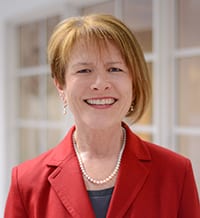 Darlene Chambers – A national leader in education reform, Dr. Darlene Chambers is the Senior Vice President for Programs & Services at the National Charter Schools Institute, and a review alum from both 2017 and 2018.
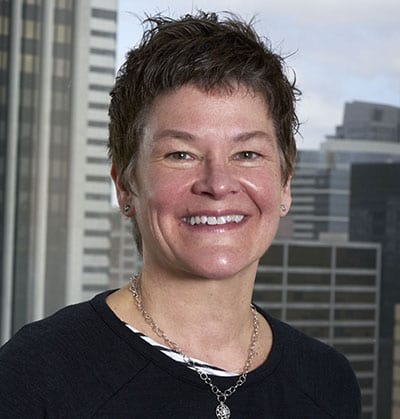 Janet Johnson – Chief Growth Officer at Charter School Capital and internal teacher/ inspiration officer herself (though she’s too humble to admit it), Janet is a review alum since 2017.
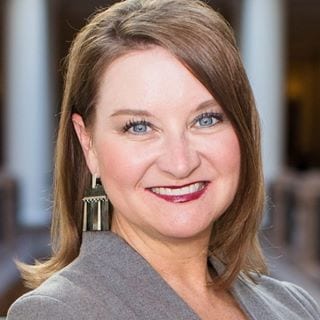 Amanda List – Amanda is a principal of AList Consulting and served as Texas Charter School Association’s first director of advocacy. Amanda has extensive state government affairs and public charter school experience including strong ties to the Texas Capitol and the Texas Education Agency. We welcome Amanda as a first time review panelist for the 2019 Dewey Awards.