Charter School Capital Dewey Awards

Announcing our 3rd Annual Charter School Capital Dewey Awards!

Most of us have had teachers, or at least one, that made significant impact on our lives. For our President and CEO, Stuart Ellis, that teacher was Mr. Dewey. In 2017, and in honor of Richard Dewey, we created the Dewey Awards to celebrate those teachers who were able to see in us what we perhaps couldn’t see, who saw our promise and potential, and made us believe that we could do anything we set our minds to.

This year, the awards are even more poignant for us as we continue to honor and celebrate the life of Mr. Dewey following his passing this year. We are so proud to pay homage to the positive impact he made on Stuart and surely countless other students throughout his career.

For this, our 3rd Annual Dewey Awards, we hope you can help us honor outstanding educators who are making a difference in the lives of their students—in Richard Dewey’s name.

The past two years, we asked you to send in your Stories of Inspiration and we were truly moved by the beautiful tributes to impactful educators from across the country. If you missed it last year, we asked Stuart to share what the awards mean to him and learn a bit more about what the impetus was for starting this program. Watch the video and read Stuart’s story below.


Video Transcript:

We asked Stuart Ellis, “What was the impetus for The Dewey Awards?”

Initially, last year we were celebrating our 10th anniversary at Charter School Capital and the work we’ve been doing with charter schools. The Dewey Awards came out of the inspirational teacher that changed the trajectory of my life back in third grade at Welby Way Elementary School in the Los Angeles Unified School District.

Richard Dewey was my teacher and he fundamentally changed the way I thought about myself. He made me feel loved as a third grader and really made me believe that I could do anything in life.

As we approached the 10th anniversary of Charter School Capital, I began to think about the difference that a Charter School makes in a child’s life and thinking back to my own experience in public school. I realized that it’s actually about the connection with the teachers that an individual child has. And those inspirational teachers who really can see each child and student for who they are, make them feel loved, bring out that potential, and instill the belief in them that they can achieve anything. Let them know that they can simply be who they are and that that is good—don’t change, just be you.

I thought, how can we celebrate this, the impact that teachers have on each of our lives? I talked with people around the company a little bit as I told my story of my teacher, Richard Dewey. When I shared my story, everybody immediately had that one teacher. It’s not that they had 10, even though we’ve all had many, many mentors and teachers. Every adult I talked to could think back and they can see that one inspirational teacher that really changed everything for them.

It was amazing to actually hear other people’s stories just flow out when I shared mine. And I think that was the beginning of the Dewey Awards. We did it last year for the first time and it generated such an outpouring of inspirational letters from others in the community and the charter school community that as we came into this year, even though we were just doing it for our tenth anniversary, we should just do it again.”

So doing it again, we are!

Have you had a teacher who made a positive difference in your life? If so, share your story with us for the opportunity to receive one of three 2019 $1,000 grants to be awarded to a charter school of your choice! See the details below to honor your most influential teacher. #WeLoveCharterSchools

Submit your story here:

Submit Story

school choice

School Choice FAQs

Editor’s Note: This post was originally published here by the Center for Education Reform. We think it’s vital to keep tabs on the pulse of all things related to charter schools, including informational resources, and how to support school choice, charter school growth, and the advancement of the charter school movement as a whole. We hope you find this—and any other article we curate—both interesting and valuable.


JUST THE FAQS—SCHOOL CHOICE

The following are answers to some frequently asked questions (FAQs) regarding school choice and what choice means for students, parents, educators, schools and communities. The answers to these FAQs are intended to provide only an introductory overview of key school choice issues. Links with additional information are provided for those who are interested in learning more.

What Does School Choice Mean?

The term “school choice” means giving parents the power and opportunity to choose the schools their children attend. Traditionally, children are assigned to a public school according to where they live. People of greater economic means already have school choice, because they can afford to move to an area with high quality public schools, or to enroll their children in private schools. Parents without such means, until recently, generally had no school choices, and had to send their children to the schools assigned to them by the district, regardless of the schools’ quality or appropriateness for their children.

School choice creates better educational opportunities for all students, because it uses the dynamics of consumer opportunity and provider competition to drive service quality. This principle can be found anywhere you look, from cars to colleges, but it’s largely absent in our public school system and the poor results are evident, especially in the centers of American culture – our cities. School choice programs foster parental involvement and high expectations by giving parents the option to educate their children as they see fit. It reasserts the rights of parents and the best interests of children over the convenience of the system, infuses accountability and quality into the system, and provides educational opportunity where none existed before.

What Kinds of School Choice Exist Today?

• Full school choice programs, also known as tuition vouchers, provide parents with a portion of the public educational funding allotted for their child to attend school, and allows them to use those funds to send their child to the school of their choice. It gives them the fiscal authority to send their child to the educational institution that best suits their need, whether it is a religious or parochial school, another private school, or a neighborhood or magnet public school. These programs empower the family and, in so doing, infuse consumer accountability into the traditional public school system. Twenty-one voucher programs serve 115,580 students across the country, and several states offer choice scholarship programs specifically for students with special needs.

Access to full school choice programs is often restricted based on geography and income. Although most programs require residency in the district to qualify for vouchers, expanding numbers of statewide programs offer more flexibility. Many programs also have restrictions on income. For instance, the Milwaukee voucher program only offers scholarships to families below 300% of the poverty line.

• Private scholarship programs, locally based and privately funded, also provide opportunities for quality education where none existed before by making the excellence of the private sector available to families of lower socio-economic status. A non-comprehensive list of available private scholarships can be found here.

For more information about and links to voucher and individual scholarship programs, check out School Choice Programs Across the Nation.

• Charter schools are public schools that provide unique educational services to students, or deliver services in ways that the traditional public schools do not offer. They provide an alternative to the cookie-cutter district school model. Charters survive — and succeed — because they operate on the principles of choice, accountability and autonomy not readily found in traditional public schools. (See Just the FAQs – Charter Schools.) Find a charter school and join the nearly 3 million students who have chosen to attend one of the more than 6,500 charter schools in the United States.

• Public School Choice: Forty-six states and DC have adopted public school choice, which allows parents to enroll their children at any public school in a district, or in some cases, in other districts.

• Tuition Tax Credits and Deductions: A number of states offer support of parental school choice through various tax credit or deduction processes. For more information on tax credit scholarship programs visit Tax Credit FAQ.

• Education Savings Accounts (ESAs): A handful of states offer ESAs, which take a child’s state education dollars and create an individual education account that parents can use as they see fit to cover private school tuition, textbooks, tutors, or a variety of education-related expenses as deemed applicable by each individual state law. Arizona was the first state to enact an Education Savings Account program.

A Matter of History

Publicly-Sponsored Secular School Choice (2), Maine; Vermont

The longest running, and least controversial, full school choice program is in Vermont. In order to meet the demand of parents who live in towns too small to support a local public school, the state pays the tuition expenses for children to attend any public or non-sectarian private school (including schools outside the state). Vermont’s initial tuition statute, adopted in 1869 to ensure that both urban and rural school children could receive a quality secondary education, did not distinguish between religious and secular schools. In 1961, a court ruling banned religious schools from participating. The citizens and school board of Chittenden attempted to challenge the ban, but in 1999, the Vermont Supreme Court upheld the ban on religious schools under the Vermont constitution’s “compelled support” clause.

Maine’s tuition system has existed in some form for well over 200 years. During colonial years, and throughout the 18th and 19th centuries, many towns provided for the education of their residents by paying tuition for students to attend “private tuition schools,” many of which were operated by religious organizations. As the public education system grew, it became apparent that many of the state’s rural towns could not afford to build high schools, and so a tuition system was developed that paid the child’s tuition to any school of the parent’s choosing, in-state or out-of-state. But in 1980, the department of education ruled out religiously affiliated schools in towns that have public high schools, limiting many of the traditional choices for quality education that Maine families once exercised. On April 23, 1999, the Maine Supreme Court ruled that the ban on religious schools is not unconstitutional, but did not say whether the inclusion of religious schools would be unconstitutional. The decision does not support the right of parents to send their children to a religious institution and receive a tuition reimbursement. In November of 2006, the U.S. Supreme Court declined to hear the case.

Do School Choice Programs Work?

Yes. While most of the programs in question are young, evidence suggests that they provide educational opportunity to those that need it most.

One choice success story comes from the largest and longest running voucher program, the Milwaukee Parental Choice Program. Students in this program tested 9 to 12 percent higher in math, reading and science than their equally disadvantaged peers. Students also graduated at an 18 percent higher rate. The District of Columbia’s Opportunity Scholarship Program (OSP) is another school choice success. A 2010 study from the Institute of Education Sciences found that students who were awarded a scholarship graduated from high school at a 12 percent higher rate than those who applied for the scholarship lottery but did not receive it.

Don’t Choice Programs Just “Cream” the Best Students?

Skeptics often argue that school choice programs only succeed because they “cream” the best students, those with the most involved parents or the best academic talents, and leave the hard-to-educate behind in the troubled traditional public school system. By measurements of student academic progress, parental involvement, constituent satisfaction and public school reaction to competition, the above mentioned studies show that choice programs do not succeed by “creaming,” but by providing quality education to all students. Consider:

•  While a third of traditional district public school students nationally are minorities, more than half of charter school students are minorities and 14 percent have identified special needs.

• Established choice scholarship programs in Cleveland and Milwaukee target at-risk children, exclusively from low-income families.

• The older programs in Vermont and Maine provide schooling in rural locations where public schooling was unavailable.

• Private scholarship programs specifically target low-income, at-risk children.

School choice does not “cream;” rather, it allows parents of at-risk children to choose the schooling that best suits their child’s educational and emotional needs, and in many cases parents are able to explore schooling alternatives before their child’s problems become too severe.

Don’t These Programs Just Subsidize the Tuition of Rich People and Leave the Poor Behind?

School choice programs are aimed at serving those least served by the traditional public school system. The two modern programs in Milwaukee and Cleveland help poor and needy children. In Cleveland, students from low-income families receive larger scholarships. 6,377 students participated in the program in the 2013-14 school year, and vouchers can be worth as much as $4,250 per elementary school student, and $5,700 for students in high school. Priority is determined by family income; the student’s family income must be below 200 percent of the poverty line. Low-income students also have a better chance of winning the initial lottery. Because this lottery received considerable attention by the local press, low-income families were more likely to find out that they had won a scholarship.

In Milwaukee, eligibility is limited to Milwaukee families with incomes at or below 300 percent of the federal poverty level. Though more students are eligible, 24,938 students participated in Milwaukee’s voucher program in the 2013-14 school year, receiving an average voucher of $6,442. The original program’s participation was limited to 1.0 percent of MPS enrollment, but the cap has since been removed.

Research Continues to Show Success and Satisfaction

In Evaluation of the DC Opportunity Scholarship Program: Impacts After Three Years, (March 2009) researchers Patrick Wolf, Babette Gutmann, Michael Puma, Brian Kisida, Lou Rizzo, Nada Eissa, and Marsha Silverbrg, found:

• Across the full sample, there was a statistically significant impact on reading achievement from the offer of a scholarship and from the use of a scholarship. These impacts are equivalent to 3.1 and 3.7 months of additional learning, respectively. However, there was no significant impact on math achievement.

• Parents of students offered a scholarship were more likely to report their child’s school to be safer and have a more orderly school climate compared to parents of students not offered a scholarship.

• The scholarship program had a positive impact on parent satisfaction with their child’s school as measured by the likelihood of grading the school an “A” or “B,” both for the impact of a scholarship offer and the impact of scholarship use.

School choice programs have become more common, especially in 2011, when 13 states passed voucher programs and almost 30 more have legislation pending. Indiana passed a voucher bill that has the broadest base of eligibility of any program to date, with no cap on participation by 2013. Vouchers have shown success and are poised to become more and more common in the coming years.

Voucher programs are expanding, but special education still receives priority: The John M. McKay Scholarships for Students with Disabilities Program, put into statewide practice in 2000, provided vouchers to 27,040 students with disabilities in 2013-14 with a total expenditure of $168,890,916.. These students are most in need and receive more direct assistance.

Are Choice Scholarships Programs Constitutional?

The strongest critics of choice scholarship programs claim that they violate the First Amendment (establishment of religion) if dollars are used for religiously affiliated schools. The First Amendment provides freedom of religion, not freedom from religion. Choice scholarship programs let parents choose where to direct their children’s education funds. The state is not imposing religion upon its citizens (a concern of the Founding Fathers), nor does offering parents the choice of a religious education for their children substantiate federal funding of religious institutions. As Clint Bolick, Vice President for Litigation at the Goldwater Institute observes:

All credible contemporary school choice proposals are constitutional.[Contemporary school choice programs] do not propose subsidizing religious schools, but merely include such schools within the range of educational options made available to a neutrally defined category of beneficiaries (usually economically disadvantaged families). No public funds are transmitted to religious schools except by the independent decisions of third parties. As the U.S. Supreme Court repeatedly has affirmed, such “attenuated financial benefit[s], ultimately controlled by the private choices of individual[s]“…are simply not within the contemplation of the Establishment Clause’s broad prohibition.

In 2002, the U.S. Supreme Court upheld the constitutionality of the Cleveland, Ohio school choice program, ensuring that laws returning parental stewardship of state educational funds for their children will not be overturned at the federal level.

Wouldn’t it Be Better To Put More Money Into the Existing School System Instead?

The “money issue” is politically charged and requires careful consideration and clarification. Many fiscal issues, from labor contracts to program mandates, are more a function of larger systemic barriers than of money, so increasing or tinkering with funding will likely do nothing to resolve perpetually mediocre education systems. In the last few decades, spending on K-12 public education has grown substantially without improving academic achievement. Expenditures have increased from $162 billion in 1982 to nearly $543 billion in the 2009-10 school year. The United States spent a higher percentage of its GDP on education than Italy, France Hong Kong, Canada, the Netherlands, or the UK in 2007 (the last year that official data is available).

Meanwhile, national indicators of academic progress have been disappointing. National Assessment of Education Progress (NAEP) scores have shown little overall improvement for students aged 17 since 1971. According to the 2012 PISA report, students in the U.S. scored only in the “average” category in reading, below countries like Finland, Canada, Japan, and Poland. In science categories, the U.S. is trailing Slovenia. Twenty-seven countries outperformed the U.S. in science literacy. Thirty-five jurisdictions outperformed the U.S. in mathematics. Twenty-three jurisdictions outperformed the U.S. in reading. Eighteen countries outperformed the U.S. in all three subjects. While money is important, America’s educational performance over the last few decades shows that “more money” is not the solution to our nation’s educational problems.

Charter School Capital logoSince the company’s inception in 2007, Charter School Capital has been committed to the success of charter schools. We help schools access, leverage, and sustain the resources charter schools need to thrive, allowing them to focus on what matters most – educating students. Our depth of experience working with charter school leaders and our knowledge of how to address charter school financial and operational needs have allowed us to provide over $1.8 billion in support of 600 charter schools that have educated over 1,027,000 students across the country. For more information on how we can support your charter school, contact us. We’d love to work with you!


LEARN MORE

Florida Charter Schools

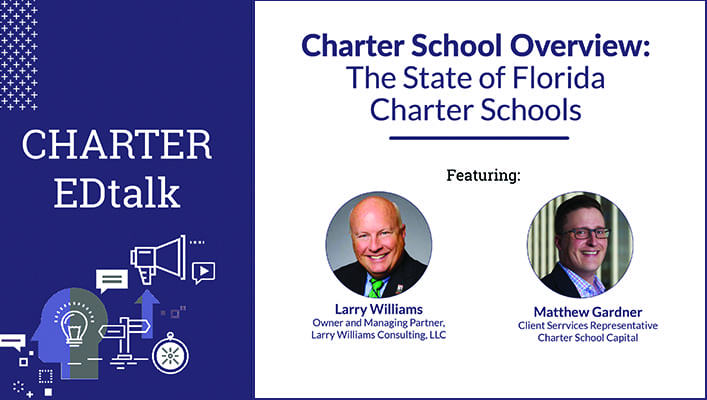
CHARTER EDtalk: The State of Florida Charter Schools

We wanted to check in on the state of Florida charter schools, so in this CHARTER EDtalk, Matthew Gardner, Charter School Capital Client Service Representative, had the privilege of sitting down with Larry Williams, Owner and Managing Partner at Larry Williams Consulting, LLC. Larry shares his expert insights on the state of Florida Charter Schools including their history and growth trajectories, performance rankings, obstacles they’re facing, and what the future looks like for charter schools in Florida.

To learn more about the state of Florida’s charter schools, please watch the video below or read the complete transcript below.

Matthew Gardner: Hello there, and thank you for joining us for this episode of Charter Ed Talks. I’m Matthew Gardner at Charter School Capital, and today we’re honored to be joined by Larry Williams to discuss the state of charter schools in sunny Florida.

So thank you for joining us, and we’re going to go ahead and just jump right in and kick things off.

So, Larry, taking the temperature of Florida, when did charter schools first appear on Florida’s educational landscape?

Larry Williams: The first charter school law for Florida was passed in 1996, which was also the same year that the first charter school opened, which was in Liberty City in the Miami area.

Actually, a group of parents there, in partnership with the future Florida governor Jeb Bush, opened that charter school in Florida. So that became the first charter school.

After that, then charter schools continued to grow. Somewhat at a slow pace there, but that was the very first one, the same year as the first charter school law was passed.

Gardner: Excellent, excellent. Thank you. What’s been the path of charter school growth since first being introduced in the state?

Williams: The charter school growth in Florida over the course of time, from 1996 to present, has been very good. From 1996 to probably 2012, 2014, that time frame there, almost a rocket pace. I mean, very steep growth rate.

Since then, over the last several years, we continue to see charter schools open. However, the rate of growth has slowed down somewhat, so we’re not seeing as many charter schools open every year. Net positive, though. We’re still seeing more charter schools open than we are seeing closed.

Gardner: Okay.

Williams: So, overall, our growth rate has gone down, but we still have significant numbers. We’re probably the third largest state. Well, we’re the third largest state, population. We have the third largest total of charter schools – over 660 charter schools servicing about 295,000 students in the state of Florida.

Gardner: Right. Wow. Excellent. How would you say the Florida charter school performance ranks with charter schools in other states?

Williams: They’re probably right around … probably very similar to their ranking with the National Charter School Alliance data on the model laws, right around number seven. So they’re in the top ten. So their performance is within top ten of other charter schools in the country.

Washington, D.C. pretty much leads the nation, but certainly with more charter schools, then we have a lot more accountability issues that we have to deal with.

Gardner: Right.

Williams: We can talk about some particular problems there. But, overall, about number six or number seven, compared to other schools in the country.

Gardner: That’s great. What do you feel is the biggest obstacle for new charter schools opening in the state?

Williams: Very interesting. If you listened to Nina Rees’s comments [at the National Charter Schools Conference] about how first people ignore you, then they’ll make fun of you, then they’ll try to brush you away, then they start fighting you, and then you try to win, we are now at a stage where we’re, in the charter school environment, having to take on the traditional public schools, the teachers’ unions, and others.

Gardner: Right.

Williams: Very, very serious. They put significant money, put significant resources behind advocating for traditional schools, as opposed to charters – not just allowing charters to be part of their portfolios, but, actually, it’s an us against them, more so than we’ve ever seen.

So that’s a very big obstacle. Another obstacle is the folks that they’re advocating to – traditionally those that are on the left side of the aisle, where you would think that those folks would be more supportive of charter schools, particularly into the student population that these folks generally represent.

But it’s not. It’s definitely a Republican vs. Democrat issue, with Republicans being solidly behind it, Democrats not, because they’re supported a lot by teachers’ unions and school districts and school board members and so forth.

Gardner: Right.

Williams: So that’s probably the biggest obstacle that I see right now, is an elevated effort by traditional public schools and traditional districts to really limit charter schools – new charter schools and present charter schools.

Gardner: Okay. That was definitely leading into my next question. So does that also affect schools that are currently in operation and open right now?

Williams: Yes, and the Florida legislature has worked very hard to walk right I call kind of a tightrope, but being in favor of strong accountability measures, but not wanting to kill the gnat with a sledgehammer type of attitude.

We have one of the statues in Florida … or the charter statute in Florida says when you get a second F, two Fs on a charter school, you have to close the charter school.

Gardner: Right.

Williams: We have a number of traditional schools in Florida who have received F, F, F, F, F, F. They may have a turnaround plan, but they just continue to operate. The legislature’s tried to kind of move that, kind of limit their choices in doing that, having certain turnaround plans, and one of those is opening up to a charter school.

We did that in Jefferson County. The State Board of Education saw just persistently failing schools there and finally toward the school board of Jefferson County … It’s like, “You have no choice. You have to turn this into a charter district. That’s the only thing we can approve.”

Since then, they’ve gone from an F to a C in their first year of operation, on less dollars than what the school district was operating on before.

Gardner: Right.

Williams: So we’ve seen where, with the right environment, that those kids are certainly capable of learning. Also, kids that were leaving Jefferson County, going to Leon County and other counties to get to better schools, where their parents were sending them, are now coming back to Jefferson. So they’re seeing their student populations increase. So we’ve proven that we can do that.

Gardner: True.

Williams: So the legislature’s worked very hard to make it as level a playing field as possible and then hold districts more accountable for those persistently low failing schools that they have.

Gardner: That’s excellent. All right. So, lastly, what do you see for the future of charter schools in Florida?

Williams: I see tremendous opportunity in terms of its growth, personally. The folks that I work with on a regular basis, the members of the legislature, and the Florida Department of Education …

We have a unique situation in Florida, where our former Speaker of the House, Richard Corcoran, who was a very, very, very big proponent of charter schools and, under his watch, passed some very significant legislation in regard to Schools of Hope, Hope Scholarships.

Gardner: Right.

Williams: Very, very, very pro-choice. After his Speaker term ended along with his legislative term, we got a new governor, Ron DeSantis, who then appointed him, essentially, as our new education commissioner.

So now we have, within the Department of Education, a very strong choice department, particularly for charter schools, and we’ve seen a lot go on recently that has certainly indicated that that’s the direction that the Department of Education’s going to go in.

The legislature continues to be very strong on choice and very strong on charter schools. We’ve strengthened the Schools of Hope legislation we passed two years ago. We’ve done some other changes to the statute that make it even more enhanced, better incentives for Schools of Hope.

We’re seeing the results of that right now. KIPP Schools is coming into Hillsborough County. They’re starting this year. IDEA schools are starting in Miami Bay. Those are already on the books. Now just had announced about in the last week or so that KIPP’s now going to open several in Duval County.

Gardner: Oh, wow.

Williams: I mean, so they’re seeing that opportunity there. So this is going to be a major influx of schools, from a world-renowned group like IDEA Schools.

Gardner: That’s good.

Williams: So I think you’re going to continue to see the legislature work both on fine-tuning the accountability measures – certainly holding those schools that are not doing as well as they should accountable, but recognizing those schools that are outperforming their traditional partners and recognizing them.

So I think the attitude and the environment is very strongly for charter schools.

Gardner: Excellent. All right. Thank you for your time.

Williams: You’re welcome.

Charter School Divide

The 2020 Election Charter School Divide: White Dems v. Minority Dems

Editor’s Note: This article discussing the political charter school divide, was originally published here on May 23rd by the Washington Free Beacon and was written by Charles Fain Lehman, a staff writer for the Washington Free Beacon.

Across the U.S., the charter school debate rolls on. Democrats are often broadly painted as opponents to school choice. But the story is not nearly so simple. This article shows an evident divide between white democrats, who are more often against charter schools, and minority democrats, who are much more inclined to be in favor of charter schools and school choice.

We think it’s vital to keep tabs on the pulse of all things related to charter schools, including informational resources, and how to support school choice, charter school growth, and the advancement of the charter school movement as a whole. We hope you find this—and any other article we curate—both interesting and valuable.

Read the full article below to learn more about the racial disparity around the charter school divide.


White Dems Oppose Charter Schools; Minority Dems Support

New data shows likely fault line in 2020 primary

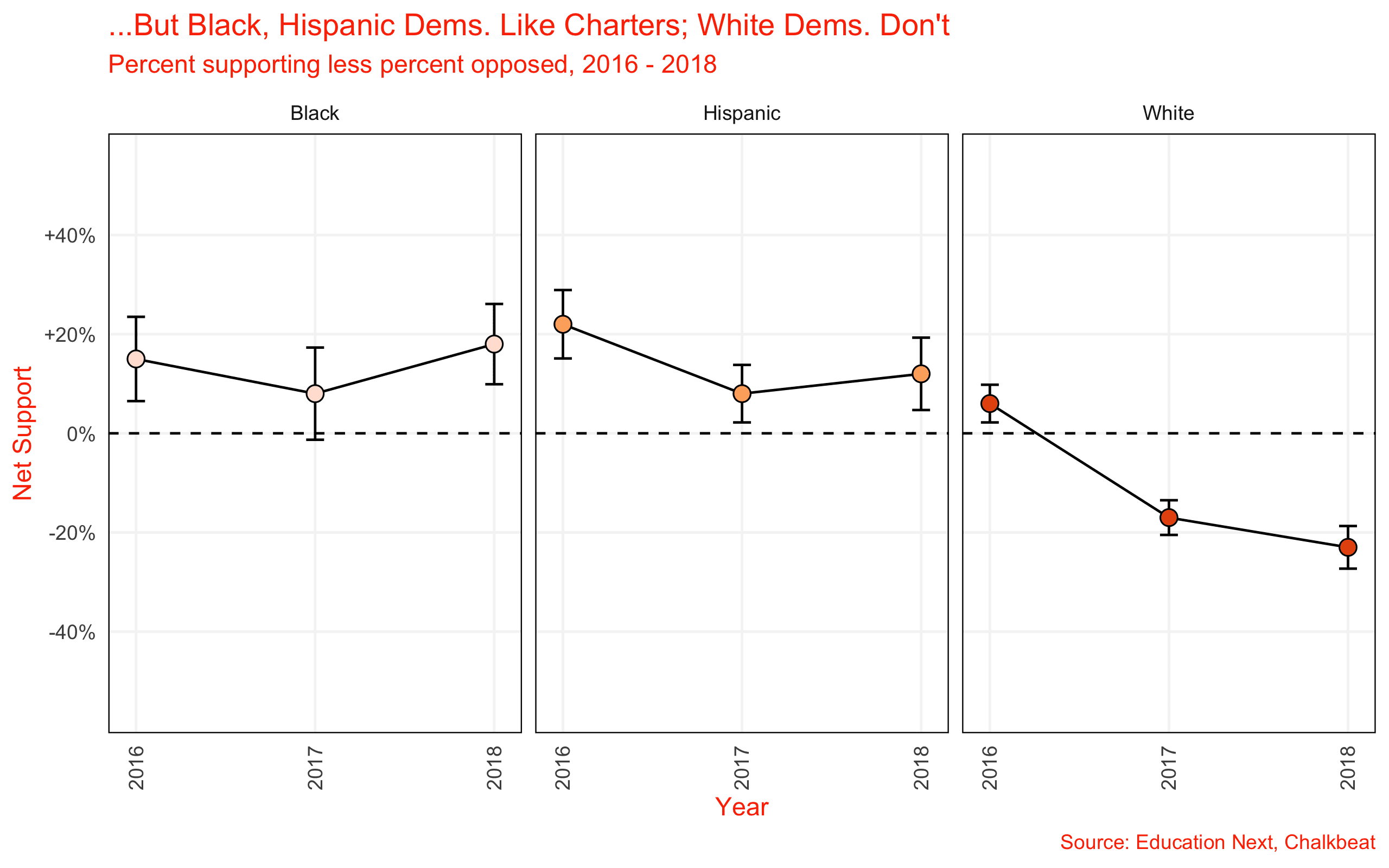
While Democrats are often thought of as opponents of school choice, new data show the story is not so simple: an examination of trends from 2016 through 2018 revealed that while white Democrats have grown staunchly opposed, their Black and Hispanic peers remain in favor of charter schools.

In an already hot 2020 campaign, charters have become targets for left-leaning candidates. Sen. Bernie Sanders (I., Vt.) in a speech Saturday called for an end to federal funding of for-profit charter schools, and a prohibition on funding of new charter schools, including not-for-profits. Sen. Elizabeth Warren (D., Mass.) sided with Sanders, calling for-profit charters in particular “a real problem right now.”

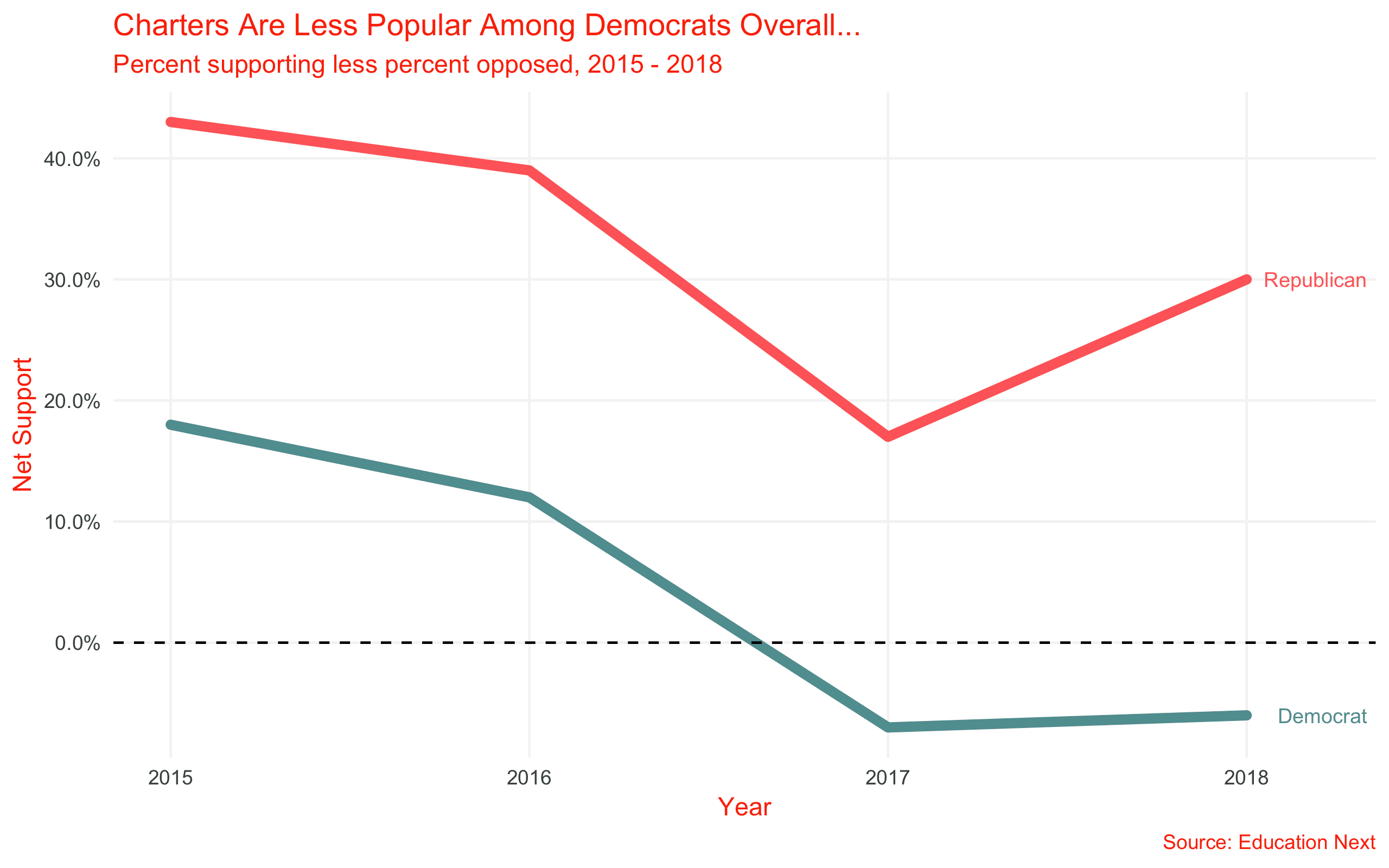
Sanders and Warren are, broadly speaking, in line with the majority view of their party. Education Next, a pro-reform journal, has polled Americans on their views on charter schools since 2013, providing detailed data on party breakdown since 2015. Their polls indicate that charters are consistently more popular with Republicans than with Democrats, and that the schools have slipped to being net unfavorable with the latter group in recent years.

However, this overall unpopularity hides a surprising trend within Democrats. Chalkbeat, an education news site, asked Education Next to provide it with racial decomposition of support for charters within Democrats. The results were startling.

Charter schools have enjoyed net support among Hispanic and Black Democrats for at least the past two years, the Education Next data indicate. But support has cratered among white Democrats. In fact, as of 2018, nearly twice as many (50 percent) of white Democrats opposed charters as supported them (27 percent).

The reason for the emergence of this racial disparity is unclear. Chalkbeat speculated that it may be because Black and Hispanic parents have more direct exposure to charter schools: The National Alliance for Public Charter Schools estimates that compared to regular public schools, public charters enroll more Black (27 percent versus 15 percent) and Hispanic (26 percent versus 22 percent) students.

It could also be because Black and Hispanic parents are more dissatisfied with their current school options. Chalkbeat pointed to a recent Pew poll finding that black voters tend to care about access to school diversity over local schooling, while white voters prefer the opposite, signaling that white respondents are happy with what they have while black respondents want better opportunities. (Hispanic and Asian parents were evenly divided.)

Regardless of the underlying cause, this divide over charter schools will likely prove important in Democratic politics in the near future. This is especially the case because, as recent research from the American Enterprise Institute shows, most figures in the “school reform” movement are Democrats. Notwithstanding broad Republican support for charters, conflict between major players in the school reform movement and their opponents is essentially an intra-party fight.

That fight will likely have consequences for the 2020 primary. Charter-opponent Sanders struggled to garner the support of black primary voters in 2016. His choice of “teachers unions over black voters,” as the Wall Street Journal framed it, may further cement his second-place status compared to front-runner Joe Biden (D., Del.), who has taken the lead among even younger black voters.

In fact, opposition to charters may have already cost Democrats not only votes, but at least one major election. Gov. Ron DeSantis’s (R.) narrow victory over Andrew Gillum (D.) in Florida’s 2018 gubernatorial election was partially thanks to a surprisingly high number of votes from Black women: 18 percent gave him their support, double the backing Sen. Rick Scott (R.) received.

The reason for this, William Mattox of the Marshall Center for Educational Options argued in the Wall Street Journal, was DeSantis’s support for school choice.

“More than 100,000 low-income students in Florida participate in the Step Up For Students program, which grants tax-credit funded scholarships to attend private schools. Even more students are currently enrolled in the state’s 650 charter schools,” Mattox wrote. “Most Step Up students are minorities whose mothers are registered Democrats. Yet many of these ‘school-choice moms’ vote for gubernatorial candidates committed to protecting their ability to choose where their child goes to school.”

DeSantis has responded to this signal: earlier this month, he signed a new school voucher program for low-income Floridians into law.

Data, meanwhile, continue to support the efficacy of charter schools over traditional public education. A recent study of Boston’s expansion of its charter program found that previously successful charters were able to “scale up,” serving more kids without losing any of their benefits to SAT scores and college enrollment compared to non-charter schools.

Charter School Digital Marketing

Up Your Charter School Digital Marketing Game!

Charter school growth requires solid student enrollment and retention programs that position their school for future replication or program growth. Having at least some digital marketing prowess can help you reach and exceed your school’s growth and/or expansion goals.

RELATED CONTENT: Charter School Marketing: Powerful Tips for Success

If you’ve been interested in upping your digital marketing game for your charter school, watch our Digital Marketing for Charter Schools webinar! You can begin to fill your toolbox with some actionable tips and basic strategies that can help you get noticed, attract more families and increase your school’s enrollment.

In this webinar, we cover:

  • Strategy: Developing a digital marketing plan;
  • Tactics: The best tools for charter schools; and
  • Resources: Where can you learn more?

You’ll learn: How digital marketing efforts can help your charter schools build a solid digital footprint, different approaches to help develop and maintain your charter school’s reputation, as well as how to leverage marketing to grow student enrollment.

We also provide an overview of the digital landscape, discuss what digital tools are relevant, how best to implement programs, and we cover the various platforms and how to effectively use them to maintain your charter’s reputation and increase awareness.


Digital Marketing for Charter SchoolsDigital Marketing for Charter Schools: An Actionable Workbook to Help You Achieve Your School’s Goals!

Scratching your head as to how to go about implementing digital marketing for your charter school? You’re not alone! This free manual will be your go-to guide for all of your school’s digital marketing needs! Download this actionable workbook to help get your marketing plans started, guide you as you define your audience and key differentiators, choose your tactics, and start to build your campaigns.

DOWNLOAD NOW

Charter School Facilities

Charter School Facilities: Overlooked and Underfunded

Editor’s Note: This article was originally published here on May 17, 2019 by the Washington Examiner and was written by Nina Rees, CEO of the National Alliance for Public Charter Schools and Ramona Edelin, Executive Director of the DC Association of Chartered Public Schools.

Across the U.S., accessing charter school facilities is, by far, the greatest challenge faced by charter schools. With more than 1 million students across the country on charter school waitlists and the fact that many charters operate in suboptimal buildings, we know that the lack of facilities is a serious obstacle to charter growth.

We think it’s vital to keep tabs on the pulse of all things related to charter schools, including informational resources, and how to support school choice, charter school growth, and the advancement of the charter school movement as a whole. We hope you find this—and any other article we curate—both interesting and valuable.


Charter school facilities are still overlooked and underfunded

It’s National Charter Schools Week, when advocates speak out for the 3.2 million students — 6% of all public school students — educated at charter schools, a thriving public education option that is increasingly popular with families.

Since the first public charter school opened one quarter of a century ago, the charter school reform has spread to 47 states and U.S. territories. In historically troubled school districts, student enrollment has grown dramatically. In New Orleans, Detroit and Washington, D.C., the share of students enrolled in public charter schools is 92%, 53%, and 47%, respectively.

Taxpayer-funded and tuition-free, charters develop their educational programs independently of school districts while being held accountable for improved student performance. This autonomy enables these unique public schools to adopt approaches that boost student outcomes. But it also creates a challenge: unlike traditional public schools, charters do not receive a schoolhouse upon opening. This makes acquiring adequate school space a constant challenge.

Nationwide, charter school leaders report that lack of access to suitable school facilities is one of their primary concerns—and one of the biggest barriers to expanding student enrollment. Nearly 1 in 5 charters had to delay opening by a year or more due to facilities-related issues.

While public school buildings paid for by taxpayers should be available to all public school students, the reality is that many school districts, including Detroit, Indianapolis, and Minneapolis, refuse to allow charter schools to lease or buy even vacant school buildings. Sadly, this results in many schools operating out of shopping malls, office buildings and repurposed industrial facilities.

Accordingly, around 40% of charters lack essential amenities such as gymnasiums, libraries, science labs, cafeterias and outdoor space, National Alliance for Public Charter Schools research finds.

This is a vital issue. Why? Because demand for charter schools from parents and guardians significantly exceeds supply. Indeed, if all families seeking a place for their child could secure one, the total number of charter students would be 8.5 million — almost three times today’s actual enrollment — according to research by Phi Delta Kappa International, a professional organization for educators. Of parents who would like to send their child to a public charter school, over half cited lack of access — the school is too distant or has a waitlist — as the reason why their children did not attend one, PDK found.

Importantly, over half of the nation’s charter students live in economically-disadvantaged homes eligible for federal lunch subsidies.

In Washington, D.C., the government spends three times the amount per student on school properties for traditional schools compared to the facility funding it makes available to their charter school counterparts, even though the charters serve a higher share of needy students. Local charters receive a per-student allowance for school facilities that varies each year through city budget wrangling and election cycles, and consequently lacks appeal to the private sector loan market to which charters must turn in a city with a red-hot real estate market.

Meanwhile, the District government has proved an appalling steward of its own property: for decades, scores of surplus school buildings have been sold to private developers, often for luxury uses, or simply left to rot. Only months ago, developers acquired five historic schoolhouses at a time when 11,000 students are on waitlists for city charters.

The District’s own laws actually require it to offer surplus school property to charters to lease or buy before developers can. This mandate is flouted more often than not, an injustice one finds repeated in the minority of other jurisdictions whose laws ostensibly protect charter students’ interests.

While four in five D.C. charter students are economically disadvantaged, those representing the city’s most vulnerable communities are twice as likely to meet college and career readiness benchmarks as their peers in the traditional school system.

At the federal level, the Charter Schools Program helps charters access space and overcome other start-up hurdles. But funding amounts to less than 1% of the U.S. Department of Education’s budget, which does not reflect the extent of charter school enrollment — or demand — today.

Because parent demand indicates millions more students would attend a charter school if one were available to them, local jurisdictions need to allow charters access to surplus public school buildings and space before developers can bid for them. Prioritizing equality in per-student facilities funding also is essential. Federal education grants could encourage this best practice.

America’s public charter schools have significantly enhanced public education quality, especially for the nation’s most disadvantaged students. Federal, state, and local government should step up to back them.


The Ultimate Guide to Charter School Facility Financing:

Thinking about a new facility for your charter school or enhancing your current one? This guide shares straightforward and actionable advice on facilities planning, financing options, getting approved, choosing a partner, and much more! Download it here.

GET THE RESOURCE

charter school board governance

The Ultimate Guide to Charter School Board Governance: How to Recruit, Build, and Manage Your Board

For your school to reach its goals, meet its mission, and be set up for success, you need to build a well-structured, well-staffed, and well-trained Board of Directors. In this brand new guide, our partners and industry experts on Board Governance, BoardOnTrack, share their expertise on the ins and outs of recruiting, building, and managing your governance team as you grow.

We’ve seen the difference in outcomes when schools have highly strategic boards that work in close collaboration with their management teams.

An effective board needs more than enthusiastic volunteers who believe in your mission.

They need to possess the skills, experience, temperament, and time to govern a multimillion-dollar enterprise.

Great boards govern in partnership with the CEO and the management team to develop a vision of excellence, work toward near-term goals, and create realistic plans for the future.

Effective boards include individuals from a range of professions, with diverse backgrounds and skills that align with the school’s immediate and future objectives. We’ve seen boards achieve ambitious goals thanks to trustees with expertise in finance, real estate, fundraising, marketing, human resources, and executive leadership.

In this guide, we’ll cover best practices for charter school governance, including the essential roles and responsibilities on your school’s governance board, how to recruit the right people, and governing for growth at every stage. This guide is intended for charter school leaders and board members who want to be strategic about governance.

Download this guide to learn:

  • Board Basics: Who should be on your governance team and what should they do?
  • How to build a strong board: Strategically recruiting for diversity and skills
  • Tips to govern for growth: How to face challenges and changes at any stage

Get the Resource

teachers of same race

Having One or More Teachers of Same Race Benefits Students

Editor’s Note: This article was originally published here on June 4, 2019 by the Thomas B. Fordham Institute. It looks at the evidence that shows how having teachers of the same race impacts a student’s educational career and makes a positive impact. It shares the disparities in teacher/student race-matches in traditional public schools and public charter schools.

We think it’s vital to keep tabs on the pulse of all things related to charter schools, including informational resources, and how to support school choice, charter school growth, and the advancement of the charter school movement as a whole. We hope you find this—and any other article we curate—both interesting and valuable.

Read on for more details.


Student-Teacher Race Match in Charter and Traditional Public Schools

There’s mounting evidence that, for children of color especially, having one or more teachers of the same race over the course of students’ educational careers seems to make a positive difference.

But to what extent, if any, do the benefits of having a same-race teacher vary by type of school?

Existing “race-match” studies fail to distinguish among the traditional district and charter school sectors. Knowing whether differences exist across school types could improve how we recruit and develop educators, as well as shed light on whether the success of urban charter schools is due in part to their greater success in recruiting a diverse teaching staff—an explanation that’s received short shrift in research and policy circles.

“Student-Teacher Race Match in Charter and Traditional Public Schools,” authored by Dr. Seth Gershenson of American University, uses student-level data for all public school students in North Carolina from grades three to five between 2006 and 2013. The analysis yielded five findings:

  1. Traditional public schools and charter schools serve the same proportion of black students, but charter schools have about 35 percent more black teachers.
  2. Black students in charter schools are about 50 percent more likely to have a black teacher than their traditional public school counterparts, but white students are equally likely to have a white teacher across the two sectors.
  3. Race-match effects are nearly twice as large in the charter school sector as in traditional public schools, though these differences are statistically insignificant, likely due to small sample sizes.
  4. In charter schools, race-match effects are twice as large for nonwhite as for white students, while no such difference exists in traditional public schools.
  5. Race-match effects are relatively constant across school locales, enrollments, and compositions.

Since the effects of having a same-race teacher appear stronger in charter schools than in the district sector—and stronger still for nonwhite students—it’s encouraging that the charter sector has more of these matches between black students and teachers, due largely to having more black teachers in the first place. This is clearly an overlooked dimension of charter effectiveness.

Moreover, traditional public schools might seek to emulate their charter school counterparts when it comes to boosting the number of teachers of color they hire, though there remains room for improving teacher diversity, not to mention academic achievement, in both sectors.


Charter School Capital logoSince the company’s inception in 2007, Charter School Capital has been committed to the success of charter schools. We help schools access, leverage, and sustain the resources charter schools need to thrive, allowing them to focus on what matters most – educating students. Our depth of experience working with charter school leaders and our knowledge of how to address charter school financial and operational needs have allowed us to provide over $1.8 billion in support of 600 charter schools that have educated over 1,027,000 students across the country. For more information on how we can support your charter school, contact us. We’d love to work with you!
Charter School Capital

BIG NEWS! Charter School Capital Has a New Look!

What do you think of our new look?

We are so excited that Charter School Capital has a shiny new website that we wanted to share it with everyone!

Our marketing team has been hard at work over the past several months with design, planning, copy, resources, and more, to ensure that our updated website is easy to navigate and the information you’re looking for is right at your fingertips. We hope you find our new look warm and welcoming and that it clearly conveys our mission—we are 100% dedicated to charter school success.

We also wanted it to be easy for you to navigate to our extensive toolbox of innovative solutions designed exclusively for charter schools:

In addition, don’t miss checking out our Resources, Blog, Partners, and Events pages which have all been updated with both improved functionality and design!

Want to learn more about us? Check out our About Us and Team pages too!

We hope you like what you see! If you do find anything amiss, or find yourself on any 404 error pages, that is often to be expected with a project of this magnitude. Please do let us know by emailing us at growcharters@charterschoolcapital.com so we can get it on our radar to fix. We appreciate your input!

Thank you for visiting and hopefully you like what you see! Please let us know your thoughts in the comments section below.


Charter School Capital logoSince the company’s inception in 2007, Charter School Capital has been committed to the success of charter schools. We help schools access, leverage, and sustain the resources charter schools need to thrive, allowing them to focus on what matters most – educating students. Our depth of experience working with charter school leaders and our knowledge of how to address charter school financial and operational needs have allowed us to provide over $1.8 billion in support of 600 charter schools that have educated over 1,027,000 students across the country. For more information on how we can support your charter school, contact us. We’d love to work with you!
LEARN MORE


Charter school leader compensation

Editor’s Note: This blog post was originally published here by one of our partners, BoardOnTrack. It was written by Marci Cornell-Feist, a national expert on charter school governance whose work has helped more than 500 charter schools nationwide.

BoardOnTrack is the platform, partner, and community empowering charter boards and executive leaders to reach a higher bar, together. They enable executive leaders to leverage their boards as strategic governing partners without turning board management into {yet another} full-time job. In short, BoardOnTrack is board leadership, simplified.

We think it’s vital to keep tabs on the pulse of all things related to charter schools, including informational resources, and how to support school choice, charter school growth, and the advancement of the charter school movement as a whole. We hope you find this—and any other article we curate—both interesting and valuable.


SHOULD I ASK MY CHARTER SCHOOL BOARD A FOR RAISE?

Each spring, charter school leaders across the country sprint to the end of the year. You’re looking forward to some well-earned time to plan the next school year…and a bit of a summer break.

Whether you’re graduating your first or your fifteenth class, the school year has likely been a long slog. You’re exhausted but energized. You know that your team, and your kids, have made real progress.

And, hopefully, you’re engaged with your board in an end-of-year school leader evaluation — one that proves out the part you played in all that progress and provides direction for your own growth. The results of  your CEO support & evaluation process should energize you.

But. There’s an elephant in the living room. It’s your compensation.

IT’S TIME TO PULL BACK THE CURTAIN ON CHARTER SCHOOL LEADER COMPENSATION.

Charter school leaders need to better understand the landscape, benchmarks, and quite frankly how to talk to your boards about your compensation.

And, conversely, charter school boards — especially the board chairs who partner most closely with charter CEOs — need proven practices and expert guidance on the subject. You need to feel confident about how to respond to CEOs when they broach the topic, how to lead your boards through the conversations, and how to make responsible decisions.

This article launches a multi-part series designed to demystify the topic of charter school leader compensation. Consider it your roadmap. And please reach out to us to share your stories and questions. Or, if you’re a BoardOnTrack member, log in to start a conversation in our members-only community.

We’re starting with a piece for the CEOs, tackling the vital and very common question: “Should I ask?”

In subsequent posts, we’ll dig into exactly how to approach your board, and, for the board, how to measure your CEO’s performance and responsibly lead your board’s approach to this vital topic.

SHOULD YOU ASK FOR A RAISE?

In most cases, the answer is…Absolutely! But…

Every situation is different. First and foremost, you have to have done your homework.

You have to fully understand your role, how your success is measured, and how your performance stacks up against those metrics.

You’ve got to be ready to make the case for a raise.

ON-DEMAND WEBINAR: CEO COMPENSATION

Learn how to talk about your charter CEO’s compensation, when a raise is right, and the tools your board needs to measure CEO performance.

WATCH THE WEBINAR NOW

ARE YOU READY TO ASK FOR A RAISE?

TIMING IS EVERYTHING.

Discussing your raise should be part of the natural cycle of the organization’s budget building, goal setting, and other planning. That means your board should be ready for it.

DON’T CATCH YOUR BOARD OFF GUARD.

This isn’t a topic to just blurt out to your board chair over coffee — or, worse, to the full board at a board meeting.

If they’re blindsided, your board will be put on the defensive. They could get the impression that you’re making an end-run or giving them an ultimatum. That could result in making any open and honest conversation nearly impossible. And you will not get your desired result.

GET YOUR POSITIONING IN PLACE.

You’re in a position to ask for a raise not because you need it. You’re ready to ask for a raise when you’ve earned it and you can prove it.

Let’s be clear. You don’t demand a raise because you just found out how much your close friend and colleague is earning. It’s not because you need to earn more to pay off your student loans, or because you haven’t been able to afford a vacation. Not even when you’re putting together a down payment for your first home {or your dream home}, or for any other myriad reasons you can think of.

You’re ready to ask for a raise when you can clearly, concisely, and accurately make the case. Because you are a skilled Chief Executive Officer, hired to do an incredibly important job, and you are knocking it out of the park — and you have the results to justify your request.

BE CLEAR ABOUT THE VALUE AND SCOPE OF YOUR ROLE AS A CHARTER SCHOOL CEO.

Charter schools come in all shapes and sizes. The same is true for the CEO role. Whether you’re an Executive Director, School Leader, Principal, or Head of School, you are at the top of the org chart.

You’re reporting to the board. You are the top executive of your organization. And that makes you the CEO, regardless of your title.

And at the core, there are similarities that define this role.

SAMPLE CHARTER SCHOOL LEADER JOB DESCRIPTION.

Set clear expectations for your charter school’s CEO. Use our template as your starting point. It’s built on the knowledge of the hundreds of charter schools we’ve worked with, nationwide.

DOWNLOAD THE PDF

A charter school leader is the CEO of a multimillion-dollar public enterprise.

As the leader of your organization, you are running a multimillion-dollar public enterprise.

This is true if you’re in the start-up phase, launching with 180 kids in a few grades, and a $2M operating budget. And it’s true if you’re in your 10th year of operations, running multiple campuses, and have grown to be a $15M organization.

AS CEO, YOU’RE ULTIMATELY ON THE HOOK FOR THE WELL-BEING AND SAFETY OF HUNDREDS OR THOUSANDS OF PEOPLE.

Size and scale varies across the charter movement. But, even the smallest charter schools are comprised of significant numbers of staff, kids, and families. And they all rely on you, as CEO, for their safety, well-being, and — for staff — their employment. This is a weighty task.

YOU ARE THE CEO OF A HIGH-RISK, ENTREPRENEURIAL START-UP.

You have chosen to be part of a relatively new movement; one that is constantly under siege. You’re an entrepreneur who chose this path over one of more stability in a traditional public education setting.

YOU ARE A HIGHLY SKILLED, INTENSIVELY TRAINED PROFESSIONAL

You’ve invested time and money in the training that prepared you to take on this challenge. You probably have an advanced degree, maybe participated in an incubator or fellowship, and have devoted significant time and money to get to the place where you are now.

YOU SHOULD ASK YOUR BOARD FOR A RAISE. WHEN YOU’RE READY.

As a highly-skilled professional running a multimillion-dollar high-stakes, high-risk entrepreneurial endeavor with hundreds, if not thousands of people relying on you for their safety and well-being, you deserve to be well-compensated. And you deserve to see an ongoing path for increased compensation, tied to the results you deliver.

But, you shouldn’t ask for a raise without doing all the right strategic work up front. If done well, asking for a raise will be uplifting for you, and will strengthen your partnership with your board.

Our next post will show you the right steps to take to get yourself in a position to ask for a raise.

Without preparing sufficiently, and timing the conversation appropriately, you won’t get your desired outcome. And you could actually set yourself back.


Charter School Capital logoSince the company’s inception in 2007, Charter School Capital has been committed to the success of charter schools. We help schools access, leverage, and sustain the resources charter schools need to thrive, allowing them to focus on what matters most – educating students. Our depth of experience working with charter school leaders and our knowledge of how to address charter school financial and operational needs have allowed us to provide over $1.8 billion in support of 600 charter schools that have educated over 1,027,000 students across the country. For more information on how we can support your charter school, contact us. We’d love to work with you!
LEARN MORE