homeless charter school students

Supporting Charter School Students Experiencing Homelessness

Editor’s Note: This resource was published by the National Alliance for Public Charter Schools on December 4, 2019. It was created in partnership with SchoolHouse Connection, a nonprofit organization working to overcome homelessness through education.

We think it’s vital to keep tabs on the pulse of all things related to charter schools, including informational resources, and how to support school choice, charter school growth, and the advancement of the charter school movement as a whole. We hope you find this—and any other article we curate—both interesting and valuable.


How Charter Schools Can Support Students Experiencing Homelessness

Education is a critical tool to address the needs of students experiencing homelessness. For these students, school can be a vital source of stability. The McKinney-Vento Homeless Assistance Act is a federal law that provides rights and services for students experiencing homelessness. It applies to all local educational agencies (LEAs) and public schools, including public charter schools.

RELATED: Low-Income Charter School Student Graduation Rates Are Two to Four Times Higher Than National Average

This toolkit was developed in partnership with SchoolHouse Connection and is intended as a charter school-focused resource that explains the basic legal requirements of the McKinney-Vento Act, while highlighting a few examples of best practices from the charter school community. The toolkit includes three main components for practitioners: (1) Introduction to Student Homelessness, (2) Enrolling Students Experiencing Homelessness, and (3) Supporting Success for Students Experiencing Homelessness.

DOWNLOAD TOOLKIT


Charter School Capital logoSince the company’s inception in 2007, Charter School Capital has been committed to the success of charter schools. We help schools access, leverage, and sustain the resources charter schools need to thrive, allowing them to focus on what matters most – educating students. Our depth of experience working with charter school leaders and our knowledge of how to address charter school financial and operational needs have allowed us to provide over $2 billion in support of 600 charter schools that have educated over 1,027,000 students across the country. For more information on how we can support your charter school, contact us. We’d love to work with you!

LEARN MORE


charter schools

What the 2020 Primary Candidates Get Wrong About Charter Schools

Editor’s Note: This article was originally published here on November 19, 2019, by the Wall Street Journal. It was written by David Osborne who leads the education work of the Progressive Policy Institute.

We think it’s vital to keep tabs on the pulse of all things related to charter schools, including informational resources, and how to support school choice, charter school growth, and the advancement of the charter school movement as a whole. We hope you find this—and any other article we curate—both interesting and valuable.


The Big Lie About Charter Schools

When Sen. Elizabeth Warren released her education plan, she trotted out a familiar charge against charter schools: that they “strain the resources of school districts.” To fight this supposed scourge, she promised to end federal financial support for new charter schools. And she’s not an outlier among the Democratic presidential hopefuls. Her fellow progressive Sen. Bernie Sanders had already charged, in his education plan, that charter schools’ “growth has drained funding from the public school system.” Even Joe Biden —who served under President Obama, an enthusiastic charter supporter—has picked up the refrain. “The bottom line” on chartering, he told an American Federation of Teachers town hall, “is, it siphons off money for our public schools, which are already in enough trouble.”

To begin with, charters themselves are public schools. The only difference is that they are operated independently of district bureaucracies, with more freedom to design their programs and choose their teachers but also more accountability. If charters fail—if their students fall too far behind—they are usually closed.

The same arguments made about charter school funding don’t make sense in other contexts. When a family moves out of a district, the district loses state and federal money for its child’s education, but no one accuses the family of draining funds from the district. When parents move their child to a private school, no one accuses them of sabotaging public schools.

So why are leading Democratic presidential primary candidates lambasting charters as a threat to public education? Because no interest group has more clout in the Democratic primaries than teachers unions. In the last presidential election, the AFT and National Education Association combined spent $64 million.

Whether charters drain money from public school districts depends on the state. In over half the states with charters, when students decamp some or all districts get to keep their local tax revenue but no longer have to educate the children, so they actually increase their spending per pupil. In Massachusetts and New York (outside New York City), the state cushions any revenue loss. By law, Massachusetts districts should be reimbursed 100% of the state money for the student for a year, then 25% for the next five years—though the state has only met about 60% of that funding since 2015.

The unions and their allies ignore these realities and focus on costs the districts can’t cut even as they lose students: pensions, principals’ salaries, building maintenance and utilities. These costs are real, but in a majority of charter states local revenue or the state-provided cushion covers most or all of them.

And the pension problem is exaggerated. As districts lose students, they reduce their number of teachers, which also reduces payments to the pension fund. If the pension system has been properly funded, there’s no negative impact. The real problem is that most states have fallen behind on their funding obligations, and now some districts are being forced, as in California, to play catch-up.

Mitigating the cost of building maintenance and utilities takes a little creative thinking. Districts can rent empty classrooms to preschool and adult-education providers. Once their schools are down to 75% capacity or below, they can lease the extra space to charter or private schools. In cities that aren’t afraid of charters, such as Washington and Denver, many school buildings house both a charter and a district school. When that’s not enough, districts can close buildings that are more than half empty and lease or sell them to charter schools.

None of this decreases the public education available to students, and it often improves the quality. But leaders of the teachers unions scream when school boards contemplate any of it.

That’s because unions shrink as charters grow. Charter schools are free to unionize, but as of last year only about 11% chose to do so. That doesn’t threaten teachers, who have more potential employers as the charter sector grows, more opportunity to choose a school that fits. But it does threaten the handsome pay union leaders receive—more than $400,000 a year for leaders of the NEA and AFT as well as more than $200,000 for other staff members.

Charter schools give millions of children—two-thirds of them nonwhite—the opportunity to get an education, go to college and move up the socioeconomic ladder. Even the unions’ favorite source of charter studies—they keep calling back to an outdated report of theirs—Stanford University’s Center for Research on Education Outcomes, has found that by their fourth year in a charter, students learn about 2.5 months more in reading every year and around two more in math than demographically similar students with the same past test scores who stayed in local district schools. In urban districts, by their fourth year students are gaining a little under half a year in reading and a little over in math—every year—over their district peers.

Graduation rates, college-going rates and college completion rates are also higher among students who enroll in charter schools. And as a handful of studies have shown, competition from charters can push district and school leaders to improve their schools, to make them more attractive to parents.

Presidential candidates should worry about how to get Americans the most bang for our education buck. The data show that the answer is to grow the best charters, as Sen. Cory Booker proudly did when he was mayor of Newark, N.J.—something he had the courage to say when debate moderators asked him the charter question. In Wednesday’s debate, other candidates should follow his example.

Mr. Osborne, whose latest book is “Reinventing America’s Schools: Creating a 21st Century Education System,” leads the education work of the Progressive Policy Institute.

Correction
New York state cushions the revenue loss when students transfer to charter schools only for school districts outside New York City, and Illinois has not done so since 2009. An earlier version misstated this.


Charter School Capital logoSince the company’s inception in 2007, Charter School Capital has been committed to the success of charter schools. We help schools access, leverage, and sustain the resources charter schools need to thrive, allowing them to focus on what matters most – educating students. Our depth of experience working with charter school leaders and our knowledge of how to address charter school financial and operational needs have allowed us to provide over $2 billion in support of 600 charter schools that have educated over 1,027,000 students across the country. For more information on how we can support your charter school, contact us. We’d love to work with you!

LEARN MORE


charter school enrollment marketing

How We Can Help with Your Charter School Enrollment Marketing

It’s never too late to start thinking about upping your charter school enrollment marketing game! Start prepping now for open houses in the spring, and get your summer enrollment marketing efforts planned for summer! Not sure where or how to get going?

Our best-in-class enrollment marketing team can help you:

  • Increase Traffic: Increase organic traffic by optimizing your website and social media channels
  • Raise Awareness: Targeted marketing efforts will help raise community awareness of your school, attracting new families and potential future students
  • Increase Enrollment: Attract more families, engage with them, nurture them, and convert them to boost student enrollment
  • Retain Students: Retaining your current students is vital to your school’s longevity and more cost effective than attracting and acquiring new ones

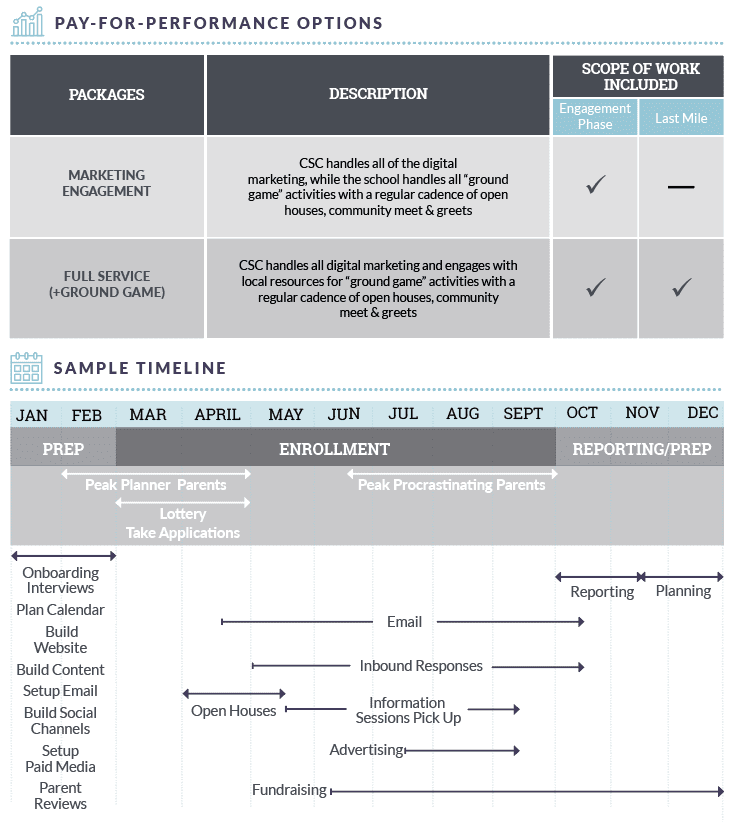
Charter School Capital’s Enrollment Marketing Program is designed to positively impact your charter school’s viability by boosting enrollment numbers through targeted marketing efforts. You can choose a program that focuses on generating awareness primarily through digital marketing, or one that also includes “ground game” marketing to convert applicants to enrollment. All efforts will be customized for each school’s unique needs, and may include the following:

DIGITAL MARKETING

  • Updated Website (if deemed needed) with Spanish language support where appropriate
  • Organic Search (optimizing website for search results)
  • Paid Search (Google, Niche)
  • Landing Pages to Capture Interest
  • Facebook and Twitter Social Media Engagement
  • Surveys / School Ratings
  • Postcards / Brochures
  • Email Campaigns to Your Parent / Former Parent Lists
  • Remarketing / Retargeting Online Advertising
  • Influencer Campaigns
  • Display and Print Advertising
  • Yard Signs and other Signage
  • Radio / Other Advertising – where applicable

THE GROUND GAME

Organizing Open Houses / School Tours

  • Ensure they’re regularly scheduled and staffed for parents and students to tour school and meet teachers (at least 2x/month)

Organizing Community Meet & Greets

  • Arrange community meetings in libraries, coffee shops, pizza parlors, etc. for parents to casually meet other families and parents and staff from school to drive interest

Putting up lawn signs, passing out brochures in the community

  • Going to doctor’s offices, supermarkets, etc. and ensuring community boards have brochures on them
  • Making sure parents can put up lawn signs for the school in the summer

Providing photos and updates to the Charter School Capital team for social media

  • Attend events or reaching out to other staff/parents/volunteers to gather photos and stories to share on Facebook and Twitter

Updating Charter School Capital team on school events, community reactions, etc.

  • Weekly meetings with the Charter School Capital team in first month, bi-weekly thereafter

HOW IT WORKS

PAY-FOR-PERFORMANCE OPTIONS

Download our one-page charter school Enrollment Marketing datasheet here

Would you like to see how two schools saw sharp increases in overall web traffic and social media traffic as a result of our enrollment marketing efforts? Download our Enrollment Marketing Results datasheet below.

SEE RESULTS


Digital Marketing for Charter SchoolsDigital Marketing for Charter Schools: An Actionable Workbook to Help You Achieve Your School’s Goals!

Scratching your head as to how to go about implementing digital marketing for your charter school? You’re not alone! This free manual will be your go-to guide for all of your school’s digital marketing needs! Download this actionable workbook to help get your marketing plans started, guide you as you define your audience and key differentiators, choose your tactics, and start to build your campaigns.

DOWNLOAD NOW

Charter School Report

Charter School Report: Leaders of Color

Editor’s Note: This report was published by the National Alliance for Public Charter Schools on November 18, 2019.

We think it’s vital to keep tabs on the pulse of all things related to charter schools, including informational resources, and how to support school choice, charter school growth, and the advancement of the charter school movement as a whole. We hope you find this—and any other article we curate—both interesting and valuable.


Profiles of Leaders of Color: Engaging Families

This is the second in a series of reports to be published by the National Alliance in partnership with Public Impact highlighting the experiences of school leaders of color in charter schools across the country. While the impact school leaders have on student performance has been well documented, there has been little attention to how leaders’ experiences and racial identities inform and influence their practice. While many practices of good leadership are universal, an individual’s identity shapes how they approach situations and can inspire new and innovative practices.

RELATED: Diversity in America’s Traditional Public and Public Charter School Leaders

The report includes the profiles of three leaders of color—Maquita Alexander of Washington Yu Ying Public Charter School in Washington, D.C., Freddy Delgado is superintendent/principal at Amigos Por Vida Charter School in Houston, TX, and Kriste Dragon of Citizens of the World Charter Schools, a network of public charter schools with locations in Los Angeles, CA, and Kansas City, MO. Each of these leaders shared the belief that their school should engage families as genuine and active partners in their children’s education and the report identifies the concrete steps they took to put that belief into practice.

DOWNLOAD REPORT


Charter School Capital logoSince the company’s inception in 2007, Charter School Capital has been committed to the success of charter schools. We help schools access, leverage, and sustain the resources charter schools need to thrive, allowing them to focus on what matters most – educating students. Our depth of experience working with charter school leaders and our knowledge of how to address charter school financial and operational needs have allowed us to provide over $2 billion in support of 600 charter schools that have educated over 1,027,000 students across the country. For more information on how we can support your charter school, contact us. We’d love to work with you!

LEARN MORE


Public Charter Schools
Public Charter Schools Give Children an Option to Succeed

Editor’s Note: This post was originally published here on November 18, 2019, by the NY Times, and was written by Cory A. Booker, Democratic senator from New Jersey and a presidential candidate.

We think it’s vital to keep tabs on the pulse of all things related to charter schools, including informational resources, and how to support school choice, charter school growth, and the advancement of the charter school movement as a whole. Especially now, when so much is on the line with the upcoming presidential election, we hope you find this—and any other article we curate—both interesting and valuable


Cory Booker: Stop Being Dogmatic About Public Charter Schools

We can’t dismiss good ideas because they don’t fit into neat ideological boxes or don’t personally affect some of the louder, more privileged voices in the party.

About 15 years ago, when I was living in Brick Towers, a high-rise, low-income housing community in Newark’s Central Ward, a neighbor stopped me and told me about how her child’s public school was failing its students, like many others in our area at the time. Desperate, she asked if I knew a way to help get her child into a private school. She knew, as all parents do, that a great education was her child’s primary pathway to a better life.

My parents knew this all too well. When I was a baby, they fought to move our family into a community with well-funded public schools. These neighborhoods, especially in the 1960s and ’70s, were often in exclusively white neighborhoods. And because of the color of my parents’ skin, local real estate agents refused to sell my parents a home. My parents responded by enlisting the help of activists and volunteers who then set up a sting operation to demonstrate that our civil rights were being violated. Because of their activism we were eventually able to move into the town where I grew up.

Fifty years later, access to a high-quality public education still often hinges on the ZIP code a child lives in, skin color and the size of the family’s bank account.

Parents in struggling communities across the country are going to extraordinary lengths to try to get their children into great public schools. There is even a trend of children’s guardians using fake addresses to enroll them in better schools in nearby neighborhoods or towns — living in fear of hired investigators who follow children home to verify their addresses.

While millions of families are struggling with this system, we have Republicans in Congress, the White House and state legislatures across the country making problems worse, undermining public education and attacking public-school teachers.

So it is largely up to Democrats — especially those of us in this presidential primary race — to have a better discussion about practical K-12 solutions to ensure that every child in our country can go to a great public school. That discussion needs to include high-achieving public charter schools when local communities call for them.

Many public charter schools have proved to be an effective, targeted tool to give children with few other options a chance to succeed.

For-profit charter school schemes and the anti-public education agenda of President Trump and Education Secretary Betsy DeVos are hurting teachers, students and their families. Of course, we must fight back against these misguided and harmful forces. But we shouldn’t let the worst actors distort this crucial debate, as they have in recent years.

The treatment by many Democratic politicians of high-performing public charter schools as boogeymen has undermined the fact that many of these schools are serving low-income urban children across the country in ways that are inclusive, equitable, publicly accountable and locally driven.

When I was mayor of Newark, we invested in both traditional public schools and high-performing public charter schools. Following our efforts, the citywide graduation rate rose to 77 percent in 2018 from just above 50 percent a decade ago. Today, Newark is ranked the No. 1 city in America for “beat the odds” high-poverty, high-performance schools by the Center on Reinventing Public Education.

We refused to accept the false choice between supporting public-school teachers and giving parents options for their kids when they had none, and the city worked with our local teacher’s union to give our public school teachers a raise too. And we didn’t just blindly invest in good public charter schools, Newark closed bad ones too.

As Democrats, we can’t continue to fall into the trap of dismissing good ideas because they don’t fit into neat ideological boxes or don’t personally affect some of the louder, more privileged voices in the party. These are not abstract issues for many low-to-middle-income families, and we should have a stronger sense of urgency, and a more courageous empathy, about their plight.

Especially at this moment of crisis for our country, we must be the party of real solutions, not one that threatens schools that work for millions of families who previously lacked good educational options.

As a party, we need to take a holistic approach to improving outcomes for children who are underserved and historically disadvantaged. That must mean significantly increasing funding for public schools, raising teacher pay, fully funding the Individuals With Disabilities Education Act, investing in universal preschool, eliminating child poverty — and yes, supporting high-performing public charter schools if and when they are the right fit for a community, are equitable and inclusive, and play by the same rules as other public schools.

As a coalition, we have to acknowledge that our goals for federal education funding will continue to face serious political opposition. Supporting well-regulated public charters, in the meantime, is a meaningful complementary solution. The promise of better schools some day down the road doesn’t do much for children who have to go to schools that fail them today.

The Democratic Party is at its best when we lead with the conviction, above all else, to help people. We fall short of that when we race to embrace poll-tested positions that may help us avoid being yelled at on the internet by an unrepresentative few but don’t reflect the impossible choices many low-income families face.

Our primary litmus test for supporting a policy should be whether it is a good idea that, responsibly implemented, can help those who need it. We must be the party that empowers people and stands with them, not against them for convenient political gain. That’s not just the way we will win. It’s the best way to govern.

Cory A. Booker is a Democratic senator from New Jersey and a presidential candidate.

The Times is committed to publishing a diversity of letters to the editor. We’d like to hear what you think about this or any of our articles. Here are some tips. And here’s our email: letters@nytimes.com.

Follow The New York Times Opinion section on FacebookTwitter (@NYTopinion) and Instagram.


Charter School Capital logoSince the company’s inception in 2007, Charter School Capital has been committed to the success of charter schools. We help schools access, leverage, and sustain the resources charter schools need to thrive, allowing them to focus on what matters most – educating students. Our depth of experience working with charter school leaders and our knowledge of how to address charter school financial and operational needs have allowed us to provide over $2 billion in support of 600 charter schools that have educated over 1,027,000 students across the country. For more information on how we can support your charter school, contact us. We’d love to work with you!

LEARN MORE


charter schools

Who Suffers by Limiting Charter Schools?

Editor’s Note: We wanted to share this story on charter schools by John Stossel and Maxim Lott that was posted here by Reason on September 10, 2019.

He shares the heartbreak of parents who wait year after year to see if their children have been selected for the charter school lotteries, and the disappointment that follows when they’re not.

They are frustrated with their local underperforming public schools but have little choice and few alternative educational opportunities for their children because the government is limiting charter schools, even though charters often do better than government-run schools with less funding.

When charter schools fail, they close. When traditional public schools fail, they stay open. There are an estimated five million students who would attend a charter school if they had the option.


Let Charter Schools Teach!

Many parents try to escape government-run schools for less-regulated “charter schools.”

Philadelphia mom Elaine Wells tells John Stossel that she wanted to get her boys into a charter because her local government-run school in inner-city Philadelphia was “horrible…there were fights after school every day.”

Her kids spent years losing lotteries that they hoped would get them into a charter.

“It’s heartbreaking,” Wells says.

In Philadelphia, thanks to government limits, only 7,000 kids get into charters. 29,000 apply.

But eventually, Wells got her kids into a new charter school: Boys’ Latin, founded by David Hardy.

Boys’ Latin does many unusual things. All kids learn Latin, wear uniforms, and stay longer hours—and it’s all-boys.

“The rules are there to set the stage for the students,” Hardy tells Stossel. “If the teacher can tell you to tuck in your shirt, they can tell you to be quiet in class…tell you to do your homework.”

Wells says that worked for her kids. “Before Boys Latin I would come home and say, ‘OK, I need you to read for an hour—read a book.’ And their response would be, ‘Why? What did we do?’ Like reading was a punishment! [After] Boys’ Latin…I would find books in the bathroom on the floor!”

Her son Ibrahim adds, “It came to the point where the teacher would tell our mom that I’d taken too many books.”

The school was better at hiring teachers who tried hard.

Wells recalls being shocked to find her sons talking to teachers at night: “He’s in his room and I hear him talking on the phone and it was 10 o’clock at night. I’m like, ‘Who are you on the phone with?’ and he was like, ‘Well, Mr. Bumbulsky told me to call him if I needed help with homework.'”

Stossel pushed back at some of David Hardy’s ideas, like making every student take four years of Latin. “It’s ridiculous. Nobody speaks Latin,” Stossel suggests to founder David Hardy.

“Well we picked Latin because it was hard,” Hardy replies.

“What’s the point of that?” Stossel asks.

“Because life is hard—to be prepared you have to work hard,” Hardy says. “We wanted to get that into the psyche of our students.”

Overall, Boys’ Latin gets somewhat better test scores than surrounding schools in most subjects.

“We deliver,” Hardy says. “Since the very first class we’ve sent more black boys to college than any high school in Pennsylvania.”

Despite that, government officials rejected his proposal to open a “Girls’ Latin” school. They’ve rejected a bunch of schools.
Opponents complain that charters “drain scarce resources” from government-run schools.

“You can’t tell me that,” Wells responds. “Every parent pays taxes…if I choose for my child to go to a charter school, then that’s where my taxes should go!”

In fact, Philadelphia and other cities don’t give charters the same amount of money they give to schools they control. Philadelphia gives them only 70 percent of that. So per student, Stossel notes, the government schools make money whenever a kid leaves for a charter. Over 13 years of schooling, Philadelphia saves $70,000 per kid.

Stossel asks Wells: What if those savings were passed onto the child?

“Absolutely! Give them the rest of the money!” Wells laughs.

But it won’t happen because, as Hardy notes, “It would also mean that there would be a whole lot less union jobs. The unions are not going to be for that.”

The views expressed in this video are solely those of John Stossel; his independent production company, Stossel Productions; and the people he interviews. The claims and opinions set forth in the video and accompanying text are not necessarily those of Reason.

Charter School Capital

Sharing Charter School Capital’s Values

It’s the holiday season and so a very good time to reflect on the things that we value. So we thought this would be a perfect time to share with you, once again, the core values here at Charter School Capital.

At Charter School Capital, we hold each other accountable to core company values as the driving force and foundation of what we do. These values are our guiding principles as we work together to more effectively support the growth and development of our charter school partners. And, as a result, Charter School Capital is a proven catalyst for charter school growth. Since our founding, we are very proud to say that we’ve invested over $2 billion to help finance the education of more than 1,000,000 students in over 600 charter schools across the United States.

Our values are, indeed, a way of life here. They’re simply woven into the fabric of daily life at the office where there’s a shared passion and mission infusing every action.

We measure everything we do by these core values:

  • Best-in-Class
  • Empowerment
  • Innovation
  • Teamwork
  • Accountability

Our values are so deeply intertwined, that you actually can’t speak about one without simultaneously touching on the others. That being said, they’re beautifully interdependent values that are the foundation for everything we do here.

Best-in-Class

Striving to be best-in-class is indeed a way of life here. It can be seen in the way everyone interacts with each other on a daily basis, in the support and encouragement each person receives here — from everyone — regardless of their department, and how individuals and teams coach and enable each other to succeed by helping schools succeed in educating more and more students each day.

Everything we do at Charter School Capital is in service to the mission, in service to our clients, and service to the charter school movement. We put our schools’ success at the forefront, working with them beyond just helping them finance their growth or facility. Best in class means providing additional value-added guidance, mentoring services, and advice to help keep schools on the right track. Because we believe that their success is our success.

It’s this holistic way of striving for best-in-class, that we’ve actually helped a lot of schools become stronger over the long run. Because, as we’re providing finances, we’re able to see any early signals that there may be problems on the horizon. In this way, we can start proactively working with our school partners to help them better understand what they may need to do to trim expenses so that they’re not in the red. We may even introduce them to back-office providers who might be able to provide a service that would help them with their bookkeeping or with other administrative support.

Being best-in-class means continually asking, are you best at serving the needs of your client? Does this help our client? Are we beneficially serving the charter school movement and the charter schools that we work with?

Empowerment

The leadership team at Charter School Capital understands that by empowering each team member, we’re ultimately empowering the success, growth, and longevity of the charter schools we serve.

What else do we mean when we talk about empowerment? It’s about how our company not only empowers its employees to be their best, but how we empower the schools we work with to achieve and even exceed their goals.

Empowerment here also means we empower our teams to speak up and think outside the box. There really is a no-fail attitude here. Of course, there are times when things go off course, but we don’t consider that failure, but simply an opportunity for growth. It’s in this way that we’re encouraged to be creative and innovative without fear.

Like each individual at Charter School Capital, our schools are not static, cookie-cutter organizations. They have a plan or a mission, and sometimes they need a little assistance reaching their goals. We’re empowered to help them to do that. We as a company, and we as employees are empowered to be as creative and flexible as possible to meet their specific needs at specific times, help them improve their financial health, or just help them grow… and we also empower our schools by giving them the stability that they may need.

Innovation

We see solutions where other financial institutions may see red flags. We pride ourselves on supporting team members to find those innovative, creative solutions our schools need to be successful and sustainable.

We understand that there is actually danger in not innovating… of being complacent. Without innovation, you will never grow — either personally or as a company. Our core value of innovation inspires us to always strive for what will make things better for our employees and even more important, better for the clients. Innovation can propel things forward in a way that ideally makes things better for everyone.

But, in order to be innovative, you have to take risks, involve a team of experienced collaborators, do your homework, and have the right goals in mind. Our spirit of innovation at Charter School Capital is always guided by one question — will it help us serve our customers better?

Embracing innovation means:

  • supporting our employees and school partners with technological innovations and platfoms that make things easier
  • thinking outside the box with our charter school solutions
  • combining it all together and understanding how that translates to putting our customers first

Teamwork

One of the things that perhaps makes us a bit different than others in our industry — is the comprehensive team of finance professionals we put in place to work with every single one of our school partners. This knowledgeable, dedicated team works together with our schools to find sustainable solutions to ensure that they succeed in the near term and as they grow.

Having a shared vision, a dedicated team of professionals, and student focus are all vital to our embodiment of the teamwork value. But all that would mean nothing if we didn’t truly love partnering with our schools and the students they’re educating.

When we commit and say, ‘yes, we’ll provide that funding,’ what we’re really saying is, ‘yes, we will get you where you want to go.’ And every member of our team — whether it’s marketing, underwriting, finance, the executives, or the account managers — knows what the end goal is and where we’re going. A common goal makes it much easier to work together as a team.

When you’re working toward this shared goal, everyone is willing to help and have open lines of communication to deliver the best product in partnership with the school. A shared vision, a dedicated team of professionals, and student focus are all vital to our embodiment of the teamwork value.

Teamwork really does make the dream work here. Because of our internal investment in teamwork and a shared vision — where we always have the students at the forefront — we’re able to support schools when and how they need it, and work as a team with charter school leaders to make their dreams for their schools happen.

Accountability

If it seems like a broken record, apologies, but the fact remains — we care about the success of our school partners. In other words, we take accountability for their sustainability, growth, and longevity. Our clients trust us to go the extra mile.

At Charter School Capital, all arrows point to the fact that we take the time and care to build relationships with our school partners. Every team member on each account feels responsible for the school’s success and ownership for their part of the equation. By having this team of dedicated professionals who connect with school leaders in this way, trust is a natural — and happy — consequence.

Being accountable, or having accountability means;

  • we’re responsible for our client’s success,
  • we own our work,
  • accept and learn from our mistakes, and
  • earn the trust of our co-workers as well as our school partners.

And, it means that when we see a need — beyond what’s right in front of us — we go the extra mile to help us achieve our mission and even more important, help our school partners achieve theirs.

In Conclusion

So, it’s clear that we have a mission-driven dedicated team, who cooperate, collaborate, and communicate, but I will conclude this post with the one single thing that is the heart and soul of everything we do — the students. We measure our success by the number of students served. And to date, we’re at over 1 million. We’re pretty proud of that.

But these words, these values, are not just lip service here… they are in our daily, our hourly lexicon. They are simply just part of our culture.

charter school leaders

Diversity in America’s Traditional Public and Public Charter School Leaders

Editor’s Note: This article about diversity among public school leaders including public charter school leaders, was originally published here on September 9, 2019 by The 74 and written by Laura Fay.

We think it’s vital to keep tabs on the pulse of all things related to charter schools, including informational resources, and how to support school choice, charter school growth, and the advancement of the charter school movement as a whole. We hope you find this—and any other article we curate—both interesting and valuable.


As Schools Diversify, Principals Remain Mostly White — and 5 Other Things We Learned This Summer About America’s School Leaders

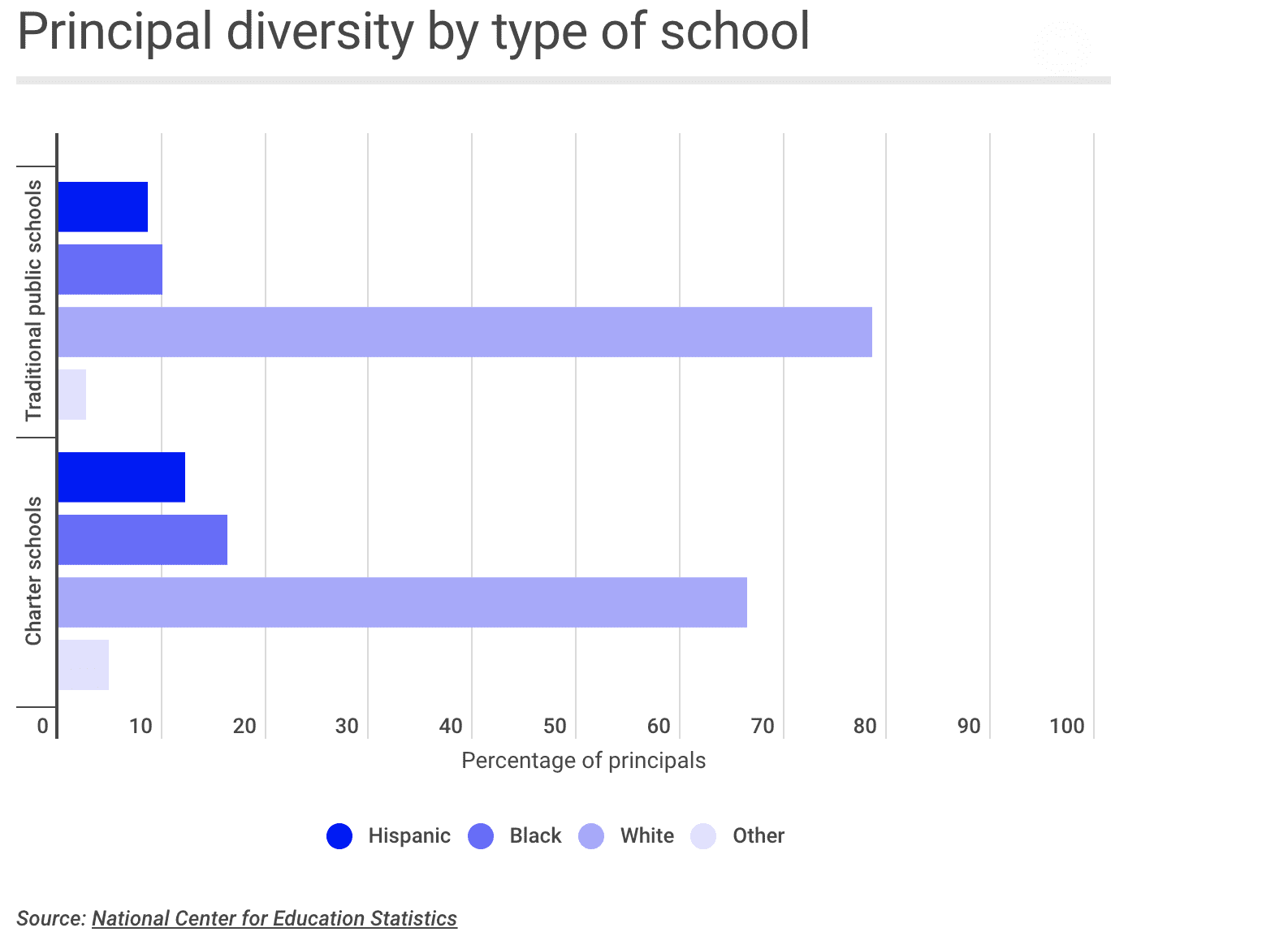
Source: National Center for Education Statistics

This is the latest article in The 74’s ongoing ‘Big Picture’ series, bringing American education into sharper focus through new research and data. Go Deeper: See our full series.

Reports released this summer offer new insight into America’s school principals, from their racial diversity to how turnover affects student achievement.

The new papers add to a growing body of research about principals but also raise new questions, said Brendan Bartanen, an assistant professor at Texas A&M University and co-author of recent reports on principal diversity and principal turnover.

“We know that principals matter,” Bartanen told The 74. “We still don’t have a great understanding of the specifics of that — how do they matter, what are the specific things that they do, what are the ways that we could train them better and provide them better development?”

Amid growing concern about teacher diversity — America’s teachers are about 80 percent white — Bartanen’s research shows that black principals are more likely to hire black teachers to work in their schools. Having just one black teacher in elementary school can improve a number of outcomes for black students. But federal data show that principals are overwhelmingly white.

Here are six things we learned about America’s principals this summer.

1. Principals are overwhelmingly white, despite increasingly diverse students.

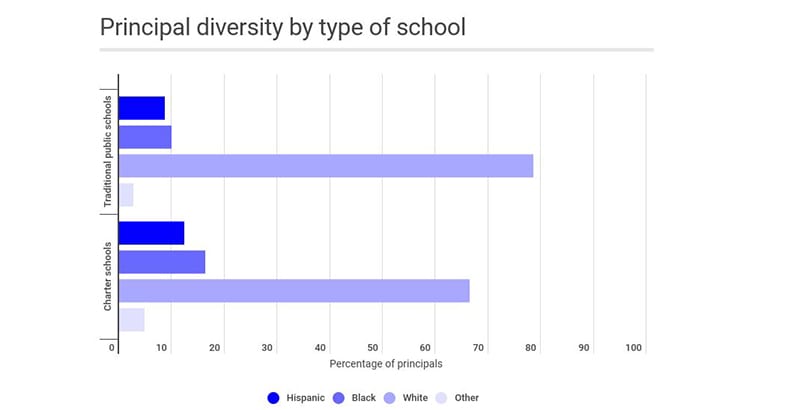
Although more than half of U.S. students are racial minorities, about 78 percent of public school principals are white, according to 2017-18 survey data collected by the National Center for Education Statistics and released in August. That mirrors the makeup of the American teaching corps, which is about 80 percent white.

The remaining principals were about 8.9 percent Hispanic, 10.5 percent black and 2.9 percent other races. Urban districts were more likely to have principals of color than their rural, town and suburban counterparts.

Most nonwhite principals were in high-poverty schools. At schools where 75 percent or more of students are eligible for free or reduced-price lunches, almost 60 percent of teachers were white while 16.5 percent were Hispanic and 21 percent were black, the NCES data show. (NCES did not break down responses in the “other” category, which includes American Indian/Alaska Native, Asian, Native Hawaiian or Other Pacific Islander, and two or more races.)

2. Charter school leadership was slightly more diverse than principals in traditional public schools.

In charter schools, 66.5 percent of principals were white, while 12.3 percent were Hispanic and 16.3 percent were black, according to the NCES numbers.

A recent study by the Fordham Institute found that charters also tend to employ more black teachers than district schools do.

3. Black principals are more likely to hire and retain black teachers.

When a school gains a black principal, black teachers are more likely to be hired and retained, according to a working paper written by Bartanen and Jason A. Grissom of Vanderbilt University and released in May by the Annenberg Institute at Brown University.

Schools that changed from a white to a black principal saw an average increase in black teachers of about 3 percentage points because black teachers were more likely to be hired and to stay in their positions.

Bartanen and Grissom used teacher data from Missouri and Tennessee, where there was not enough information to gauge the effects of switching from white to Latino principals. The working paper has not been peer-reviewed and is subject to change.

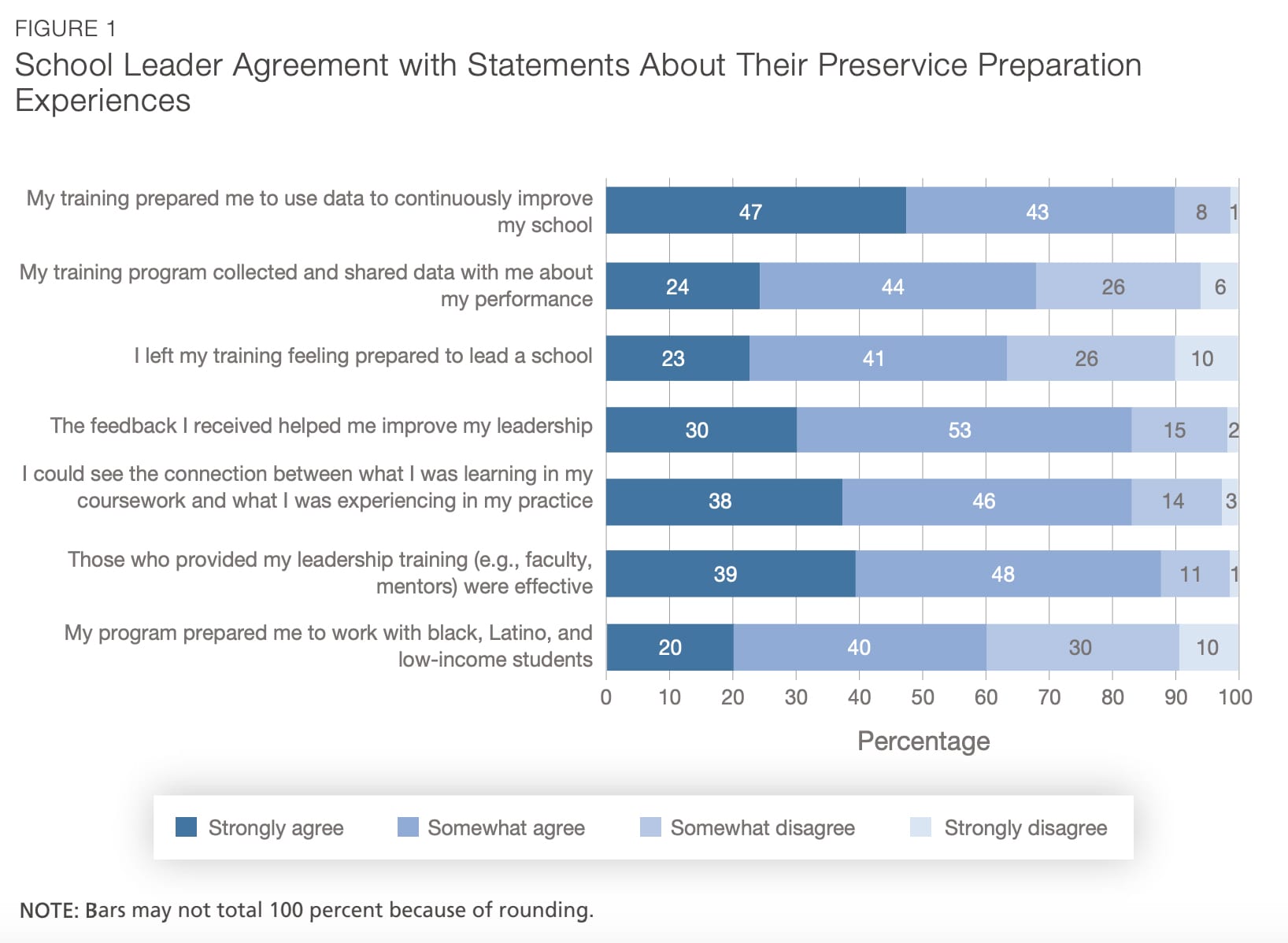
4. Most principals say their training left them well prepared.

A report released by RAND used survey data to look at teachers’ attitudes about their preparation programs.

Overall, principals reported that their training prepared them well to lead a school, with more than 80 percent responding that they could see a connection between their coursework and practice as school leaders.

Additionally, the RAND researchers found a positive relationship between the amount of field experience educators had and how they rated their training programs. Both teachers and principals who had more field experience reported feeling more prepared for their work in schools.

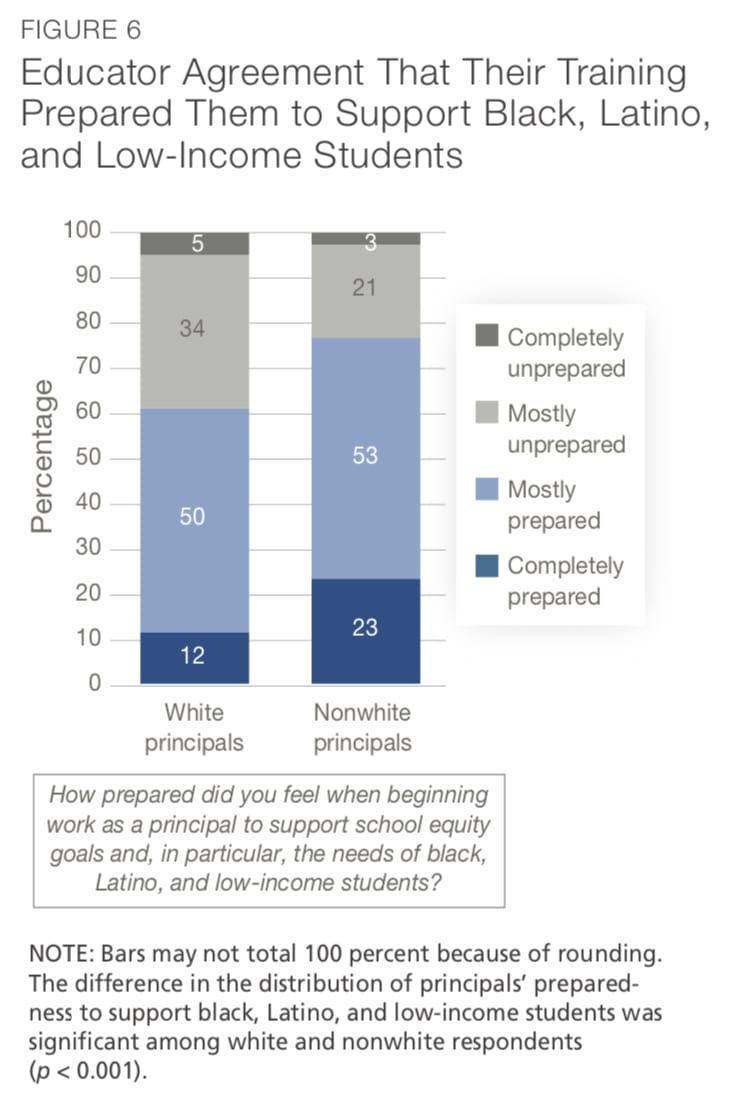
5. But 39 percent of white principals say they were not well prepared to support black, Latino and low-income students.

When asked whether their preservice training prepared them to support black, Latino and low-income students, 62 percent of white principals agreed, compared with 76 percent of nonwhite principals, according to the RAND report. The leaves about 2 in 5 white principals who said they were “mostly” or “completely” unprepared to work with poor and minority students.

There was a similar gap among teachers.

6. Principal turnover tends to hurt student achievement — but not always.

The average rate of principal turnover is around 18 percent, according to NCES data. The schools principals left typically saw declines in math and reading scores, but the reason for the leadership change affected the outcomes, according to a new report published in June in Education Evaluation and Policy Analysis. For example, in cases in which the principal was demoted, student achievement stayed the same or improved. Meanwhile, students whose principals moved to other schools or to district-level positions saw a decrease in their math and reading scores.

The takeaway is that districts should be strategic about retaining strong principals but not afraid to remove low-performing ones, said Bartanen, who wrote the paper with Grissom and Laura K. Rogers.

Disclosure: The Carnegie Corporation of New York, Bill & Melinda Gates Foundation, Walton Family Foundation and Charles and Lynn Schusterman Family Foundation support both RAND and The 74.


Charter School Capital logoSince the company’s inception in 2007, Charter School Capital has been committed to the success of charter schools. We help schools access, leverage, and sustain the resources charter schools need to thrive, allowing them to focus on what matters most – educating students. Our depth of experience working with charter school leaders and our knowledge of how to address charter school financial and operational needs have allowed us to provide over $2 billion in support of 600 charter schools that have educated over 1,027,000 students across the country. For more information on how we can support your charter school, contact us. We’d love to work with you!


LEARN MORE


Charter School Fundraising

Charter School Fundraising: Boost End-of-Year Giving

Charter school fundraising is a necessary part of being able to provide the programs and services your students deserve. We know that it’s no easy task, asking for money. But this is the season to do so, if you haven’t already set up an annual giving program. And, no, it’s not too late to get the ball rolling! If you do already have a program in place, this post may give you a few new ideas to help push your school’s giving program to the next level.

Giving Tuesday is right around the corner (December 3rd) so now’s the perfect time to maximize your opportunities for charitable donations to your charter school. Giving Tuesday truly kicks off the “Season of Giving” when folks are trying to make those last-minute decisions about which deserving non-profits they should receive their hard-earned dollars. We wanted to put this blog post together to help you optimize your fundraising opportunities before the year’s end.

Remember, in your communications and outreach, make sure to let your community know that your charter school is a 501(c)3 organization and that all donations are tax-deductible. Also, don’t forget to include your Tax ID number. And, at the end of this post, we’ve included some tips on setting up your organization on Amazon Smile, how to then select your organization to receive your Amazon Smile dollars, as well as some additional resources to get your giving programs either set up or just tuned up!


We found this fantastic post with several great fundraising tips from EdTec originally published here on October 24, 2017 and written by Melanie Horton. It may be a few years old, but still has some great tips!

Five Minutes of Practical Fundraising Advice for Charter Schools

All charter schools can use a few extra dollars to fund projects and programs that support the success of their students. Wherever your school is with its fundraising strategy, there’s always room for evaluation and improvement. We’ve put together a list of five simple actions schools can take to increase donations, as well as a few quick tips to help strengthen the connection to potential and existing donors.

Five Fundraising Actions Your School Can Take Today

1. Participate in #GivingTuesday: Celebrated the Tuesday following Thanksgiving, #GivingTuesday was started in 2012 as a way to harness “the potential of social media and the generosity of people around the world to bring about real change in their communities” (www.givingtuesday.org). The movement provides an opportunity for charitable organizations to rally their communities and encourage donations to their causes, and has grown rapidly over the last few years. For #GivingTuesday 2015, 700,000 donors contributed nearly $117 million, and the hashtag earned 1.3 million mentions on social media and 114 billion Twitter impressions! You can find several resources to help plan for #GivingTuesday 2017 at givingtuesday.org, including a social media toolkit and ideas and case studies specific to schools. Don’t worry about implementing all the recommendations the first time you participate; you can start by incorporating #GivingTuesday into your existing social media plan, and set aside time well in advance next year to develop a more comprehensive strategy.

2. Register on Amazon Smile. Amazon Smile donates 0.5% of the price of eligible purchases to the charitable organization of your choice. There is a simple registration process, so you will need access to the school’s EIN and bank account information. Once you are registered, remind parents, teachers, staff, and other stakeholders to bookmark amazon.com, where they can select your school as their charitable organization of choice; they only need to do this once, and all future eligible purchases made at smile.amazon.com will result in a 0.5% donation to your school. Once an individual makes a purchase that results in a donation, they’ll be able to view and keep track of the total amount donated to the school across time; this is a fun, useful feature that allows donors to see the collective impact of several small donations made by members of the school community across time.

3. Remember to ask donors if their employer participates in a matching gift program. Most people are not aware their employer offers a matching gift program, leaving potential fundraising dollars on the table! Make sure to include this reminder on your website’s donation page, as well as in any direct mail fundraising campaigns. While there is technology available for purchase that can be linked to your school’s website, which allows donors to check their employer’s matching gift policy and guidelines on the spot, this is easy to do without the help of extra tools. Just include a simple, noticeable message that prompts donors to ask if their employer, or their spouse’s employer, participates in a matching gift program. You can also prompt donors to check a box if they already know they have access to a matching gift program, and remind them to proceed with the necessary paperwork. Asking donors to check a box makes it easy for you to follow-up about matching gifts.
What happens next? The donor will then need to request the proper paperwork from their employer (as well as verify that the school is eligible for a matching donation) and submit a matching gift form to your school. Upon receipt of the form, a school employee will need to confirm donation from the individual, and submit the form to the employer.

4. Register with local supermarkets and other retail stores. Several retailers offer programs that allow customers to donate a percentage of their purchase to the charitable organization of their choice. For example, Ralphs’ has a Community Contribution Program that allows rewards card users to select a community organization to donate to. The process varies with each retailer, so it’s best to pay a visit to your local retailers and ask if they have similar programs.

5. Don’t leave grant money on the table! There are hundreds of grant opportunities available to charter schools, some of which require no more than a simple application form.  It can be difficult to make time to focus on grant writing when there are so many other things to get done, which is why EdTec offers flexible grant research and writing services for busy school leaders.  Set up a call with us for more information and sign up to receive our monthly grants email.

Two Ways to Strengthen Your School’s Fundraising Program

1. Make your case. The stronger your story, the more compelled your stakeholders will feel to give. Is your per-student funding rate less than the state average? Less than the neighborhood school district? Share these facts with your audience, and include numbers when you have them. You’ll also want to include a list of things you aim to accomplish through fundraising, be it reducing class size, purchasing new musical instruments, enhancing facilities, or starting an after-school STEM program, as well as a tally of funds raised to date (if any) and what you’ve been able to accomplish as a result. Give your potential donors proof that their money will be put to good use!

2. Be thankful! Always send timely thank you notes, preferably within two weeks of receiving a donation (and sooner if you can). While it is a nice gesture to send hand-written notes, this is not always feasible, especially for larger schools. Have a template thank you note ready to go, personalize the letter with the donor’s name and donation details, and ask the school’s principal or executive director to sign it. You might also consider putting together an annual publication that recognizes donors for their contributions, and includes information about the projects and improvements that were made possible by their generosity. Donors will enjoy being recognized, and be more compelled to give in the future.


Here are some additional resources we thought might be helpful to boost your end-of-year giving programs:

AMAZON SMILE INFORMATION

To register your organization with Amazon Smile: https://org.amazon.com/ref=smi_se_saas_org_org

To change your charitable organization:

  1. Sign in to smile.amazon.com on your desktop or mobile phone browser.
  2. From your desktop, go to Your Account from the navigation at the top of any page, and then select the option to Change your Charity. Or, from your mobile browser, select Change your Charity from the options at the bottom of the page.
  3. Select a new charitable organization to support.

For more information about Amazon Smile: http://smile.amazon.com/about

ADDITIONAL ARTICLES TO READ

Getting started with planned giving:
https://www.thebalancesmb.com/how-your-nonprofit-can-get-started-with-planned-giving-2502443

Tips for year-end fundraising success:
https://k12hub.blackbaud.com/fundraising-and-alumni-management/year-end-fundraising-success-at-your-school

Fun fundraising ideas for year-end giving:
https://k12hub.blackbaud.com/fundraising-and-alumni-management/3-fun-fundraising-ideas-to-energize-year-end-giving

Easy fundraising tips for end-of-year giving:
https://brightmindsmarketing.com/marketing-operations/6-low-effort-school-fundraising-ideas/


Charter School Capital logoSince the company’s inception in 2007, Charter School Capital has been committed to the success of charter schools. We help schools access, leverage, and sustain the resources charter schools need to thrive, allowing them to focus on what matters most – educating students. Our depth of experience working with charter school leaders and our knowledge of how to address charter school financial and operational needs have allowed us to provide over $2 billion in support of 600 charter schools that have educated over 1,027,000 students across the country. For more information on how we can support your charter school, contact us. We’d love to work with you!

LEARN MORE


Charter School Parents

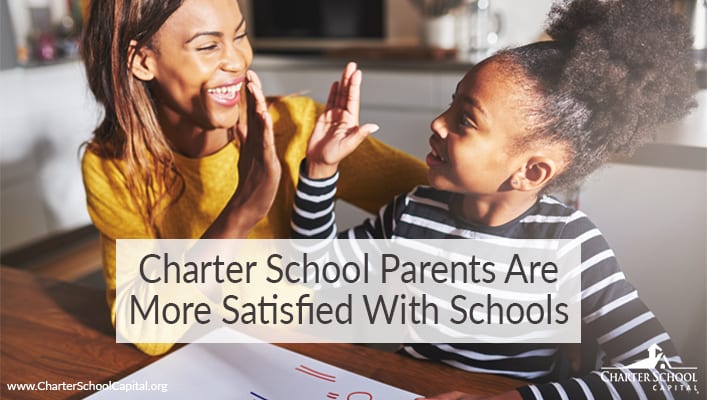
Charter School Parents Are More Satisfied With Schools

Editor’s Note: This date for this article on charter school parent satisfaction was taken from the National Center for Education Statistics’ Parent and Family Involvement surveys. It was originally published here on August 20, 2019 by Education Dive and was written by Linda Jacobson.

We think it’s vital to keep tabs on the pulse of all things related to charter schools, including informational resources, and how to support school choice, charter school growth, and the advancement of the charter school movement as a whole. We hope you find this—and any other article we curate—both interesting and valuable.


Charter parents express greater satisfaction with schools

Dive Brief:

  • Charter school parents are more likely than parents in traditional district schools to report volunteering and attending parent-teacher conferences or parent group meetings. But overall, there are no significant differences between charter and district parents in participating in general meetings, committees, fundraising and guidance counselor activities, according to an article in the American Educational Research Journal.
  • The study, which uses data from the National Center for Education Statistics’ Parent and Family Involvement surveys, also shows charter parents report significantly higher levels of satisfaction. But as the charter sector grew between 2007 and 2016, there was also an “uptick” in satisfaction among district parents and a downward trend among charter parents.
  • The study’s author, Zachary Oberfield of Haverford College in Pennsylvania, suggests parent volunteering contracts, sometimes in place at charter schools, could be one reason these parents report more volunteering. In addition, the differences in satisfaction levels, he said, could “result from steps that charter schools are taking to ensure that parents and children are having positive schooling experiences.”

Dive Insight:

While the study adds another layer to the many ways researchers are comparing traditional and charter schools, Oberfield also addresses what he calls a charter school debate that “often devolves into caricature and hardline position taking,” noting the research overall on whether charter schools are different or better than traditional schools is mixed.

“As these results accumulate, perhaps they can encourage policymakers and stakeholders to ratchet down the rhetoric and engage in more generative conversations,” he wrote. “In doing so, we can deepen our understanding of how charter and district schools compare and what they can learn from one another.”

Digging into the satisfaction data, for example, he found parents whose children attended district schools outside of their geographically assigned school had higher levels of satisfaction than those who attended assigned schools. Perhaps, he wrote, exercising some choice — whether it’s a charter or district school — “conditions a positive feeling.”

In a Q&A about a book on charters he published last year, he also noted “a fire has been lit under public school administrators” in traditional schools, and many are working harder to attract families and provide unique opportunities for students.

Oberfield adds that a future area of research — and comparison — should explore parents’ experiences with school leaders and teachers. “Future work could contribute by comparing how district and charter parents experience the teachers and leaders who run their child’s school and how this is connected to their engagement and satisfaction,” he wrote.


Charter School Capital logoSince the company’s inception in 2007, Charter School Capital has been committed to the success of charter schools. We help schools access, leverage, and sustain the resources charter schools need to thrive, allowing them to focus on what matters most – educating students. Our depth of experience working with charter school leaders and our knowledge of how to address charter school financial and operational needs have allowed us to provide over $2 billion in support of 600 charter schools that have educated over 1,027,000 students across the country. For more information on how we can support your charter school, contact us. We’d love to work with you!
LEARN MORE