charter school fundingLearn4Life Served 2,000 More Students by Partnering with Charter School Capital

With so many choices for where go to access financial resources for your school, it’s important to select the right one for you. At Charter School Capital, we believe in the power of charter schools and their leaders to deliver quality education to families across the country. And we’re proud to provide the reliability and stability charter leaders require as they walk their journey to better educate more students today—and in the future.
Please watch and listen as Skip Hansen, Chief Executive Officer, Learn4Life  shares his experience working with Charter School Capital during some very difficult financial times for charter schools in California.

This video was originally published Jul 17, 2014. We are honored to continue to partner with Learn4Life and are very proud of the way our support has helped them continue to serve their students and grow their enrollment. To learn how other school’s have achieved success by partnering with us, check out our other success stories here and filter by the content type, “School Spotlights”.

Watch the short video to hear Skip’s story and find the transcript below. You can learn more about Charter School Capital here.


At Learn4Life, we work with at-risk youth. Our schools typically go after students who are sitting at home on the couch, have no direction, looking for a job, but can’t get one because they don’t have a high school diploma.

Our charter schools in the state of California have been faced with a number of problems. The first and foremost is a reduction in ADA (average daily attendance) funding. And then, problem number two, to balance the budget, the state of California was basically delaying the payments to charter schools and not allowing us to cash flow our business properly.

Charter School Capital came to us as a gift, for the most part, in a time when it looked like there was not a lot of hope for charter schools (in terms of cash flow financing) with the delays in payments that the government had placed on us. If we had not had the type of resources that Charter School Capital has, it certainly would’ve hampered our growth over the last three years.

Without that kind of opportunity, we would’ve really been limited to our cash on hand. And it would’ve really put a stunt on our growth. It would have affected a lot of kids. I think we’ve served another 2000 students, in the last two years because of the availability of cash flow financing. Those are 2000 kids that could go on to cure cancer or do something really great in our society.

For the first time in a long time, cash is really not our biggest issue, thanks to Charter School Capital.

Our relationship with charter school capital is a very positive one. They really helped us in terms of helping better understand how the state makes its payments to our school. If I had to use one word to describe our relationship with charter school capital, it’s been “partnership”. For the first time in a long time, cash is really not our biggest issue, thanks to Charter School Capital.


Charter School Capital logoOur team works with you to determine funding and facilities options based on your school’s needs. If you are trying to meet operational expenses, expand, acquire or renovate your school building, add an athletic department, enhance school safety/security, or buy new technology, complete the online application below and we’ll contact you to set up a meeting.


GET STARTED

charter school facilities fundingCharter School Facilities Funding: It’s Time to Fill the Gap

Editor’s Note: This content originated here and was posted by the National Alliance for Public Charter Schools. Across the U.S., facilities are, by far, the greatest challenge faced by charter schools and accessing a school building is often the biggest obstacle in expanding charter school options. And, it’s one of the main reasons we have over one million students sitting on charter school waiting lists. Most charter school leaders have to jump over serious hurdles to cobble together the charter school facilities funding to provide their students with an adequate school building. It’s time to fill the gap in public school funding.


charter school facilities funding


Note: The following content is also from The National Alliance for Public Charter Schools on September 18, 2018, and was originally published here.

Here are the five things we think you need to know about charter school facilities:

Charter schools rarely have access to taxpayer-funded facilities, even when they’re vacant.
Taxpayers own public school buildings and they should be available to all public school students, but that’s not the reality. Unlike district schools, charter schools don’t have an inventory of buildings to choose from. And in many places – like Detroit, Indianapolis, and Minneapolis – districts refuse to allow charter schools to lease or purchase buildings even when they’re vacant. As a result, you can find charter schools operating in shopping malls, office buildings, repurposed factories, or co-located with other schools.
Charter schools on average spend about 10% of per-pupil funding on facility space.
While some charter schools access federal or state programs these initiatives have limited funding and reach. They don’t work for all charter schools. Moreover, many of these programs simply reduce the cost of borrowing money – schools still need to cover the debt which shifts much needed funds from the classroom and to the building.
Charter school facilities often lack amenities like gymnasiums, libraries, or science labs.
Specialized instructional spaces, such as science labs, libraries, and computer labs, are an important part of a comprehensive educational program, but about 40 percent of charter schools do not have the right amenities or specialized classrooms to best implement their educational model.
Access to school buildings is one of the biggest obstacles to expanding charter school options.
Charter school leaders report that lack of access to adequate facilities is one of their primary concerns and one of the biggest barriers to growth. In fact, nearly one in five charter schools had to delay their opening date by a year or more due to facilities related issues. Even celebrities can’t avoid the facilities challenge.
5 million parents want to send their child to a charter school, but don’t have the option.
Based on parent demand, estimates suggest that the potential number of charter school students is 8.5 million – almost three times larger than today’s actual enrollment. Thirty percent of parents surveyed would be interested in sending their child to a charter school, with 10 percent saying that a charter school would be their top choice. Of interested parents with charter schools in their community, over half cited access problems – such as the school is too far away or has a wait list – as the reason their children do not attend a charter school.
Learn more about the facilities challenge many charter schools face and help ensure charter schools can open their doors to students!


The Ultimate Guide to Charter School Facility Financing:
Thinking about a new facility for your charter school or enhancing your current one? This guide shares straightforward and actionable advice on facilities planning, financing options, getting approved, choosing a partner, and much more! Download it here.

GET THE RESOURCE


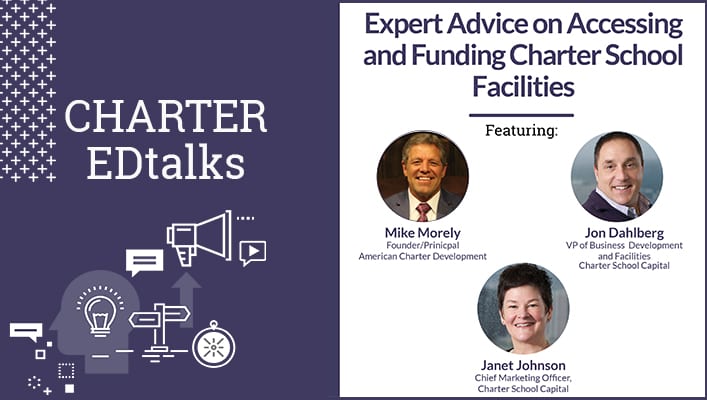
Charter School FacilitiesExpert Advice on Accessing and Funding Charter School Facilities

In this CHARTER EDtalk, we sat down with Mike Morely, Founder and Principal at American Charter Development to talk about charter school facilities. Mike shares his years of experience in working with charter schools and supporting charter school success. Learn some insights on how to know when you’re ready for a new facility, what your funding options are, some pitfalls to avoid, and how to set yourself up for success whether building from the ground up or renovating your charter school facility.


Janet Johnson (JJ): Good day. This is Janet Johnson with Charter School Capital at the National Charter School Convention in Austin, Texas, and we’re honored today to be talking with Mike Morely with is ACD, who is a developer of charter schools.
Mike Morely (MM): That’s correct, yes.
JJ: John Dahlberg from Charter School Capital, and we’re going to have a conversation about charter school facilities. Take it away gents.
Jon Dahlberg (JD): Thank you. Hey Mike, thanks for making the time.
MM: My pleasure.

Why Charter Schools?

JD: We’re doing a campaign, We Love Charter Schools, can you share what you love about charter schools in less than 20 minutes.
MM: That may be hard, but I can sure try. You may know, in fact I know you know that we’ve got a large family. I come from 13 kids and have nine children of my own and so we’re into kids, and so we’re into whatever is good for kids. Several years ago I was in the legislature in Utah and was introduced to charter schools, didn’t really know much about them. A wise senator told me, as I was looking at that in terms of policy decision, that if parents can vote with their feet we’re going have a lot less administrative and regulatory needs for schools.
I got into charter schools, started looking at them, seeing that they were doing more with less, and in many cases outperforming schools that were run by districts with seemingly unlimited funds. Not obviously that, it is something that is debatable, but certainly on less funds that are being provided for district schools and being successful. We fell in love with the choice in education. We started a couple charter schools, started doing facilities for charter schools, and they were accepted well and been successful. My children, at least those that were growing up during the years that we were in charters schools and been in them, and we’ve been really pleased with the outcome. We love philosophically the choice option and we also are committed to providing that opportunity for others.

How to Know When You’re Ready for a New Facility

JD: That’s great. Well, so let’s take that to our listeners here. How do you know when a school is ready for a new facility?
MM: Well, we have been in the business of trying to help schools get facilities from the beginning, and we initially started back in the early 2000s trying to figure out how to bring construction and development funds into the charter school. Because obviously, it’s not available through state funding, they get funded based on the kids that they have in the seats. It’s kind of cart before the horse because they don’t have any kids in the seats when they’re starting out. We have funded schools from inception or even before inception and help them get their charters, help them establish a board, help them move through the process and having a school, a brand new school, ready for them to start in the first year.
Not all schools are able to do that, and it may not even be wise for all schools to do that. It really has a lot to do with the demand in the area, what the curriculum is going to be. I mean we’ve helped schools from project-based, sports, STEM and STEAM. We’ve helped classical education schools, and there are schools that are focused on a particular niche that may not be as widely accepted as maybe some other schools.
We look at the experience of a board. We like to see a wide diversity of experience on a board. We like to see the somebody that has accounting experience, marketing experience, legal experience business experience, school experience, but usually, that’s not the problem. Usually, most of them have good education experience, but we like to see a really diversified board with experts in many areas so that they can pull from that. We like to see some experience in the charter school world now. In the beginning not many had it, but now there’s usually good experience to be had on a board from the charter world. If we’ve got that, and we are comfortable with their curriculum, and their focus, and their direction, we may take them on right out of the chute.
If not, we like to see them have a year or two in maybe a rental facility, and it’s hard sometimes to find. But they may have to start out a little small and rent some space from a church, or some other local facility that’s not going to be maybe the best situation for the first year or two, but to build a little bit of a track record to see if they’re going to be successful. It really is ultimately a business and ultimately it’s pretty risky. We’ve had a few of those, as you know, that hasn’t been quite as stellar and so we’re trying to make sure that we don’t repeat those that are not quite as well prepared as others.
JD: Well, I think to the point about the risk, I think that proof of concept starting in any space where you can get your school open and get the kids coming and prove your operation of success and your academic success, that momentum builds and builds and creates opportunity in the future.
MM: It does.

Avoiding Mistakes

JD: When you talk about the business aspect of it, right? The education is not hard. What are some of the avoidable mistakes that a school should be mindful of as they’re building and growing in to their next facility project?
MM: You know, to be honest, most of the mistakes that we have seen have been very preventable and most of them have been friction within the board, within the founding boards. When the schools have the most trouble it’s typically when the board itself gets heavily in two separate directions and end up in a collision course with each other, and end up destroying what they created or trying to change direction from what was originally envisioned. Because of that they lose half the parents, they pick sides, and it becomes a disaster. Cohesiveness on board is really key and to avoid that they need good board training, they need to recognize what a board does, how a board operates and the way that a board should function with regard to the administration, and the product that they’re proving. They’re really providing an education product, and they need to be on board with that and need to understand how a board effectively is to run, so that’s been our biggest problem.
There are mistakes. They get into a building that doesn’t meet their needs, they get into a building that they didn’t really clearly think out what their program was or growth options. They could then be unable to grow in that position in that particular building and then be tied into either a long-term lease, or they purchased the building, and it isn’t suitable for their current needs or expanding needs. It’s really important that you really sit down with somebody that understands and lay out a long-term vision of the school.
Have the board be on board with that decision as well. Make sure that everybody is kind of firing with the same cylinders and moving in the right direction. Recognizing that, “Hey, we want to be a 400-student school forever. We want to grow to a K-12, or we’re going to stay at K-6, or we want to grow to 600.” Come up with what your ultimate vision is because if you’re in a place that can’t be expanded and you’re tapped out at 200 kids and you got a long-term commitment and you want to grow, you’ve contract yourself. Those are some concerns that need some-
JD: I think the advice that you gave to our audience about making sure that your building and your charter are in sync is really, really sound advice here. The building is going to create the culture of your school. We do speak with leaders who are very intentional, and we also speak with leaders who have that aha moment that goes, “Oh, a stem school but I don’t have a science lab.” That’s a good …
MM: A sports school and don’t have a gym or a …
JD: Right.
MM: … or a performing arts school and no place to perform. Yeah, those are a lot of the issues.
JD: If you’ve got a board that’s cast division and everybody’s on board, what are some of the guidelines and guiding principles that schools should pay attention to when they’re thinking about that next facility?
MM: Well, if everybody’s locked stamp, then I think it’s important to maybe look at what’s the most economical and formal way to provide those facilities. It always seems to be the vision of every school to bond. That’s the goal. We just come out of a situation not too long ago where the school was ready to bond, they were so excited about it. They were saying, “Hey the cost of this building is too high, we can’t really bond because we’re going to be paying $106,000 a month for our facility.” I said, “Whoa, what are you paying for it now?” In a lease scenario, they were paying $65,000 and they were expanding with the bond. They were going to add on a gymnasium and some other classroom, but we’d already priced that out, and under the lease scenario they were going to be at $85,000 a month with total expansion taken into account. I said, “Why are you so anxious to bond and pay $20,000 more a month for a facility that you can control and have long-term security for $85,000.” That was the A-ha moment.
“But their interest rate is lower than your PACT rate.” Okay, let’s look at that, what that means. Interest rates are easy to talk, but they were adding on several million dollars in reserves, they had the cost of issuance, they had attorneys fees that were building up this huge amount that they would have to bond and pay interest on. Then it was advertised rather than just an interest only, so by the time you take all that into account the interest rate of the bond had very little to do with the cost of the facility on a monthly basis. Be careful that you’re not misled by some arbitrary interest rate or some lost leader kind of thing, and becoming so consumed with owning the facility.
Ownership is great and there are some times when it is a good decision, but ultimately if you own it you really own it. You’re responsible for all of the future expansions, you’re responsible for whatever taxes or insurance or other things, and you may have those kinds of things in the lease agreement as well, but you’re amortizing the facility and the ultimate goal is to own it, and if it’s a 30-year bond you own it just in time to completely refurbish it and start over. I’m not saying ownership is not a good thing, but it’s not the only way to do it.
JD: What’s in the middle? There’s the bond, which historically meets the need of about 12% of the charter schools since the exception. Then we talk about the lease. You’re in the market, are there other options besides the lease or beside a bond that you’re seeing schools take advantage of right now?
MM: Well, you know, there are organizations like the CSC that have purchased facilities and leveled the lease market and created an option for schools. That we have worked together on a couple of schools where you would’ve been able to purchase the school and put them in a better position than they would’ve been in a bond situation. It’s an interesting dynamic because right now the cost of constructions is going up.
JD: And so is the cost of money.
MM: And so is the cost of money, which is hard. You got the cost of construction, cost of land skyrocketing in this market which is … The fed just raised the rates again last week, and so we’ve got interest rates going up. And they’re indicating that there will probably a couple more bumps, in trying to cool inflation. In a market where cost and money are going up even though we are seeing increases in education funding that are a much lower rate, you may get a two or three percent bump each year, while we’re seeing double digit increases in funding cost and in construction cost. We are in a kind of a paralysis market right now, and it is hard. We’re struggling to try and balance those things and make sure that schools are getting affordable facilities for themselves. It’s a bit of a challenge.
JJ: It’s a dance.
MM: It is.
JD: It’s a dance.
MM: We’re in that dance, and you’re in that dance, and we’re all trying to …
JD: It’s a fun place to be.
MM: It is.
JD: It’s work, because if it was easy they would call it a PTO.
MM: A while back it was kind of easy you know because the cost were fair. Right now, we’ve talked about this multiple times, there is a point where the school can’t pay any more than maybe 20% max of their gross revenue. If the cost of facilities goes beyond that then it really does make it difficult, if not impossible, for them to go for owning. There are places in the country like that.
JJ: But you’re here to help.
MM: We’re here to do what we can.
JJ: Right, yeah. That’s right. That’s great. Well, we’re very grateful for your time today Mike, and John thank you for facilitating this discussion and I know you guys speak a lot on the road so I’m sure that our viewers will see you again soon. Thanks for your time.
MM: You’re welcome. My pleasure, thank you for inviting me.

public charter schoolsUnderstanding The Value And Importance Of Public Charter Schools
Todd Feinburg with Amy Wilkins

In this informative podcast, Todd Feinburg from Radio.com interviews Amy Wilkins, Sr. Vice President Advocacy National Alliance for Public Charter Schools.
They answer the question if charter schools are the only alternative for poor, minority and urban students to find alternatives to public schools, why aren’t there more of them, and why don’t Democrats fight for them? They go on to discuss the need for more charter schools as well as the benefits of charter schools in a failing public school system. Finally, they’ll dispel some common myths around charter schools and the charter school movement.
Please listen to the podcast or read the transcript below to learn more.
We think it’s vital to keep tabs on the pulse of all things related to charter schools, including informational resources, and how to support charter school growth and the advancement of the charter school movement as a whole. We hope you find this—and any other article we curate—both interesting and valuable.


TRANSCRIPT
Todd Feinburg:  WTIC. You know I love Charter Schools. I want everybody to get a great educate in America and we are far from that point. Joining us now to talk about it is Amy Wilkins, Senior Vice President at the National Alliance for Public Charter Schools. How about that? Amy, welcome to WTIC. Thanks for talking to us.
Amy Wilkins: Hi, Todd, how are you this afternoon?
Feinburg: I’m psyched to have you here, so let’s talk Charter Schools and what’s going on. What are the trends going on in the choice world in providing alternatives, particularly in poor communities where it would be nice if people had Charter School options and more choices for their kids for schools. What’s your assessment of where we’re at right now?
Wilkins: Demand far outstrips supply, especially in communities of color. There are far more families who would choose Charter Schools for their kids than currently can, just because of limited space and really, the biggest obstacle we face, to opening more high quality Charter Schools for kids, whether they’re low income, urban, rural, wherever they are, is the facilities question, the school building question. You know, if you’re a district-operated school, the district just gives you a building, right? You get a school building. Charter Schools have to finance their own buildings and finding appropriate and adequate space is really among the things that are holding back growth for these much-needed schools.
Feinburg: And what is the … well, before I ask you that, I’m surprised by what you’re saying about the facility. I understand. I’ve seen Charter Schools that are in church basements and in what were industrial buildings, where they throw up some dividers and make classrooms and those aren’t ideal, but what you find out when you see those schools in action is that the facilities maybe are over-emphasized in our public schools. And what’s really important is having a great education in whatever kind of walls you can find.
RELATED ARTICLE: BEST PRACTICES FOR CHARTER SCHOOL FACILITIES FINANCING 
Wilkins: Oh, absolutely. You know, what matters most, what is the heart of any school are the teachers and the curriculum, I would agree with you 100% on that, Todd. But, I also think the kids whose families choose Charter Schools deserve libraries, labs, playing fields, all of those facilities as well. So, yes, better to go to a strip mall and get a really strong educate, than to go to a palace where you get a not so strong educate. In the best of all worlds, you go to a high-quality Charter School that has a lab, a library, a playing field, all of those facilities.
Feinburg: So, how do Charter Schools get the buildings?
Wilkins: Well, you know, too often they have to buy a building and then they face the same mortgage problems that all of us face when we want a mortgage and the problem, as you know, is Charter Schools, when they’re looking for a building, are often brand new and don’t have much of a track record to stand on, so it’s hard for them to get financing or they pay rent for a building. And what happens then, as you know, you have district-operated schools where their building is just free, it’s given to them by the district. Charter Schools, when they’re paying rent or financing a mortgage are having to take funds that would otherwise be directed to their instructional programs and pay building costs.
Feinburg: Have Charter Schools proven to be worth the investment? We hear all this conflicting information about whether they’re actually a successful alternative or not.
Wilkins: I think like anything, we have some really great Charter Schools and we have some Charter Schools that I think should be closed. But, in general, the general trend suggests particularly for urban kids and for kids of color, Charter Schools are their very best bet. We have solid evidence that kids, those kids in particular, gain months of learning over their peers in district-operated schools. So, the trend seems to be telling us, yes, this is really important from a data point of view, from a student achievement point of view, they are absolutely the right answer. From a parenting point of view, they are the right answer as well. I mean, parents deserve a choice. Not every school fits every child, you know? You may want a different type of curriculum for your child. Your child may have special needs that the district schools are unable to meet. So, both from an academic point of view and from the point of view of parents having some control over the kind of educate their kids get, Charter Schools are absolutely a vital part of kind of a healthy public education ecosystem.
Feinburg: We’re talking to Amy Wilkins on Charter Schools. I love talking about Charter Schools because my belief is, particularly in urban areas, that there is a crisis going on, and I don’t feel, Amy, as a country that we can afford to have millions of kids, rich, poor, minority, white, whatever … we can’t afford to have millions of kids not getting a great education.
Wilkins: Absolutely not. I mean, at bottom, it’s sort of inhumane and, you know, no adult should look at a child who’s not getting an education and feel good about it. But, I mean, there are certainly strong implications for our future economy, including who’s going to pay your Social Security and mine, Todd. There are big implications for national security. Educating our kids is the foundation of our future and Charter Schools are a proven sort of winner in that for our kids and so, to me, it’s a no-brainer, that we just have to do it. We have to do well and we have to do more of it.
Feinburg: Do you see a way to make this argument, though, for cities? So, in Connecticut, we have so many cities and they’re not particularly large, but they are part of a pattern of a city being a place where minority kids, poor kids are essentially stored and not given an opportunity to get out. It just strikes me, as you say, as some kind of human rights violation, if you want to argue from the humanity point of view, that the system is rigged to be mediocre, at best and oftentimes worse and there’s no economic opportunity. There’s really not a way out and that drives a lot of minority kids into gangs and bad behavior that puts a lot of boys into prison. And how does that pattern get broken through education, because that’s the only tool I think we have available?
Wilkins: No, you’re absolutely right. Education is the surest way out of poverty and the strongest weapon, I think, we have against racism. It really is up to … I hate to say this, it’s up to communities. You know, they have to stand up on behalf of their kids and demand something better, demand something different. Now, you could also … I don’t know, this is like being really kind of out there … you know, you saw the kids at Parkland saying, “We’re not happy with the kind of safety of our schools and we’re afraid of guns in our schools.” I think, you know, the kids know when they’re being short-changed. We really sort of have to start talking to the kids about how they feel about the schools they’re going to and, unfortunately, they’re not old enough to vote, but I think conversations … if elected officials had conversations with kids at some of these schools, some of the kids I talk to and hear what goes on in their schools, I think that would spur some action that we’ve yet to see.
Feinburg: Have you ever seen that kind of thing going on where there are public displays of rebellion or unrest over the idea that oppression, the educational oppression of minority students?
Wilkins: Well, I don’t know if I would call it unrest. I have seen groups of students in various parts of the country … I know it’s happened in Wisconsin. I know it’s happened in California, who do lobby days and go to their state legislatures to lobby and testify about the conditions in their schools. One could certainly see the same things happening at School Board meetings and City Council meetings in Connecticut, if there were folks willing to help these kids begin to organize.
Feinburg: Yeah, but there has to be a spark of something bigger because the rigged education system, the partnership between the Democratic party and the Education Unions, there is this fixed system that says this is the only way education can happen, and we live in times where we need educational agility, where policy can change quickly, where schools can adapt over the very short term to the needs of the kids. How do we get from here to there if there’s no model if there’s nothing for people to look at and say, “We want that.”
Wilkins: Well, there are models. I mean, that’s the thing. In Connecticut, for example, you have the Amistad Charter Schools which are among the best in the country and people should really go see them. They have done a wonderful job with those schools. So there are things … part of this … part of the challenge here is people don’t … and I’ve been doing education for years, and years, and years. What’s so sad is that people really don’t see schools beyond the schools that they attended and the schools their children have attended and they don’t know that something else is out there, that something else can be better and you know, part of the responsibility of groups like mine, in doing interviews like this one, is to let people know there are better alternatives and to say that it’s easy to create one, it’s easy to sustain one, I would be lying. But you know, there are better things, but like most better things, they require work and commitment.
Feinburg: Amy Wilkins is the Senior Vice President at the National Alliance for Public Charter Schools. So, what exactly do you folks do?
Wilkins: We represent in Washington, primarily. The Charter Schools out there in America, we lobby Congress to ensure that there’s funding to start more and better Charter Schools.
Feinburg: So, the Federal dollars are a critical part?
Wilkins: The Federal dollars really are start-up dollars. Once you’ve started, then you really are reliant on state and local funding, but the Federal government does supply … it’s a program called the Charter Schools Program and it supplies seed money for new Charter Schools to get started.
Feinburg: What are the … can you shoot down the basic arguments against Charter Schools, the kind of superficial ones that have appeal to people who aren’t very involved, and they hear about how, for example, that Charter Schools are taking dollars away from the public schools, it’s an attempt to destroy the public schools.
Wilkins: Well, that just doesn’t make any sense because Charter Schools are public schools. Charter Schools are part of the public school system, so I don’t understand how they could take money away from a system that they’re already a part of. It’s just a nonsensical argument that the Teacher’s Unions have sort of … it’s a catchy phrase, but it means nothing.
Feinburg: How about Charter Schools just have to … they get to pick whatever kids they want. They don’t have to worry about the special ed kids?
Wilkins: That’s not … in fact, Charter Schools currently are serving a slightly higher percentage of special needs kids than our traditional public schools, so that’s just not true. Charter Schools serve as many and, in some cases, a few more special needs kids than do traditional public schools.
Feinburg: I forget what else the arguments are. Is there one more you can give us?
Wilkins: Yeah, that they’re a plot to tear down the traditional public school system. At this point, Charter Schools make up less than 5% of all schools in the country.
Feinburg: So it’s a failing plot?
Wilkins: Yeah, we’re doing a pretty bad job. I mean, if the traditional public schools, which are educating 95% of the children are so scared of something that only represents 5%, there’s something deeper going on there, you know? And I think that that’s one of the things we really have to understand about Charter Schools. The demand for Charter Schools, to me, reads like an indictment of the traditional public school system. If everything were hunky-dory in traditional public schools, there wouldn’t be this enormous demand for Charter Schools. And so when the traditional public schools point to Charter Schools and say, “Oh, they’re a problem, they’re a problem, they’re a problem,” they really should turn and look more in the mirror to say, “Why are these schools even existing? Why do people demand them?” They demand them because public schools have fallen so far short for so many kids.
Feinburg: Amy Wilkins, National Alliance for Public Charter Schools. What’s the website?
Wilkins: It’s www … I have to get some help here, www.publiccharters.org.
Feinburg: What is it?
Wilkins: It’s publiccharters.org.
Feinburg: Publiccharters.org. Amy, thank you so much. Great to talk with you.
Wilkins: Thank you so much. It’s great to talk to you. Have a good afternoon. Bye-bye!
Feinburg: Bye-bye. I hit her with a tough surprise question at the end.


The 5 Essential Steps to Charter School Facilities Planning

Charter school facilities planning can be daunting. If you think that finding the perfect facility for your charter school seems like a huge, complicated undertaking, you’re in good company. This handy, information-packed guide, will help as you move towards realizing your facility expansion or relocation goals.
In it, we cover these five essential charter school facility planning steps—in detail:
  1. Charter School Facilities Planning Plan – Begin planning at least one year in advance
  2. Fund – Understand your options to make savvy decisions
  3. Acquire – You know what you can afford and how you’ll pay for it … now go get it
  4. Design – Partner with experts to design your new space
  5. Execute – Let the construction begin and get ready to move in

DOWNLOAD NOW


charter school fundingCharter School Capital Helps The Academy for Sciences & Agriculture High School Survive and Thrive

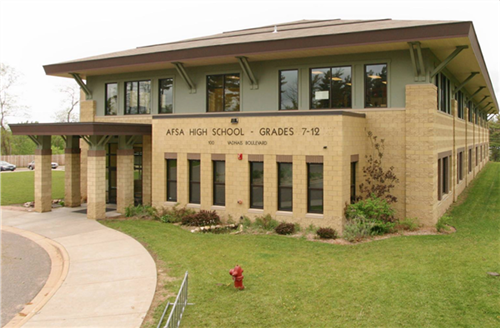
Listen as Becky Meyer, the Executive Director of the Academy for Sciences & Agriculture High School (AFSA) shares how Charter School Capital helped AFSA overcome some critical financial challenges when the state of Minnesota was holding back funding for charter schools and bank financing was hard to come by.


Video Transcript:
AFSA charter schoolAFSA is an agriculture and science-focused charter school, located in Vadnais Heights, Minnesota. In 2001, the school opened its doors as a charter school, serving the seven-county metro area to help students understand that there are good careers in agriculture and science waiting for them.
Most urban students aren’t aware of those careers. And so, part of our mission is to create a literacy around agriculture and agriculture business.
I think funding for education, in general, is difficult, but in charter schools, we have some additional problems. There are a number of charter schools who do have some good relationships with the local banks. But when the holdbacks went from 15% to 30%, to 40% a lot of local banks got out of the business of loaning money to charter schools also. My school’s budget is somewhere in the range on about three and a half million dollars per school year, and if we’re having to fund nearly a third or more of that money, we have a lot of expenses. We have a lot of time consumed doing that.
And it’s different from a regular district because we do not have access to the low-interest rate pool funding that traditional districts have. We also, technically, don’t have any collateral other than the tables and chairs, perhaps, in our schools, so banks don’t like to look at us very much.
Charter School Capital understands Minnesota charter schools and understands the funding model that we have in place and I think that they’re in the business more than just for the purpose of lending money. I think they’re interested in making sure that charter schools are successful, and that’s an important piece to me.
AFSA charter schoolIf Charter School Capital wasn’t around at the time when the holdbacks increased, I’m sure that a number of charter schools would have had to close their doors. And, in fact, a few charter schools are continuing to close their doors because they don’t have the financial resources to make it through holdbacks, not necessarily at the fault of the charter school but, probably, because that state is not funding education appropriately. And Charter School Capital stepped in and filled a need that was there in the charter school world.

I think that one word I would use for Charter School Capital would be personal.
-Becky Meyer, Executive Director, AFSA

I think that one word I would use for Charter School Capital would be personal. It feels like when they came to Minnesota and funded AFSA High School that they were funding AFSA High School, not just any charter school. They spent a lot of time at our school. They got to know the staff members. They got to know students and they worked with us, and they seem to be proud of our accomplishments as any one of the members of our community would be.

We’re open right now because Charter School Capital came in and funded AFSA High School.
-Becky Meyer, Executive Director, AFSA


Charter School Capital logoOur team of caring charter school financing professionals works with you to determine funding and facilities options based on your school’s needs. If you are trying to meet operational expenses, expand, acquire or renovate your school building, add an athletic department, enhance school safety/security, or buy new technology, complete the online application below and we’ll contact you to set up a meeting.

GET STARTED


charter school authorizingCharter School Authorizing: A Change In The Landscape

Editor’s Note: This post was originally published here, by The 74, and written by Greg Richmond, the president and CEO of the National Association of Charter School Authorizers. In it, we learn about some trends showing that fewer new charter schools are being authorized under school districts. You’ll learn more about a change in the charter school authorizer landscape, why we’re seeing a shift from district authorizers to non-district authorizers, and what impact that may have on producing better outcomes for students. Read this article in its entirety to learn why these shifts can be seen as both bad and good for the charter school movement.
We think it’s vital to keep tabs on the pulse of all things related to charter schools, including informational resources, and how to support charter school growth and the advancement of the charter school movement as a whole. We hope you find this—and any other article we curate—both interesting and valuable.


Richmond: Why School Districts Are Walking Away From Authorizing New Charter Schools — and Why That’s Both a Bad and a Good Thing

In recent years, more school districts have walked away from the opportunity to authorize new charter schools. New research from the National Association of Charter School Authorizers has found a shift in the national charter school landscape: For the first time, most new charter schools are opening under authorizers other than local school districts, with state education agencies and independent chartering boards leading the way.
In 2016, school district authorizers opened 222 fewer schools than they did in 2013. While fewer new schools opened overall during this period, the drop among school districts is striking: It’s nearly 2.5 times as large as the decrease in new charter school openings under all other types of authorizers combined.
Many districts did not slow down their authorizing activity; they simply stopped. Nearly two-thirds of districts with charter schools did not authorize a single new charter school in the past four years. Conversely, 70 percent of state education agencies and independent chartering boards authorized a school in at least three of the four years examined.
This trend is a bad thing. Yet it is also a good thing.
It is bad because millions of children in the United States lack access to a good school that will prepare them for success in life. Rigorous research has found that quality charter schools are providing better education opportunities to students, especially students from disadvantaged backgrounds. No other public education activity of the past quarter-century has been as effective for disadvantaged children as charter schools. We need to be doing more to make these schools available, not less.
So when we see local school districts — a group of authorizers that at one point was helping 350 new charter schools open every year — walk away, we know they are shunning the opportunity to provide a better education and a better future for young people who need it.
This is especially troubling because school districts make up 90 percent of the authorizers around the country. In fact, in six states — Alaska, Iowa, Kansas, Maryland, Virginia, and Wyoming — districts are the only entities that can authorize charters. Giving more students access to great schools requires districts to embrace, not flee, the opportunities and responsibilities that come with authorizing charter schools.
But the trend is also a good thing.
Earlier this year, our research found that the authorizers with the strongest school portfolios have an institutional commitment to charter school authorizing and see it as their mission to provide more quality options to kids. Authorizing is visible and championed within their institutional framework, not buried in layers of bureaucracy. Their day-to-day authorizing staff has meaningful influence over decision making.
These qualities are more likely to be found in authorizers like state education agencies and independent chartering boards than within school districts. It is not impossible for districts to be good authorizers — and they exist — it simply is not their core mission.
We know that districts, by far, use fewer nationally recognized authorizing best practices than any other type of charter school authorizer. In some places, districts are openly hostile to charter schools and look for any reason to decline applications.
When viewed through this lens, the shift from district authorizing to non-district authorizing could be a net positive, as it will likely lead to better authorizing and better charter schools. That’s why public education advocates and policymakers should work to ensure that every city and state has a non-district authorizer.
Experience shows that independent, statewide charter boards hold the most promise, as a singular focus on authorizing can build substantial expertise and strong practices that lead to better outcomes for children. In some places, a state education agency may be the better route; in other places, it may be universities.
There is much to learn about what is driving this trend within school districts, and whether it is possible to reverse it — or whether we should even try. Are districts receiving fewer applications, or are they denying them at higher rates? Is this all just a result of increased political opposition and competition for scarce resources?
But given that all types of authorizers are opening fewer schools, we need more great authorizers that are willing to step up, identify obstacles to growth, and work to solve them. In places like Colorado, New York, Washington, D.C., South Carolina, and Massachusetts, we see authorizers that are looking for areas of need in their communities, recruiting new operators, and creating transparent and accessible application processes. They’re working with education leaders in their cities and states to create an ecosystem that fosters innovation and policy conditions that support quality growth.
Too many U.S. children lack access to a good school. One powerful way to provide more children with a better future is through better authorizing and more high-quality charter schools. Let’s keep working.
Greg Richmond is president and CEO of the National Association of Charter School Authorizers.


Charter School Capital logoSince the company’s inception in 2007, Charter School Capital has been committed to the success of charter schools. We provide growth capital and facilities financing to charter schools nationwide. Our depth of experience working with charter school leaders and our knowledge of how to address charter school financial and operational needs have allowed us to provide over $1.8 billion in support of 600 charter schools that have educated over 1,027,000 students across the country. For more information on how we can support your charter school, contact us. We’d love to work with you!

LEARN MORE


Top 5 Financial Mistakes Charter Schools Make and How to Avoid ThemHow To Avoid The Top Financial Mistakes Charter Schools Make

If you missed this information-packed webinar on how to avoid the top mistakes charter schools make, don’t despair! We’ve got the recording for you to watch at your convenience. In this webinar, we were joined by some phenomenal charter school leaders from Desert Star Academy, SALTech, and Wayne Preparatory – and they generously and bravely shared the mistakes they’ve made as charter leaders, and of course, how they solved those problems for the future.
Watch the video recording to understand the five mistakes and walk away armed with the tools you’ll need to avoid them.
Our esteemed panelists:
Tricia Blum Head of Business Consulting, Charter School Capital
 
 
Margie Montgomery Founder, Desert Star Academy
 
 
Sharon Thompson, Chairman of the Board, Wayne Academy
 
 
Michael LaRoche Founder/Executive Director, SALTech


Watch the video of the live presentation, here.

And, to download a printable PDF datasheet, click here.


charter school financingThe Charter Leader’s Definitive Guide to Budgeting Best Practices
Over the past decade, we’ve reviewed thousands of charter school budgets and helped guide countless schools through their charter school financing processes. Year after year, we see many charter schools make the same mistakes when budgeting for the academic year. To help you achieve your goals, we’ve put together this informative and thorough guide to share best practices and call out common pitfalls to avoid.
It covers:
• Planning for long-term financial health
• Implementing best practices for achieving buy-in and setting internal controls
• Understanding key financial metrics to watch
• Utilizing tips on cashflow planning and more!
Download it now and get the tools to be more strategic about your budgeting practices!
GET THE RESOURCE


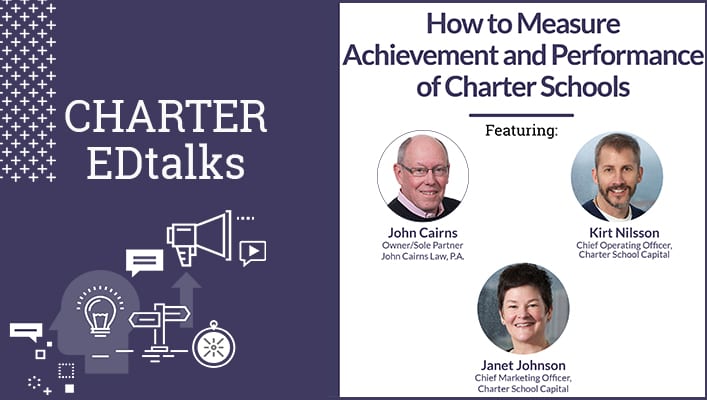
charter school performanceCHARTER EDtalk: How to Measure Charter School Performance and Achievement

In this CHARTER EDtalk, Charter School Capital’s Chief Marketing Officer, Janet Johnson, and Chief Operating Officer, Kirt Nilsson, were privileged to sit down with the “father of the charter school movement”, John Cairns.  John shares his perspective on how to best measure charter school achievement and performance. He also provides some thoughts on what steps he believes should be taken if a school is found to be underperforming. At the heart of the conversation is the vital nature of accountability and engagement between the school Board, the executive director, and the teaching staff. Watch the video or read the transcript below for the full story.


Janet Johnson (JJ): Good morning. I’m Janet Johnson with Charter School Capital and we’re here with John Cairns, who is one of the founders of the first idea of charter schools and the first law in the nation about charter schools. We’re honored to have you here, John.
John Cairns (JC): Nice to be here.
JJ: Thank you. Along with Kirt Nilsson from Charter School Capital and we’re going to be talking about charter school performance with John.
JC: Good.

On School Choice

Kirt Nilsson (KN): John, we’re doing a campaign at Charter School Capital called, surprisingly, We Love Charter Schools.
JC: Good campaign.
KN: Definitely a good campaign. I’m sure one that you can align with. So, can you tell us in a couple sentences why you love charter schools.
JC: Well, I got interested in the charter school reform movement in 1969 when I was elected into the city council in Minneapolis. And we had a school district within a school district, meaning we had no teacher’s contract.
We had self-governed Boards, we had teachers on Boards. And EDs [executive directors] we selected. We had six elementary schools and so many high schools. That’s how I found public schools,choice was in place. In our neighborhood, where I was a city councilman, parents could choose where you go to school.
I didn’t have any real responsibility. Nobody knew who their school board members were, so they called me all the time to get involved. And I got right in the middle of this. I had no choice, even though two school board members lived on my block. Nobody knew who they were.
So, that got me into the whole choice side and the idea that schools were going to be based on the kids learning. I thought that’s how a traditional system worked, you would think. So that got me started. So, that’s almost 50 years I’ve been on the education reform side of things.

On Measuring Student Achievement

KN: That’s great. And so you mentioned how students learn in their schools, within the charter school world, choice is obviously a big component. So is achievement. How do you think about achievement in charter schools and how it should be looked at, measured?
JC: I’ve been concerned about this since we opened the first school. I think the movement towards tests tells us something about the child’s performance, and it’s a measure. You can at least see the change in the test scores, that’s a measurement.
There are other measures of growth which are not specifically tests. So I start from a standpoint of wanting to see the growth curve through the kids. And because charter schools can be more focused on the kids one-on-one and they spread their money across the classroom with as little administration as possible, there’s usually two adults in every classroom, and they can do some remediation right in that room.
And the other kids are pretty much self-learners and they get started on a project. In fact, I’ve seen several schools where they actually have tables of eight and they started on a topic and the teacher leads the discussion gets them going, and then she’ll pull out one or two of the kids that she knows needs some help. And meanwhile, a senior learner at the table will run the program. So the kids are actually teaching the kids.
KN: That’s amazing.
JC: I saw that even in first grade, some of them.
KN: Leaders of the future.
JC: You bet.

Addressing Underperforming Schools

KN:  So, choice is a very powerful thing within the charter school world because parents can choose schools based on what they perceive to be the benefits in achievement. But as we know, sometimes schools aren’t performing the way that they probably should.
What are some routes that you see how that can be addressed? So, what should be done with schools that aren’t performing to the level that probably they should be?
JC: The first place I’d start is with the Board and the ED. They have to admit, and it’s a hard admission to make. So the first step I’d take is I want the Board or the ED to recognize they’ve got a problem. And sometimes the board is very weak and they rely on the ED doing everything.
The Board’s have to understand. Too often that’s not the case. So I’d do a lot board governance to try to get the boards to understand they need to know as much about the school and ask, are the kids learning? Not necessarily all they all advanced, but are they learning?
I try to get every charter school to have their own agenda, have at least a 15-minute discussion about how are the kids learning in this area or in that area. What areas are working best? And then inside the faculty, at the beginning they have to have some sort of way of understanding that they can’t let one teacher have a bad experience and a bad classroom, because it will drag people down.
It’s compounded a bit because charter schools typically get fairly young teachers. In most States, teachers would be a bit reluctant to walk away from a tenured job. Even though in Minnesota they keep their spots. So if a five-year teacher comes to a charter school and works five years, they still have five years of tenure. They don’t gain any tenure, but they still have the five.
So I’d go to the board, the ED and I’d try to get the faculty to have some leadership to say, “This isn’t working very well. What should we do?” Out of that ought to come –with the authorizer – some sort of transformation process. It should. And it could be new leadership, it could be new ED, it could be better organizing or training the faculty. But the Board’s got to be in charge of that, and if the board isn’t willing to take charge of that then it’s simply going to stay there and get worse.
KN: It starts with leadership, right?
JC: You bet.

Assessing a School’s Improvement

KN: So then with that leadership, assuming it plays the way it ought to be, how do you know when a school that was under-performing starts to perform? What are some of the things and signs that you see of, “Oh yeah. They’re heading in the right direction.”
JC: Well, you certainly will see an improvement in internal testing on subject matter, and they do some standardized tests that aren’t required. Many schools will do something every month of their own creation that they think is a measure of kids learning. And that goes down just like the standard scores go down, so they’ll first see a turn in the internal testing.
You’ll then start to see some sort of project-based learning. So the kids not only have a test, they have a product of something they’ve done and it’s going to be out of enjoyment. So the kids identify with this, in particular, when you go to say, fourth grade. It’s a little harder in K-3. But they have an outcome. It’s visible, touchable and it’s something that happens every month, not just once a year.
And the third thing I’d look to see is, the enthusiasm from the teachers because if they’re in a school that’s not doing well they’re not going to feel very good about themselves. But when it starts to turn, they all of a sudden say, “Oh! We can do this. This will really work.” You see a completely different attitude. And then the board should be acting the same way. So you start to see a slow turn-up.
And some schools can’t pull it off, and so we have closures. In Minnesota, we have 165 schools open now but in the 20 or 30 years, we’ve done this we’ve probably authorized 260. And some of those schools today are new. So we’ve probably closed somewhere between, around 80 schools. Over the years.
Lack of money, usually it’s lack of enrollment. We’ve had no fiscal management coaches for about 10 years, because we’ve learned much about how to make that work. We had a few rip-offs back in the first round of schools, so we watch carefully about the board really being engaged. That’s a good sign.

On Working with Charter School Capital

KN: We all are interested in the success of charter schools, and those that are performing are so fun to watch. Those that are having challenges are fun to work with and try and get them to move forward. So we’re all headed in that direction, Charter School Capital included. So we’ve worked together for a bunch of years, what’s your experience been like in working with Charter School Capital?
JC: I first met Stuart and one of the partners who’s left, I think in 2009 or 2010. Minnesota schools had a budget shortfall, so we were trying to fill the gaps from the shortfall. And after the first two days of being with them, as they were leaving, I said, “Two things. One is, the biggest problem the charter school industry has, is lack of capital to grow, and lack of capital to manage the schools. And the second thing I said was, if I was 20 years younger I would stop my law practice and join Charter School Capital.”
JJ: That’s great.
JC: So, it’s been a great experience. I mean, I think in some ways I may be a little underused, in the sense that one of the things I’ve been able to do is, for anybody who gets confused or doesn’t understand the charter school concept or charter school practice, I’ve had a number of calls. And I probably should make it more clear to people that, that’s part of my mission—to take the call anytime about somebody who can’t figure out.
JJ: So you’ve heard it here, folks. He’s ready to take the call.
JC: I’m ready to take the call. From anybody inside Charter School Capital or outside.
JJ: That’s great. Thank you so much, John, for joining us today. We really appreciate your work on our behalf, too.
JC: I think Charter School Capital is just a fabulous organization.
KN: Thank you, John.


Charter School Capital logoSince the company’s inception in 2007, Charter School Capital has been committed to the success of charter schools. We provide growth capital and facilities financing to charter schools nationwide. Our depth of experience working with charter school leaders and our knowledge of how to address charter school financial and operational needs have allowed us to provide over $1.8 billion in support of 600 charter schools that have educated over 1,000,000 students across the country. For more information on how we can support your charter school, contact us. We’d love to work with you!

LEARN MORE


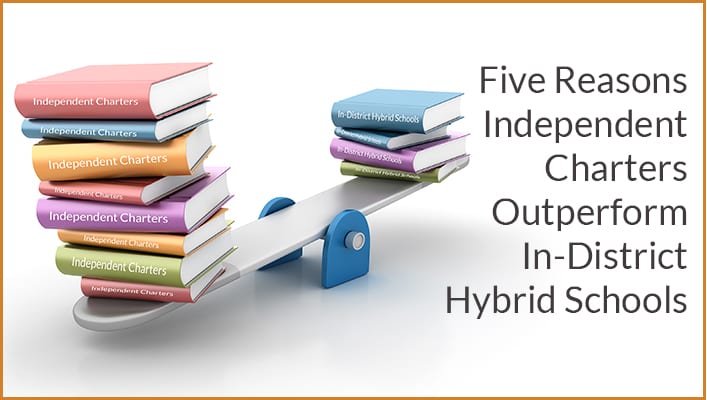
independent charter schoolsFive Reasons Independent Charters Outperform In-District Hybrid Schools

Editor’s Note: This post was originally published here on August 23, 2018, by Forbes and written by Emily Langhorne, policy analyst for the Reinventing America’s Schools project at The Progressive Policy Institute.
We think it’s vital to keep tabs on the pulse of all things related to charter schools, including informational resources, and how to support charter school growth and the advancement of the charter school movement as a whole. We hope you find this—and any other article we curate—both interesting and valuable.
Read on for the complete article.


Five Reasons Why Independent Charters Outperform In-District Autonomous Schools

Over the past 15 years, cities across the country have experienced rapid growth in the number of public charter schools serving their students. Charter schools are public schools operated by independent organizations, usually nonprofits. They are freed from many of the rules that constrain district-operated schools. In exchange for increased autonomy, they are normally held accountable for their performance by their authorizers, who close or replace them if they fail to educate children. Most are schools of choice, and unlike magnet schools in traditional districts, they are not allowed to select their students. If too many students apply, they hold lotteries to see who gets in.
The charter formula – autonomy, accountability, diversity of learning models, choice and operation by nonprofits – is transforming urban education. In states with strong charter laws and equally strong authorizers, charter schools have produced impressive students gains, especially in schools with high-minority, high-poverty populations.
Recently, districts from Boston to Los Angeles have tried to increase student achievement by replicating parts of this formula, in particular giving their school leaders more autonomy.
District-run “autonomous” schools are a hybrid model— a halfway point between charters and traditional public schools. They’re still operated by district employees, but school leaders can opt out of many district rules and, in some models, union contracts.
The Progressive Policy Institute’s recent analysis of state exam scores from 2015 and 2016 in Boston, Memphis, Denver, and Los Angeles shows that public charter schools outperformed both traditional public and in-district autonomous schools on standardized tests in three of the four cities studied. In the one exception, Memphis, the district concentrated its best principals and teachers in, and provided extra funding and support to, its autonomous schools.
The analysis reveals that district-run autonomous schools in these cities sometimes performed better than traditional public schools, but they seldom performed as well as independent public charters. So the big question is: what do independent charter schools have that district-run autonomous schools are missing?
Below are five reasons why public charter schools outperform district-run autonomous schools.

1. Most Independent Charter Schools Have True Autonomy

Charter school leaders have true autonomy over staffing, school models, curriculum, budgeting, school calendars and schedules and professional development. Without the constraints of district policies, charter leaders can create educational models that work best for their students – whether Montessori, project-based, dual-language, or others. They can choose curriculum and materials that engage their teachers and students. They can manage their own school budgets, using money creatively and effectively and to meet the unique needs of their students. If needed, they can extend the school year.
Many in-district autonomous schools allegedly have these freedoms too. In reality, however, the long reach of the district’s central office sometimes hamstrings them, making their autonomies little more than paper promises.

2. Most Charter Schools Are Schools of Choice

Because independent charter schools are schools of choice, charter leaders can develop schools with specific educational models and cultures. Children learn differently, come from different backgrounds, speak different languages, have different interests, and thrive in different environments. Having multiple learning models allows parents to choose the schools that best fit the needs of their children.
When a district assigns children based on their neighborhoods, as some do, it’s much harder to have diverse school designs. Most parents would object to being told their child must attend a specialized school – such as Montessori school, a STEM school, or a performing arts school – so neighborhood schools often rely on the traditional one-size-fits all model.
In contrast, schools of choice can specialize. And when families have choices, both parents and students are more likely to “buy-in” to the school’s culture and academic philosophy.
Giving families the choice to attend a variety of schools also creates a second layer of accountability for independent charters, because the public dollars follow that choice. School operators are in direct competition for funds, and parents have much more leverage in demanding what their children need because they can send their children elsewhere and the money will follow them.

3. Most Independent Charter Schools Are Held Accountable for Student Performance

Unless forced to by the state, elected school boards rarely close or replace failing schools – because it’s political suicide. Teachers unions often initiate district-wide protests over school closings, and parents and community members often join in. Because turnout in school board elections is often under 15 percent, their votes may determine the winners. For a school board member, closing or replacing a failing school often means losing the next election – even if it benefits children.
Most charter schools are not unionized, however. They answer to authorizers, which often have appointed boards. Even when an elected board closes a charter, it may trigger a protest from one building, but not from all teachers in a city or district.
If they are doing their jobs, authorizers hold schools accountable for student achievement benchmarks laid out in their charters, which are essentially performance contracts. Every few years, authorizers review their schools. If the students aren’t learning, the school will undergo a period of probation – after which time, if student performance does not improve, authorizers will close or replace the failing school.
When authorizers fail to hold schools accountable, charter schools generally don’t perform much better than traditional public schools. Studies show that, in states where authorizers consistently close low-performing charters, charter students far outpace their district counterparts on standardized tests. Where they don’t close schools, charters often underperform their district counterparts.

4. Most Independent Charters Go Through a Careful Authorization Process

Strong authorizers also investigate charter operators prior to allowing them to open schools. Not all parents have the ability to assess schools, so effective authorizers ensure that the schools available to their children are of high quality. This requires evaluation of performance and replacement of failing schools, but also scrutiny of applications to ensure schools have a strategy for success before they open. As part of the authorization process, charter applications undergo a thorough vetting process before authorizers grant applicants a charter and allow them to open a school.

5. Independent Charter Sectors Are Sustainable

The Achilles heel of most in-district autonomous approaches is sustainability. In a large district, the autonomy agenda often rests with one or two innovative leaders at the district level. When they depart (as they always do), the bureaucracy usually reasserts its control. People in bureaucracies tend to resent any special privileges given to those in “autonomy zones” – in all sectors of government. Education is no different. In-district autonomous schools are vulnerable to shifting political winds and changes in attitudes at district headquarters, either of which can endanger their autonomy. In contrast, independent charters operate outside of school districts, so it would take a change in state law, rather than district leadership, to infringe upon their autonomy.


Charter School Capital logoSince the company’s inception in 2007, Charter School Capital has been committed to the success of charter schools. We provide growth capital and facilities financing to charter schools nationwide. Our depth of experience working with charter school leaders and our knowledge of how to address charter school financial and operational needs have allowed us to provide over $1.8 billion in support of 600 charter schools that have educated over 1,027,000 students across the country. For more information on how we can support your charter school, contact us. We’d love to work with you!

LEARN MORE


charter school fundingCharter School Capital Funding Helps T-Squared Honors Academy Overcome Challenges

About T-Squared Honors Academy

T-Squared Honors AcademyEstablished in 2014, T-Squared Honors Academy is currently enrolling students in grades seven through twelve. The school focuses on four key pillars: intelligence; broad sympathy; knowledge of the world that was and is; and the relation of men to the world. Their mission is to utilize a rigorous, innovative academic curriculum to infuse a passion for people, intrinsic motivation, and self-discipline in their students. They aspire for each of their students to be challenged, develop strong character values, and to serve publicly and lead the world in social reforms.

The Challenges

  • In Ohio in 2014, there was a period where charter school fund distribution was being delayed­, creating a challenging situation for charter
    schools to operate effectively
  • As the state funding payments came through, both the timing and funding amounts were irregular and unpredictable
  • Without consistent and stable funding, T-Squared lacked the ability to provide job security for their staff, would have been forced to make operational reductions, and their future was uncertain

The Solution

  • Charter School Capital purchased Ohio state aid payments owed to T-Squared Honors Academy and then provided consistent funding to the school in advance of the state payment distribution dates
  • Charter School Capital supplied the working capital needed for T-Squared to be able to make payroll for their staff and purchase necessary academic materials like laptops and new books
  • Charter School Capital’s online Client Portal has made the documentation process much faster, easier, and more transparent for school leadershipWe’re so grateful to Charter School Capital.

Whenever we have questions or are confused about something, our account manager, Michelle, is very patient in explaining things to us. Anytime I need her, she is available or will call us right back. She’s made the process so easy and understandable.
Dr. India Ford, Superintendent,
T-Squared Honors Academy

The Result

T-Squared Honors AcademyThe funding provided by Charter School Capital provided T-Squared Honors Academy the financial predictability they needed for operational stability. It is currently the top-performing charter school in the area and they’re setting their sites on becoming one of the best charter schools in Ohio—and then the nation. Since 2014, they’ve more than doubled their enrollment, exceeded academically, and are now nearing their goal of financial stability and independence. The next milestone for them will be to move into their very own high school building. With their leaders’ dedication and commitment, we know it will happen.


Charter School Capital logoAt Charter School Capital, our team works with you to determine working capital funding and facilities options based on your school’s needs. If you are trying to meet operational expenses, expand, acquire or renovate your school building, add an athletic department, enhance school safety/security, or buy new technology, complete the online application below and we’ll contact you to set up a meeting.

GET STARTED