Charter School Capital

Your Funding Journey with Charter School Capital

We are 100% dedicated to the charter school space and measure our success by the number of students we serve.

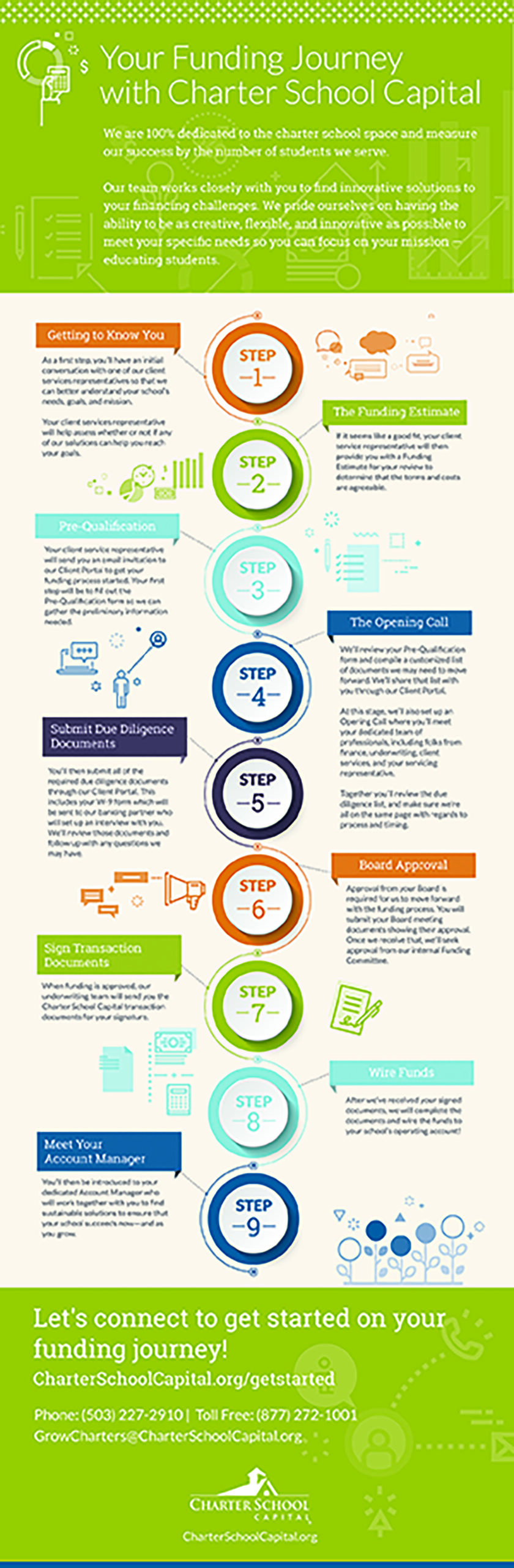
We’ve created this infographic to show you what a typical funding journey with Charter School Capital looks like. Our team works closely with you to find innovative solutions to your financing challenges. We pride ourselves on having the ability to be as creative, flexible, and innovative as possible to meet your specific needs so you can focus on your mission — educating students. You can download a PDF of the infographic here!

We are so excited to share this new infographic with you, so let us know what you think!


charter school capital funding

Charter School Capital logo

If you are trying to meet operational expenses, expand, acquire or renovate your school building, add an athletic department, enhance school safety/security, or buy new technology, complete the online application below and we’ll contact you to set up a meeting. Our team works with you to determine funding and facilities options based on your school’s unique needs.

GET STARTED

underperforming Charter Schools
Editor’s Note: This post was originally published here by ExelinEd on October 31, 2018, and written by Claire Voorhees, ExcelinEd’s National Director of Policy. We are focused on helping all students access quality education. So how do we best address underperforming charter schools? Some intervention strategies can certainly help, but what are some other options? Check out this article to learn about some other options.
We think it’s vital to keep tabs on the pulse of all things related to charter schools, including informational resources, and how to support charter school growth and the advancement of the charter school movement as a whole. We hope you find this—and any other article we curate—both interesting and valuable.


#AskExcelinEd: How can states address the challenges of school turnaround?

Three years into the ESSA era, the rubber has finally met the road. All 50 states and D.C. have approved plans, identified their first set of lowest-performing schools and are now undertaking the most difficult – and most important – task of all: school turnaround.
To support states, ExcelinEd has partnered with the National Alliance for Public Charter Schools and Chiefs for Change to provide information on leveraging federal funds and promoting rigorous, evidence-based turnaround strategies.
ExcelinEd is excited to release its first contribution from this partnership: School Interventions Under ESSA: Harnessing High-Performing Charter Operators. The brief reasons that states and districts can consider a wide variety of intervention strategies, such as replacing staff, improving curriculum and instruction and providing integrated student supports that address students’ health, emotional and behavioral needs.
However, in districts where schools fail to turn around—or have already been failing for multiple years—states should consider the one option that can give students languishing in low-performing schools a higher-quality option: bringing in high-performing charter schools.
This brief also builds on our earlier findings, How to Recruit High-Performing Charter Management Organizations to a New Region, to highlight strategies states can use to attract high-quality CMOs to districts where schools are struggling the most. These strategies fall into three main categories: leveraging state and federal funding; authorizer quality and operating autonomy; and talent pipelines.
We look forward to working with states as they address the challenge of school turnaround and ensuring their students receive a quality education.


charter school fundingCharter School Capital Financing Helps New Designs Stay On Track for Success

With so many choices for where go to access financial resources for your school, it’s important to select the right one for you. At Charter School Capital, we believe in the power of charter schools and their leaders to deliver quality education to families across the country. And we’re proud to provide the reliability and stability charter leaders require as they walk their journey to better educate more students today—and in the future.
Please watch and listen as Paul Okaiteye, Chief Executive Director, New Designs Charter School, shares his experience working with Charter School Capital at a very critical time for California schools.
This video was originally published Jul 17, 2014. While we are not currently funding New Designs Schools, we are proud of the way our support helped them meet the needs of their students, parents, and teachers. Our team is dedicated to helping your school become financially stable, successful, and set up for future growth. To learn how other school’s have achieved success by partnering with us, check out our other success stories here and filter by the content type, “School Spotlights”.
Watch the short video to hear Paul’s story and find the transcript below. You can learn more about Charter School Capital here.


New Designs is a charter college preparatory school that is focused on math, science and technology to prepare kids in southern Los Angeles to make sure that by the time students get out of 12th grade at New Designs Charter School, they meet and exceed their requirements for entry into a four year university.
Most of the time when the kids come in, they’re usually two or three grades below where they’re supposed to be. And it takes us to work with them for a year or two—in some cases a little longer to be able to get them to grade level.
We have a fiscal consultant, and he’s the one who first introduced Charter School Capital to us. And it came at a very critical time. It has helped us to stay afloat, to be able to stay in business for our teachers and all the employees to have the confidence that when I go to work I can give my all and know that at the end of the period when I’m supposed to get my check, it will come on time.
So, I would say the Charter School Capital has been a partner to New Designs Charter School. I say that because have gone beyond just giving us money, and to making sure that we can stay in business and they’re also interested in the education aspect of what we do.
Not just in the financial aspect. Anytime I have a question, anything regarding financing with a state or even with any transaction, I’ve had an exceptional response. They’re very professional. They want to get you what you need.
They have been a lifeline because they have come through for us at times when we needed it the most and they have done things that other institutions have not been able to do. And so they have been making sure that the blood keeps flowing through our veins.


Charter School Capital logoSince the company’s inception in 2007, Charter School Capital has been committed to the success of charter schools. We provide growth capital and facilities financing to charter schools nationwide. Our depth of experience working with charter school leaders and our knowledge of how to address charter school financial and operational needs have allowed us to provide over $1.8 billion in support of 600 charter schools that have educated over 1,027,000 students across the country. For more information on how we can support your charter school, contact us. We’d love to work with you!

LEARN MORE


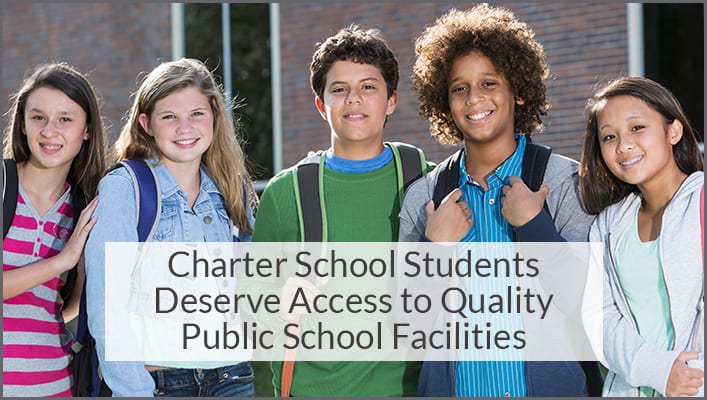
public school facilitiesCharter School Students Deserve Access to Quality Public School Facilities

Editor’s Note: This post was originally written by Nina Rees on October 18, 2018. Nina Rees is the president and chief executive officer of the National Alliance for Public Charter Schools and former deputy assistant for domestic policy to Vice President Dick Cheney. Follow her on Twitter @Ninacharters.
Though charter schools are public schools, supported by state and local tax dollars, they don’t usually have the same access to public school buildings, let alone funding for new facilities. Unfortunately, even when district-owned buildings are underused or completely abandoned, districts don’t like to give, sell, or lease them to charter schools, which are viewed by much of the educational establishment as their competitors.
Read on to learn about some potential solutions to this issue and what can be done to ensure that all students, both from traditional public district-run schools and public charter schools have access to school facilities that provide optimal learning environments for our nation’s children.
We think it’s vital to keep tabs on the pulse of all things related to charter schools, including informational resources, and how to support charter school growth and the advancement of the charter school movement as a whole. We hope you find this—and any other article we curate—both interesting and valuable.


Public school buildings belong to public school students — including charter students

As children conclude their first weeks of school across America, how do you envision their school buildings? The traditional brick-front building with big windows and rows of tidy desks? A more modern structure with laptops at workstations and a dual-use gym and theater?
How about an abandoned big box store in a strip mall?
For charter school students in many states, this last option is too familiar. Even though charter schools are public schools, supported by state and local tax dollars, they don’t usually have the same access to public school buildings, let alone funding for new facilities. As a result, they must dip into funds that would otherwise be used for instruction to pay for rents or mortgages. While charter schools are safe havens for learning, they don’t always have the amenities that one would typically associate with a school. Gyms, libraries, even cafeterias aren’t guaranteed for charter school students, because the schools are often located in buildings that were never designed to educate children.
Many students in district-run schools are learning in outdated spaces. But unlike most charter schools, district-run schools have free access to public buildings, and public financing options are more easily available to them. They get direct support from their state or community, or they can issue bonds that offer tax advantages to buyers, while taxpayers foot the bill for the added debt. Additionally, school districts usually maintain large inventories of school buildings that can be renovated to accommodate growing school enrollments. Charter schools rarely have these options.
Adding to the challenge is that school districts tend to be parsimonious with their own buildings. Even when district-owned buildings are underused or completely abandoned, districts don’t like to give, sell, or lease them to charter schools, which are viewed by much of the educational establishment as competitors. The anti-charter behavior can get so extreme that some school districts have not only refused to sell or rent school buildings to charter schools, but they’ve also attached legal riders that prevent private buyers from selling or renting their buildings to charter schools. Better to convert those old classrooms into condos than to allow a growing, high-demand charter school to teach students in them.
Some states, however, are rising to the challenge and giving charter schools a fair shake. Nine states include charter schools in district capital planning and bond issuance. However, existing efforts don’t even come close to meeting the estimated $375 million in additional funding needed annually to meet the facilities needs resulting from increased parental demand for charter schools.
With the need so great, state governments, the federal government, and private investors can all be part of the solution.
Every state should give charter schools the first right to unused district facilities. Public school buildings no longer needed by a school district should be used by other public schools — i.e. charter schools — if those schools need the space. Opposition to that is simply unjustifiable.
States could also provide facilities funding to charter schools in the form of a per-pupil facilities allowance, establishing a state grant program for charter school facilities, and requiring that charter schools be included in school district bonding and mill levy requests.
The federal government can help, too. Several federal programs exist to help charter schools access facilities, but funding is limited both numerically and geographically. Other programs require technical financial expertise that may be beyond the reach of local school founders. Many current programs are inaccessible to all but the largest charter school networks.
Support for charter schools is a rare issue that President Trump and congressional leaders of both parties agree on. The federal government can use public funding to incentivize better state policies, or private investment — for instance, by enabling the sale of charter school infrastructure bonds and notes to investors in the capital markets, in the same way, that other tax-advantaged bonds and notes are sold. The newly enacted Opportunity Zone tax incentives may provide help for charter schools that open facilities in the most economically distressed parts of the country, but it depends on investors willing to create funds that will invest in charter schools.
There are many possible solutions to the charter school facilities funding challenge, but action is needed now. Millions of parents want to choose their child’s school but can’t because a lack of facilities funding limits charters’ growth. And too many charter school students and teachers are making the best of inadequate facilities that lack essential school features. With smart investments now, policymakers can help more students start future school years in buildings designed for learning.


The Ultimate Guide to Charter School Facility Financing:
Thinking about a new facility for your charter school or enhancing your current one? This guide shares straightforward and actionable advice on facilities planning, financing options, getting approved, choosing a partner, and much more! Download it here.

GET THE RESOURCE


charter school growthCharter School Growth Manual: Expert Tips and Pitfalls to Avoid as You Grow

At Charter School Capital, we believe in the power of charter schools and their leaders to deliver quality education and foster success in their students. Over the past 10+ years, we have partnered with hundreds of charter schools to help them access the capital they’ve needed to achieve financial and operational stability.
Along the way, we’ve had the privilege to learn from charter school leaders and educators about what works and what doesn’t—and we’ve come to see that the hurdles they face tend to be remarkably consistent.
Although charter schools are champions of educational diversity, they typically face similar sets of challenges and encounter the same potential pitfalls, regardless of their focus, location, or population.
For this guide, we turned to our wide network of charter school experts for best practices and strategies for success at every stage of maturity. All of the advice in this book comes from experienced charter school leaders who have been where you are now—they understand what you’re facing and the pitfalls to avoid. We hope the growth strategies here include useful tips for you and your team on developing a strong charter, building culture and community support, and boosting your financing and facilities practices to support your growth.
For each of the three key stages (start-up stage, growth stage, and sustainable maturity stage) you’ll learn:

  • Challenges & How to Conquer
  • Them Pitfalls to Avoid
  • Start-up Tips from Experienced Charter School Leaders


GET YOUR FREE COPY!

The Charter School Growth Manual: Expert tips and Pitfalls to Avoid as You Grow
Whether you’re just beginning the process of starting up a charter school, looking to expand or trying to prioritize your next steps, download this guide to get expert tips and pitfalls to avoid as you grow.
For this charter school resource guide, we turned to our wide network of charter school experts for best practices and strategies for success at every stage of maturity. All of the advice in this book comes from experienced charter school leaders who have been where you are now—they understand what you’re facing and the pitfalls to avoid.

DOWNLOAD NOW

charter-like schools9 Tips For How To Create More Successful Charter-Like Schools In Urban Districts

Editor’s Note: This article from The74, was originally published here on September 19, 2018 and was written by David Osborne and Emily Langhorne. David directs the Progressive Policy Institute’s education work and is the author of Reinventing America’s Schools: Creating a 21st Century Education System. Emily Langhorne, a former English teacher, is an education policy analyst and project manager with the Progressive Policy Institute.
This article highlights how, over the past 15 years, the fastest improvement in urban public education has come from cities that have embraced the key tenants that have led to charter schools’ success — autonomy, choice, diversity of school designs, and real accountability for performance. In order to compete, many districts have recently tried to spur charter-like innovation and increase student achievement by granting their school leaders more autonomy.
Interestingly, studies in Boston, Memphis, Denver, and Los Angeles showed that public charter schools outperformed both traditional public and in-district autonomous schools on standardized tests in three of the four cities studied. But getting a charter isn’t always an easy road in today’s political landscape. In this case, in-district autonomous models may be the second-best option. Learn how districts can increase the success of these schools if they take guidance from these nine lessons learned from districts already embracing this new charter-like model.


Osborne & Langhorne: Where Politics Make Charters Difficult, 9 Tips for How Urban Districts Can Create Charter-like Schools — and Improve Their Success
charter-like schoolsOver the past 15 years, the fastest improvement in urban public education has come from cities that have embraced charter schools’ formula for success — autonomy, choice, diversity of school designs, and real accountability for performance. To compete, many districts have recently tried to create charter-like schools to spur innovation and increase student achievement by granting their school leaders more autonomy.
District-run autonomous schools are a hybrid model, a halfway point between charters and traditional public schools. They’re operated by district employees, but they can opt out of many district policies and — in some cities — union contracts.
Our recent analysis of state exam scores from 2015 and 2016 in Boston, Memphis, Denver, and Los Angeles showed that public charter schools outperformed both traditional public and in-district autonomous schools on standardized tests in three of the four cities studied. In the one exception, Memphis, the district concentrated its best principals and teachers in, and provided extra funding and support to, its autonomous iZone schools.
However, when the political landscape makes chartering difficult, in-district autonomous models may be the second-best option. Districts can increase the success of these schools if they heed these nine lessons learned by the four cities in our study.

1. Protect unrestricted autonomy

When autonomy is limited, so is principals’ ability to meet students’ needs. Districts need to give these schools unrestricted staffing and budgeting authority.
Staffing autonomy allows school leaders to hire effective staff who believe in their school’s vision and to evaluate staff based not only on performance but also on cultural fit. Forced placement of teachers not only harms student learning; it can also undermine a school’s culture. As one autonomous school principal in Los Angeles said, sometimes a principal needs to “lose a teacher and save a school.”
Budgeting autonomy enables principals to hire staff according to their schools’ unique needs — for example, bringing on additional guidance counselors rather than a dean. Leaders who control their own budgets can fund hands-on learning, purchase tablets for blended learning, hire a full-time substitute teacher, or employ any of a hundred other innovations.

2. Create a district office or independent board to support and protect autonomous schools

Autonomous school leaders spend a significant amount of time fighting to exercise the autonomies they have been promised. Sometimes, they get so frustrated, they leave. Districts with autonomous schools should create a central unit dedicated to supporting them, defending their autonomy and advocating on their behalf when disputes arise.
An alternative is to create a 501(c)3 nonprofit board, as Denver has. These boards are appointed, not elected, so they are free to make decisions that benefit students and schools without fear of political backlash. The boards oversee school progress, provide financial oversight, select school leaders and evaluate their performance, and protect them from district micromanagement.

3. Articulate a district-wide theory of action and secure buy-in from central office staff

Changing the mindset of the central office requires a huge cultural shift. Autonomous schools necessitate that many parts of the central office do things differently, so employees need to believe in the connection between school autonomy and student success, rather than seeing autonomous schools as an inconvenience and/or a challenge to centralized authority. District leaders need to openly discuss why they believe school autonomy will produce better performance, share this information publicly with school leaders, central office employees, teachers, and the community — and constantly reinforce the message.

4. Turn some central services into public enterprises that must compete with other providers for schools’ business

The fastest way to change the mindset of central office staff who provide services to schools — such as professional development, food, maintenance, and security — is to take away their monopoly. When internal service shops have to sink or swim in a competitive market, they almost always swim, because they are much closer to their customers than private competitors are. But, in the process, they increase their quality and reduce their costs.


RELATED
Five Reasons Independent Charters Outperform In-District Hybrid Schools


5. Authorize district-run autonomous schools like charter schools

Rigorous authorization has been essential to the success of strong charter sectors. Districts should use similar processes to authorize their own autonomous schools — allowing only the most promising applicants to open schools and removing those that prove ineffective. A careful authorization process weeds out weak proposals at the beginning reviews performance along the way and replaces schools that fail with stronger operators.

6. Ensure continuous improvement by using a clear system of accountability to close and/or replace failing schools

A common shortcoming among districts with autonomous school models is their failure to impose consequences that create real urgency among teachers and principals — closing and replacing failing schools. Every district should implement a performance framework that requires schools to show academic growth. If they fail, the district should provide additional supports during a probationary period but replace them if they still don’t meet targets. If a school is successful, the district should provide resources and incentives to encourage it to open another campus, as Denver does with its Innovation Schools.

7. Invest in developing autonomous school leaders

Giving schools autonomy does nothing to help student achievement if school leaders follow district procedures rather than looking for ways to be innovative. Districts need to invest in developing school leaders so they can take advantage of their freedoms. Careful selection of and support for principals has been a large part of the Memphis iZone’s success. Novice principals there are placed in partnerships with experienced principals, meeting over the summer and throughout the year to collaborate on strategies for leveraging autonomy to achieve results.

8. When possible, give families a choice of autonomous schools

Families and students who can choose their school tend to show more commitment than children who are assigned to one. Choice empowers them, and people who feel empowered are more likely to give their best efforts. In addition, systems of choice allow for the creation of schools with a variety of learning models, so students can select a school with the culture and curriculum that best fit their needs.

9. Explore district-run autonomous models from other cities

By examining a variety of successful strategies, districts can find and adapt the model that best fits their political climate and meets the needs of their community.
In addition to the four cities we studied, Springfield, Massachusetts, and Indianapolis, Indiana, have launched interesting in-district autonomy strategies.
The Springfield Empowerment Zone Partnership, created as an alternative to a state takeover of several schools, contains nine struggling middle schools and one high school that have been given significant autonomy, overseen by a seven-member board of four state-appointed officials and three locally appointed members. The teachers union negotiated a new contract that includes longer hours, increased pay, and some compensation based on performance.
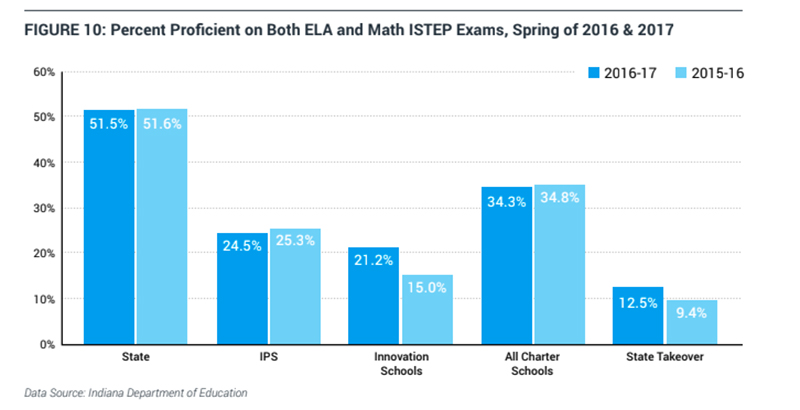
Indianapolis’s Innovation Network Schools, which start with full charter-like autonomy rather than with waivers from district rules, are the fastest-improving in the district. They have the same exemption from laws, regulations, and contract provisions as charters, and while the schools operate in district buildings, the principals and teachers are employed by the nonprofit corporation that operates the school. Each school’s board hires and fires the principal, sets the budget and pay scale, and chooses the school design. The nonprofits have five- to seven-year performance contracts with the district. If schools fail to fulfill the terms of their contracts, the district can refuse to renew them; otherwise, the district cannot interfere with their autonomy.
By following the recommendations above, districts can create self-renewing systems in which every school has the incentives and autonomy to continuously innovate and improve. At the same time, they can offer a variety of school models to families, to meet a variety of children’s needs.
Whether school boards will have the courage to close failing autonomous schools full of unionized district employees will always be a question. The long-term sustainability of in-district autonomy after the leaders who championed it have left is another Achilles’ heel. But if done well and sustained, such schools have the potential to improve public education in urban America

Charter School Capital logo
Charter School Capital is proud to deliver access to growth capital and facilities financing to charter schools nationwide. In the past 10 years, Charter School Capital has invested more than $1.8 billion to 600+ charter schools, helping them provide a high-quality education to more than 1,000,000 students across the country. If you are trying to meet operational expenses, expand, acquire or renovate your school building, add an athletic department, enhance school safety/security, or buy new technology, complete the online application below and we’ll contact you to set up a meeting. Our team works with you to determine funding and facilities options based on your school’s unique needs.


GET STARTED


National School Choice WeekNational School Choice Week is Only One Week Away!

National School Choice Week (NSCW) is coming January 20-26th, and we want to make sure you’re up-to-date on all the cool happenings so you don’t miss a thing!  

What is National School Choice Week?

Not familiar with NSCW? This inspiring week recognizes all K-12 options, including traditional public schools, public charter schools, public magnet schools, private schools, online academies, and homeschooling. It’s the world’s largest annual celebration of opportunities in education that includes over 10,000 independent events. It’s a nonpartisan, non-political, independent public awareness effort that’s not associated with any legislative lobbying or advocacy efforts.
Every child deserves a bright future. Having school choice simply means that parents are empowered to select the best possible educational experience and learning environment for their unique child’s individual needs—helping them thrive!

Join the Conversation!

Make sure to join the conversation all next week with Charter School Capital, as we share stories and quotes about school choice on Facebook, Twitter, and on LinkedIn. Follow all the school choice week festivities, events, and conversation using the #schoolchoice and #SCW hashtags.

Learn More

There are so many events going on across the country next week, that we can’t list them all here; but if you’re interested in finding a National School Choice Week activity in your area check out this state-by-state map to see what’s happening near you! We’d also love to hear what you’re doing to celebrate the week. Leave us a comment below.
Have a great #schoolchoice week!

charter school funding

A Strong Partnership for Success Between New City Schools and Charter School Capital

With so many choices for where go to access financial resources for your school, it’s important to select the right one for you. At Charter School Capital, we believe in the power of charter schools and their leaders to deliver quality education to families across the country. And we’re proud to provide the reliability and stability charter leaders require as they walk their journey to better educate more students today—and in the future.

Please watch and listen as Sabrina Bow, Executive Director, New City Schools, shares her experience working with Charter School Capital during some very difficult financial times for charter schools in California.

This video was originally published Jul 17, 2014. While we are not currently funding New City Schools, we are proud of the way our support helped them meet the needs of their students, parents, and teachers. Our team is dedicated to helping your school become financially stable, successful, and set up for future growth. To learn how other school’s have achieved success by partnering with us, check out our other success stories here and filter by the content type, “School Spotlights”.
Watch the short video to hear Sabrina’s story and find the transcript below. You can learn more about Charter School Capital here.


Sabrina Bow: Executive Director, New City Public Schools:

“We are a small Charter Management Organization in Long Beach, California. We offer a dual language program in English and Spanish, and our focus is on social justice, collaboration, the natural environment, and technology. Charter schools are increasingly having to find other ways of funding. We’ve made commitments to students, parents, and teachers to provide a high level of education and really an all-inclusive second family, if you will, for students.

We’ve made those long-term commitments to be there, and unfortunately, with the state of the economy and the state of deferrals, we find ourselves having to find different options.

Charter School Capital is a financial partner that comes in, understands the school, understands the school leaders. They take the time to do that.

In my experience, Charter School Capital is a financial partner that comes in, understands the school, understands the school leaders. They take the time to do that. They’re able to sit down with us and create a funding plan and be part of our financial plan, provide the technical expertise to schools, and present it in a straightforward way.

There’s always a cost to finance. Some of the criticism has been Charter School Capital, and other providers who purchase receivables are taking advantage of charter schools. I think that that really diminishes the responsibility that charter school operators have to build not only a solid educational program but also to build a solid business infrastructure that supports that educational program.

It’s never been a doubt for me that Charter School Capital is deeply concerned, deeply interested, in the well-being of schools, and beyond the financial well-being is the ability of schools to continue to provide a solid education for students. I’m happy that Charter School Capital is able to work with schools and work with us to help us so that we can continue to meet the needs of our students, parents, and teachers. I view them as a close partner.”


Charter School Capital logoSince the company’s inception in 2007, Charter School Capital has been committed to the success of charter schools. We provide growth capital and facilities financing to charter schools nationwide. Our depth of experience working with charter school leaders and our knowledge of how to address charter school financial and operational needs have allowed us to provide over $1.8 billion in support of 600 charter schools that have educated over 1,027,000 students across the country. For more information on how we can support your charter school, contact us. We’d love to work with you!

LEARN MORE


public charter schoolsNew 2018 Survey Shows Support for Public Charter Schools is Strong

Note: This post from the National Alliance for Public Charter Schools was originally published on December 5, 2018, and can be found here. It is a summary of a new report “2018 Schooling in America Survey” by EdChoice. We thought sharing it was a great way to wrap up this year!
This annual survey—developed and reported by EdChoice and interviews conducted by their partner, Braun Research, Inc.—measures public opinion and awareness on a range of K–12 education topics, including parents’ schooling preferences, educational choice policies, the federal government’s role in education and more. They report response levels, differences (“margins”) and intensities for the country and a range of demographic groups. And this year, the survey includes an additional sample of current public school teachers to gauge whom they trust and how they feel about their profession, accountability, standardized testing and more.
We think it’s vital to keep tabs on the pulse of all things related to charter schools, including informational resources, and how to support charter school growth and the advancement of the charter school movement as a whole. We hope you find this—and any other article we curate—both interesting and valuable.


61 Percent of Americans Support Public Charter Schools in “2018 Schooling in America Survey” by EdChoice

*Today [*on December 5, 2018] EdChoice released the 2018 Schooling in America Survey, which measures public opinion, awareness and knowledge of K-12 education topics and reforms.
This year’s results confirm that support for charter schools is strong. While parent satisfaction among home school, private school, and district school students decreased, satisfaction increased among charter school parents. Additionally, 43 percent of parents surveyed indicated that they were “very satisfied” with charter schools, compared to just 26 percent of parents at district schools.
National Alliance for Public Charter Schools President and CEO Nina Rees said,
“The EdChoice survey findings put data behind what we hear from parents all the time: They love public charter schools and they want more children to have access to them. Seeing that six out of 10 Americans (61 percent) support public charter schools, while just 29 percent oppose them should convince lawmakers at every level of government to work together to ensure that students have access to high-quality, free public-school options.”
About 62 percent of parents surveyed would rate their local charter schools with an A or B grade, 10 percent higher than the rating parents would give to their local district schools. Furthermore, 13 percent of current and former school parents said they would prefer to send their child to a public charter school if it was an option. Among the surveyed teachers, 61% of teachers favored charter schools when provided with a basic description of a charter school. The report findings clearly indicate that parents want to have the opportunity to choose the best school for their child, and that the majority of public school teachers recognize charter schools put kids first.


Charter School Capital logoSince the company’s inception in 2007, Charter School Capital has been committed to the success of charter schools. We provide growth capital and facilities financing to charter schools nationwide. Our depth of experience working with charter school leaders and our knowledge of how to address charter school financial and operational needs have allowed us to provide over $1.8 billion in support of 600 charter schools that have educated over 1,027,000 students across the country. For more information on how we can support your charter school, contact us. We’d love to work with you!

LEARN MORE

nbsp;

charter school funding

Charter School Funding Reaching Schools in 38 States

Editor’s Note: This post on charter school funding originally ran here, on November 6, 2018. It was written by Christy Wolfe, a Senior Policy Advisor for the National Alliance for Public Charter Schools (NAPCS)and was published by The National Alliance for Public Charter Schools. We are always inspired by the outstanding content disseminated by the NAPCS and are proud to share their valuable information.
We think it’s vital to keep tabs on the pulse of all things related to charter schools, including informational resources, and how to support charter school growth and the advancement of the charter school movement as a whole. We hope you find this—and any other article we curate—both interesting and valuable.


FY 2018 PROGRAM UPDATE: CHARTER SCHOOLS PROGRAM FUNDS REACHING SCHOOLS IN 38 STATES

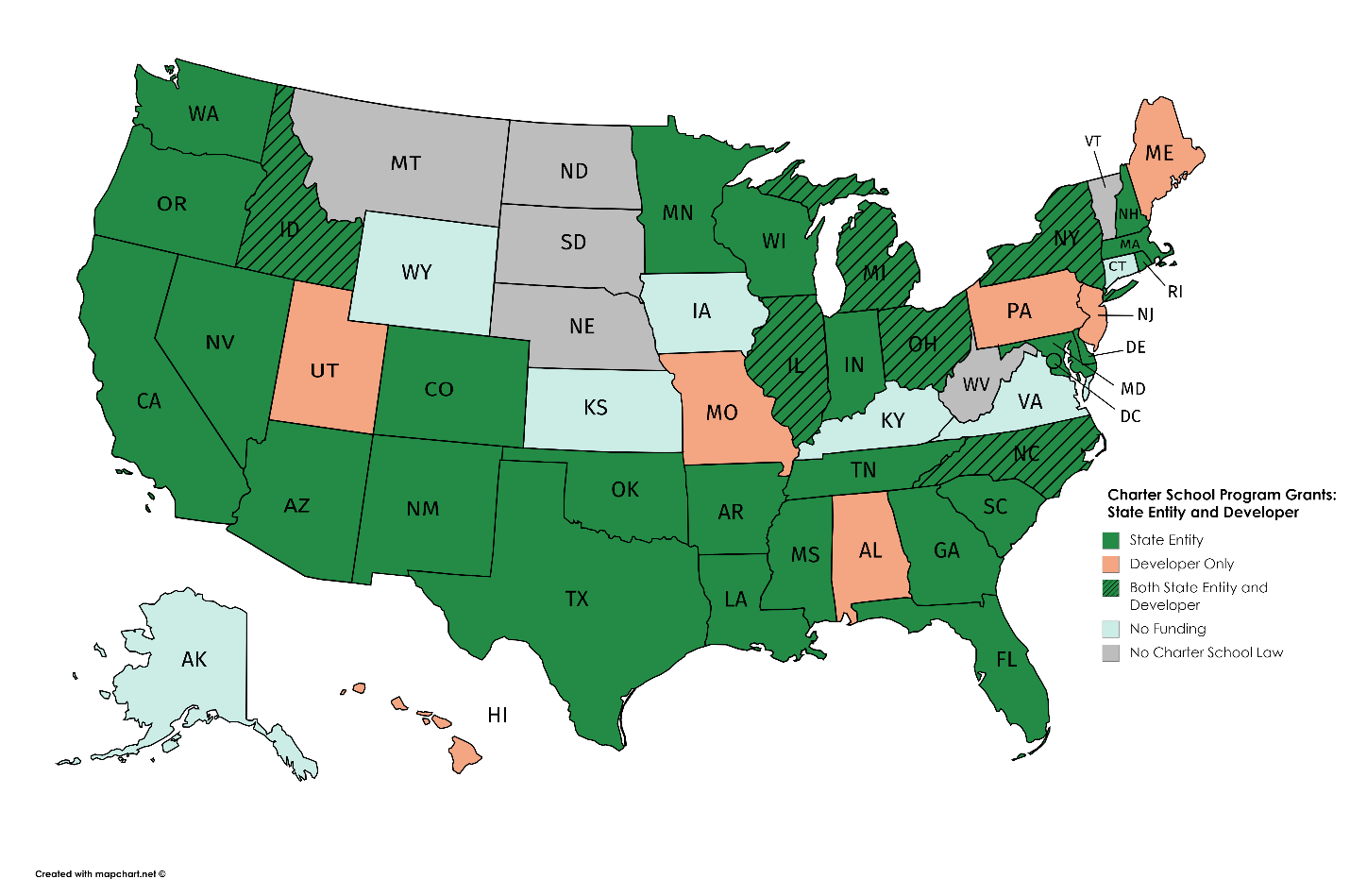
In September, the U.S. Department of Education (ED) awarded grants in four of the six Charter Schools Programs (CSP): State Entities, Developers, Credit Enhancement, and Dissemination.
charter school funding map
Congress appropriated a total of $400 million for these awards for FY 2018, including funds for active awards previously awarded. Due to increased funding in recent years, more states than ever have access to start-up funding—31 states have State Entity grants and charter schools in an additional seven states were successful in receiving Developer grants. Many states are also seeing charter school growth through grants to Charter Management Organizations for the Replication and Expansion of High-Quality Charter Schools, but awards were not made for that program during FY 2018.
This year, the program awards are a bit more complicated because, for the first time, two competitions were run under the new requirements in the Every Student Succeeds Act (ESSA). Let’s take a closer look at where the money went:

State Entity Grants: Funds to Open Charter Schools and Build Statewide Sector Quality

The State Entity grant program plays a key role in not only awarding subgrants to schools, but also providing funding for technical assistance and strengthening the quality of authorizers in a state.

  • Eight states received awards: Arkansas, Arizona, Colorado, Delaware, Idaho, Michigan, North Carolina, New York.
  • Five states were not successful: Alabama, D.C., Guam, New Hampshire, Puerto Rico.
  • Two Charter Support Organizations (CSOs) were funded: The new changes in ESSA unlocked CSP funding for non-state educational agency applicants, including CSOs. This year, two funded applicants from Arkansas and Idaho were CSOs.

At the close of this competition, 31 states (including D.C.) have a current CSP grant in their state (14 states with charter school laws are unfunded). Next year, nine states will likely have expired grants, which leaves a potential (although unlikely) pool of 24 applicants. If Guam and Puerto Rico are included, there will be 26 potential applicants.

Charter School Developer Grants: The Safety Net Program

This is the first year the competition has been run since the passage of ESSA. What is new is that there were two sub-competitions: one for replication/expansion grants, and the other for new charter school operators. There were 22 replication/expansion awards and 10 single site applicants. This year there were 32 funded applicants for a total of $30.2 million.
Ideally, this program would be obsolete. It is a safety for charter schools that wish to open in states that do not have a state entity program. If there was enough funding – and state capacity – for every state with a charter school law to have funding, new charter schools could simply apply to their state. Instead, after obtaining their charter contract, schools need to jump through the hoops required by federal grants to access funding. So, until every state has adequate funding for start-ups in their state, this program will continue to play a key role in advancing charter school growth.
BUT—you may have noticed that some developer grants went to states that also got a state-entity award (Idaho, Illinois, Michigan, North Carolina, and New York). The reason for this is, in part, because ED ran the State Entity and Developer competitions at the same time this year, so Developer applicants didn’t know if their state would receive a State Entity grant prior to applying. ED did not deem those applicants ineligible even when their state ended up receiving a State Entity grant. In addition, some developers were awarded a grant for replication and expansion because their state didn’t have a State Entity grant that permits them to make such awards, such as Ohio (NCLB-era grants don’t permit such awards unless a state has an approved waiver).
Of states that don’t have a CSP State Entity grant, seven have schools that received Developer grants: Alabama, Hawaii, Maine, Missouri, New Jersey, Pennsylvania, and Utah have charter schools that received Developer grants. Eight states with charter school laws have neither State Entity nor Developer grants (not including Guam and Puerto Rico).

Current Charter Schools Program Grants: State Entity and Developer Grants

Charter School Funding

Credit Enhancement: Reducing Facility Costs for Charter Schools

The Credit Enhancement program awards grants to organizations to “enhance” charter school credit so that they can access private-sector and other non-Federal capital in order to acquire, construct, and renovate facilities at a more reasonable cost. This year early $40 million was awarded to four entities.
This is a significant decrease from the $56.2 million in awards for 2017. More funds were awarded last year, in part, due to the large pool of high-quality applicants and the needs of the sector. This year, appropriators restricted ED’s flexibility to fund additional applicants, so they were limited to $40 million. Unlike the other CSP programs, Credit Enhancement funds are a one-time allocation so there aren’t any continuation awards—the amount appropriated is the amount that goes out the door.

Dissemination: Advancing Accountability and Facilities Access

Like the Developer program, this was the first competition year for the new National Dissemination program under ESSA. Previously, this program was known as the National Activities program and had a somewhat broader focus. Under ESSA, the program is focused on the dissemination and development of best practices. This year, 8 grants were awarded to organizations and charter school operators for a total of $16.2 million over the grant period. There were two “buckets” of funding to which applicants could apply: charter school authorizing and charter school facilities. For FY 2019, we anticipate that ED will propose new priorities for this program.
The National Alliance is pleased to be a recipient of a Dissemination grant to establish the National Charter Schools Facilities Center to develop and disseminate best practices and reduce the burden of obtaining and financing charter school facilities.

Grants to Charter Management Organizations for the Replication and Expansion of High- Quality Charter Schools: A Delayed Competition

ED did not run a competition for the CMO Replication and Expansion program because the agency is required to propose and take public comments on new program rules under ESSA. Comments for the new competition closed on August of 2018 and the competition will open later this year or in early 2019. Congress knew that ED would need extra time, so FY2018 funds for this program didn’t expire on September 30—ED has until March 2019 to make awards. ED’s “forecast” indicates that the competition for this program will be announced in late November 2018 and applications will be due around the start of the New Year. $120 million is available, and a little more than half of that amount will likely be available for new awards.


Charter School Capital logoAt Charter School Capital, our dedicated team of finance professionals works with you to determine funding and facilities options based on your school’s needs. If you are trying to meet operational expenses, expand, acquire or renovate your school building, add an athletic department, enhance school safety/security, or buy new technology, complete the online application below and we’ll contact you to set up a meeting.


GET STARTED

nbsp;