Facilities Financing

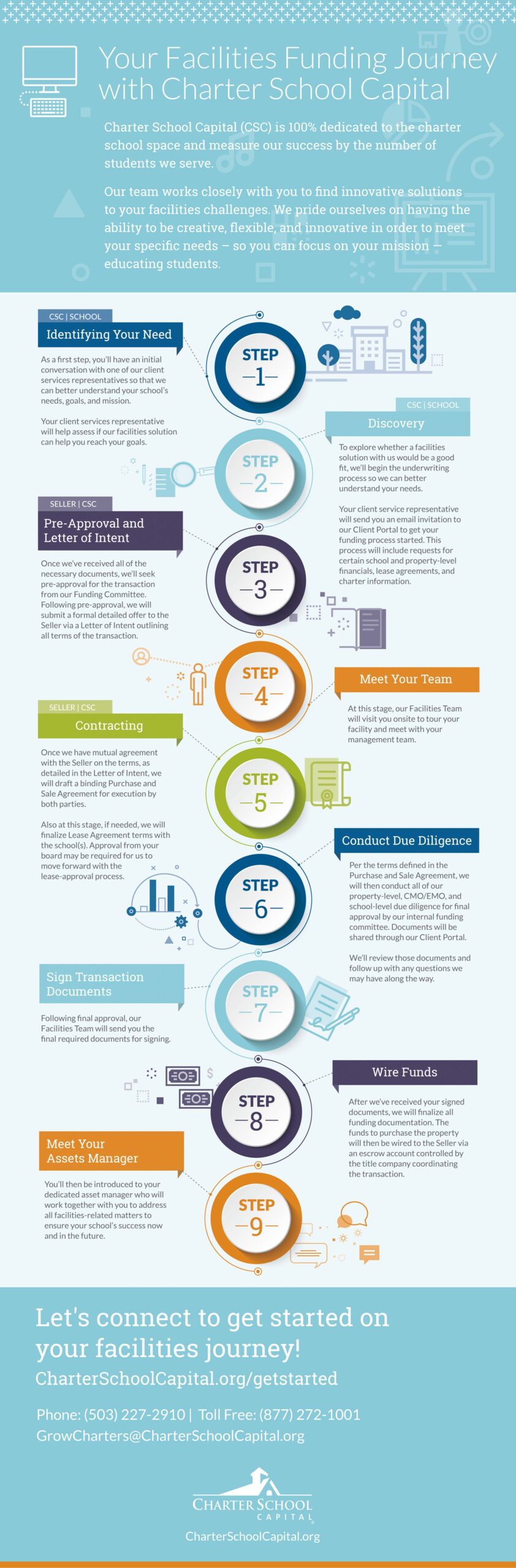
Your Facilities Financing Journey with Charter School Capital

We are 100% dedicated to the charter school space and measure our success by the number of students we serve.
We’ve created this infographic to show you what a typical facilities funding journey with Charter School Capital looks like. Our team works closely with you to find innovative solutions to your facilities challenges. We pride ourselves on having the ability to be as creative, flexible, and innovative as possible to meet your specific needs so you can focus on your mission — educating students. You can download a PDF of the infographic here!
We are so excited to share this new infographic with you, so let us know what you think!
Facilities Financing


charter school authorizing

Charter School Authorizing 101

Editor’s Note: This video was produced by the National Association of Charter School Authorizers (NACSA) on November 12, 2018. NACSA is an independent voice for effective charter school policy and thoughtful charter authorizing practices that lead to more great public schools.
This short video does a clear and thorough job at explaining how charter school authorizers function and the role authorizers play in maintaining quality charter schools across our country by holding schools accountable for their performance.
We think it’s vital to keep tabs on the pulse of all things related to charter schools, including informational resources, and how to support charter school growth and the advancement of the charter school movement as a whole. We hope you find this—and any other article we curate—both interesting and valuable.
Watch the video and/or read the transcript below to learn more.


What Are Charter Schools?

Hi there. I’d like you to meet Gina. Today, she becomes one of tens of thousands of kids who will graduate from a public charter school this year. What are charter schools? Well, charter schools are independently run public schools that have greater flexibility in their operations and are accountable for great performance. Simply put, charter schools receive more freedom for meeting higher expectations. Charter schools don’t just pop up in a community. There’s an important process to create a new charter school, and it begins with a vision and authorizers.

What Are Authorizers?

Now, let’s take a look at how authorizing works. Although their work happens in the background, they’re pretty important to producing great schools. Authorizers are entities that decide who can start a charter school, set the academic expectations, and monitor school performance. They also decide whether a charter school should remain open or close. Authorizers are all around the country. Some states have many, while others have only a few. In some states, authorizers are universities or non-profits. They might be state education agencies, independent boards, or municipalities, but almost 90% of authorizers are local school districts.

How do Schools Get Authorized?

That’s the case for Gina’s school. The process that brought Gina here started many years ago when a group of teachers came up with the idea to create a bilingual charter school based on the need they identified in the community. These teachers did their homework. They submitted their application to the local charter school authorizer. The authorizer reviewed the mission, the academic plans, the fiscal and operational details, and their overall strategy to run the school successfully. The authorizer met with the teachers and school leaders. Together, they agreed on specific academic and financial goals, as well as general school operations. And the charter school was approved!

Getting a Charter Renewed

Gina’s school has been successful for 10 years. The authorizer kept a close eye on their progress and their contract was renewed! Unfortunately, that’s not always the case. Two schools in Gina’s city didn’t do so well, and because they are required to meet these high expectations, it’s up to the authorizer to decide what’s best for these students—keep the charter school open or shut it down? One school was put on probation and the other was closed. Authorizers ensure that no child attends a failing school.

Not all families around the country have Gina’s experience. Terry lives in a district with a school board whose application process is so hostile to charters that no one even bothers to apply. In Tamika’s case, there are several charter schools in her community, but all are among the lowest performing in the state.

Ensuring that Charter Schools Thrive

There’s Avery, and Daniel, and Kai, and so many more children who are on a waiting list to attend only two other charter schools in the city because their authorizers are under political pressure and won’t open any new charters.
It’s not supposed to be this way. 

Make sure your community has a great charter school authorizer by visiting www.AuthorizingMatters.org.
Together we can open the door to a better future for millions more students like Gina.


Charter School Capital logoSince the company’s inception in 2007, Charter School Capital has been committed to the success of charter schools. We provide growth capital and facilities financing to charter schools nationwide. Our depth of experience working with charter school leaders and our knowledge of how to address charter school financial and operational needs have allowed us to provide over $1.8 billion in support of 600 charter schools that have educated over 1,027,000 students across the country. For more information on how we can support your charter school, contact us. We’d love to work with you!

LEARN MORE


Charter School EnergyProudly Announcing Our New Charter School Energy Program!

We are so proud to announce the official launch of our newest program exclusively for charter schools, Charter School Energy Powered by BioStar Renewables program.
We’re always listening to our school partners to better understand how we can best serve your needs and help you succeed—this new program was designed to do just that. With Charter School Energy Powered by Biostar Renewables, we are now able to offer access to energy efficient and renewable energy solutions for your school building.
These upgrades are designed to not only improve the learning environment for your students but also dramatically reduce your utility and maintenance expenses—positively impacting your bottom line. If you are interested in learning more details about this program, please visit our Charter School Energy page.
Charter School Energy is a full-service energy upgrade program with flexible financing options that enable school leaders to greatly reduce energy costs and enhance student learning environments through improved lighting, HVAC and thermostat upgrades and building controls. Renewable solutions such as solar allow the school to offset some or all of the building’s remaining energy consumption.
As always, we would welcome the opportunity of working with you to find sustainable solutions for your school’s success. Contact our team of dedicated professionals to learn how you can now access energy efficiency and renewable energy solutions for your charter school building.


LEARN MORE


Charter School Facts

Dispelling Myths with These Five Charter School Facts

1. Fact: Charter Schools Are Public Schools

Charter schools are tuition-free, independently run public schools and open to all students. They are granted greater flexibility in operations for greater accountability for performance. Their “charter” is a contract detailing the school’s mission, program, the students they serve, performance goals, and methods of assessment.

2. Fact: Charter Schools Serve All Students

Charter schools do not have selective admission requirements. They accept every student who wish to attend, including English Learners, students with special needs, and students of color. Unfortunately, due to the high demand for charter schools, over one million students are currently on wait lists.

3. Fact: Charter Schools Are Accountable

Charter schools are granted more educational flexibility in exchange for higher accountability. They must meet both state and federal education standards as well as rigorous student achievement, financial, and managerial standards to retain their charter.

4. Fact: Charter Schools Are Diverse

Charter schools are incredibly diverse, providing unique learning opportunities for students. Some cater to children with special needs, some to students who require credit recovery, while some have specific educational focusi such as math, science, art, or the performing arts.

5. Fact: Charter Schools Get Results

By meeting students exactly where they are and tailoring the educational experience to their particular needs, charter schools allow kids to reach their full potential. Studies show that charter schools often outperform their district traditional school counterparts. They are also graduating ready for college and careers at higher rates.


GET THE RESOURCE

Charter School Capital logoSince the company’s inception in 2007, Charter School Capital has been committed to the success of charter schools. We provide growth capital and facilities financing to charter schools nationwide. Our depth of experience working with charter school leaders and our knowledge of how to address charter school financial and operational needs have allowed us to provide over $1.8 billion in support of 600 charter schools that have educated over 1,027,000 students across the country. For more information on how we can support your charter school, contact us. We’d love to work with you!

LEARN MORE


legislative visit

How to Host a Successful Legislative Visit to Your Charter School

Editor’s Note:
Elections may be over – for now, but it’s never too late to reach out and make connections with your local elected officials.
We wanted to share this incredibly helpful and information-packed toolkit that was put together by the National Alliance for Public Charter Schools. In it, you’ll learn the elements of a visit and each section will provide step-by-step detail to making a legislative visit to your charter school a success.
Members of congress, your state legislators, and other local elected officials can all be powerful allies that influence how charter schools are both funded and perceived.
And who better to share all of the amazing things that charter schools are doing, than you, a charter leader and someone deeply invested in the success of the charter school movement? This is a great opportunity to tout the accomplishments of your school, your students, and your community.
Here is your school visit checklist as outlined in the toolkit (download the complete toolkit for all the details):

  • Invite your representative or senator through National Alliance for Public Schools platform.
  • Schedule a date for the tour when the legislator is in his or her congressional district.
  • Coordinate a media plan with congressional staff.
  • Reach out to local press.
  • Share the agenda and other support materials with congressional staff.
  • Communicate with the school community.
  • Review materials and talking points for the visit.
  • Host the visit.
  • Follow up on media plan (press release and/or social media).
  • Thank your legislator.

Once you have your visit confirmed and scheduled, be sure to loop in the National Alliance to keep them posted!

  • Email the National Alliance for Public Charter Schools at info@publiccharters.org.
  • Be sure to include the email subject as “School Visit Confirmed: {Insert School Name} in {City, State}”.
  • Please list all relevant details about your school visit in the body of the email (who, what, when, where).

You can download the complete Hosting a Successful Legislative School Visit toolkit here.


Charter School Capital logoSince the company’s inception in 2007, Charter School Capital has been committed to the success of charter schools. We provide growth capital and facilities financing to charter schools nationwide. Our depth of experience working with charter school leaders and our knowledge of how to address charter school financial and operational needs have allowed us to provide over $1.8 billion in support of 600 charter schools that have educated over 1,027,000 students across the country. For more information on how we can support your charter school, contact us. We’d love to work with you!

LEARN MORE


California Charter School LegislationCalifornia Legislative New Update: Conflict of Interest Legislation on the Governor’s Desk

Here’s your latest California legislative update! We try to do our best to make sure you have the most up-to-date information on what pieces of California legislation may affect charter schools.
SB 126 (charter school conflict of interest provisions) has passed the legislature and is heading to the Governor for his signature. The Governor had promised that he would implement conflict of interest standards on charter schools during his campaign and he is keeping that promise.
The measure was fast-tracked through the legislature and sent to the Governor in two weeks. The measure would apply Government Code 1090, the Brown Act, Public Records Act, and the Political Reform Act to charter schools and entities managing charter schools.
To view the bill go to https://leginfo.legislature.ca.gov and put in the bill number.


Charter School Capital logoSince the company’s inception in 2007, Charter School Capital has been committed to the success of charter schools. We provide growth capital and facilities financing to charter schools nationwide. Our depth of experience working with charter school leaders and our knowledge of how to address charter school financial and operational needs have allowed us to provide over $1.8 billion in support of 600 charter schools that have educated over 1,027,000 students across the country. For more information on how we can support your charter school, contact us. We’d love to work with you!

LEARN MORE


Charter School Funding
Editor’s Note: This post was originally published here on November 28th, by Education Dive. It was written by Linda Jacobson, the senior reporter for Education Dive: K-12 based near Los Angeles, California.
We think it’s vital to keep tabs on the pulse of all things related to charter schools, including informational resources, and how to support charter school growth and the advancement of the charter school movement as a whole. We hope you find this—and any other article we curate—both interesting and valuable.


Study: Funding gaps between district, charter schools widening in big cities

Dive Brief:

  • Charter schools in 14 U.S. cities receive on average $5,828 less in per-pupil funding than traditional public schools, with funding gaps growing wider since 2003 in Atlanta, Los Angeles, Denver, Washington, D.C. and New York City, according to a report released Wednesday by researchers at the University of Arkansas.
  • In actual spending, the funding gap between district and charter schools is the largest in Camden, New Jersey, with a more than $14,600 difference. And in terms of percentage, the gap was the widest in Atlanta — a 49% difference in per-pupil funding between $18,276 in traditional public schools and $9,382 in charter schools. The researchers gave Houston an A grade because charter schools there only receive 5% — or $517 — less in funding per student than district schools, the report says.
  • The team, led by Corey A. DeAngelis of the Cato Institute, a free market-oriented think tank, and Patrick J. Wolf of the university’s Department of Education Reform, also analyzed documents and provided equity grades for schools in Boston; Indianapolis; Little Rock, Arkansas; Memphis, Tennessee; Oakland, California; San Antonio, Texas; and Tulsa, Oklahoma. New Orleans, which mostly has charter schools and has received federal funding to help schools recover from Hurricane Katrina, is a unique case and was excluded from the overall analysis. But the researchers still found some large disparities in funding between traditional and charter schools there.

Dive Insight:

Some experts argue that comparisons between district schools and charters are unfair for a variety of reasons. Traditional public schools operate under some different legal mandates and policies than charters, and charter schools serve families who choose to be there, not the general student population. Others also note that public schools serve a much larger proportion of students with disabilities, but the authors of this study argue that except for Boston, special education expenses shouldn’t be an excuse.
“While [traditional public schools] tend to enroll higher proportions of students with disabilities than charter schools, the additional spending required for students with special needs rarely explains all or even most of the inequities in the funding of public charter schools,” they write, recommending that states adopt weighted student funding formulas “and then funnel 100% of public school funding through that formula, regardless of whether the school the student is attending is a public charter or a traditional public school.”
The study is part of the researchers’ continuing work to compare how charters and district schools receive and use funds — data that can help guide policymakers as they make decisions about school funding, how many charter schools to authorize and perhaps how funding should be allocated. In areas where cooperation between charter schools and districts is more likely, these comparisons can also help school administrators learn from each other.
Last year, the team released a study showing that even with in-kind support, such as access to free facilities, charter schools in New York City receive almost 40% less funding per student than traditional public schools. And in February, the team released a cost-effective and return-on-investment analysis showing that for every $1,000 in per-pupil spending, charter school students earn more points in math and reading on the National Assessment of Educational Progress. Other researchers, however, criticized that study, raising questions over the methodology.


Charter School Capital logoIf you are trying to meet operational expenses, expand, acquire or renovate your school building, add an athletic department, enhance school safety/security, or buy new technology, complete the online application below and we’ll contact you to set up a meeting. Our team works with you to determine funding and facilities options based on your school’s unique needs.


GET STARTED

Charter School Honor RollNow Accepting Nominations for the 2019 Charter School Honor Roll

We are very excited to announce the nominations are now open for our second annual Charter School Honor Roll! The Charter School Honor Roll honors high-achieving charter schools from across the country.

About the Honor Roll

Currently, in its second year, the Charter School Honor Roll celebrates the outstanding work that charter schools around the nation are doing. We hope you’ll take a few minutes to nominate a school that exemplifies excellence in any of the following categories:
  • School growth
  • Student achievement
  • Community service
  • School leadership
  • Positive school climate
Our 2019 Charter School Honor Roll winners will be awarded a special gift package, free admission to the National Charter Schools Conference (in Las Vegas, Nevada June 30-July 3, 2019), and will be honored at an exclusive honoree awards event during the conference.
If you have a school you’d like to be considered, or if you’d like to nominate your own school, please click on the button below. We’re looking forward to reading your inspiring submission!

NOMINATE A SCHOOL

charter school funding
Editor’s Note: This article about Federal charter school funding and its reach, was originally posted here on November 6, 2018 by the National Alliance for Public Charter Schools and was written by Christy Wolfe, a Senior Policy Advisor for the National Alliance for Public Charter Schools.
We think it’s vital to keep tabs on the pulse of all things related to charter schools, including informational resources, and how to support charter school growth and the advancement of the charter school movement as a whole. We hope you find this—and any other article we curate—both interesting and valuable.


Charter Schools Program funds are reaching schools in thirty-eight states

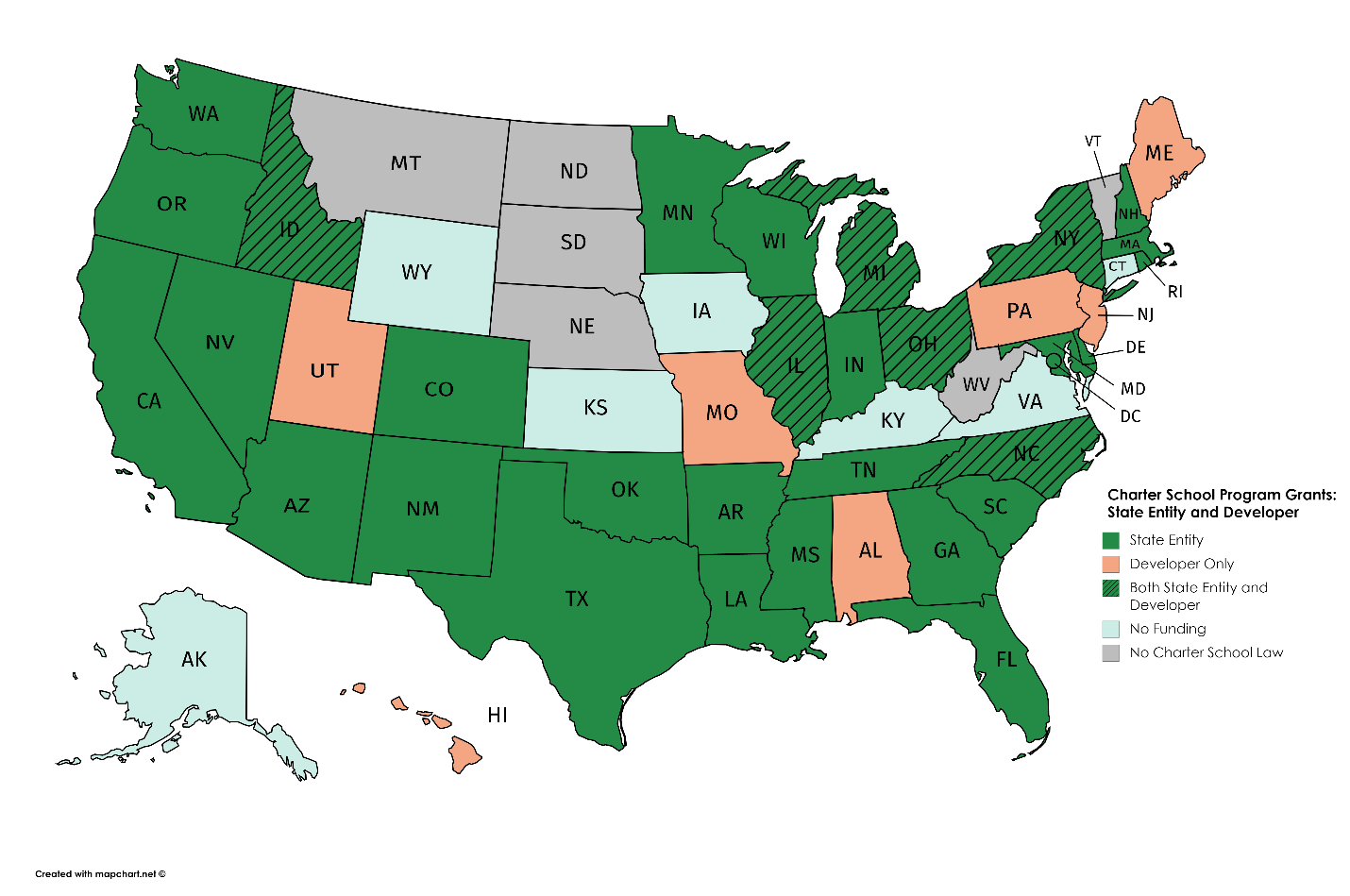
Congress appropriated a total of $400 million for these awards for FY 2018, including funds for active awards previously awarded. Due to increased funding in recent years, more states than ever have access to start-up funding—31 states have State Entity grants and charter schools in an additional seven states were successful in receiving Developer grants. Many states are also seeing charter school growth through grants to Charter Management Organizations for the Replication and Expansion of High-Quality Charter Schools, but awards were not made for that program during FY 2018.
This year, the program awards are a bit more complicated because, for the first time, two competitions were run under the new requirements in the Every Student Succeeds Act (ESSA). Let’s take a closer look at where the money went:

State Entity Grants: Funds to Open Charter Schools and Build Statewide Sector Quality

The State Entity grant program plays a key role in not only awarding subgrants to schools, but also providing funding for technical assistance and strengthening the quality of authorizers in a state.

  • Eight states received awards: Arkansas, Arizona, Colorado, Delaware, Idaho, Michigan, North Carolina, New York.
  • Five states were not successful: Alabama, D.C., Guam, New Hampshire, Puerto Rico.
  • Two Charter Support Organizations (CSOs) were funded: The new changes in ESSA unlocked CSP funding for non-state educational agency applicants, including CSOs. This year, two funded applicants from Arkansas and Idaho were CSOs.

At the close of this competition, 31 states (including D.C.) have a current CSP grant in their state (14 states with charter school laws are unfunded). Next year, nine states will likely have expired grants, which leaves a potential (although unlikely) pool of 24 applicants. If Guam and Puerto Rico are included, there will be 26 potential applicants.

Charter School Developer Grants: The Safety Net Program

This is the first year the competition has been run since the passage of ESSA. What is new is that there were two sub-competitions: one for replication/expansion grants, and the other for new charter school operators. There were 22 replication/expansion awards and 10 single site applicants. This year there were 32 funded applicants for a total of $30.2 million.
Ideally, this program would be obsolete. It is a safety for charter schools that wish to open in states that do not have a state entity program. If there was enough funding – and state capacity –  for every state with a charter school law to have funding, new charter schools could simply apply to their state. Instead, after obtaining their charter contract, schools need to jump through the hoops required by federal grants to access funding. So, until every state has adequate funding for start-ups in their state, this program will continue to play a key role in advancing charter school growth.
BUT—you may have noticed that some developer grants went to states that also got a state-entity award (Idaho, Illinois, Michigan, North Carolina, and New York). The reason for this is, in part, because ED ran the State Entity and Developer competitions at the same time this year, so Developer applicants didn’t know if their state would receive a State Entity grant prior to applying. ED did not deem those applicants ineligible even when their state ended up receiving a State Entity grant. In addition, some developers were awarded a grant for replication and expansion because their state didn’t have a State Entity grant that permits them to make such awards, such as Ohio (NCLB-era grants don’t permit such awards unless a state has an approved waiver).
Of states that don’t have a CSP State Entity grant, seven have schools that received Developer grants: Alabama, Hawaii, Maine, Missouri, New Jersey, Pennsylvania, and Utah have charter schools that received Developer grants. Eight states with charter school laws have neither State Entity nor Developer grants (not including Guam and Puerto Rico).

Current Charter Schools Program Grants: State Entity and Developer Grants
Credit Enhancement: Reducing Facility Costs for Charter Schools

The Credit Enhancement program awards grants to organizations to “enhance” charter school credit so that they can access private-sector and other non-Federal capital in order to acquire, construct, and renovate facilities at a more reasonable cost. This year early $40 million was awarded to four entities.
This is a significant decrease from the $56.2 million in awards for 2017. More funds were awarded last year, in part, due to the large pool of high-quality applicants and the needs of the sector. This year, appropriators restricted ED’s flexibility to fund additional applicants, so they were limited to $40 million. Unlike the other CSP programs, Credit Enhancement funds are a one-time allocation so there aren’t any continuation awards—the amount appropriated is the amount that goes out the door.

Dissemination: Advancing Accountability and Facilities Access

Like the Developer program, this was the first competition year for the new National Dissemination program under ESSA. Previously, this program was known as the National Activities program and had a somewhat broader focus. Under ESSA, the program is focused on the dissemination and development of best practices. This year, 8 grants were awarded to organizations and charter school operators for a total of $16.2 million over the grant period. There were two “buckets” of funding to which applicants could apply: charter school authorizing and charter school facilities. For FY 2019, we anticipate that ED will propose new priorities for this program.
The National Alliance is pleased to be a recipient of a Dissemination grant to establish the National Charter Schools Facilities Center to develop and disseminate best practices and reduce the burden of obtaining and financing charter school facilities.

Grants to Charter Management Organizations for the Replication and Expansion of High- Quality Charter Schools: A Delayed Competition

ED did not run a competition for the CMO Replication and Expansion program because the agency is required to propose and take public comments on new program rules under ESSA. Comments for the new competition closed on August of 2018 and the competition will open later this year or in early 2019. Congress knew that ED would need extra time, so FY2018 funds for this program didn’t expire on September 30—ED has until March 2019 to make awards. ED’s “forecast” indicates that the competition for this program will be announced in late November 2018 and applications will be due around the start of the New Year. $120 million is available, and a little more than half of that amount will likely be available for new awards.

Charter School Capital logoIf you are trying to meet operational expenses, expand, acquire or renovate your school building, add an athletic department, enhance school safety/security, or buy new technology, complete the online application below and we’ll contact you to set up a meeting. Our team works with you to determine funding and facilities options based on your school’s unique needs.


GET STARTED


Education Reform

Education Reform: The Lessons Learned and What’s in Store

Editor’s Note: This article discussing the need for a reinvention of public education and education reform was originally published here, by The 74, and was written by Robin Lake, Director of the Center on Reinventing Public Education as well as affiliate faculty at the School of Interdisciplinary Arts and Sciences at the University of Washington Bothell.
Robin shares her perspective (one we agree with) on our mandate as a country to prepare our children for a challenging economic future, enabled by new possibilities for an agile learning system that maximizes the potential of every student. Unfortunately, the current state of education does not support these goals effectively. So what have we learned? What’s working? What’s not? Lake provides some interesting perspective in this article.
We think it’s vital to keep tabs on the pulse of all things related to charter schools, including informational resources, and how to support charter school growth and the advancement of the charter school movement as a whole. We hope you find this—and any other article we curate—both interesting and valuable.
Read the complete story to learn more.


Robin Lake: On the 25th Anniversary of the Center on Reinventing Public Education, a Look at Lessons Learned & New Imperatives Ahead

At the Center on Reinventing Public Education, we are celebrating our 25th anniversary. We are thinking a lot about our principles and lessons learned.
At our core, we believe schools can make a difference even for the most disadvantaged children. To do that, they must be coherent — meaning they must be grounded in a set of explicit values, hold all students to high standards, provide academic supports, give students opportunities for meaningful relationships with adults, and demonstrate links between school and real life. They must be free to try different approaches and use time, money, and teacher talents differently. Since schools will differ, parents must be free to choose. And governance can and must protect students without making schools into incoherent bureaucracies.
We still believe in these principles and are still working to make them reality. Yet there is an even deeper principle beneath CRPE’s work: We know that no idea is so good that it will work exactly as expected. People who want to make a difference must keep their eyes open, expect surprises, and learn from them.
By following this last principle, we have seen many of our hopes and expectations about the value of charter schools and the power of citywide portfolio strategies confirmed. But we have also learned about their limitations. We see many current efforts to improve public education frustrated by political logjams. More than ever, we are driven by the imperative to prepare children for a challenging economic future, enabled by new possibilities for an agile learning system that maximizes the potential of every student.

Hopes and Expectations Confirmed

Over the past 25 years, we have seen that coherent schools have long-term benefits for students, into and through college. They can make teachers more effective — and happier, too.
A quarter-century ago, charter schools were mostly theoretical. The very first ones were operating in only a handful of states. Once criticized as likely bastions of privilege, they have created coherent educational environments for thousands of disadvantaged children, and thus become lifesavers. In districts with open-minded leadership, they can serve as educational laboratories and sources of innovative ideas, as the original visionaries suggested.
But charter schools do not have a monopoly on excellence. District-run public schools, given the right levels of autonomy and support, can specialize and become excellent.
We have also learned that low-income and poorly educated parents can make good choices. Just like advantaged parents, they seek the school where their child is most likely to be valued and motivated, not the one with the highest test scores. But disadvantaged families also need access to resources, including information and transportation, to exercise choice on an equitable basis.

Factors Limiting Progress

However, as we look across an educational landscape where progress is slowing in many cities and leading education policy thinkers are searching for new ways forward, we’ve also had cause to reflect on the factors limiting reform efforts to date.
In response to signals from funders and state regulators, charter schools have too narrowly focused on average test score gains and college acceptance rates. This has slowed innovation. And charter schools, once established, often begin to act like the status quo, resisting transparency, innovation, and accountability — the forces intended to drive continuous improvement in portfolio school systems.
At the same time, middle-class families often don’t see any personal benefit from charter schools and other forms of public school choice, and they can perceive these things as direct threats to the advantages they currently have. In a related vein, nobody in the school system wants to redistribute money, even when it is obvious that schools serving low-income and students of color get the lowest-paid teachers and meager support from district programs.
All this means leadership matters. Yet superintendents and school board members can simultaneously want coherent schools and take actions that remove school freedoms and reinforce a culture of compliance. Even when city leaders succeed in making progress by replacing weak schools with more coherent ones, continuous improvement cycles don’t necessarily continue forever, and key indicators like student achievement often plateau. This is in part due to political pressure to keep schools open and in part a failure to innovate further by looking at new ways to help students succeed.
A newer wave of efforts to transform public education to more individualized, engaging, and mastery-based classrooms too often fail to truly serve every student’s needs and — as our recent study showed — are stymied by the habits and rules of a system designed for sameness.

New Imperatives, New Possibilities

All told, we have learned that school coherency is necessary but not sufficient. Every student needs a learning environment that makes sense, where the parts add up. But tomorrow’s students will also need access to new skills and forms of knowledge that will determine their ability to adapt and thrive in a rapidly changing world. Schools will need to enable individual students to hone their talents and develop the special skills that can define their lives as earners and citizens. Students of every background will need these kinds of opportunities, especially those with the most disadvantages. To create new pathways to upward mobility, we must bridge institutional divisions, especially between K-12 and higher education, teach to the individual rather than the mean, and look outside the boundaries of today’s traditional schools to expand opportunities for students.
Today, we are releasing a volume of essays that begin to explore these new possibilities. We look forward to the conversation ahead.


Charter School Capital logoSince the company’s inception in 2007, Charter School Capital has been committed to the success of charter schools. We provide growth capital and facilities financing to charter schools nationwide. Our depth of experience working with charter school leaders and our knowledge of how to address charter school financial and operational needs have allowed us to provide over $1.8 billion in support of 600 charter schools that have educated over 1,027,000 students across the country. For more information on how we can support your charter school, contact us. We’d love to work with you!

LEARN MORE