Six Charter School Sustainability Tips from Experienced Charter School Leaders
We hope these six charter school sustainability tips help your team be more adaptable, strategic, data-driven, analytical, and efficient—all in support of your school’s continued success.
1. BE MINDFUL OF—AND ADAPTABLE TO—PIVOTAL MOMENTS
An active board member retires, a storm renders three classrooms unusable, a well-loved teacher leaves. It’s impossible to predict every circumstance that can disrupt a school’s operational rhythm and culture. The important thing is to acknowledge the disruption when it occurs and to have a plan to maintain operational and cultural continuity for your students no matter what.
2. UNDERSTAND THAT STRATEGIC ENROLLMENT = STABILITY
Mature-stage schools are past the point of increasing enrollment by 30 – 40% every year, and that’s great news. But remember: strategically increasing enrollment can be an effective way to ensure financial and operational stability. If you have staff and space in your facility, weigh the financial costs and benefits of recruiting a small number of students to every grade, in addition to the traditional focus on the incoming class of kindergarteners, sixth graders, or ninth graders.
3. CONTINUE TO FOCUS ON A DATA-DRIVEN CULTURE
Ensure that everyone, including students and parents, knows the goals for the academic year and can access school-wide metrics whenever they like. Keeping the goals and the metrics top of mind will help to keep everyone focused and let you know if you’re meeting key benchmarks along the way.
4. CELEBRATE YOUR SUCCESS AND VIEW FAILURES AS STRATEGIC OPPORTUNITIES
Celebrate every goal that’s achieved, award that’s won, and staff member that receives recognition. But look at the failures, too. That’s where your opportunities for improvement lie. Analyzing failures can be a great way to begin next year’s strategic plan.
5. DEVELOP THE PILLARS THAT DEFINE THE CULTURE YOU WANT TO HAVE
Look back at your charter; have you fulfilled the promises you made at the outset? Sit down with your team and think about the values at the core of who you are now and who you want to be in the future. Choose four or five pillars so students and staff can remember them, and give public recognition to any individual who goes out of their way to embody a value.
6. ASSESS ALL MANAGEMENT SYSTEMS REGULARLY
We’ve all been there—using a billing system that makes you grit your teeth or sitting through half a dozen interviews with unqualified candidates. At any school there will be frustrations on occasion, but schedule time to review and replace faulty and time-wasting systems whenever possible.
Click here to download this resource in single-page PDF format.
The Charter School Growth Manual
Whether you’re just beginning the process of starting up a charter school, looking to expand, or trying to prioritize your next steps, download this guide to get expert tips and pitfalls to avoid as you grow.
For this charter school resource guide, we turned to our wide network of charter school experts for best practices and strategies for success at every stage of maturity. All of the advice in this book comes from experienced charter school leaders who have been where you are now—they understand what you’re facing and the pitfalls to avoid.
Charter Schools: Parents Deserve the Right to Choose
Editor’s Note: This is an insightful opinion piece written by Raymond J. Ankrum, and was originally published on March 18,2019 by Citizen Ed, here. Mr. Ankrum is the current Superintendent of the Riverhead Charter School. Mr. Ankrum has gained notoriety as a school turnaround expert. He is enthusiastic about helping students from low (SES) find ways to end generational poverty through educational advocacy.
We think it’s vital to keep tabs on the pulse of all things related to charter schools, including informational resources, how to support school choice, charter school growth, and the advancement of the charter school movement as a whole. We hope you find this—and any other article we curate—both interesting and valuable.
Stop Blaming Charter Schools for the Failures of Traditional Public Schools
Let’s please stop blaming charter schools for school failure. I know we’re easy targets, but I assure you that education is just outright bad for [People of Color] PoC.
Pundits that are against charter schools and school choice have stated: “Black and LatinX parents aren’t smart enough to choose schools for their children.” To the individuals that are shaming these parents for choosing for their children, I say, “we’ve been down this road before.” Historically, we have always had folks telling us what’s best for us.
Regardless of where you stand on the school choice argument, the one fact we can’t debate is that parents have the absolute right to choose the education that best fits their children.
Healthy Competition.
Sports, occupations, politics, everyone has competition. The beauty of education is that no one model works for 100% of students. We are continually practicing new strategies to teach students.
“Parents are fed up with traditional public schools. They have watched these same schools fail generations.”
Recently, some have said that parents choose charter schools because they “don’t do their due diligence.” In fact, It’s 100% the opposite. Parents are fed up with traditional public schools. They have watched these same schools fail generations. Due diligence comes in the form of the generational poverty experienced by relatives that attended and continue to participate in these failure mills disguised as educational institutions. There is no better spokesperson than someone that has continuously failed at a task. The lived experience of these parents has to account for something.
Agree to Disagree.
We can agree to disagree on the intellectual prowess of those that seek school choice. As a parent that has chosen to educate my child in a charter school, I find it somewhat non-sensical that folks have the nerve to question me about my child and my decision. I’ve done my “due diligence.” Now what? You want me to put my baby, in a school that has failed generations? But, I’m the crazy one?
For the last three years, we’ve spent close to undergraduate tuition at a state school in NY, to ensure our daughter was ready for pre-K. I know many families are not as blessed to be able to allocate that kind of money towards their child’s education. However, these are the very families that need more than just a status quo education for their children. A quality education should help to break cycles of poverty, not continue to create them.
The Story.
Every school choice parent has a story. Every child of a “choice” parent that has attended a public school and no longer attends that school also has a story to tell. Instead of persecuting these parents, let’s find out their stories. Have you ever asked a school choice parent why they chose the school they selected? This type of dialogue would be far more engaging. It may also help to get to the root of the problem, and learn why certain schools no longer work for certain types of students.
The Nuance of Blame.
Let’s be real here. Charter schools are relatively new. Experts may disagree on the era in which public schools began to deteriorate. You have some that say public schools were never intentioned for Black and LatinX students. Wherever folks reside in the argument, we should all agree that public schools need to improve for minority students. If you’ve never stared poverty in the face, don’t talk to me about the choices I make for my child.
Enough of the Blame Game.
Okay, people. Let’s grow up. We have identified the problem. It isn’t charter schools. It is terrible schools. Now that we’ve identified the problem as bad schools, how do we fix them? Blaming the competition is not the answer. Admitting there is a problem, and committing to addressing the issue is the first step towards resolving it. Stop blaming charter schools. We need genuine and thoughtful dialogue. Enough with this “let’s blame charters” argument because it is getting tired.
Since the company’s inception in 2007, Charter School Capital has been committed to the success of charter schools. We provide growth capital and facilities financing to charter schools nationwide. Our depth of experience working with charter school leaders and our knowledge of how to address charter school financial and operational needs have allowed us to provide over $1.8 billion in support of 600 charter schools that have educated over 1,027,000 students across the country. For more information on how we can support your charter school, contact us. We’d love to work with you!
National Charter Schools Week: How We’re Celebrating Amazing Charter Schools
It’s the beginning of National Charter Schools Week and what better way to celebrate than to share some amazing charter school stories and images from our 2019 Charter School Honor Roll! We were blown away by the inspiring, not-enough-positive-words-to-say-about-them, submissions for this year’s Charter School Honor Roll. Selecting just 30 winners out of the hundreds of submissions across the five categories was no easy task, to be sure. This blog post hopefully pays homage to just some of the amazing submissions that we’ve received from across the country.
Note: The photos below are in no particular order, just a compilation of some of the great photos that were sent in with submissions. And, for the sake of brevity, the submission excerpts below may not be the submission in its entirety.
Charter School Growth
Kenner Discovery Health Sciences Academy, Louisiana
In its first year of operation the school welcomed 420 students in grades PreK-3rd, 5th, and 6th. Now, in its sixth year, the school has a bustling student body of 1,536 students in PreK-11th grade. Since its opening Discovery has had an active wait list of over 1,000 students. ~2019 Honor Roll Winner: School Growth
Towpath Trail High School, Ohio
Towpath Trail High School is dropout recovery high school located in Akron, OH. It is managed by Oakmont Education and served just over 100 students in 2012. Towpath recently opened a satellite campus and now serves just under 500 opportunity youth across its two locations. Towpath also recently opened a career tech wing where students can earn industry credentials in the fields of Healthcare, IT, Construction, and Manufacturing. Oakmont and the school have partnered with Habitat for Humanity and the construction students have just begun work on building a new house in the community that when complete, will go to an under-resourced local family. Academically, the school has met standards on Ohio LRC and has grown its number of graduates each of the past 6 years. And the school’s growth has allowed the board to purchase both buildings. Towpath is making a difference in the lives of hundreds of students who are the definition of “at risk” and they’re making a difference in the Akron, OH community. They’re doing this by providing a safe environment with a multitude of wraparound services, helping students earn a high school diploma that most think is out of reach, and by offering industry credential career tech pathways in high need fields that provide opportunities for jobs paying living wages immediately upon graduation.
~2019 Honor Roll Winner: School Growth
Charter School Leadership
Mission View Public Charter, California
Principal Berry has demonstrated leadership and vision geared toward increasing student learning through academic integrity. She does not want her students to simply “get through” their courses, she wants them to grow through their coursework. This is evident through policies and procedures she has put into place to ensure academic integrity. ~ 2019 Honor Roll Winner: School Leadership
Amana Academy, Georgia
Mr. Ehab Jaleel, has shown a dedication to not only his students and staff but also to the greater community. They are actively looking to replicate their model (Number 1 STEM Certified K-8 School in Georgia) to offer their model in underserved areas of Metro Atlanta.
~2019 Honor Roll Winner: School Leadership
Compass Charter School, California
Compass Charter School Leadership is built from a team. Of hard-working, inspirational and highly capable leaders. Amir three years ago the school was on the verge of closing. One of the board members, Jay Luis, took over as CEO and has turned the organization around closing underperforming campuses and increasing enrollment substantially. JJ Lewis and compass charter schools could be equally nominated for growth and strong leadership. In fact, it is difficult if not impossible to grow a school without strong leadership. I have had the pleasure in the honor of working with JJ for the last few months and find that he had he is compassionate and empathetic but also drives a hard bargain. Compass leadership is the type of leadership that is always a joy to work with. ~2019 Honor Roll Winner, School Leadership
Positive Charter School Climate
The Bronx Charter School for Better Learning, New York
BBL has developed an inclusive community and culture that contribute to an exemplary school climate of scholarship, connection and high achievement. Productive relationships lie at the center of all action where the school fosters trust and gratitude filled relationships between staff within their schools, across locations and also with neighbors within co-located space. Knowing that learning, progress and development do not occur in spaces of discomfort, BBL goes above and beyond to ensure their staff and students are happy. ~ 2019 Honor Roll Winner, Positive School Climate
Pine Springs Preparatory Academy, North Carolina
At Pine Springs Preparatory Academy, teachers have their students work both collaboratively and individually in the classroom, promoting teamwork, as well as independence. With an unwavering respect for discipline, the PSPA classroom is very demanding yet vastly rewarding.” When asked about Pine Springs, students respond that the school provides project-based learning experiences, a safe learning environment, discipline and rigor. The school gives them opportunities and is focused on relationships. Pine Springs teaches students to have ownership and be critical thinkers in a global world. The mayor of the town shared at a ceremony that Pine Springs is the only school in town he does not get complaints about which is a direct result of a positive school climate and the heart each staff member gives to such an amazing school. ~2019 Honor Roll Winner, Positive School Climate
Community Service
Early College High School, Delaware
HIA works hard throughout the year to “multiply good” through its participation with the Jefferson Awards’ Students in Action program. This past school year, HIA has completed multiple service projects. It’s Hoops for Hurricanes in October raised funds for an Early College HS in South Carolina where many of the students were negatively impacted by the hurricane. In addition to collecting donations, HIA organized a basketball tournament where many in the ECHS community participated or helped out. HIA has also raised funds for Delaware Coalition for Prostate Cancer through a “No Shave November” fundraiser, collected cans for the Delaware Food Bank, volunteered with the Special Olympics’ State Bowling Tournament, helped promote other organizations’ fundraisers like Wreaths Across America and Rock Your Socks, and also organized a Candygram sale for Valentine’s Day. The proceeds from the Candygram sale fund the HIA care package project to benefit Shepherd Place, a family homeless shelter in Dover, DE. ~ 2019 Honor Roll Winner, Community Service
Leadership Prep School, Texas
Leadership Prep School (LPS) empowers students to be servant leaders. Teachers and students have both taken the initiative to create community service projects. Each year, LPS computer science high school students raise money to purchase computer parts, build desktop computers from scratch, and donate the computers to “make an authentic impact.” For the past two years, students have chosen Computer for the Blind as their charity. The unemployment rate for blind people is 63%, so many cannot afford computers. Donating 17 computers provides online access to individuals who were otherwise disconnected because of blindness. This past fall, seventh-grade math/science students from LPS used their project-based learning assignment to raise $1500 to battle childhood cancer. The students worked in teams and used math ratios, business math and chemistry to create the best slime to sell at the school carnival. They donated $1500 raised from the sale of the slime to Team Connor whose mission it is to raise funds for childhood cancer research and inpatient programs. A team of fourth graders pitched the idea of a buddy-to-buddy peer mentoring program where fourth graders would partner with two to three kindergarten or first-grade students to help them with English / Language Arts learning. LPS elementary principal, Michelle Creamer, said that when the students approached her with their idea, she provided them with guidance and suggestions, but ultimately she left the coordination and implementation of the project to them. LPS Fourth-grader pitched a service project idea to his teachers, principal, and classmates after his family contributed to World Vision to purchase farm animals to provide food and income and help build sustainable communities across the globe. With his classmates, they launched a school-wide fundraiser and exceeded their goal of raising $2720 to purchase 28 farm animals in less than three weeks. ~2019 Honor Roll Winner, Community Service
Charter School Student Achievement
Signature School, Indiana
Signature School, Indiana’s first charter high school founded in 2002, focuses its International Baccalaureate (IB)-based curriculum on fine and performing arts, science, technology, mathematics and the liberal arts. Signature, an open-admission high school, believes all students, given proper support, are best served by high expectations. All, regardless of GPA or test scores, are expected to be IB diploma candidates. In May 2018, 361 Signature students sat for 999 Advanced Placement (AP) exams. 198 Signature students were designated AP Scholars by College Board in recognition of their exceptional achievement on the AP exams. 89% of seniors participated as IB diploma candidates. Signature continues to expand student achievement opportunities, becoming an AP Capstone school in 2018. All students take AP Seminar and AP Research courses; all are eligible to earn the Capstone Diploma. The Class of 2018 included three National Merit Finalists and six Commended Scholars, roughly 14% of the total graduating class. 92% received the Indiana Academic Honors Diploma. This class also collectively performed 7,894 hours of community service and generated $22.6 million in scholarship offers. Beyond the classroom, Signature’s participation in national science fairs continues to grow. Two sophomores participated in the Intel International Science Fair in Pittsburgh. Another advanced to round two in the highly competitive American Mathematics Competition for the second year in a row. Signature’s success has been consistently recognized by respected national publications. The Washington Post ranked Signature the third Most Challenging High School in the nation, and US News and World Report ranked Signature the 17th Best High School nationally. Thank you for the opportunity to nominate Signature School, which consistently exemplifies student achievement through its emphasis on rigor and excellence in academics, the arts, integrated technologies and community service. ~2019 Honor Roll Winner, Student Achievement
RISE, Colorado
At RISE, we address social injustices while valuing scholar identity through innovative planning and “empathy” interviews. As a college prep school, we serve all scholars whether gifted, Emerging Bilingual, scholars with Individual Education Plans (IEP) and/or scholars in our Multi-Intensive center. Therefore, the category of “Student Achievement” looks different at each level, but one thing that remains true for all scholars is experiencing achievement that is meaningful. Examples of scholar achievement at RISE include (but are not limited to): an outstanding 11th grader winning the Marshall-Brennon Moot Court Competition and heading to the national competition in D.C. while his peer, a member of the Colorado Youth Congress, will be speaking with Denver’s new superintendent about important issues facing our community. One of our oldest scholars, who has an IEP, completed necessary coursework to begin his alternate path to graduation, which included securing part-time employment; he is also the lead in the school musical. One scholar testified at the Colorado State Capitol on HB-1032 and then weeks later won 2nd Place at the State Speech Championships. An unmotivated scholar has made tremendous progress in controlling his explosive anger by practicing coping skills and has even started encouraging his peers to find better paths when they fall off-track. A young woman scholar in our Multi-Intensive center informed staff about what she felt was a violation of her personal space and comfortability and, in a formal meeting, advocated to get her schedule changed to feel safe at school again. Two other speech & debate scholars took 2nd place in Duo and Drama at State in our very first year in CHSAA. Finally, a small group of 11th graders partnered with their teacher and principal to co-create a new course entitled Life 101 where scholars earn civics & economics credits via real-world simulations. ~2019 Honor Roll Winner: Student Achievement
To see the complete list of this year’s winners, click here!
And be sure to join in the National Charter Schools Week conversations! Our team will be following along and featuring some of the happenings and activities on our social channels including Facebook, Twitter, Instagram, and LinkedIn.
Since the company’s inception in 2007, Charter School Capital has been committed to the success of charter schools. We provide growth capital and facilities financing to charter schools nationwide. Our depth of experience working with charter school leaders and our knowledge of how to address charter school financial and operational needs have allowed us to provide over $1.8 billion in support of 600 charter schools that have educated over 1,027,000 students across the country. For more information on how we can support your charter school, contact us. We’d love to work with you!
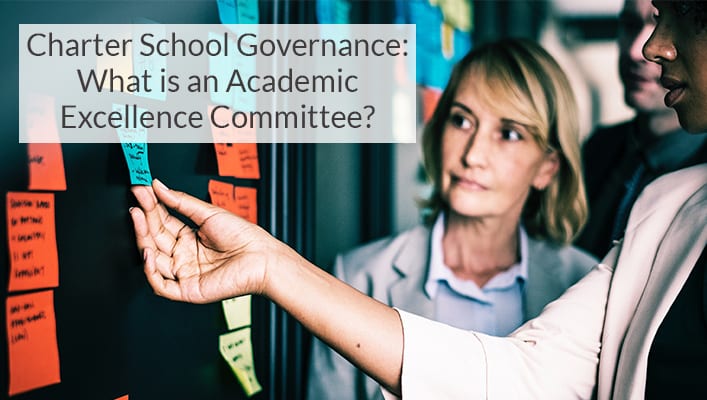
Charter School Governance: What is an Academic Excellence Committee?
EDITOR’S NOTE: We’ve curated this informative post from our knowledgeable friends at BoardOnTrack and was originally published here. BoardOnTrack is the platform, partner, and community empowering charter boards and executive leaders to reach a higher bar, together.
They equip trustees with a powerful combination of data and proven practices to govern for growth, without drowning in the details that form the underpinnings of good governance. You can learn more about how their platform can help you to build a better board, a board that enables sustainable growth for exceptional results, here.
We hope you find this—and any other article we curate—both interesting and valuable.
What’s an Academic Excellence Committee?
Academics are at the very heart of your organization, and your board is focused on ensuring nothing short of excellence.
The Academic Excellence Committee is absolutely essential to providing the necessary level of support and oversight required to successfully govern a multimillion-dollar public organization.
Key Responsibilities of an Academic Excellence Committee
The committee’s primary responsibilities are to:
Ensure that the full board and the CEO have a shared vision of academic excellence and a clear road map to achieve it
Ensure that all trustees understand the academic promises in the charter and accountability plan — and how well the organization is performing against those promises
Educate the full board to conduct proper oversight of the academic program
Sample Academic Excellence Committee Goals and Tasks
As with any committee, your Academic Excellence Committee’s work should be organized around goals and tasks.
One of your committee’s primary goals might be: Develop a process to educate and train the full Board on proper academic oversight by March 1st. Submit growth plan to authorizer by March 1st deadline.
And, to ensure you meet that goal, you might assign specific committee members the following tasks:
CEO and leadership align on key academic indicators of success.
Chief Academic Officer {CAO} drafts presentation outlining the academic vision of excellence and key indicators of success.
Committee reviews presentation at its next committee meeting and discusses training/education plan.
CAO and committee chair reserve time on next month’s board meeting agenda for training.
Best Practices for Making Your Academic Excellence Committee a Success
Understand the Role and Functions of this Committee
The main purpose of the academic excellence committee is to measure the academic results of the organization against the goals established in the organization’s charter, accountability plan, and annual CEO goals.
In one sense, the Academic Excellence Committee is similar to the Finance Committee. Both exist to monitor performance against stated goals. For the Finance Committee, this means measuring financial results against the budgeted goals. For the Academic Excellence Committee, this means measuring organizational outcomes against stated goals for metrics such as:
performance on state tests,
performance on nationally normed standardized tests (e.g., the TerraNova, SAT 10, etc.)
performance on interim assessments (e.g., Achievement Network tests, the STEP, the DIBELS, or interim assessments created by the school).
In addition, this committee may look at budgets to actuals on metrics such as attendance, student and staff retention, and family and staff satisfaction surveys.
Focus on Outputs Rather Than Inputs
One of the biggest pitfalls for Academic Excellence Committees is to engage over inputs—the means by which the organization pursues its mission, rather than outcomes — the objective data used to assess how well the organization is meeting its mission.
Inputs are management-level issues, which should be handled by the CEO.
Outputs are what the board should be focused on and governing towards.
The best Academic Excellence Committees help CEOs set clear goals for the year, by building on outcomes that are related to the mission. They then set up check-ins throughout the year, at which they meet with the CEO to monitor progress towards those goals.
Your Committee Members Don’t Have to be Educators
While it can be useful for some members of the Academic Excellence Committee to have a background in education, it is by no means necessary in order to participate meaningfully.
Many effective Academic Excellence Committees don’t have educators on the committee.
We find that the key functions of the committee — helping the CEO to set ambitious goals and then monitoring data to assess progress towards those goals — are often well met by people with strong analytical skills. These people need not be educators.
The best Academic Excellence Committee members are those who are very analytical, are great at digesting data and asking good questions, and do not have to have an academic background.
Keep Your Focus on Board-level Work; Not Management Level
Academic Excellence Committees should not be involved in management-level work like:
evaluating teachers
selecting, designing, or reviewing the quality of curricula
planning professional development for teachers
interacting with teachers or other staff members on a regular basis (i.e., daily or weekly)
interacting with families or students on a regular basis (i.e., daily or weekly)
presenting themselves as an outlet for staff, family, or student complaints or concerns that have not first been formally addressed to the CEO
Your organization strives for academic excellence. Having a strategic Academic Excellence Committee in place provides the necessary support for optimal growth.
Want to learn how to recruit, build, and manage your Board as you grow?
Join us Thursday, May 16th, 2019 at 9:00 a.m. PT/ 12:00 p.m. ET for an exclusive webinar:
Board Governance 101
For your school to reach its goals, meet its mission, and be set up for success, you need to build a well-structured, well-staffed, and well-trained Board of Directors. In this important webinar, our partners and industry experts on Board Governance, Board on Track, will be sharing their expertise on the ins and outs of recruiting, building, and managing your governance team as you grow.
Join us and learn:
Board basics: Who should be on your governance team and what should they do?
How to build a strong board: Strategically recruiting for diversity and skills
Tips to govern for growth: How to face challenges and changes at any stage
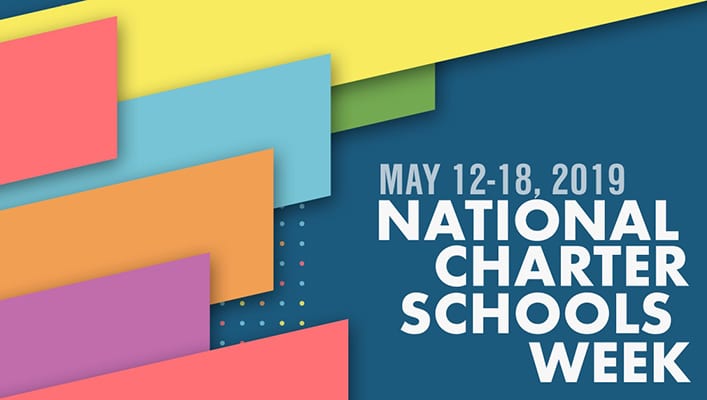
It’s Almost National Charter Schools Week—Are You Ready?
Get ready for it! National Charter Schools Week is May 12-18, 2019 and we’re excited to take this opportunity to help recognize and raise public awareness for charter schools, school choice, student success, and the charter school movement as a whole. This is a time for charter school leaders, students, parents, and advocates to come together and showcase the amazing things that charter schools are doing.
About the Charter School Movement
The charter school movement has been growing steadily since the first charter law passed in 1991 in Minnesota and the first charter school opened in 1992. To date, 44 states (D.C., Guam and Puerto Rico) have charter laws, 3.2 million students attend charter schools, and there are over 7000 public charter schools nationwide receiving $400 million in Federal CSP Funds. Charter schools currently employ 219,000 teachers.
This Year’s Theme
This year, during National Charter Schools Week, the National Alliance for Public Charter Schools theme is “Charter Schools Are…” because each charter school is unique in how they serve their students, families, and communities—and because we all have a different definition of what charter schools mean to us.
The National Alliance for Public Charter Schools is encouraging schools and advocates alike to join in the celebration by hosting/attending local rallies, inviting elected officials to classroom visits, and sharing your voice through blog posts, media outlets, and social media posts. Learn how you can get involved with some great ideas and templates from the National Alliance here.
Get some shareable facts and learn about the state of the charter sector in this recent information-packed blog post!
Get Social and Start Sharing!
Our team will be following along and featuring some of these National Charter Schools Week activities on our social channels including Facebook, Twitter, Instagram, and LinkedIn.
We invite you to join the conversation as well by using the hashtags #CharterSchoolsWeek and #WeLoveCharterSchools so we can help amplify your voice and the voice of the movement!
Since the company’s inception in 2007, Charter School Capital has been committed to the success of charter schools. We provide growth capital and facilities financing to charter schools nationwide. Our depth of experience working with charter school leaders and our knowledge of how to address charter school financial and operational needs have allowed us to provide over $1.8 billion in support of 600 charter schools that have educated over 1,027,000 students across the country. For more information on how we can support your charter school, contact us. We’d love to work with you!
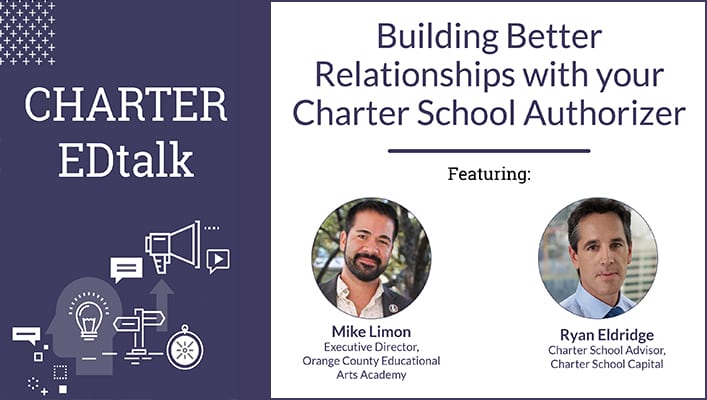
Tips on Building Better Relationships with Charter School Authorizers
For this episode of our CHARTER EDtalks, Ryan Eldridge, one of Charter School Capital’s Charter School Advisors, had the honor of sitting down with Mike Limon, Executive Director at Orange County Educational Arts Academy (OCEAA), to discuss actionable tips for building better relationships with charter school authorizers.
To learn the tips on how to build better relationships with your charter school authorizers, please watch the video or read the transcript below to get the full story.
Building Relationships with Charter School Authorizers
Ryan Eldridge: Hello there and thank you for joining us in this episode of CHARTER EDtalks. I’m Ryan Eldridge, Charter School Advisor for Charter School Capital, and I’m honored to be joined by Mike Limon, Executive Director at Orange County Educational Arts Academy (OCEAA). And we’re going to be discussing building better relationships with charter school authorizers. Mike Limon: Great. Eldridge: So, thank you, Mike, for joining us. We appreciate it. Limon: Thanks for having me. Eldridge: Why don’t we just jump right into it. Limon: Sure.
Breaking Down Barriers, Collaborating, Accountability
Eldridge: The first question is, “Can you define what building better relationships with charter authorizers means to you?” Limon: Sure. So before even I dive into that, I want to give a big thank you to the Santa Ana Unified School District. They’ve been great at getting me up and running because this is year one for me as executive director.
So, I’m definitely excited to dive in, learn, and build relationships. And so, with that, the bigger topic is the students. We’re here to educate all students, whether they’re in a public charter school, a traditional school, a private, a Catholic school, etc., whatever. We’re here to educate them together. And so, with that, the word in my mind that pops up is collaboration. Let’s break down those barriers and truly collaborate together as the authorizer and the public charter school.
We want to work beyond just our traditional responsibilities that board members have. There’re responsibilities that they’re held accountable to, and I have my responsibilities that I’m held accountable to. Let’s not lose sight of how we can go beyond those responsibilities and build a tighter relationship to educate all our students in our district.
A lot of folks have this very transactional process or experience with their charter school manager or their authorizers, or the board themselves—very transactional. I want to break beyond that and truly build a partnership with them to figure out how to elevate our students to the next level.
How to Build Those Relationships
Eldridge: What does effective relationship-building look like?
Providing Feedback
Limon: People traditionally just go in and submit interim budget reviews or attendance reports, just check the box off. For me, again, I want to break down those barriers, get to know who these people are that sit on the board, and also the folks behind the scenes. The assistant superintendents, the charter school manager, or whatever their title is, breaking that down and building processes together, because I know that the school districts are also trying to systematize their processes.
And even, for example, in Santa Ana, they just started using this new tool called Epicenter, and so I think its year one for them, if I’m not mistaken. But I know that they’re also trying to figure out how it works, how to systematize it, how to make it better for both users. I know that it’s a brand new tool, so for them, they want to go in and try to customize things.
If you don’t give them constructive criticism or feedback on how to elevate their processes, we’re not going to get anywhere versus just submitting your traditional transactional paperwork, etc.
One of the things I’ve learned in working with them … and I call them. I email them. I text them when I need something or just education as well, because we’re cross-educating each other.
They don’t know what our challenges are either because they’re not in our shoes every day throughout the year. They come in maybe twice a year, check out the school, that kind of thing. But if we’re not giving them feedback, we can’t help them help us make our jobs easier.
Because at the end of the day, charter school teams are pretty small, and so to be able to have another informal colleague on the other side supporting you and cheering you on, you can’t really get anywhere. Again, it’s a very fast-paced environment as well. If you’re not creating constant touchpoints or conversations, you can’t really elevate processes.
Build relationships at the city, county and state level
Limon: The other thing, too, that came up with this conference—and this was only day one—is the notion … because my authorizer is Santa Ana. We’re in Santa Ana, so for us, it’s easy to just quickly build relationships with them.
But also, at the county level, that’s something that is a best practice. You should be building relationships with them as well if you have a city authorizer. We forget.
We focus all our energies on developing those relationships with the city, but we lose sight that we also should be building relationships at the county level and even at the statewide level as well because sometimes, even in Santa Ana, they may not have answers to some of your questions.
To be able to have someone that you can call at the state level, at the county level, that you already built relationships with … because sometimes you might be down to the wire trying to get some things done, and you definitely need that support to try to answer that question.
Just building processes together to be more effective in the long term. You’ve got to plant the seed to gain the results a year later. If you start now and have those meaningful touchpoints and help them help you, it’s definitely very effective.
If you build it, will they come?
Eldridge: Can you give me a few examples of how you can collaborate with a charter authorizer in the school board? Limon: I’ll start off with very simple things first, and then I’ll dive into some recent things that have just come up as far as opportunities for me.
You know your traditional site visits; have coffee, get them to come to your events. Constantly invite them out. It’s going to be really hard to get them on your calendar because, especially for Santa Ana, our district is pretty large and there’s constant events happening at their schools. And there’s fundraisers and “munch and learns” and etc. I see all kinds of formats of events.
Just get them to come out to your school, let them get to know who your students are, who your teachers are, who the families are … because there’s all these misconceptions about the people that we serve at our charter schools. And for our school, for example, we’re about 86%, 87% Latino/Hispanic students that we serve. The misconception in the community is that it’s the other way around, very low Hispanic rates that we serve, which is completely wrong.
For us, to get them to come out … and it doesn’t have to be a school board, it could be some other staff, maybe even some other teachers to come out and see who we are so that as they’re telling the story about OCEAA in the community and they have a good understanding [of who we are].
They’ve been in the classrooms. They’ve seen the parents. They’ve engaged with them. That’s definitely something I’m going to be really pushing for the next year.
It’s going to take a lot of work because even just for you guys as service providers, to be able to educate people in your programs and get people to come in and learn about the services you offer, it takes a lot of work. It’s kind of that similar situation, so I’m going to have to work my butt off to try to get them to come into our buildings.
One other thing that, for me, I’m lucky I’m in downtown Santa Ana, we have food, great food, throughout the city that we’re in. Just trying to get them on the calendar to come to break bread with me would also be an easy ask. They’re breaking bread at a very yummy place that’s maybe not so hoity-toity. And that builds that relationship a little further.
Do your homework, get involved, and get connected!
Limon: A lot of them are also very involved with community organizations or non-profits in the Orange County area. For example, the Orange County Hispanic Chamber of Commerce, the National Latina Business Women Association. There’re these ethnic organizations that these board members of Santa Ana support and maybe even have leadership roles in, which I’ve been doing for the last decade or so. I’m on the board of the California Hispanic Chambers of Commerce here in Sacramento. And there’s all this synergy happening to elevate Hispanic youth or even leaders already in the community supporting each other, paying it forward.
Doing some homework with regards to where you are in the nation or California on where these board members spend the rest of their time.
Do they support other organizations?
Figure out what interests them and work with them to build that relationship aside from your day-to-day responsibilities, like I was mentioning earlier, get to know them on a personal level and start to build that relationship, because, as we all know, we’ve got those interim budgets, the renewal. There’s all this compliance that we have to do. If you start building those relationships and even planting the seed or even asking, “Okay, so for this year, for the renewal this time around, what are the things that we need to start preparing for?”
Because it’s probably a good time to start preparing for that renewal. You never know with all the laws that come up and those constant changes. To be able to have someone to call on really quickly versus at the last minute, 30 days coming up, you’re probably scrambling, and you don’t really have any relationships that you’ve established, that’s going to be a huge challenge for these folks.
Again, community relationships, building those processes, those collaboration opportunities, get to know who they are.
And then something that just happened recently with me is the school board president just invited me to be a principal for the day at one of their schools, and I feel so honored. So, thank you, Santa Ana. But to get that opportunity to go and be an admin at one of their schools as a charter leader, I think that’s a home run right there. Eldridge: Absolutely. Limon: And it goes back to all the work that I’ve been doing over the last few months and trying to build relationships with them, supporting them. Of course, there are only so many hours in the day, and I would love to duplicate myself and get out to more events and support them. But you have to have that balance because you don’t want to burn yourself as well at the end of the day.
It’s been quite the ride so far, and I’m looking to see what the future holds in partnership with you guys. You guys have been great as educators, educating our school on different opportunities and how we can focus on our facilities because that’s a big challenge as well for other organizations out there. I didn’t realize that.
Even for us, for example, we had a short-term challenge with flooding with all these rains. And so, you quickly get a reminder about the importance of facilities. And so, we’ve been chatting just recently about how we can elevate our school with your support. Eldridge: Well, great. Well, that wraps up this episode of CHARTER EDtalks. Mike, thank you very much for joining us. We appreciate it. Limon: Thanks for having me. Eldridge: And hopefully it was beneficial to you viewing out there. Take care.
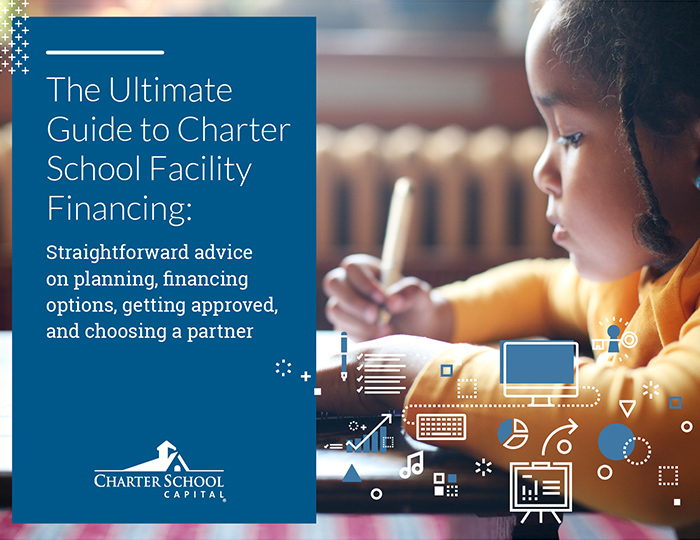
The Ultimate Guide to Charter School Facility Financing:
In this CHARTER EDtalk, Mike chatted about potential upcoming facilities projects he’s considering. Are you thinking about a new facility for your charter school or enhancing your current one? This guide shares straightforward and actionable advice on facilities planning, financing options, getting approved, choosing a partner, and much more! Download it here.
Charter Schools Are A Better Investment Than Traditional Public Schools
Editor’s Note: This article was originally published here on April 9, 2019 by the New York Post. It was written by Patrick Wolf, a distinguished professor of education policy and holds the endowed chair in school choice at the University of Arkansas and Corey DeAngelis, a policy analyst at the Cato Institute. It examines which type of public school — traditional or public charter — delivered the most academically cost-effective education.
We think it’s vital to keep tabs on the pulse of all things related to charter schools, including informational resources, and how to support charter school growth and the advancement of the charter school movement as a whole. We hope you find this—and any other article we curate—both interesting and valuable.
Case closed: Charter schools deliver more education ‘bang’ for the buck
Polls show that most Americans think our public schools deserve more funding. Meanwhile, each year, states and school districts make choices about how to spend the education funds that they have. Doesn’t it make sense for them to invest in schools that work — schools that help students learn the most with the lowest burden on taxpayers?
Several years ago, we began researching which type of public school — traditional or public charter — delivered the most academically cost-effective education. In a 2018 report, we examined eight cities: New York City plus Atlanta, Boston, Denver, Houston, Indianapolis, San Antonio and Washington, DC.
While their sizes and demographics vary widely, each city has a substantial concentration of students enrolled in charter schools. In every city, we found that charter schools were more productive — that is, they yielded more learning per education dollar spent than traditional district schools.
Students enrolled in New York City’s charter schools scored roughly 12 points in reading on the 2015 National Assessment of Educational Progress, or NAEP, for every $1,000 invested in those schools.
By contrast, students in the city’s traditional public schools produced about 9.5 NAEP reading points per $1,000 invested, generating a cost-effectiveness advantage of 24% for charters in the Big Apple. The results for math were similar: More than 13 NAEP points per $1,000 of funding for charters compared to almost 10.5 points for traditional schools.
We also discovered that Washington, DC, charters were 67% more cost-effective than traditional schools. Indianapolis charters bested their traditional counterparts by 65% on the productivity measure.
This year we revisited the same eight cities to see if the trend had continued. It had. Once again, the charter schools in each city proved more cost-effective. Public charter schools in New York were 25% more cost-effective than the city’s traditional public schools in producing 2017 NAEP reading scores and 26% more cost-effective in generating math scores.
San Antonio charter schools, to take another example, were 29% more cost-effective in math and 30% more cost-effective in reading than traditional schools. Washington charters were 43% more cost-effective in both subjects. The results for each city are detailed in our report, “A Good Investment: The Updated Productivity of Public Charter Schools in Eight U.S. Cities.”
We recognized that NAEP scores represent only a snapshot of academic performance. So we were curious what long-term academic results would reveal.
By calculating the average amount of learning at traditional and charter schools, the economic returns to those learning levels over the average lifetime, as well as each type of school’s total per-pupil funding over the course of a K-12 education, we were able to calculate the return on investment, or ROI, delivered by each type of school.
In all eight cities, we found that charters delivered a greater lifetime ROI. For each dollar invested in a student enrolled in traditional schools, that student secures $4.41 in lifetime earnings. The same dollar invested in a student enrolled in charter schools yields $6.37 in lifetime earnings for that student.
Public charter schools’ ROI exceeded that of traditional public schools by an average of 53%. Atlanta charter schools yielded an ROI that was 102% greater than traditional schools. Indianapolis came in second, with charters’ ROI 73% greater than traditional schools, followed by Washington charters at 58% and Boston charters at 53%.
The ROI for learning generated in New York City charters was 29% higher than the ROI in the traditional public schools in the city.
Elected officials and policymakers have a choice about where to invest educational resources and a responsibility to invest wisely. Charter schools are, simply put, a good investment. Our findings are just one more reason why lawmakers in Albany should raise the cap on charters in New York City and give the more than 53,000 Big Apple families on charter waitlists the chance to get the sound education they deserve.
If you are trying to meet operational expenses, expand, acquire or renovate your school building, add an athletic department, enhance school safety/security, or buy new technology, complete the online application below and we’ll contact you to set up a meeting. Our team works with you to determine funding and facilities options based on your school’s unique needs.
Your Ultimate Guide to Charter School Facilities Financing
If you clicked from somewhere to read this blog post, you probably already feel that finding charter school facility financing finding or locating the perfect facility for your charter school is a huge, complicated undertaking. Not to worry, you’re in good company. We understand that most charter school leaders aren’t financial or real estate experts, and for a good reason—you’re focused 100% on educating children. And, you want the best for them. Planning and financing any facility project is complex, time-consuming, and has the potential to distract your team from its core mission: serving your students.
Across the U.S., accessing charter school facilities is, by far, the greatest challenge faced by charter schools. In addition, planning and financing any facility project is complex,time-consumingg, and has the potential to distract your team from its core mission: serving your students.
We’ve created this manual to share our insights and perspectives on the charter school facilities landscape market and also share advice on planning—and realistically balancing—your team’s facility dreams with budget realities.
In it, we also cover the four primary funding structures that charter schools use to finance facilities: cash, banks, bonds, and long-term leases.
It can indeed be a complicated endeavor and that’s a key reason as to why it’s so important to find the right funding partner to help guide you through the process and help you succeed. Charter School Capital is 100% dedicated to charter schools and has years of experience in navigating the unique needs and challenges they face. We have helped schools achieve their facility goals using each of those methods—and we’ll help you determine which options might be the best fit for your school’s unique situation.
Over the past ten years, we’ve invested almost $2 billion in more than 600 charter schools to help them grow, finance facilities, and achieve academic excellence and operational stability. We view ourselves as a long-term partner of charter schools and a strong advocate of the charter school movement.
Download this free guide to get all of your facilities questions answered!
In it, you’ll get straightforward, actionable advice on:
If you are trying to meet operational expenses, expand, acquire or renovate your school building, add an athletic department, enhance school safety/security, or even buy new technology, complete the online application below and we’ll contact you to set up a meeting. Our team works with you to determine funding and facilities options based on your school’s unique needs and mission. Contact us, we’d love to get to know you.
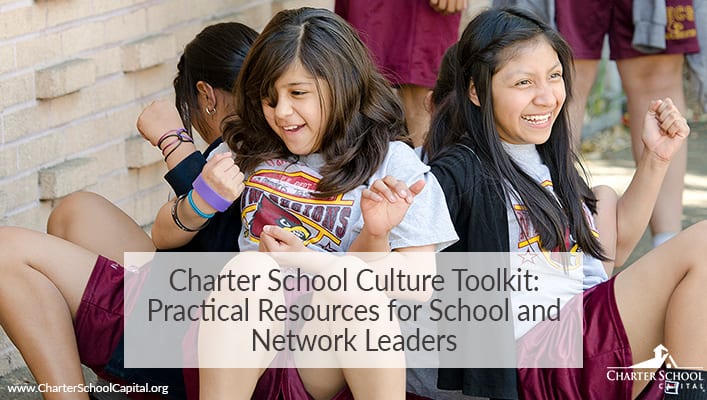
How to Build Positive Charter School Culture: Toolkit for Schools and Network Leaders
Editor’s Note: Building a positive school culture in your charter school can help students achieve more, build morale among both staff and students, and attract and retain exceptional teachers, among other key benefits. This outstanding content is from the National Alliance for Public Charter Schools and was originally published here on February 5, 2019. If your goal is to implement or improve the school culture in your charter school but don’t know where to start, this toolkit will be an invaluable resource to get the ball rolling.
We think it’s vital to keep tabs on the pulse of all things related to charter schools, including informational resources, and how to support charter school growth and the advancement of the charter school movement as a whole. We hope you find this—and any other article we curate—both interesting and valuable.
SCHOOL CULTURE TOOLKIT: PRACTICAL RESOURCES FOR SCHOOL AND NETWORK LEADERS
CULTURE IS KEY
Positive culture is a key ingredient in any school’s success. A strong culture helps schools hire, develop, and retain more great teachers; avoid challenges with staff morale; and inspire students to reach greater heights. But we’ve found many charter schools are unsure where to begin in understanding or improving their culture.
This toolkit contains practical resources to help school and network leaders build stronger cultures at their schools—starting tomorrow—so that they become places where the best teachers want to build long, rewarding careers. Many of the tools were created and curated by TNTP, a national nonprofit with more than two decades of experience working with public charter schools and traditional district schools.
SCHOOL CULTURE OVERVIEWS
These resources provide a high-level overview of the most important elements of a strong instructional culture.
Greenhouse Schools in Boston: School Leadership Practices Across a High Performing Charter Sector: A case study of charter schools in one city that have successfully incorporated the elements of strong instructional cultures.
RETAINING GREAT TEACHERS
A key part of sustaining a strong school culture is holding on to outstanding teachers who embody it. These resources can help school leaders do just that.
Teacher Retention Roadmap: A overview of retention best practices, with tools to support them (such as a retention planner).
Retaining High Performing Teachers: A presentation that shows how several school systems have implemented best practices for retaining top teachers.
Long-Term Retention Planner: A template that helps school leaders create long-term retention plans for their best teachers.
Teacher recognition email templates: Suggestions for short emails school leaders can send to recognize their high-performing teachers—a simple step that makes them more likely to stay.
Avoiding Teacher Burnout: A guide to help schools create cultures that minimize teacher burnout.
COMPENSATION AND CAREER PATHWAYS
Salaries and career advancement matter to teachers as much as they matter to other professionals—and both are an important part of how teachers perceive their school’s culture. Network and school leaders can use these resources to help ensure their compensation and career pathway policies reinforce strong cultures at the school level, and give their best teachers more opportunities to shape policies and practices beyond their own classroom.
Every teacher hiring decision sends a message about what a school truly values in its culture. Those new hires, in turn, help shape the school’s culture for years to come. Building a selection process around a clear vision and set of expectations can help schools hire the teachers who best fit their culture—and reduce morale and performance challenges over the long run. These resources can help school and network leaders take stock of the standards they want to set when hiring teachers and implement them consistently.
Recruitment and Selection Guide: A sample blueprint for a teacher recruitment and selection process—including resources to help clarify a school’s vision and expectations—that can be customized to fit any charter network and school.
Teacher Recruitment Roadmap: A roadmap for recruiting a pool of highly qualified teacher candidates (with several embedded guides on marketing, job posting, and recruiting in rural areas).
Sample Job Description (Uncommon Schools): An example of a teacher job description from a charter network.
Since the company’s inception in 2007, Charter School Capital has been committed to the success of charter schools. We provide growth capital and facilities financing to charter schools nationwide. Our depth of experience working with charter school leaders and our knowledge of how to address charter school financial and operational needs have allowed us to provide over $1.8 billion in support of 600 charter schools that have educated over 1,027,000 students across the country. For more information on how we can support your charter school, contact us. We’d love to work with you!
Charter School Facts: The State of the Charter Sector Today
Editor’s Note: Bellwether Education Partners published the first The State of the Charter Sector in 2015. They have just recently completed the second edition, The State of the Charter Sector: What You Need to Know About the Charter Sector Today, in January of this year. It includes the latest available information on the charter sector (data on growth, geographical trends, school performance, etc.)
Because charter schools and the charter school movement continue to be a topic widely debated across the country, we are consistently working to dispel myths by sharing the facts. Similarly to the sentiments of the team at Bellwether, “Our goal is not to persuade but to inform. Rigorous debate — based on accurate information — is necessary for thoughtful policymaking and, ultimately, to ensuring all students have access to a high-quality education.”
The State of the Charter Sector: What You Need to Know About the Charter Sector Today
General Summary
Schools: There are 7,039 charter schools
Enrollment: 3 million charter students
Enrollment Share: 6% of total public school enrollment are charter students
State Charter Laws: 44 states and D.C. have charter school laws
Growth
After years of rapid growth, the number of charter schools and students is starting to level off, though school closures understate the pace of new school openings
The majority of schools opened since 2005 are in 16 states; 40 percent of all new school growth during that time occurred in California, Texas, and Florida
Growth in high-performing CMOs far outpaces overall sector growth
Performance
The latest available research shows that, nationally, charters outperform traditional public schools in reading and underperform in math
National performance masks strong performance across many regions, locales, & student groups
Charter performance is improving over time
More recent sector-wide research is necessary to understand charters’ impact nationally
Challenges
Charter schools face challenges in seven areas: state policy, authorizers, facilities, human capital, funding, public opinion, and
State laws do not allow or set a cap on charters, restrict authorizers, and limit access to funding and facilities
Authorizers are a key driver in charter performance, but there is wide variation in effectiveness
Charters have limited access to appropriate facilities, but some state and federal policies help
Charters face human capital issues, including shortages of teachers of color, unequal compensation, and low staff sustainability
Charters receive 27 percent less in per-pupil funding than TPS
Public support for charters has gone down in recent years
Charters, like many TPS, struggle to ensure that all students have equitable access to high-quality schools and experiences once enrolled
The sector has made progress on these challenges in recent years, but none have been truly solved
For the purpose of this blog post, we’ve just highlighted some top-level numbers and facts, but you can read the complete report here.
Since the company’s inception in 2007, Charter School Capital has been committed to the success of charter schools. We provide growth capital and facilities financing to charter schools nationwide. Our depth of experience working with charter school leaders and our knowledge of how to address charter school financial and operational needs have allowed us to provide over $1.8 billion in support of 600 charter schools that have educated over 1,027,000 students across the country. For more information on how we can support your charter school, contact us. We’d love to work with you!


 The Charter School Growth Manual