If you feel that finding the perfect facility for your charter school seems like a huge, complicated undertaking, you’re in good company. Across the U.S., facilities are, by far, the greatest challenge faced by charter schools. Planning and financing any facility project is complex, time consuming, and has the potential to distract your team from its core mission: serving your students. Check out these five key considerations when considering charter school facility financing.

1. Before you do anything else, understand what you can afford.

Take the time to understand your revenue and expenses. Knowing what you can afford for rent will inform how much you can borrow for your new facility or facility expansion.

2. Plan at least a year ahead.

Any kind of facility expansion will involve quite a lot of effort and likely involve your entire team. The range of burden varies, but moving staff, students, furniture, and equipment is an enormous undertaking. If you’re renovating your current facility, you still need to plan ahead so your programs aren’t disrupted.

3. Look at market trends

The charter school market boils down to this: Plenty of kids want to attend charter schools, but there just aren’t enough seats, classrooms, and schools to serve all of them. Looking at market trends, money is cheaper than it was a decade ago or even five years ago, but interest rates have actually been rising over the last few years and are expected to continue to rise even more. The Federal Reserve Board is always analyzing the effect of interest rates on inflation and economic growth and has the ability to raise or lower them at any time. Changing interest rates affect every aspect of the capital markets.

4. Reconcile your dreams with your budget realities

Three key considerations here are:

  • Requirements: Everyone wants a school that they can be proud of, but that isn’t as important as having a facility that enables you to meet your academic mission, fulfill the promises made in your charter, and meet your charter’s enrollment goals in the near term. So, go back to your mission and your board of advisors and dive deeply into what your facility must have to carry out your mission. Science lab for a STEM school? Auditorium or music room for a performing arts school?
  • Curb Appeal: What are the minimum requirements needed to attract enough families to meet your enrollment goals? The way your facility looks isn’t as important as what it can do—but it’s still important. Depending on the area, the way a school looks can have a significant impact on student enrollment, and enrollment numbers drive operating revenue, which in turn affects the quality of your academic programs.
  • Budget: Taking into account revenue and financing streams, what can you afford? Getting prequalified is the key first step in the process of renovating, expanding, or finding a new facility.

5. Understand the financing options available to your school

There are four main types of financing that charter schools use to finance facilities:

  • Cash
  • Investment Banks
  • Bonds
  • Long-term Leases

Your financing options may expand as your school matures. After a school secures its first charter renewal, more options become available, and the more conservative players in the capital markets begin to feel more confident about participating.
Depending on your school’s specific situation, one option may be the obvious best choice, or maybe you’ll need to weigh the pros and cons of a few different options. For each option, compare and contrast the amount of funds you’ll spend up front and annually to get the facility that you need. The time and opportunity costs associated with each option can vary widely, with bonds generally on the high end and long-term leases on the low end. Some transactions can take six to 12 months; a long-term lease typically takes between 60 and 90 days.

Charter school facility financing is complex, that’s why it’s so important to find the right funding partner to help guide you through the process and help you succeed. Charter School Capital has years of experience in navigating the unique needs and challenges of charter schools and has helped schools achieve their facility goals using each of those methods—and our team of dedicated charter school experts will help you see which solutions might be best for your school’s situation. Connect with one of our charter school advisors to learn how we can help you achieve your goals.

If you’re still feeling overwhelmed, don’t worry, we’ve developed a manual to cover our perspectives on the charter school facilities landscape market and provide you with practical and actionable advice on planning and realistically balancing your team’s facility dreams with budget realities. We also cover in-depth the four primary funding structures that charter schools use to finance facilities mentioned above: cash, banks, bonds, and long-term leases.

Download this guide to get a deeper dive into the five keys to charter school facilities financing we’ve mentioned in this blog post.


The Ultimate Guide to Charter School Facility Financing:
Thinking about a new facility for your charter school or enhancing your current one? This guide shares straightforward and actionable advice on facilities planning, financing options, getting approved, choosing a partner, and much more! Download it here.

GET THE RESOURCE


The Charter School Movement

The Charter School Movement Thriving: A look at the Growing Numbers

Editor’s Note: This information/report about the growth of the charter school movement was published by the National Alliance for Public Charter Schools on March 11, 2019 and can be found here. We think it’s vital to keep tabs on the pulse of all things related to charter schools, including informational resources, and how to support school choice, charter school growth, and the advancement of the charter school movement as a whole. We hope you find this—and any other article we curate—both interesting and valuable.

Over the past ten years, enrollment in charter schools has increased by nearly 2 million students—and the number of school districts with a significant charter school presence continues to grow, too. When the National Alliance published the first edition of this report in 2006, only one district—New Orleans—had more than 30 percent of its students enrolled in charter schools. In 2017-18, 21 districts had at least 30 percent of their students attending charter schools.

Public charter schools are unique public schools that foster innovative approaches to solving some of today’s most difficult educational challenges. Over the past ten years, enrollment in charter schools has increased from 1.3 million in 2007-08 to nearly 3.2 million in 2017-18.

In addition, the number of school districts with a significant charter school presence continues to grow. In 2017-18, 21 districts had 30 percent or more of their students enrolled in charter schools, and 214 districts had at least 10 percent of their students enrolled in charter schools. In 2017-18, more than 10.5 million public school students, or one in five, attended school in a district with at least 10,000 total students and 10 percent or more charter school enrollment share.

Free from many of the constraints that traditional schools face, the charter school movement has been a leader in innovation, school choice, and education reform for more than 25 years. At the same time, charter schools are held accountable for advancing student achievement by the communities and states they serve.

The unique combination of innovation and accountability have allowed charter schools to demonstrate that all children are capable of academic achievement that prepares them to succeed in college, their career, and their life. Charter schools have led efforts to eliminate achievement gaps, boost graduation rates, and revitalize communities.

Because charter schools have a successful track record of meeting students’ specific needs, parental demand for them remains high. In fact, a 2016 survey commissioned by the National Alliance for Public Charter Schools shows that 78 percent of parents support a new charter school opening in their neighborhood.1 In addition, most parents, regardless of background, support public school choice.

This report identifies communities that have the highest percentage and the highest number of students enrolled in charter schools. The National Alliance collected public school enrollment data from 2017-18 to identify communities across the country where the highest proportions of students were enrolled in charter schools.

To calculate these proportions, charter schools were mapped to geographic school district boundaries based on their address. This report compares the enrollment of charter schools located within geographic school district boundaries with district run schools in the same area, resulting in “enrollment share.”

To download the full report, click here.


Charter School Capital logoSince the company’s inception in 2007, Charter School Capital has been committed to the success of charter schools. We help schools access, leverage, and sustain the resources charter schools need to thrive, allowing them to focus on what matters most – educating students. Our depth of experience working with charter school leaders and our knowledge of how to address charter school financial and operational needs have allowed us to provide over $1.8 billion in support of 600 charter schools that have educated over 1,027,000 students across the country. For more information on how we can support your charter school, contact us. We’d love to work with you!

LEARN MORE


charter school start up tips
We hope these six start-up tips help guide your team to learn from others, stay focused, build relationships, mind your budget, and stay on mission— all to spur growth and long-term success.

1. STUDY AND MEET WITH SCHOOLS THAT ARE DOING THINGS WELL

How are other schools helping their students achieve academic success? Are there ways to adapt those tactics to your curriculum? You can learn a lot from those who have already walked the path, so it’s always a good idea to connect and maintain positive relationships with other educators.

2. MASTER A FEW THINGS AND DO THEM REALLY WELL

Don’t try to be a master of everything—it’s impossible. Have a strong outline of the implementation plan proposed in your charter petition. What are your goals for the first few years? It’s better to have a plan and be straightforward about incremental goals than to promise a lot of things and to fail to deliver.

3. BUILD GENUINE AND ROBUST RELATIONSHIPS

Build real relationships with parents, teachers, leaders, vendors, and external constituents. Never create enemies. Always be honest and genuine, even with your detractors. Foster strong relationships with your vendors and even with businesses that could become your vendors later on. You’ll have emergencies and may need things you hadn’t planned on in a hurry. Vendors will be more likely to come through in a pinch if they already feel a personal connection with your school.

4. PAY CLOSE ATTENTION TO THE BUDGET

As needs change and shift, review the budget and make sure it aligns with your goals. Always prepare for the unexpected and have a plan for dealing with surprise cash flow issues. Build a solid relationship with your financial partners; treat your budget as a living document; and know how you’ll pay for everything. Above all: never miss payroll.

5. PAY EVEN CLOSER ATTENTION TO STUDENT PROGRESS DATA

Everyone will want to see your student data, but you may not have much of it at the beginning. Think about the data you do have and how you can report it in the most compelling, meaningful way possible. In addition to the metrics you track to maintain your charter and to report to regulators, find out what’s meaningful to parents and report that out: attendance, time-to-completion, classroom hours, pages read, math problems solved, miles run. Make sure to share the data with students, too.

6. DO NOT WAVER IN YOUR BELIEF OR YOUR MISSION

You will encounter people who will try to convince you to change your mission to suit their needs. You can’t please everyone. Your mission should serve as your guideposts when you’re faced with tough decisions; they absolutely shouldn’t be the thing you modify when faced with a tough decision.
To download this information in PDF format, please click here.


The Charter School Growth Manual
Whether you’re just beginning the process of starting up a charter school, looking to expand, or trying to prioritize your next steps, download this guide to get expert tips and pitfalls to avoid as you grow.
For this charter school resource guide, we turned to our wide network of charter school experts for best practices and strategies for success at every stage of maturity. All of the advice in this book comes from experienced charter school leaders who have been where you are now—they understand what you’re facing and the pitfalls to avoid.

DOWNLOAD NOW

Education Reform
Editor’s Note: This article was originally published on May14, 2019 here by The 74. It was written by Earl Martin Phalen, founder and CEO of the George and Veronica Phalen Leadership Academies.
We are strong believers in education reform, school choice, and the responsibility we have as a country to provide equal educational opportunities for all of our nation’s children. We also think it’s vital to keep tabs on the pulse of all things related to charter schools, including informational resources on school choice, charter school growth, and the advancement of the charter school movement as a whole. We hope you find this—and any other article we curate—both interesting and valuable.


Phalen: Modest Reforms Are Not Enough to Give Millions of Kids a High-Quality Education. We Need Bold Action to Transform Our Schools

This essay is part of a special series commemorating the 65th anniversary of the landmark Brown v. Board of Education school desegregation case. Read more essays, view testimonials from the families who changed America’s schools and download the new book Recovering Untold Stories: An Enduring Legacy of the Brown v. Board of Education Decision at our new site: The74Million.org/Brown65.
Many believe that the historic Brown v. Board of Education case was only about integration. It wasn’t. It was truly a courageous effort to leverage the legal system to help ensure that through education and hard work, all children can fulfill their tremendous innate potential.
While this value was one of the fundamental pillars of our great nation, it was not the reality for many. For many American children, education — in addition to housing, health, safety and access to capital, to name a few — was both separate and unequal.
Brown was an effort to ensure all children had access to a high-quality education that, when combined with their hard work and effort, would position them to pursue their dreams. Sixty-five years later, while there has been so much progress in so many areas, access to a high-quality education is still out of reach for millions of American children. By conservative estimates, nearly 9,000 of our nation’s 98,000 public schools are abysmal. Every day, 5 million children are being separated further and further from their tremendous, God-given, innate talents. Every day, we are setting up millions of our children to fail.
Although many initiatives and billions of dollars have been invested into reforming our schools over the past few decades, those efforts have produced only modest improvements. Other efforts to improve the quality of education for all American children have focused on offering low-income families choice, through charter schools and, for those who could afford it, vouchers. Charters, when implemented well, have brought the vision and spirit of Brown to life: Institutions like the Kauffman School, Brooke Charter School, Success Academies, Rocketship, KIPP, IDEA Public Schools and many, many more have provided excellence and given children the opportunity to transform their futures — and their families’ futures — through a good education.
Unfortunately, modest reforms to traditional public schools, and the development and expansion of charter schools, cannot solve this problem alone. Today, charters make up only 5 percent of the schools in the United States, and while many have been exceptional, many more are mediocre at best and horrific at worst.
More and more, I believe that we must take bold action in transforming our nation’s failing public schools, where most of our children currently go. Organizations such as Green Dot, Democracy Prep and Friendship Charter Schools are demonstrating that not only is school turnaround possible, it can be done in authentic collaboration with our public school districts and educators. In fact, their models’ successes are centered on collaboration, realizing the genius of Brown to create positive change from within the system, thus closing the gap between what is needed today and what is possible tomorrow.
Because of the valiant and courageous leadership provided by several of these nonprofit organizations, Phalen Leadership Academies entered the turnaround space. Founded only six years ago, PLA, named in honor of my parents, has already successfully transformed five F-rated schools into A-rated schools. And we did this with most (87 percent) of the same staff, a strong educational model and a fierce urgency that reflects our love for our scholars.
Today, millions of American children are attending schools that are chaotic and unsafe; where little teaching and learning is taking place; and where students are being pulled further and further from who they are meant to be. I truly hope that those who can and those who care use every ounce of their power to give these and all our children the education and the futures they truly deserve.


Charter School Capital logoSince the company’s inception in 2007, Charter School Capital has been committed to the success of charter schools. We help schools access, leverage, and sustain the resources charter schools need to thrive, allowing them to focus on what matters most – educating students. Our depth of experience working with charter school leaders and our knowledge of how to address charter school financial and operational needs have allowed us to provide over $1.8 billion in support of 600 charter schools that have educated over 1,027,000 students across the country. For more information on how we can support your charter school, contact us. We’d love to work with you!

LEARN MORE


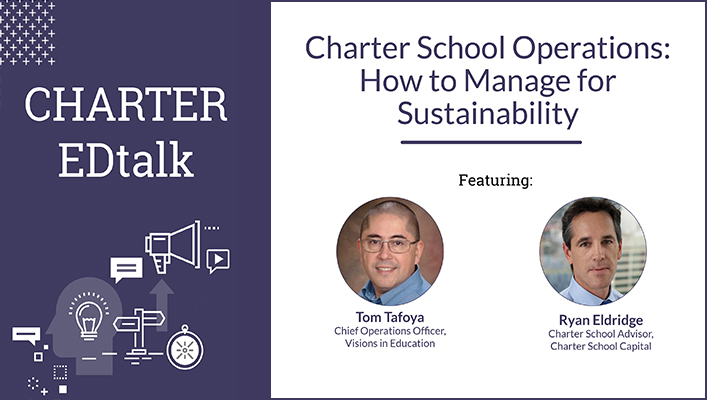
charter school operationsCharter Schools Operations: How to Manage for Sustainability

For this episode of our CHARTER EDtalks, Ryan Eldridge, one of Charter School Capital’s Charter School Advisors, had the honor of sitting down with Tom Tafoya, Chief Operations Officer for Visions in Education as he shares his tips for managing sustainable growth and provides key operational strategies for long-term success.
Visions in Education is a tuition-free public charter school that supports personalized learning in public education. They now serve over 6,400 students across a nine-county service area, making us one of the largest and most stable charter schools in the Sacramento Valley region.
To learn the tips and strategies Tom Tafoya so generously shared with us, please watch the video or read the transcript below to get the full story.


Ryan Eldridge: Hello there, and thank you for joining us for this episode of CHARTER EDtalks. I’m Ryan Eldridge, charter school advisor for Charter School Capital. I’m honored to be joined today by Tom Tafoya, Chief Operations Officer for Visions in Education.
And we’re here to discuss managing sustainable charter schools, operational strategies for long term success. So I appreciate you coming today, Tom. Welcome. Why don’t we just kick it off, jump right into it? The first question… So Visions has been around for about 20 years now. So what have been some of the greatest challenges over the years?

Overcoming Initial Challenges

Tom Tafoya: So I’ve been with Visions for 14 years, and over that timeframe, we’ve encountered a lot of ups and downs. You know, when we had initial growth we did not have a lot of administrative systems and people in place to manage the growth. We tripped over ourselves constantly and I think that really hurt us.
We had a period where we had declining enrollment because we just weren’t doing our job well. And so I think over that time, we started to get smarter, and started bringing the right people, and started building the systems for kind of sustained growth.
Starting out with not having some good administrative systems and people in place really was a challenge. At the same time, you have the competitor pressure. So if the competition is coming and you’re not really set up to succeed, you’re not going to succeed. And so I think between the … just having good systems and good structures for the operation, let alone are we providing great services to our students is a really big challenge. And I’m only going to talk about the operational pieces. Because as the operations officer, I’m in charge of business technology, enrollment, ordering materials, all those types of things.
From my perspective, not having good people and systems was a big challenge. And then the competition, and then you have the external environment that’s constantly changing and impacting the things that we have to do to meet our obligations as a charter school.

Maximize Revenues

Tafoya: Those are some of the big challenges that we faced over the years. The big things in trying to maintain a sustainable charter over time is really being focused on two things: maximizing revenues, minimizing expenditures. It sounds so simple.
Under each of those umbrellas, you can go for days on all the different tactics and strategies for each. And so I’ll just kind of cover some of the top two. Number one, maximizing revenue and driving enrollment and/or maintaining your enrollments are the top two.
So I think growing enrollment, but if you have a retention problem you’re going to continually have to keep filling that leaking bucket. And so we’ve done a lot of work to systematize and really improve our enrollment practices from using really advanced marketing, and building enrollment systems to have the workflow— the enrollment process— be very streamlined to continue to grow enrollment. And then also kind of working on ensuring that our retention is good.
And really, the biggest challenge is retention. Do we know why students are staying with us and why they’re leaving? Are we serving them or not? Are we learning from those surveys and making adjustments as we go?
And over time, we’ve done that. We’ve listened to the surveys, kind of paid attention to what the competitors are doing, making adjustments every step of the way so that those families that we get … we want to keep them. And then continue to grow the kids in a really managed way.
We don’t want to just chase growth for sake of growth because that’s generally going to lead to not a good outcome for the kids, because you’re not really serving them well. We’ve tried to approach it as a managed growth approach. We average about 10% growth a year.
Eldridge: Wow.
Tafoya: For us, that’s what we want to do. We’re turning away hundreds of kids a year, but we don’t want to get ahead of ourselves where we’re not providing really great services and systems to have good outcomes for them. And so, really focusing on that piece … that’s that maximizing enrollment piece which results in maximized revenues.
Certainly, you’ve got to pursue all types of revenues whether that be your SELPA arrangement, special ed, summer school ADA programs, Medical reimbursements. Are you fully utilizing all of your teachers because you manage them properly and appropriately?
Those are all tactics we’re constantly looking to turn over every stone to ensure we’ve maximized our revenues. Again, we’re not trying to grow 30, 40% a year. We want to maintain a really good, steady growth. But in that steady growth, maximize our revenue so that we’re not kind of wondering what happened to all the money.

Minimize Expenses

The flip side is minimizing expenses. And so with that is really … I’m cheap. I’m always looking for a deal, and I want to make sure we’re getting the best deal. Whether we’re building technology or buying technology, for all the staff we hire do we have systems and metrics in place to ensure our staff is fully utilized? That’s a lot of the work we do is really … We hire 10 new teachers, we want to make sure they’re full on day one and they stay full throughout the year.
You can only do that if you have really good enrollment processes and practices. As you lose a student, we can immediately replace the student. That’s a way for us to minimize our expenses on our staffing, and we have elaborate systems and processes in place to make sure that we’re able to do that with high efficiency. Which again, allows to really have a lot of money left over. We have an online program that serves about 2,500 kids. Every kid gets a Chromebook. If they’re low income, they get a MiFi unit. And those aren’t cheap. That’s how we’re able to do those types of things is by making sure every stone is turned over and every expense is minimized.
Really kind of paying attention, but this is taxpayer money. It’s not our money.
Eldridge: Right.
Tafoya: It’s taxpayer money. And we’re really cognizant of that, and respecting that, and doing our best with all the resources we have and trying to serve as many kids who want to be served by us. But doing so in a way that’s really good for them and not just for growth’s sake.
Eldridge: Yeah, that’s great. How many total students do you serve?
Tafoya: We serve about 6,300 right now. We have one charter in Northern California with 6,300 students. This past spring, we turned away about 900 kids. We do an independent study program, so we have homeschooling and several online high school programs … one for at-risk kids and one for kind of a college preparatory program.
Eldridge: Yeah. Yeah, that’s a lot of kids to manage. Sounds like you’re doing a great job up there. Appreciate you coming on screen today, and chatting with us, and giving your insight and expertise. That wraps up this episode of CHARTER EDtalks. Again, thank you, Tom. We appreciate it. Hopefully everybody enjoyed the session today. Thank you.

Education Reform
Editor’s Note: This article on Puerto Rico’s education reform efforts, was originally published here on March 27, 2019 by EducationNext and written by Robin J. Lake, the director of the Center on Reinventing Public Education at the University of Washington. After Hurricane Maria decimated Puerto Rico, their secretary of education made headlines by making wide-sweeping changes to address the issues with their long-struggling education system. Read this article to understand how new investments, creative thinking, and locally driven community support are the cornerstones of a concerted effort to make their path forward and create sustainable education reform even perhaps here on the mainland.


Resilience, Hope, and the Power of the Collective: What Puerto Rico Can Teach the States about Education Reform

Hurricane Maria’s wrath created new urgency to address Puerto Rico’s long struggling education system. As soon as electricity was back on, policy types immediately started making analogies to New Orleans. Indeed, new legislation created sweeping new authorities to restructure public education and create new public school options, including charter schools and vouchers. Puerto Rico’s secretary of education made headlines for closing more than 200 underenrolled schools before the 2018–2019 school year.
I recently had the opportunity to visit the island and learn about the unique challenges and opportunities there. I came away with a picture that is much more complex than what is portrayed in the national news. Unlike New Orleans, the island hasn’t seen a surge of volunteers, Teach for America recruits, or new donations from philanthropists on the mainland. Teachers have not been fired. School choice is a relatively small part of the picture. The existing public school system, though under heavy strain, remains in place.
Puerto Rico’s efforts to improve opportunities for young people are rich and varied and locally driven. I came away with the strong belief that people on the island have at least as much to offer us back on the mainland as what we can offer to help them.
First, a bit about the context of Puerto Rican public education.
• Declining enrollment: The student age population of Puerto Rico has been on the decline. The birth rate is now lower than the death rate. The number of school-age children was down to 340,000 in 2017; just 300,000 students remained after the hurricane. Projections show further declines in coming years.
• Hurricane impact: 82 percent of households suffered damage from Hurricane Maria. School-age children missed an average of 78 days of school. More than 20 percent of children were reported to have suffered attention and emotional problems post-hurricane.
• Intensive needs: 35 percent of students qualify for special education services—more than double the rate on the mainland. Eighty-one percent of students are below the poverty line.
• Undervalued workforce: The median worker in Puerto Rico earns about half as much as the median worker on the mainland, and similar disparities apply to teachers. The average teacher makes $29,000 a year—and opportunities abound for bilingual teachers to double their salaries on the mainland. As a result, the island has seen a mass exodus of teachers. Districts on the mainland actively recruit and hire away some of Puerto Rico’s best talent. Exacerbating the problem, there is a shortage of teachers with English and STEM skills and a huge retirement wave coming. Nearly half (14,000) of Puerto Rico’s teachers are expected to retire in the next five years. Finding school leaders will be a problem, too.
• Stagnant achievement: only 10 percent of 7th, 8th, and 11th graders achieved proficiency in a standardized math test last year. PISA results in math, science, and reading lag behind the average for Latin American countries. There is chronic absenteeism—one out of every four K–3 students is absent 10 percent or more of the time.
These combined statistics of Puerto Rico’s situation are sobering. Finding a path forward must go well beyond any one reform, policy, or strategy, or person. They will require a concerted and sustained effort, new investments, and creative thinking, all locally driven. There is no “proven” path to follow in the states or elsewhere. The solutions must be uniquely Puerto Rican and must be powered by Puerto Ricans. I visited three schools that leave me wholly confident that this can happen.
ColaborativoPR: intensive community-based supports for high school students. Loiza, a deeply impoverished community on the northeastern coast, is the center of Puerto Rico’s Afro-Latino community and home to a promising effort to ensure more young people attend, and successfully complete, post-secondary education. More than 50 percent of Loiza’s youth live below the poverty level, and 48 percent of 18- to 20-year-olds are not in school. According to the 2006 census the median income for families was under $10,000. It is well-known for its cuisine and traditional “bomba” dance.
The Colaborativo was established by six foundations, along with a suite of community partners, to motivate and support Loiza’s high school students to complete high school and pursue post-secondary education.
The organization partners with Centro Esperanza, which has provided educational, music, and psychological services in the community since 1977, including a Montessori kindergarten. The Colaborativo did research on what was holding students age 18-20 back from attending college and then did further work to identify the high schools in the area with students least likely to attend college. They then partnered to provide remedial math and science education, mental health support, and college and career guidance.
Counselors take students on college visits and help them fill out financial aid forms, whatever is needed. The goal is to help students manage the difficulties of life so that can focus on education, identify their interests and strengths and apply to college.
Without these supports, students say they would not have been able to manage the process and paperwork given that their parents had not been to college themselves. We met one young woman who has gone into business administration at University of Puerto Rico.
Another is studying graphic design and though she has been accepted to Syracuse, she is doing her first year of college in Puerto Rico before she decides whether to move to New York. She says that the Colaborativo “always pushed her to look for the best”. We heard about another student who was deeply depressed after her mother died and didn’t want to go to college. After working with psychologists, she was able to go. The key, the students say, is in providing individualized support and encouragement to students. They wish schools would adjust more to the personalized needs of individuals, provide more exposure to possible careers.
Being in the students’ community has been essential. Counselors know the local dynamics at play and they know the kids. The Colaborativo works to ensure that students meet with counselors in recognized “peace places” where are all treated equally. After the Hurricane, and during the period where students were unaccounted for and not attending schools.
More than 80 students showed up at the Colaborativo. Sister Cecilia Sorrano, of Centro Esperanza, says she believes education should be about transformation and about creating healthy communities. She says they try to get students to compete with themselves, not others, and provide individualized supports that respect each student.
Instituto Nueva Escuela: Montessori for all. Nueva Escuela is part of a loose network of 50 K-8 schools that bring a traditional Montessori education to 14,200 Puerto Rican students. Nueva Escuela (not associated with the Centro Esperanza Montessori kindergarten) was started by Ana Maria Garcia Blanco, a revered educator and community leader who radiates warmth and energy. All of the markers of a Montessori class are apparent: the beads, the candles, etc. Students with special needs are fully included in the small classes. The school feels joyful and students seem confident. The network touts impressive (though unconfirmed) statistics: high rates of continuing education, many in selective high schools and colleges, no drop-outs, no serious incidents of violence, and no drug use.
Ana Maria insists that what makes the schools effective is much more than the Montessori curriculum. The model has three tiers: Montessori, collective decision-making, and family engagement. She is adamant that the most important element is the “collectivo”—the collective decision-making body that adjudicates issues that arise. Parents can be employed as aides and teachers at the schools. Teachers are fully engaged in all decision-making. The collectivo says that if a teacher is hired who is not fully on board with Montessori or is struggling, it is not a problem: “We make sure they are not alone,” providing constant coaching and guidance.
The schools operate as public schools under a special division of the Puerto Rico department of education. They receive a line item in the budget of around $6,400 per student. The nonprofit organization run by Ana Maria supplements that funding through private donations and provides teacher training and support for running effective collectives in schools that voluntarily join the network.
Proyecto Vimenti (Lifelong learning in English): The first and only charter school on the island. Proyecto Vimenti is run by the Boys and Girls Club of Puerto Rico. The organization provides after-school programs to local students but found that they were spending more time working with students on academic remediation than on play and enrichment. And they realized these students’ families were locked into cycles of poverty that led to hopelessness and domestic problems, making it difficult for students to achieve upward mobility. Concerned, they started developing plans to open a school that would tackle education and poverty as interlocking pieces, drawing from all of the Boys and Girls Club’s programming and resources.
Vimenti was preparing to open as a private school for Kindergarten and first grade when Puerto Rico passed its education reform law in March 2018, which allows for charter schools. As a charter, Vimenti will eventually serve 190 students and will grow to include to 5th grade. Students receive intensive academic and social-emotional support and from an early age learn competencies, like coding and design-thinking, that can help qualify them for well-paying jobs later in life—primarily in technology, tourism, and health care. Health and welfare screenings and supports have identified many students with vision impairment who were previously considered as needing special education.
The large and modern building is meant to be a central gathering place and a hub for community resources to serve a holistic set of family needs. There is an adult employment training and entrepreneurship center that provides workshops and support for basic job skills, like how to conduct oneself at work, how to dress professionally, and how to apply for jobs. Those seeking work, typically single mothers, get help finding jobs and even have access to work-appropriate clothing. Entrepreneurship classes support families to take marginal business activities, like food carts, to a more sustainable level. Vimenti’s belief is that a two-generation approach to addressing intergenerational poverty is critical. Students need skills, Vimenti believes, that will position them for new opportunities, but they also need to see the adults in their life modeling how to seize those opportunities.
Vimenti chose to operate as a charter school to have access to government funding. They could not have operated on private dollars alone. But being the island’s first charter has come with plenty of challenges. There is community suspicion that charter schools are a mainland reform and the funding levels are very low. Under the education reform law, charter schools receive base funding of $1,800 per student, plus add-ons for special needs, poverty, etc., bringing Vimenti up to an average of around $3,500 per student. This is just a fraction of the total $7,639 spent per student in Puerto Rico’s public education system. Without the financial backing and trusted brand of the Boys and Girls Club, it’s hard to imagine this school could have launched successfully. The school pays teachers 50 percent higher than other schools and heavily subsidizes the cost of the program through private donations.
Beyond the schools, I learned of efforts by Puerto Rico’s College Board to create a Spanish version of Khan Academy, which will provide online assessments and opportunities for students to practice in weak content areas, and is providing career and college data to school counselors. The Flamboyan Foundation (run by my friend Kristin Ehrgood) is focused on K–3 literacy and recently partnered with Lin-Manuel Miranda for a special island showing of Hamilton that raised money for Puerto Rican arts and arts education. The Puerto Ricans I met were amazing people, focused on finding locally crafted solutions, and not waiting for answers from anyone.
Secretary of Education Julia Keleher, whom someone described as “a fast-talking Philly girl who speaks fluent Spanish,” was appointed by the governor and approved by the legislature in December 2016. Julia has brought a new intensity and urgency to address the deep dysfunctions and corruption in the educational bureaucracy and wants to move more decisionmaking to the local level. Though charter schools have gotten much of the attention about the reforms, they are very small but important part of the story. More broadly, people speak of the reform focus as an effort to bring Puerto Rico’s education system into the 21st century, including training and supports for educators, a less centralized system (previously all principals in the state reported directly to the secretary of education), and efforts to update the technology infrastructure.
I left with a strong feeling of possibility for Puerto Rican education. The needs are enormous and multidirectional. Nascent efforts to build solutions could go awry in many ways. And the overall underfunding and underinvestment in our fellow Americans’ education system is shameful. But many determined and creative people are at work and great things are happening as a result. They are working in partnership—crossing organizational lines and eschewing the traditional boundaries of school in recognition of the fact that schooling must be integrally related to other community assets and needs, and to opportunities for upward mobility.
These efforts largely emerged in the absence of policies designed to nurture them. People don’t talk about “scaling” solutions in Puerto Rico. They create solutions and hope that others will do the same. They focus on recognizing the interconnectedness between school, family, and community, not on academics alone. For us on the mainland, it raises the question of how policies can support, rather than stifle, bottom-up problem-solving that connects educators more closely with the communities they serve. On the island, it raises questions about how policy can help sustain promising initiatives, enable existing efforts to reach more students, and allow new ones to develop. Puerto Ricans want to be a productive part of economic revival and opportunity for youth. The work ahead is to help them catalyze those possibilities.


Support your charter school, contact us. We’d love to work with you!Charter School Capital logoSince the company’s inception in 2007, Charter School Capital has been committed to the success of charter schools. We help schools access, leverage, and sustain the resources charter schools need to thrive, allowing them to focus on what matters most – educating students. Our depth of experience working with charter school leaders and our knowledge of how to address charter school financial and operational needs have allowed us to provide over $1.8 billion in support of 600 charter schools that have educated over 1,027,000 students across the country. For more information on how we can

LEARN MORE


Webinar: Board Governance 101

If you missed this information-packed webinar, now you can watch it when it’s convenient for you!
For this presentation, we were honored to be joined by Board Governance experts, BoardOnTrack. Our Ryan Eldridge, Charter School Advisor, sat down with Mike Mizzoni, Director of Leadership and Governance Training at BoardOnTrack to provide top-level tips on developing and managing your Board of Directors.
For your school to reach its goals, meet its mission, and be set up for success, you need to build a well-structured, well-staffed, and well-trained Board of Directors. In this important webinar, our partners and industry experts on Board Governance, BoardOnTrack, share their expertise on the ins and outs of recruiting, building, and managing your governance team as you grow.
Watch the video below to learn:

  • Board basics: Who should be on your governance team and what should they do?
  • How to build a strong board: Strategically recruiting for diversity and skills

Tips to govern for growth: How to face challenges and changes at any stage


charter school due diligenceCharter School Due Diligence: The Added Value of Partnering with Charter School Capital

At Charter School Capital, our mission is to help charter leaders access, leverage, and sustain the resources their schools need to thrive, allowing them to focus on what matters most – educating students. In addition to the extensive toolbox of solutions we provide to help charter schools thrive, another key benefit of partnering with us is the value added by our in-depth due diligence process. We hope that our thorough process can be utilized as just another set of eyes in support of the important work that Authorizers, back office providers, and financial managers are already doing to support charter school success.

Due Diligence

Many of the items we are reviewing in the due-diligence process (to make sure that schools are in compliance with our funding requirements) actually may overlap with the compliance that they have to maintain with the State, their Authorizer, financial manager, or back office provider. This comprehensive due diligence process is just an added benefit that our school partners (and back office providers, authorizers, financial managers) are receiving for free, as partners of Charter School Capital.
That’s not to say that we are focused on highlighting what schools are doing wrong, but rather we’re always solution oriented. Our goal is to help them figure out ways to bring them back into compliance if for some reason an issue has gone unattended.
Another important service that we provide our school partners—at no additional cost— is financial guidance.

Finances

School leaders are experts at educating students but may not always also possess that same expertise around budgets, finances or working with cashflows. But because it’s one of our requirements, we’ll work together with them at no additional cost, to build that out. Once developed, this helps schools foster an understanding of the consistent cash flow they’re striving for because they can now actually see it month by month. This process helps school leaders become more strategic about budgeting and avoid the short-term mistakes that can lead to unintended long-term consequences.

Corporate Governance

We can also provide guidance in various corporate governance areas. For instance, when a school schedules a board meeting to approve various matters or Charter School Capital documentation, the school must meet all open meeting requirements such as notices, quorums and voting requirements. These requirements can be imposed by the Authorizer or by the school itself via its bylaws. As part of our diligence, Charter School Capital reviews all of the conditions and ensures that the requirements are fully and timely met. We can also brief the school on any open meeting requirements that may be governed by State law.
Our team also tracks the school’s charter holder’s corporate status, including State good standings, annual reports, and lapsed entity formation filings. While we cannot file corporate documentation on behalf of the school or charter holder, we can provide reminders when a filing is due or has lapsed.
Ensuring that the school’s charter holder remains in good standing is one of our most important underwriting objectives.
Finally, as part of our standard due diligence, we run various searches that might reveal new or old liens or judgments that the school may not be aware of or have not been timely satisfied. In most cases, these liens collect interest until paid. We can guide the school in how to get the liens or judgments removed, or, in some cases, satisfy them out of the funding proceeds.
These in-depth due diligence processes we have in place for our school partners can also be seen as a value add for Authorizers, back office providers, and financial managers. Providing these additional services to our charter partners is 100% in service to our mission of providing charter leaders with the critical resources they require to spur growth and build more sustainable futures for their schools.


Charter School Capital logoSince the company’s inception in 2007, Charter School Capital has been committed to the success of charter schools. We help schools access, leverage, and sustain the resources charter schools need to thrive, allowing them to focus on what matters most – educating students. Our depth of experience working with charter school leaders and our knowledge of how to address charter school financial and operational needs have allowed us to provide over $1.8 billion in support of 600 charter schools that have educated over 1,000,000 students across the country. For more information on how we can support your charter school, contact us. We’d love to work with you!

LEARN MORE


Charter Schools

Are Charter Schools Really Hurting Traditional Public Schools?

Editor’s Note: This op-ed article was originally published here on March 22,2019 by Show-Me Institute and written by Susan Pendergrass.
Charter schools are tuition-free public schools. The public funding that follows a child to a traditional public school, also follows that same child to a charter school. The money, therefore does not inherently belong to traditional public schools specifically, but rather to the individual child’s education. This allows for choice in education and supports the right of families to select the best option for their children whether it be a traditional public school or a public charter school. This article shares an enlightening perspective.
We think it’s vital to keep tabs on the pulse of all things related to charter schools, including informational resources, and how to support school choice, charter school growth, and the advancement of the charter school movement as a whole. We hope you find this—and any other article we curate—both interesting and valuable.

DON’T CHARTER SCHOOLS HURT PUBLIC SCHOOLS?

Without a doubt, the question that I get most often about charter schools is, “But don’t they hurt the public schools?” Setting aside the fact that charter schools are public schools, the short answer is charter public schools don’t hurt traditional public schools any more than other factors that can affect enrollment. But they may challenge them.
The assertion seems to be that all children who live within the borders of a public school district are the property of that school district, unless their parents can pay to opt them out. If free public charter schools become available and parents choose them, then they’re rejecting, and thereby hurting, their local school district.
When a parent chooses to send a child to a charter school, the state funding that would have been sent to the public school district where that student lives is sent, instead, to the charter school the parent has chosen. Federal funding, such as that for low-income students or students with disabilities, also, theoretically, follows the student. Some, but not all, of the local funding may go with the student. The same is true whether the student chooses a charter school, moves to another school district, or moves to another state. The local public school district is no longer tasked with educating the student, so they no longer get the money to do so.
It’s true that districts with declining enrollment may struggle to downsize, at least quickly. The same is true whether parents are choosing to move out of the district or whether they turn to charter schools. But the solution isn’t to prevent kids from choosing charter schools because the district can’t afford it, any more than it would be reasonable to prevent parents from moving out of the district.
Public school districts have some options when faced with the loss of students to charter schools. They can consider it a challenge and do what’s needed to bring parents back. They can collaborate with the charter school to better serve the needs of all students. They can move away from long-term fixed expenses to a nimbler way of doing business, similar to how many charter schools finance their buildings. Or they can complain that the world’s not fair.
All students are guaranteed a free public education by the state, and the power over that funding should be in the hands of parents, rather than locked into a public school district. And defenders of the status quo should stop calling for protected status for schools that parents don’t choose.


Charter School Capital logoSince the company’s inception in 2007, Charter School Capital has been committed to the success of charter schools. We help schools access, leverage, and sustain the resources charter schools need to thrive, allowing them to focus on what matters most – educating students. Our depth of experience working with charter school leaders and our knowledge of how to address charter school financial and operational needs have allowed us to provide over $1.8 billion in support of 600 charter schools that have educated over 1,027,000 students across the country. For more information on how we can support your charter school, contact us. We’d love to work with you!

LEARN MORE


charter school graduation rates
Editor’s Note: This post was originally published here on March 26, 2019, by The 74 and written by Richard Whitmire. Whitmire is author of several books, most recently “The B.A. Breakthrough: How “Ending Diploma Disparities Can Change the Face of America.” Whitmire is a member of the Journalism Advisory Board of The 74.
We are always thrilled to highlight the exceptional work that charter schools are doing, and this story exemplifies the opportunities that charter schools are creating, especially for low-income students across our country. This report specifically looks at college success records at the major charter networks serving low-income students.
We think it’s vital to keep tabs on the pulse of all things related to charter schools, including informational resources, and how to support school choice, charter school growth, and the advancement of the charter school movement as a whole. We hope you find this—and any other article we curate—both interesting and valuable


New Numbers Show Low-Income Students at Most of America’s Largest Charter School Networks Graduating College at Two to Four Times the National Average

By Richard Whitmire
A fresh look at the college success records at the major charter networks serving low-income students shows alumni earning bachelor’s degrees at rates up to four times as high as the 11 percent rate expected for that student population.
The ability of the high-performing networks to make good on the promise their founders made to struggling parents years ago — Send us your kids and we will get them to and through college — was something I first reported on two years ago in The Alumni.
Writing the new book I’m about to publish with The 74, The B.A. Breakthrough: How Ending the Diploma Disparity Can Change the Face of America, provided the chance to go back and revisit those results. (You can track B.A. Breakthrough updates here.)
The baseline comparison number is slightly different but still dismal — just 11 percent of low-income students will graduate from college within six years — while for the big, nonprofit charter networks that serve high-poverty, minority students, most of them in major cities, the rates range from somewhat better to four times better and, in some cases, even higher.
The improved chances of earning a degree held while the ranks of charter alumni grew and the data became more robust. In some cases, the numbers are getting stronger and at least one prominent network, Uncommon Schools, predicts its graduates will close the college completion gap with affluent students in the next several years and surpass it a few years after that.
“Our mission is to get students to graduate from college, and that has influenced everything we do while we have students in elementary, middle and high school,” said Uncommon CEO Brett Peiser. “We’ve learned a lot about what works in helping students succeed in college, and everyone is focused on that goal.”
Ever since the first charter school was launched in Minnesota 27 years ago, educators watching the experiment have asked the same question: What lessons do they offer traditional school districts? Now, we may have that answer: Greatly improved odds that their alumni will earn college degrees.
Assuming that the charter completion rates persist, there’s a reasonable chance that their lessons learned could transform the way traditional school districts see their obligations to their graduates: How do they fare in college, and what effective methods from the charters could they start adopting to improve their outcomes later in life? Currently, almost no traditional districts track their alumni through college, although those in New York, Miami and Newark are moving in that direction.
All these issues get laid out in The B.A. Breakthrough. The book’s theme: The college success strategies pioneered by these charter networks are combining with entrepreneurial programs to spread data-driven college advising to high school students who lack it and with a growing commitment from colleges and universities to embrace low-income, first-generation students and ensure they walk away with degrees despite their vulnerabilities. Together these efforts add up to a breakthrough.

The charter network leg of the breakthrough

Given that college success is measured at the six-year mark, only recently has it become possible to evaluate the charter networks. In 2017, The 74 published a first-ever look at those rates as part of its series, The Alumni.
As with that project, the 11 percent college success rate used for comparison comes from The Pell Institute. That statistic provides an imprecise measurement, however, because it doesn’t take into account that most of these charter students are not just low-income, but also minority students living in urban neighborhoods whose college completion odds are even more daunting.
Comparing college graduation rates across charter networks is not easily done. KIPP, for example, tracks all alumni who completed eighth grade with KIPP, regardless of whether they go on to a KIPP high school. That puts KIPP in a category by itself. The other networks use the traditional approach of tracking only their high school graduates.
Even among the charter networks that track their high schoolers from graduation day, there are significant variations. While all the networks draw on the same foundational source, the National Student Clearinghouse, which matches the IDs of high school graduates to enrolled college students, some networks invest in their own tracking system, which picks up students missed by the Clearinghouse system. That makes their data more accurate and likely to produce higher rates.
Given the complexities, I divide the charter data into three groups:

Category 1 — Tracking from eighth grade, record-keeping that KIPP says is necessary to account for dropouts:

KIPP (national): As of the fall of 2017, KIPP had 3,200 alumni who were six years out of high school. The network’s national college completion rate is 36 percent for all alumni who completed eighth grade at a KIPP school and 45 percent for those who graduated from a KIPP high school. That counts students who entered a KIPP high school in ninth grade and stayed a year or more. In the national group, another 5 percent earned two-year degrees; in the group that graduated from a KIPP high school, another 6 percent earned two-year degrees.

Category 2 — Networks that use both Clearinghouse and internal tracking data:

Uplift Education (North Texas): Thirty-seven percent of the 1,075 graduates of the classes of 2011, 2012, 2013 and 2014 earned bachelor’s degrees within six years. When associate’s degrees are included, that climbs to 40 percent. If calculated just on the classes of 2011 and 2012, the rate would be 57 percent.
Uncommon Schools (New Jersey and New York): Fifty-four percent of their alumni earn a bachelor’s degree within six years. Among those, 39 percent earn a bachelor’s within four years. Drawing on data that track students currently enrolled, Uncommon predicts that it will close the college graduation gap with high-income students (58 percent) in the next few years. Within six years, Uncommon expects to hit a success rate of 70 percent.
DSST Public Schools (Denver): Among the 1,075 alumni, starting with the class of 2011, half earned bachelor’s degrees within six years.
YES Prep (Houston): The network has 974 alumni from the graduating classes of 2001-2012. Among the earliest graduating classes (2001-2008), 52 percent earned a two- or four-year degree within six years of high school graduation. Of the most recent graduating classes (2009-2012), 40 percent earned a four-year degree and 6 percent earned a two-year degree within six years of high school graduation.
Noble Network of Charter Schools (Chicago): Noble has 2,259 alumni who are six years or more out of high school. Among that group, 35 percent have bachelor’s degrees, 7 percent have associate’s degrees and 9 percent are still in college.

Category 3 — Charter networks that rely solely on National Student Clearinghouse data:

Achievement First (New York, Connecticut and Rhode Island): There were 74 alumni from the classes of 2010-12. Of those, 34 percent earned bachelor’s degrees within six years. Another 2 percent earned associate’s degrees.
Green Dot Public Schools (California): Green Dot has 6,601 alumni from the classes of 2004-2012. Of those, 14 percent earned bachelor’s degrees by the six-year mark. Another 15 percent completed two-year degrees. (Green Dot has a less aggressive college success program than other networks, and, as seen in its absorption of the failing Locke High School in Watts, it takes on significant challenges.)
Aspire Public Schools (California and Tennessee): Aspire has 619 alumni from the classes of 2007-2012 who have reached the six-year point. Of those, 26 percent earned bachelor’s degrees, a rate that rises to 36 percent when associate’s degrees and certificates are included.
Alliance College-Ready Public Schools (California): At Alliance, 610 of their 2,617 alumni have reached the six-year point. Of those, 23 percent have earned four-year degrees. When two-year degrees are added in, the percentage rises to 27.
IDEA Public Schools (Texas, Louisiana): At IDEA, 508 alumni have reached the six-year mark. Of those, 38 percent earned bachelor’s degrees. Another 4 percent earned associate’s degrees in that time. (Another 2 percent earned either a bachelor’s degree or an associate’s, but it’s unclear which, due to reporting issues.) The network says it is experiencing steady improvements: Whereas only 31 percent of 2009 IDEA graduates completed college in six years, 50 percent of its 2012 graduates did.

Single charter schools:

There are a few solo charters, not part of networks, with significant numbers of alumni who have passed the six-year mark.
One example from Boston, a city which has some of the longest-running charters, is Boston Collegiate Charter School. There, 51 percent of the 177 alumni six years out earned bachelor’s degrees; another 8 percent earned two-year degrees. The school appears to be experiencing sharp increases in success rates: For the class of 2014, 79 percent graduated from college within four years.

More on the data

Consider this an early take on the promise charters made to offer better odds on college success. For many of the networks, the number of alumni who have reached the six-year mark is modest. We’ll know more as larger classes graduate and reach that milestone.
Comparing the networks is difficult because some use internal tracking systems that pick up students missed by the Clearinghouse. For example, networks using only Clearinghouse data miss students exercising their privacy rights, known as “FERPA blocks” for the Family Educational Rights and Privacy Act. That shields their college transcripts from outside review. In a time when immigration issues are contentious and parents (and some students) could face deportation, FERPA blocks are an attractive option for families. The number of blocks varies greatly by region, with few on the East Coast exercising the option and as high as 6 percent of all students attending West Coast colleges opting to shield their records, according to the Clearinghouse.
Translation: Charter networks such as IDEA Public Schools, with many of its schools located in Texas border towns, that also rely only the Clearinghouse data, are likely to show lower success rates.
Also tricky: When comparing the charter alumni to the broader student population, what’s the right comparison number to choose? The 11 percent Pell number I’m using should be viewed as a rough marker. First, that makes the denominator all low-income students — not just low-income high school graduates — which suggests the 11 percent figure is low. But the fact that most of these networks enroll minority students from urban neighborhoods suggests 11 percent is high because the Pell number would include low-income Asian and white students, who across income levels have higher college graduation rates than black and Hispanic students. Bottom line: The 11 percent emerges as a useful if imprecise comparison figure.

Watching a network do the math

By necessity, all the college graduation data are self-reported. Outcome figures from the National Student Clearinghouse, which is private, are proprietary to the networks, which pay the Clearinghouse for the information. For the sake of transparency, I asked one network, Uncommon Schools, to open up its books for me so I could observe both processes, the Clearinghouse data combined with its own tracking data.
In April 2018, I met Ken Herrera, Uncommon’s senior director of data analytics, in Newark at North Star Academy Charter School. There, Herrera clicked on his laptop and showed me a listing of alumni. For privacy reasons, the students had been “de-identified” and showed up only as numbers on the modified Salesforce (the customized business software Uncommon and other networks use to track their alumni) program. Twice a year, said Herrera, usually in March and October, Uncommon sends a list of alumni names and their dates of birth to the Clearinghouse for tracking. Why just some? Because Uncommon saves money by omitting names of alumni who, for example, already had their college graduation confirmed through a university. In about two weeks, the Clearinghouse sends back an Excel sheet with the information it collected on the asked-about students: where they are in school and what term — fall semester, for example — they are in.
If Herrera sees a “no match,” which happens about 10 percent of the time, he and the counselors investigate. At networks that don’t track alumni individually, that student would be counted as a dropout. When digging into it further, Uncommon finds out whether they truly have dropped out by contacting the university or the family or the student, whatever means is available. They also track down whether it’s just a matter of having entered the wrong birth date or a name mix-up, such as a nickname used when enrolling in college. If it is just a bookkeeping issue, the counselors request a copy of the college transcript so the error can get fixed.
Another reason for the “no match” might be the FERPA block, which prompts the Uncommon team to contact the students and convince them to unblock their records. Some universities make records disclosure an opt-in process, done every semester, which makes life especially difficult for Herrera, because if the student fails to take action the default status is a FERPA block.
In early April each year, Herrera meets with the counseling team to sort out data omissions, a painstaking, student-by-student process. “We’ll say, ‘This is what the Clearinghouse says about the student, here’s what Salesforce says about the student. What are we going to do about this conflict?’” That leads to a counselor personally investigating: Where is the student? When all the data issues get settled, Uncommon can calculate its college success figure.
Now the trickier issue: Unlike most other networks, Uncommon predicts where its college success rate is headed. Here’s what Uncommon predicts, as noted above: In roughly six years, the college success rate will rise to about 70 percent. Given that 70 percent exceeds the rate for well-off white students, that’s a remarkable prediction. What’s it based on? Uncommon tracks its alumni by cohorts, so it can establish a historical rate for, let’s say, how many students drop out between their freshman and sophomore year in college.
“When we look at each of those [dropout points] we can predict where an individual cohort is going, based on those historical rates, and predict what we think their graduation rate is going to be,” Herrera said.
Currently, Uncommon is seeing significant improvements, such as half the historical rate of dropouts between the sophomore and junior years. Also an issue: Uncommon is growing. By the year 2022, it projects 1,000 graduates a year, compared with the roughly 400 current graduates. That also figures into the math, because younger cohorts, which are showing better persistence rates, have a bigger impact on the overall college success math. The newer cohort, for example, is showing a 50 percent success rate at the four-year mark (older cohorts achieved that only at the six-year mark). Thus the prediction: 70 percent overall success rate within six years.
So why the improved persistence? Most of that, says Herrera, comes from strengthening the high school curriculum and programs such as Target 3.0, a mandatory class to boost the grade point averages for all students with a GPA less than 2.5.
“What we found, perhaps unsurprisingly to many people, but I think really profoundly for us, was that students with higher GPAs were more likely to graduate from college,” he said. “When we cut the data, getting above a 3.0 GPA [in high school] was very significantly correlated with future college success.”

Where all this leads

Yes, it is early to be judging college success among these networks, but not premature. There are thousands of alumni in these calculations, and their academic outcomes are crucial. If their success persists and, more importantly, if their lessons learned are picked up by the far larger traditional school districts, we could be looking at one of the most successful anti-poverty programs ever seen in this country.
There’s no guarantee it will happen, but the seeds are there, all explained in the upcoming The B.A. Breakthrough.

Charter School Capital logoSince the company’s inception in 2007, Charter School Capital has been committed to the success of charter schools. We help schools access, leverage, and sustain the resources charter schools need to thrive, allowing them to focus on what matters most – educating students. Our depth of experience working with charter school leaders and our knowledge of how to address charter school financial and operational needs have allowed us to provide over $1.8 billion in support of 600 charter schools that have educated over 1,027,000 students across the country. For more information on how we can support your charter school, contact us. We’d love to work with you!

LEARN MORE