blog post image with blue background and students of color

Financial Opportunities for Minority Students: Closing the Gap

Financial opportunities for minority students (to support the attendance of higher education institutions) are often limited. According to a 2017 study, Hispanic and Black students graduate from college at a rate of up to 25% lower than their white and Asian counterparts. The persistent racial disparity in higher education is caused by a wide array of barriers, one of the prevailing ones being economic hardship among minority populations. We also know that traditionally underserved students, including minorities and low-income students, attend and complete college at far lower rates than their peers. These students are suspended, expelled, and drop out at higher rates, and are less likely to have access to strong teachers and challenging curricula.

We think it’s vital to keep tabs on the pulse of all things related to charter schools and educational opportunities, including informational resources, and how to support charter school growth and the advancement of the charter school movement as a whole. We hope you find this—and any other article we share—both interesting and valuable.
We believe that all children in our country deserve access to a world-class education. That anyone with dreams and determination should have the opportunity to reach their potential and succeed.

But we are not yet where we need to be. While we often might expect that schools in low-income communities receive extra resources, the opposite is often true; a Department of Education study found that 45 percent of high-poverty schools received less state and local funding than was typical for other schools in their district. In order to help alleviate the financial burden on these underserved communities, you’ll find two resources of information for minority/BIPOC students.

EduBirdie.com

EduBirdie.com, a platform for writers and students, put together a solid list of scholarships available to black students. In its post entitled List of African American Scholarships And Grants for 2020, you’ll find an exhaustive list of scholarship opportunities to explore.

Best Colleges.com

The team at BestColleges.com researched and compiled information on financial aid opportunities for minority students. You can check out some of their findings below:

Their comprehensive guides can help aspiring college students attain their dreams, without their socio-economic class acting as an obstacle. You can also use this College Scholarship Database to search for the perfect opportunity.

BestColleges.com partners with HigherEducation.com to provide students with direct connections to schools and programs suiting their educational goals. They also host a wide array of free college planning, financial aid, and career resources to help all students get the most from their education and prepare for the world after college. 


Here are a few additional resources you might find helpful:


Charter School Capital logoSince the company’s inception in 2007, Charter School Capital has been committed to the success of charter schools. We provide growth capital and facilities financing to charter schools nationwide. Our depth of experience working with charter school leaders and our knowledge of how to address charter school financial and operational needs have allowed us to provide over $1.8 billion in support of 600 charter schools that have educated over 1,027,000 students across the country. For more information on how we can support your charter school, contact us. We’d love to work with you!
LEARN MORE
This post was originally published on October 18, 2018, and was updated with new resources on June 12, 2020.


For charter school leaders, the news isn’t heartwarming: States are now collectively projecting spending cuts over the next few years in the neighborhood of $500 billion

As Daerel Bernette II from EdWeek put it, “Almost half of the nation’s 13,000 school districts may be forced to make the deepest cuts to education spending in a generation—slashing programs and laying off hundreds of thousands of administrators, teachers and other staff—to fend off financial collapse brought on by the coronavirus.”

Reduced tax revenues across the country due to the COVID-19 pandemic will potentially result in deferrals, delays, and reductions in state payments for charter schools. And states more reliant on tax revenues not connected to property taxes may face even starker choices as taxes from other sources—sales tax as people spend less, tourism taxes as people travel less—dry up.

As charter leaders navigate the next few months, one recent guide post came from Nathan Barrett, the Senior Director of Research and Evaluation at National Alliance for Public Charter Schools. In his brief entitled COVID And Education Finance: Acting During the Impending Fiscal Downturn, he noted…

“The uncertainty and impending fiscal challenges will require careful planning and execution. They will also require the ability to make thoughtful but quick course corrections should fiscal realities fail to meet projections. While all schools will be affected, charter schools are of interest because of their unique position in public education, the policies under which they operate, and the fact that they disproportionally serve students who are potentially at greater risk of disruptions because of the pandemic.”

As we’ve done throughout this crisis, Charter School Capital wants to ensure charter school leaders have the best advice possible. And tomorrow, we will continue that work by welcoming Mr. Barrett from National Alliance for an hour-long webinar to help leaders prepare a charter school safety net.

Joining him will be Ricardo Mireles, Executive Director of the Los Angeles-based charter school Academia Avance, who navigated his charter school through the Great Recession. Our VP of Business Services, Tricia Blum, will host Mr. Mireles and Mr. Barrett. 

Watch this recorded webinar now!

WATCH NOW

As charter school leaders look towards the future and this coming fall, there has never been more important to time to begin thinking about their enrollment. Reduced tax revenues across the country due to the COVID-19 pandemic will potentially result in deferrals, delays, and reductions in state payments for charter schools.

Amongst that uncertainty, school leaders must start crafting their plans for and securing tools to enable next year’s enrollment right now. To help leaders do just that, here are 5 tips for securing your school’s enrollment for next year.

Your Best Students Are Your Current Students

As the saying goes, “your best customers are your current customers.” Before you even start any promotional efforts for new students, focus on your current students. By delivering the best possible educational experience to your students and parents, they need not look at other education options.

Additionally, enable parents and students to provide feedback for next year, so that you can address their concerns. We have no doubt that both students and parents are feeling just as uncertain about what next year’s school life might look like and how they can be prepared for those changes. Seek those questions and provide easy ways for parents/students to access those answers via your website, social media profiles, email, or text/SMS campaigns.

Begin Outreach to New and Prospective Students Next

Once your school leaders have a good understanding of potential enrollment gaps for next year, start crafting your marketing plan to drive awareness and interest in your school.

You can increase traffic to your website and social media channels by optimizing them for search engines and local hashtags/keywords. Raise awareness of your school through targeted ads on Facebook, Instagram, and TikTok. Nurture prospective parents and students leveraging email and text-message campaigns, along with direct mail.

If you’re looking for help with your enrollment marketing plans, our team at Charter School Capital has done that for schools all over the country. You can find out more here.

Create Easy-to-Understand Enrollment and Lottery Guidelines

Parents and students need clear, easy-to-understand enrollment and lottery guidelines. Ensure your website provides all the information and deadlines required to enter your lottery, as well enrollment preferences for your school (i.e., preferences are given to returning students, siblings of current students, and students living the same community school district).

Using simple tools like AddEvent.com, your team can quickly help parents add dates and deadlines to their calendars.

Ensure Your Lottery System Is Best-in-Class

Take the hassle out of your lottery system by leveraging a best-in-class lottery platform like Lotterease.  It’s easy to use, manages weighted lotteries, including siblings and twins, allows parents to add all the data required, generates both selected and waiting lists based on the cutoff criteria, and waiting lists for each grade. It has built-in security and is fully auditable. Even better, it provides granular level notification controls so that parents and your staff are up-to-date and informed.

Enable Parents and Teachers with Tools and Content

Parents, teachers, and staff will often be your best advocates. Arm them with content and visuals they can use on their social media profiles, and develop one-pagers they can provide to friends, family, and their neighborhoods. Canva is our favorite free tool for helping schools make this happen.


teacher retention

How Schools Can Improve Retention Among Teachers of Color

Editor’s Note: This report on turnover and retention among teachers of color was published by Teach Plus on September 25, 2019. We think it’s vital to keep tabs on the pulse of all things related to charter schools, including informational resources, and how to support school choice, charter school growth, and the advancement of the charter school movement as a whole. We hope you find this—and any other article we curate—both interesting and valuable.


If You Listen, We Will Stay: Why Teachers of Color Leave and How to Disrupt Teacher Turnover

Studies consistently show that teachers of color matter for all students, and especially for students of color. Yet, the proportion of teachers of color in the workforce continues to lag far behind the share of students of color in our schools. Recruiting teachers of color only gets them into the building. We must pay equal, if not more, attention to their retention to make long-lasting change in the diversity of the workforce.

This is why Teach Plus and The Education Trust set out to learn why teachers of color are leaving schools, what teachers of color believe would help solve the turnover problem, and what strategies exist in schools and school systems that are intentionally working to bring about change.

“If You Listen, We Will Stay: Why Teachers of Color Leave and How to Disrupt Teacher Turnover,” examines the challenges teachers of color face as they navigate the profession and zeroes in on the solutions adopted by schools working to retain faculty of color.

Read the Report

charter school policy

Charter School Policy: A 50-State Comparison

Editor’s Note: This is a great resource on charter school policy that was published on January 20, 2020. It is from the Education Commission of the States and compares charter school policies and how they align or differ across the 50 states. Education Commission of the States is the trusted source for comprehensive knowledge and unbiased resources on education policy issues ranging from early learning through postsecondary education.

We think it’s vital to keep tabs on the pulse of all things related to charter schools, including informational resources, and how to support school choice, charter school growth, and the advancement of the charter school movement as a whole. We hope you find this—and any other article we curate—both interesting and valuable.


50-State Comparison: Charter School Policies

Charter schools are semi-autonomous public schools that receive public funds. They operate under a written contract with a state, district or other entity (referred to as an authorizer or sponsor). This contract — or charter — details how the school will be organized and managed, what students will be expected to achieve, and how success will be measured. Many charter schools are exempt from a variety of laws and regulations affecting other public schools if they continue to meet the terms of their charters.

Charter school laws vary from state to state and often differ on several important factors, such as who may authorize charter schools, how authorizers and charter schools are held accountable for student outcomes, and whether charter school teachers must be certified.

Currently, 45 states and the District of Columbia have charter school laws. West Virginia’s charter school laws, created in 2019, are the newest.

Education Commission of the States has researched charter school policies in all 50 states to provide this comprehensive resource, updated January 2020. Click on the questions below for 50-State Comparisons, showing how all states approach specific charter school policies. Or view a specific state’s approach by going to the individual state profiles page.

50-State Comparisons

Charter School Basics

 Charter School Applications

 Charter School Authorizing

Charter School Autonomy and Accountability

Charter School Funding

 Charter School Teachers

 Virtual Charter Schools

Related Resources


Charter School Capital logoSince the company’s inception in 2007, Charter School Capital has been committed to the success of charter schools. We help schools access, leverage, and sustain the resources charter schools need to thrive, allowing them to focus on what matters most – educating students. Our depth of experience working with charter school leaders and our knowledge of how to address charter school financial and operational needs have allowed us to provide over $2 billion in support of 600 charter schools that have educated over 1,027,000 students across the country. For more information on how we can support your charter school, contact us. We’d love to work with you!
LEARN MORE


Here’s another post from our own Liz Overson, who’s gone the extra mile to interview parents around the country to hear how families are handling this phase of their kids’ learning… And it’s not easy, as she notes, below. (But she has some great tips for parents as a result of her research!) Thank you, Liz, for sharing these suggestions and resources.

The New (Not) Normal

It’s happening, and it’s hard. Parents and kids are adapting to the new normal of being home every day together, and now homeschooling is rolling out around the country. Not every family or every public charter school district can accommodate online learning from home, but for those that can – it’s introducing a myriad of new challenges.

We’ve spoken with parents from Ohio to California about the homeschooling challenges they’re seeing daily, especially for younger kids who aren’t yet self-starters. And here’s what we have learned:

Suggestions for Homeschooling Parents with Young Kids 

  • It’s an adjustment. Phase in slowly.
  • Beware of being too aggressive with online learning. Every kid is different, and tolerance levels will vary from kid to kid and even day-to-day for each child.
  • Don’t try to recreate the school day. We heard this a lot.
  • Some things won’t work. That’s ok and even normal in homeschooling.
  • Charter Schools are learning as they go on this as well. Think about feedback channels and communication strategies for your teacher(s). They’re your partners in homeschool, too.
  • Reach out to other parents from your kids’ grades and classes. Maybe they’re finding success with areas that you find unnavigable.
  • Ignore social media and what other people are doing. Who knows what else is happening before and after that sweet photo.
  • Making a checklist every morning can be helpful for all. Crossing tasks off is so satisfying, too!
  • Work together with your kids and follow through on the realistic expectations you set. Some type of school-based assignments will happen Monday – Friday.
  • Find other things your kids like to do online and make space for that in the weeks at home. Online art classes, instructional videos, research, and explorations. There’s a world of educational content available for every age and stage.

Life with Quaranteenagers

And while teenagers may be better equipped to self-manage during homeschooling, they may bristle faster and more often being around their adults 24/7. And motivation is an ebb and flow for every teen in the easiest of times.

Here’s what communications might help:

  • Targeted emails and posts about ways to stay on track – like journals, checklists, and even Productivity Apps would be helpful for these bigger kids.
  • Hearing from college/career advisors about testing and all the other planning and prep that usually gets underway in spring.
  • Virtual office hours and ways to make online appointments with teachers, advisors, administrators, and others who can help.
  • Words of support from administrators, coaches, teachers, and more. Keep the communication coming and supportive.

And if parents are worried about their quarantines and the time they’re spending online – the experts at Common Sense Media have tips about TikTok, Fortnite, YouTube, parental controls, and more.

We found solid parenting advice from the pros at Child Mind InstituteThe Clay Center for Young Healthy Minds is an incredible resource. And the gems at Unicef have excellent ideas to support parenting and caregiving during this pandemic, and they’re quick to remind us it’s the most important job in the world.

Suggestions for Charter School Teachers and Educators as we Partner in Homeschooling

  • It can be hard for parents to figure out where to start
  • Trial and error will happen, what should parents expect with the recommended web sites or assignments.
  • Kids get irritable when on screens for too long. What options for workaround can we provide?
  • Kids miss interacting with their teachers!
  • If there wasn’t time for a practice session before schools closed, can there be some instructional videos for parents? Schoology and others seem to allow for this.
  • Don’t abandon PE now – keep kids moving,
  • Help problem-solve for not regressing
  • Try not to spring ‘days off’ on working parents. If there’s going to be a Friday without assignments or an “Art” day, give as much forewarning as possible.
  • Offer advice for motivating sad or stubborn kids.
  • Your community is everything! Now more than ever.

Flexibility and patience seem to be at the forefront of successful homeschooling. Each day is a reboot and a chance to try again. And for everyone’s health – students and their parents – positive reminders to keep moving (even indoors), find a quiet corner when needed, and keep up the virtual visits and socializing can go a long way. So can reminders about the abundance of ways to foster creative and critical thinking.  

As our weather gets warmer and more beautiful as March turns to April and beyond, it’ll allow for more and more charter school families to get outside together, all while still maintaining a healthy #socialdistance.

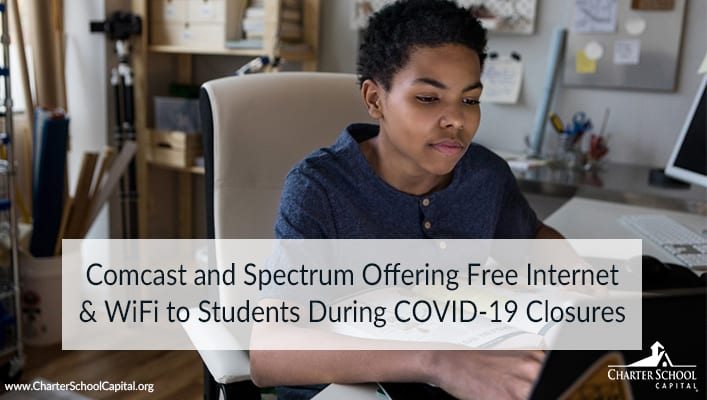
Image of Student working at his desk

Comcast, Spectrum, and Cox are both offering 60 days of free internet to students during the Coronavirus closures.

As schools across the country close to minimize the spread of COVID-19, we reached out to charter schools and state charter school associations to learn what the biggest challenges facing students, parents, and schools. The resounding answer has been equity issues with distance learning—lack of technology and technology training and internet connectivity.

An estimated 17% of U.S. students do not have access to computers at home and 18% do not have home access to broadband internet, according to an Associated Press analysis of census data.

Comcast and Spectrum both announced 60 days of free internet – with slightly different offers.

  • Spectrum is offering free Wi-Fi and broadband access up to 100 MBPS to any household with K-12 and/or college students that don’t already have Spectrum. Installation fees are for these households, and anyone wishing to enroll will need to call 1-844-488-8395.
  • Comcast is expanding a service they already offer for low-income families called Internet Essentials. The service will be free for new customers for 60 days and is 25 MBPS. People hoping to sign up for the services can call 1-855-846-8376 for English and 1-855-765-6995 for Spanish.
  • Both providers are also offering free access to their Wi-Fi hotspots across the country.

Cox announced that effective Monday, 3/15/2020, Effective Monday, March 16, they are providing:

  • Limited-time, first two months free of Connect2Compete service, $9.95/month thereafter.
  • Until May 15, 2020, Cox is providing phone and remote desktop support through Cox Complete Care at no charge to provide peace of mind and ease for technology needs.
  • Resources for discounted refurbished equipment through our association with PCs for People.
  • A Learn from Home toolkit for schools, including instructions on how to fast-track eligible students without internet access Download toolkit.
  • Visit www.cox.com/c2c to qualify and learn more.

Additionally, the California Department of Education has a full list of internet offerings and details from all the major carriers.

We are working on supporting our client schools and are planning a webinar series to help charter school leaders better understand the myths and facts of the Coronavirus (COVID-19).

Join us for our third webinar in the series, COVID-19: Preparing for Attendance and Staffing Issues, Friday, March 27th at 10:00 A.M. PT.

REGISTER HERE

We will post recorded webinar series on-demand here after each is completed and will continue to update about the coronavirus as the situation demands.

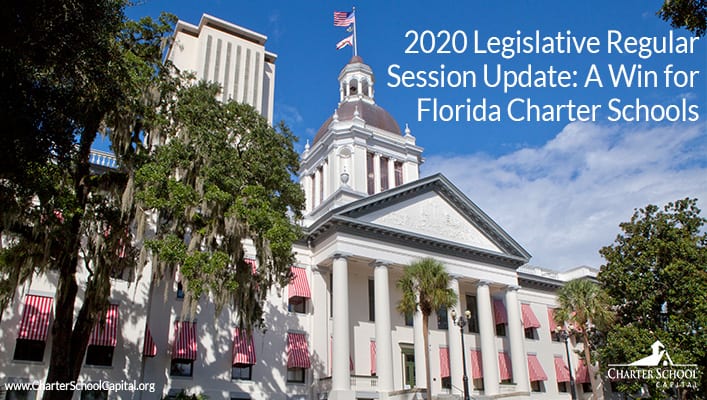
Florida Charter Schools2020 Legislative Regular Session Update: A Win for Florida Charter Schools

For the fourth year in a row, Florida’s Regular Legislative Session was forced into overtime, but in the end, Florida charter schools came out with a win-win.

It is said that laws are like sausages – it is best not to see them being made.

And in this case, policy and budget differences between the two chambers forced an extension of Session past the scheduled 60 days. But in the end, the differences were resolved and the Legislature passed a $93.2 billion budget for the 2020/2021 fiscal year along with associated education policy.

Here are a few highlights that impact Florida’s public charter schools.

Teacher Pay

Legislative members went into the start of Session following the Governor’s call to spend nearly $1 billion for teacher salary increases and bonuses. Negotiations between the two chambers continued until the very last scheduled day of Session with the goal of trying to get to where the Governor wanted things to be. Lawmakers finally settled on a total of $500 million and agreed-upon language as to how school districts and charter schools must apply their share of the dollars, directing $400 million to increase minimum pay for all teachers and $100 million to raises for veteran teachers. They couldn’t, however, manage to get a bonus plan passed.

School districts and charter schools must use 80% of their share of the salary allocation to increase minimum base salary for all full-time classroom teachers and certified pre-kindergarten teachers to $47,500 or the maximum amount achievable based on the allocation. School districts and charter schools must use 20% of their share of the allocation to provide salary increases to full-time classroom teachers and certified prekindergarten teachers who did not receive an increase or who received an increase of less than 2% as a result of increasing the minimum base salary.

School Safety

First the first time since the shooting at Marjorie Stoneman Douglas High School that occurred in February of 2018, the Legislature failed to pass major school safety policy. Legislation was introduced at the beginning of Session that would have implemented a number of recommendations from the Marjorie Stoneman Douglas High School Public Safety Commission but lawmakers just could not get it across the finish line before Session ended.

However, one school safety-related bill did manage to make it through. Lawmakers approved a measure that would mandate that all public schools implement a mobile panic alert system that would communicate with first responder agencies beginning in the 2020/2021 school year. The legislation also directs the Florida Department of Education to work through the procurement process to identify a single state-wide solution. However, school districts and charter schools would not be forced to use any particular solution recommended by the department if they choose a different vendor or have already installed systems on their own ahead of this policy going into effect.

Funding Florida Charter Schools

Lawmakers agreed to an education budget totaling close to $22.7 billion for the upcoming fiscal year. The budget funds $7,839.58 per student, an increase of $183.62 from current year per-student spending. Also included in the budget is an increase of $40 per student in the Base School Allocation which are the unrestricted dollars available to school districts and charter schools that can be used for general operations.

Lawmakers also approved its annual tax package that includes a measure that would require school districts to share discretionary sales surtax revenues with eligible charter schools. These funds come from voter-approved sales tax referendums and must be shared with charter schools based on their proportionate share of the total school district enrollment. These shared funds must be used for fixed capital expenditures at individual charter schools.

Even with the overhang of the spread of COVID-19, this Legislative Session ended up being very positive for charter schools. Teachers will get a pay raise. Students will be better protected. Schools will get more student and facilities funding. This is truly a win-win-win for Florida charter schools.


Charter School Capital logoSince the company’s inception in 2007, Charter School Capital has been committed to the success of charter schools. We help schools access, leverage, and sustain the resources charter schools need to thrive, allowing them to focus on what matters most – educating students. Our depth of experience working with charter school leaders and our knowledge of how to address charter school financial and operational needs have allowed us to provide over $2 billion in support of 600 charter schools that have educated over 1,027,000 students across the country. For more information on how we can support your charter school, contact us. We’d love to work with you!
LEARN MORE


school resources for COVID-19 coronavirus10 Great School Resources for COVID-19 (Coronavirus)

As promised, we’re going to try to keep you as informed as possible and continue to provide school resources for COVID-19 (coronavirus) preparation and response. These recent articles come from several trusted resources including Education Week, National Association of Independent Schools, UNESCO, the National Association of School Psychologists, and the Centers for Disease Control and Prevention.

Here are 10 great articles with school resources for COVID-19 (coronavirus). Take a look!

  1. Symptoms of Coronavirus

2. Preventing the Spread of COVID-19 in Communities 

3. COVID-19 Educational Disruption and Response

4. How to Respond to Coronavirus: 6 Steps for Schools

5. 9 Things Educators Need to Know About Coronavirus

6. Coronavirus and Schools

7. 6 Lessons Learned About Remote Learning During the Coronavirus Outbreak

8. Understanding Coronavirus: What Schools Need to Know

9. Coronavirus (COVID-19) Guidance for Schools

10. Talking to Children About COVID-19 (Coronavirus): A Parent Resource

We will continue to keep a pulse on the situation and share information as it becomes available.

Stay tuned to our Events page to attend our upcoming webinars on this topic and find any we’ve recorded here on demand.


Charter School Capital logoSince the company’s inception in 2007, Charter School Capital has been committed to the success of charter schools. We help schools access, leverage, and sustain the resources charter schools need to thrive, allowing them to focus on what matters most – educating students. Our depth of experience working with charter school leaders and our knowledge of how to address charter school financial and operational needs have allowed us to provide over $2 billion in support of 600 charter schools that have educated over 1,027,000 students across the country. For more information on how we can support your charter school, contact us. We’d love to work with you!

LEARN MORE

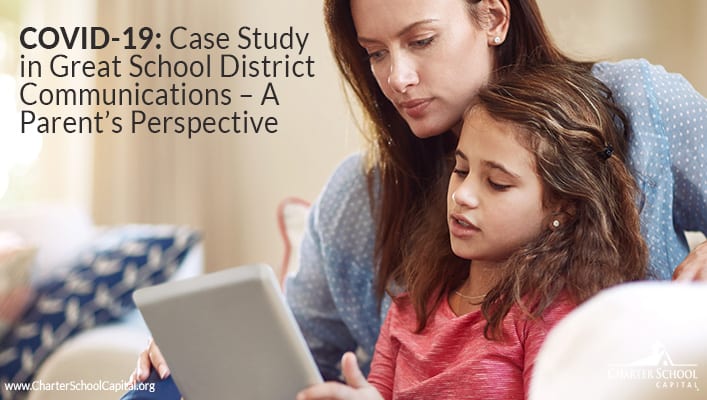
COVID19 School District CommunicationsCOVID-19: Case Study in Great School District Communications – A Parent’s Perspective

In late February, a Lake Oswego, Oregon school staff member tested positive for the COVID-19 virus. It was very early in the initial days of the outbreak, and the Lake Oswego School District (LOSD) was suddenly thrust into the front lines of crisis communications.

One of our team members has two kids in the district, and in her own words, she describes some essentials for keeping parents and caregivers calm and a good model for handling communications during a crisis.


Regular School District Communications

Messages, Multiple Channels – Liz Overson’s Perspective

As a Lake Oswego parent, I feel the district has done a very good job of keeping the people informed when the first Coronavirus case was found/presumptive and later tested positive. I feel aligned with the updates with each move since.

6:00 pm Friday, February 28 – first robocall came explaining a staffer at Forest Hills elementary has tested positive for the coronavirus and is in isolation in the hospital. Text message and emails also came communicating the same message.

7:00 pm Friday, February 28 – second robocall saying all LOSD schools and campuses were closed for the weekend for deep cleaning. Text message and emails also came communicating the same message.

12:00 pm Saturday, Feb 29 – a press conference with the district Superintendent, Communications Director and County/ Health Authority was held. This press conference timing and link were communicated via text, email and robocall as well.

1:00 pm Sunday, March 1 – a health alert update was posted reiterating the safety measures being taken.

On the LOSD home page there is a Health Alert box now. From there, parents can click through to find a timeline of everything that has been shared and done since 2/28:

As a parent, I appreciate:
• Regular communications of fluid info – LOSD is acting as a resource and all LOSD families have the same info.
• LOSD has links to Clackamas County and Oregon Health Authority – making it easy for me to research more if I so choose.
• LOSD communicated in simple and straightforward language.


We can look at this as a model to prepare for the potential that your school will need a similar plan.

Join us for our upcoming webinar:
COVID-19: Six Essential Guidelines for Contingency & Communications Planning
Friday, March 20th | 10:00 a.m. PT

REGISTER HERE