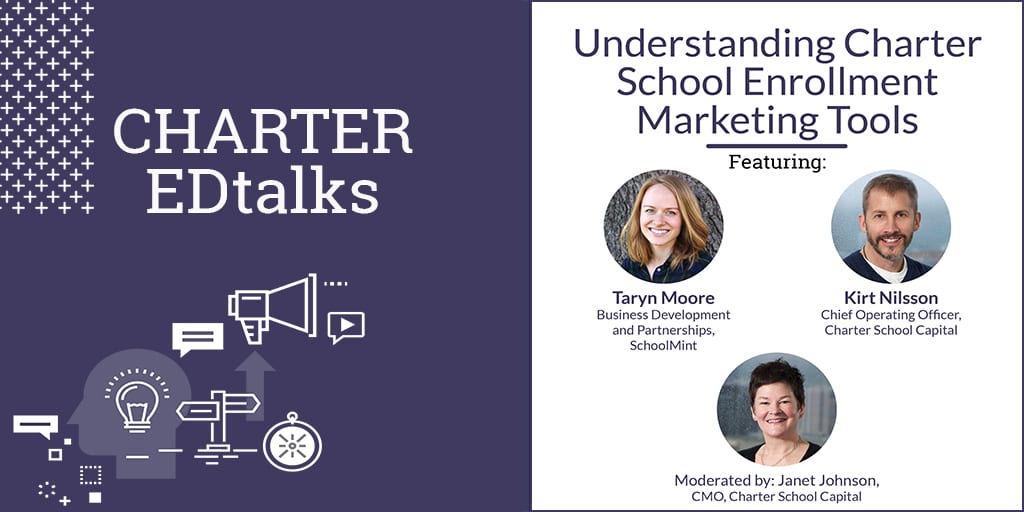
charter school enrollment marketingUnderstanding Charter School Enrollment Marketing Tools

Editor’s Note: In this, the proverbial age of technology, we wanted to dive deeper into how technology tools could specifically help with charter school enrollment marketing. For this CHARTER EDtalk, we were honored to be joined by Taryn Moore in Business Development and Partnerships at SchoolMint. SchoolMint has years of experience working with charter schools — from single-site schools to large charter management organizations (CMOs). They understand your environment and can help optimize your system for your requirements and your recruitment, application, lottery, and registration processes.
We think it’s vital to keep tabs on the pulse of all things related to charter schools, including informational resources,  and how to support charter school growth. We hope you find this—and any other blog post we write—both interesting and valuable. Below you will find the video and the transcript. Please read on to learn more.


Janet Johnson (JJ): Good morning. I’m Janet Johnson with Charter School Capital. We’re here with Taryn Moore from SchoolMint and Kirt Nilsson from Charter School Capital, talking about enrollment today. Thanks for joining us.
Taryn Moore (TM): Thank you for having me.
Kirt Nilsson (KN): School enrollment—when it comes to schools thinking of that, it can be a little daunting. They have to run their schools and also try and get their word out. When it comes to things like leads and lotteries, can you think of ways they can manage that kind of information and that kind of process?
TM: Sure. There are so many great tools out there. I think the key is really finding the tool that’s right for you. I would say look to your current challenges. If you have a lottery that families are saying is not transparent, find an automated lottery tool. Something that really directly addresses that challenge. First and foremost, I would say with whatever tool you choose, find one that’s suitable for your families. If your families don’t have home computers, necessarily, find a tool that’s accessible on mobile, or find a tool that’s available in multiple languages. The goal is to make it easier and more accessible for families.
KN: You talked about some of the tools that are right for the school. Does it matter if they’re a school that’s just getting started, or they’re one that’s been around for several years and have been renewed … is there a right time for a school to start accessing technology like that?
TM: I would say as early as possible is really the best time to start. I think, when you start early, you can tackle some of those change-management hurdles early on and start reaping the benefits sooner. And you can start out light-weight. Start out with a online application. Then, when it makes sense, move into a lottery or a lead tracking system.
KN: I can definitely hear some of the reasons why a school would want to access technology like that. Are there also benefits to the families and the students from schools that access technology? If so, what comes to mind?
TM: I think, for families, bringing technology into the mix really makes things more simple, more accessible to them. It can make really confusing policies feel simpler. It can bring a lot of transparency to various processes as well. Like I was saying before, if you have a tool that’s accessible on mobile, a tool that’s available in a language that’s comfortable for you, that’s going to do wonders for families.
KN: Fantastic. Broadly, if you were to take your experience and say, “Hey, over the last couple of years things are changing in the enrollment technology space,” what kind of things are you seeing? What kind of things should schools be aware of as they think about this?
TM: I think we’re seeing a lot of different trends. One is a move toward common applications. We’re seeing more and more cities unified – bringing all of their charter schools, or a subset of those schools, together onto a common timeline and into a single application – so parents only go to one place to put that application in. We’re also seeing a lot more sophistication in interest tracking and events tracking so that schools can manage, track, and engage prospective families.
The last thing I would say, we’re seeing a lot more sophistication in the way of data analysis. Schools want to know where their student applicants are coming from. And schools want to see what their acceptance rates are like year over year.
Also, on the front of data analysis, when you think about something simple, like a student address. We’re all collecting student addresses on a paper form. You can’t do much with it; it’s just on paper. If you have an online tool that takes that student address and drops a pin at that student’s home location, then you have this beautiful visualization of a map. You can see there’s this cluster of students in this area, and there’s kind of this bare spot over here. Then, you can make really data-driven decisions about outreach, to help achieve your enrollment goals.
JJ: That’s great.
KN: When I listen, I’m like, “She’s really offering great information.” But if I’m the school, and I hear all that, I’m like, “Wow, that sounds a little daunting.” Why shouldn’t I be worried about taking the first step to move in this direction, if I’m a school?
TM: Everybody’s got to start somewhere, and there’s definitely some change management involved in the move to technology, but there are some benefits right off the top. I think, particularly for school staff. If you think about admins, who are today, spending lots of time entering data from paper systems. The move to online makes them really have a simpler day to day experience in the office. If they’re not entering that data from paper systems, if they’re not spending time manually tracking and managing a wait list, for example; they have more time to spend directly with families, which is really a better use of their time anyway. Of course, they have so much more powerful data to deal with as well.
KN: As we listen to you and start to get comfortable with the idea of using that technology to really move forward enrollment in schools, what kind of things do you see that come from it? What’s the success story that comes from using this kind of technology?
TM: I think some of the points that we’ve hit on already. An easier, more transparent experience for families, for sure. More powerful access to data for schools, so that they can really make data-driven decisions, and really move into the 21st Century. Parents are already using so many online tools as it is, to check student’s grades, to get e-newsletters from schools. To bring more and more of those processes online. I think it’s a lot less daunting today than it was even just five years ago.
KN: As you mentioned the different systems, and how schools are coming up to speed, do enrollment technology systems integrate with other systems of the school? Do they even need to?
TM: Yes, absolutely. We see it both ways. We see a lot of schools where they have a bunch of ad hoc systems that are working independently, and they’re navigating through those. We use those every day on our phones. If you open up your phone, you’ve got a whole slew of different apps that don’t have anything to do with each other. We somehow find a use for all of them and a way to navigate through them. Then there are also systems that are really end-to-end, so there’s not a need to integrate with other systems because they really cover a whole range of processes. Then, of course, there are systems that have great partnerships, or maybe there’s a platform of systems that really integrate seamlessly.
KN: It sounds like a lot of choices out there. If I’m a school, and I’m thinking through the choices, how do I take the first step? What’s the first thing that I should do?
TM: I think, in terms of making the choice, a simple Google search, of course, will render a lot of great results. I think also just talking to school admins and school leaders in your area can be a really helpful starting point. So many tools exist, and many of them are already in use by schools today. Finding out what others’ experiences have been like, I think, can be really helpful. Even thinking beyond just the horizons of your immediate geographic area, reaching out to school leaders in other areas of the country that maybe have similar challenges as you or similar demographics, can be really, really helpful. Kind of finding out what it’s like to work with a particular technology provider or a particular system.
KN: Now is the time of year, when schools have finished, and they’re all giddy that the school year is over; but the fall is not that far away. Are they too late to start thinking about these technologies, or using them? Are they too late, if they get started now, for the fall?
TM: I think it depends on the system that you’re looking for, the issue that you’re looking to address. I think if you’re looking to an online application system, for example, a lot of those systems can get you up and running in a matter of a couple of weeks, or maybe a month. I think it’s definitely not too late. It’s certainly never too late to at least begin exploring what your options are.
KN: It sounds like that’s the message. It’s not too late. There are a lot of benefits of enrollment marketing tools to charter schools. A lot of benefits to parents. So get it going.
TM: Yes, absolutely.
JJ: All right. Thank you, Taryn, so much.


Feel free to email Taryn (taryn@schoolmint.net) with any questions you may have about your charter school enrollment needs. 


Digital Marketing for Charter SchoolsDigital Marketing for Charter Schools: An Actionable Workbook to Help You Achieve Your School’s Goals!
Need strategic tips on enrollment marketing for your charter school? Scratching your head as to how to go about implementing digital marketing? You’re not alone! This free manual will be your go-to guide for all of your school’s digital marketing needs! Download this actionable workbook to help get your marketing plans started, guide you as you define your audience and key differentiators, choose your tactics, and start to build your campaigns.
DOWNLOAD NOW

Charter School Expansion
Editor’s Note: This post was originally published here by the Fordham Institute on May 3, 2018. It was written by Amy Ruck Kagan, National Association of Charter School Authorizers’ (NACSA) Vice President of Authorizer Engagement and Advancement. The article addresses the need for charter school expansion in areas where high-need students don’t have access to elementary charter schools. Kagan challenges authorizers to review the data showing where elementary charter schools are – and are not – in relationship to high-poverty areas.  She asserts that if authorizers use this data to rethink their state policy, authorizing environment, and community needs, more underserved children would have the opportunity for equal access to great public school options.
Read the complete article below.


Charter school deserts or opportunities for access?

At NACSA, I lead a team that works directly with hundreds of charter school authorizers across the country. I interact with many of them on a day-to-day basis, and they’re all driven by a commitment to ensure that every child has access to quality schools, regardless of zip codes. They know that great charter schools can transform children’s lives and that too many neighborhoods are void of quality educational opportunities.
Doing the work thoughtfully and meeting this critical demand requires the right tools and supporting data. Our research finds that the best authorizers are obsessed with data: They actively and intentionally seek out new information about their schools and communities, and they incorporate it into their decisionmaking when it’s appropriate. When this information is accessible, authorizers have the power to do something about the charter deserts within their communities.
One piece of this data puzzle might be a new report from the Thomas B. Fordham Institute, Charter School Deserts: High-Poverty Neighborhoods with Limited Educational Options. It seeks to help authorizers and those in the charter sector answer the question: What high-need areas in my city or state lack elementary charter schools?

Even if we added just one charter school in each desert, we’re talking about opening up great schools for up to 150,000 more kids.

The report maps the location of elementary charter schools against high-poverty areas using data from the U.S. Census Bureau. Alarmingly, it found that almost all states with a charter school law have at least one desert. More specifically, it found that there are roughly 500 neighborhoods across the country with a high concentration of families in need and no charter schools. The potential impact is huge: Even if we added just one charter school in each desert, we’re talking about opening up great schools for up to 150,000 more kids.
That’s why authorizers should take a moment to review this report and reflect upon their own state policy, authorizing environment, and community needs. Then ask: “What can I do to make sure that every child served within the boundaries of my portfolio have equal access to a great public school option?”
This isn’t an easy question. There are many factors that hinder growth within a portfolio—and many are out of an authorizer’s control, such as a lack of facilities, law and regulations, and other political obstacles. But I am a firm believer that there is a solution to every problem, and that authorizers are the solution-oriented and passionate professionals that can indeed create much-needed change.
Here are some ideas for how authorizers can start using these data to create access for kids:

  • Share this report with decisionmakers within your organization and determine the right strategy for using the data to help communities in need.
  • Use this report in conjunction with expansion and renewal decisions with high-performing schools to create seats where they are most needed.
  • Evaluate how the data included in this report and other information can be used as part of the application decisionmaking process.
  • Truly examine and address the geographic discrepancies within your own portfolio of schools.
  • Opening more great schools that serve the students who need them most is one of the greatest challenges—and greatest opportunities—facing authorizers today. Authorizers have the power and the responsibility to help change lives. Using this report as a tool in their toolbox will only help provide more great schools for kids.

The views expressed herein represent the opinions of the author and not necessarily the Thomas B. Fordham Institute.


Since the company’s inception in 2007, Charter School Capital has been committed to the success of charter schools. We provide growth capital and facilities financing to charter schools nationwide. Our depth of experience working with charter school leaders and our knowledge of how to address charter school financial and operational needs have allowed us to provide over $1.6 billion in support of 600 charter schools that educate 800,000 students across the country. For more information on how we can support your charter school, contact us. We’d love to work with you!

LEARN MORE


charter school funding sourcesCharter School Funding Sources: Receivable Sales vs. Traditional Bank Loans

At Charter School Capital, we are 100% dedicated to the charter space and to enabling the success of charter schools. Schools often have difficulty finding charter school funding sources for operations and growth.
One method of financing widely used by many industries is receivable sales. This reliable and flexible transactional process, pioneered by Charter School Capital for charter schools, provides access to capital needed to support operations, facilities, programmatic expenses, or other obligations.
To make things a bit easier, we wanted to help clarify some of the differences between accessing capital with a traditional bank loan or line of credit versus our receivable sales product with regards to access to money, cost, and risk.
Read on to get answers to the most commonly asked questions around options for charter school funding sources.


Access to Money

Who qualifies for funding?

  • With a traditional bank loan or line of credit, it’s limited and depends on the school’s credit history.
  • With Charter School Capital’s receivable sales product there is universal access as greater than 90% are approved for funding.

How much can be approved?

  • With a traditional bank loan or line of credit, it really depends on your credit rating which can also restrict the amount awarded.
  • With Charter School Capital’s receivable sales product, the amount is only limited by your school’s budget and we can fund all qualified receivables.

Can a lender/purchaser increase amount of contract?

  • With a traditional bank loan or line of credit, it can be difficult, time-consuming, and also require credit committee approval.
  • With Charter School Capital’s receivable sales product, it can be increased quickly and easily and the amount available will be based on qualified receivables.

Can you get funds when needed?

  • With a traditional bank loan or line of credit, it depends and the amount awarded and access to the funds can be restricted.
  • With Charter School Capital’s receivable sales product, the answer is yes, we can fund all qualified receivables when you need the money.

Cost

How much will it cost?

  • With a traditional bank loan or line of credit, the cost is not known until the loan is paid. In addition, state delays can cause additional interest, late fees, and penalties.
  • With Charter School Capital’s receivable sales product, the cost is known upfront and fixed, even when state payments are delayed.

Budget Planning –Dollars per Student

  • With a traditional bank loan or line of credit, the cost is unknown and harder to plan because of the fact that the cost is uncertain.
  • With Charter School Capital’s receivable sales product, the cost is fixed and certain. Having more predictable costs makes planning more reliable.

Risk

Who is obligated to pay?

  • With a traditional bank loan or line of credit, the school is obligated to repay debt.
  • With Charter School Capital’s receivable sales product, it is a state obligation, not a school debt.

What is at risk if the state delays payment?

  • With a traditional bank loan or line of credit, the school is at risk for interest costs, late fees, and possibly even default if the payment is delayed because the state is late.
  • With Charter School Capital’s receivable sales product, if payments are delayed at the state level, there is no recourse to the school and Charter School Capital assumes the risk.

Click here to download the free one-page PDF datasheet on these two charter school funding sources!


The Charter School Growth Manual
Whether you’re just beginning the process of starting up a charter school, looking to expand or trying to prioritize your next steps, download this guide to get expert tips and pitfalls to avoid as you grow.
For this charter school resource guide, we turned to our wide network of charter school experts for best practices and strategies for success at every stage of maturity. All of the advice in this book comes from experienced charter school leaders who have been where you are now—they understand what you’re facing and the pitfalls to avoid.

DOWNLOAD NOW


charter school investmentsWalton Family Announces $100 Million for Charter School Investments

Editor’s Note: This post about the Walton Family grants towards charter school investments was originally published here, on June 19, 2018, by the Walton Family Foundation.


More than $100 million in new grants will support diverse and innovative school models and leaders

AUSTIN, Texas – Today, the Walton Family Foundation announced efforts to build and expand on two decades of school startup grants to fuel the growth of high-quality schools across the country. The strategy, detailed in Rooted in Opportunity: The Walton Family Foundation’s Approach to Starting and Growing High-Quality Schools, includes continued grants to proven organizations, like those that help create successful charter schools, with an expanded focus on innovative school models to meet the learning needs of all children. Foundation grants totaling more than $100 million will allow educators and leaders to launch hundreds of schools in the coming years.
“Thanks to courageous school founders – overwhelmingly teachers who have a vision for what school can be – we know that quality schools that put children on a path to college and career success at scale are possible,” said Walton Family Foundation K-12 Education Director Marc Sternberg. “But the simple truth is that a great school remains out of reach for too many families. So we’ve got to do more – more to support educators with a passion and plan for something better, more for families who look to schools as a pathway to opportunity. And in order to build on two decades of work, we need partners old and new in philanthropy and positions of civic leadership who share a vision for the day when all children have access to a school that is right for them.”

Areas of continued and new support are:

Starting and scaling more proven high-quality public charter schools.
Building Excellent Schools: Identify, recruit and train leaders to launch high-quality public charter schools across the country.
KIPP: Grants that support all of KIPP’s strategic priorities including growth, academics, talent and the KIPP Through College program.
Supporting district and private schools that are embracing accountability and autonomy.
Indianapolis Public Schools: Expansion of school-based autonomy and principal trainings.
Partnership Schools: To bring a proven turnaround model to struggling Catholic schools.
Implementing diverse pedagogical approaches.
Big Picture Learning: Open 15 new public schools focused on real-world learning through internships and other activities.
Wildflower: Support for opening new, teacher-led Montessori schools in this network of district, private and forthcoming micro-charter schools across the country.
Increasing early-stage support for leaders of color
Teaching Excellence: Train and support at least 620 educators, 70 percent of whom will identify as people of color, to teach across 15 charter organizations and school districts.
Camelback Ventures: Recruit, train and support leaders and entrepreneurs as they start schools or education-focused ventures across the country.
Navigating the student transition from secondary to post-secondary college and career
The Match Foundation: Grow the college-support program Duet, which provides flexible and affordable degree programs and start-to-finish college coaching.
YouthForce NOLA: Help hundreds of New Orleans students secure internships and earn industry-recognized credentials, putting them on a path to high-wage jobs.
Growing schools that are serving special student populations well
CHIME Institute: Grow the network of fully-inclusive schools where students with and without special needs outperform state averages.
Collegiate Academies: Expand Opportunities Academy, a rigorous full-day program that helps students with moderate to significant disabilities reach their highest potential.
Starting more schools that serve students of diverse backgrounds
Bricolage Academy: Support to help the New Orleans school grow to meet the needs of local families. Currently, six times as many students seek enrollment at Bricolage than the school has capacity to serve.
Diverse Charter Schools Coalition: Study, source and share best practices of intentionally diverse public charter schools. Work closely with a select number of future school leaders to incubate and launch new schools.
Early stage support for entrepreneurs
Reframe Labs: Recruit and support diverse leaders as they design and open innovative public schools in Los Angeles.
4.0 Schools: Recruit and support early stage entrepreneurs developing transformative schools, learning spaces and technology tools.
“Quality public schools are the bedrock of thriving communities and a strong democratic society. The investments that the Walton Family Foundation is making in innovation, accountability for serving students well, and diversity in American public education are heartening because of the difference they will make in the lives of students and families across the country,” said former U.S. Secretary of Education and CEO and President of The Education Trust John B. King, Jr. “More students, particularly those from low-income backgrounds and students of color, will be able to receive rich learning opportunities, successfully transition from P-12 into college and careers, and attend intentionally diverse public schools — with diverse, effective teachers and school leaders. I’m looking forward to the ways in which these important efforts will advance excellence and equity in public education.”
Some of the most impactful grants that span multiple focus areas include:

Charter School Growth Fund

Charter School Growth Fund invests in talented education entrepreneurs who are building networks of great charter schools. To date, CSGF has funded networks that operate more than 870 schools that serve over 370,000 students. Walton’s most recent support will help CSGF identify, develop and train school leaders of color with proven educational track records who have a high potential for success in starting and scaling high-performing charter management organizations.

NewSchools Venture Fund

NewSchools Venture Fund is a venture philanthropy that raises contributions from donors and uses them to find, fund and support teams of educators, and entrepreneurs who are reimagining public education and opening high-quality, innovative schools. New support from the Walton Family Foundation will allow NewSchools to support early-stage ventures that will increase the proportion of Black and Latino leaders in Prek-12 education, as well as incubate and support the launch of more than 30 schools.

Valor Collegiate Academies

Valor Collegiate Academies is a network of high-performing, intentionally diverse public charter schools in Nashville, TN. This support will allow Valor to codify its successful model that blends academic rigor and social-emotional learning and share best practices with schools in Nashville and across the nation.
“Every child deserves access to a great school, which is why it’s important to see a strong commitment to accountability,” said former U.S. Secretary of Education and Managing Partner at Emerson Collective Arne Duncan. “To continue our progress as a country, we need to aim higher for all children and all schools.”
“It requires a collective effort to have a transformative effect on the lives of students and teachers across our great nation,” said former U.S. Secretary of Education and University of North Carolina System President Margaret Spellings. “I applaud the Walton Family Foundation for undertaking this optimistic endeavor, and I am inspired to see their willingness to address issues in education through a varied and holistic approach.”
“As former Houston Superintendent and US Secretary of Education, I saw firsthand the power and importance of new school startup support provided by the Walton Family Foundation,” said former U.S. Secretary of Education Rod Paige. “These resources allowed thousands of passionate educators and other community members to open new schools that today prove what is possible in public education and how to change for the better the lives of children, families and communities across the nation.”
The Walton Family Foundation has supported the creation of more than 2,200 charter, district and private schools with $424 million in grants since 1997. These schools now serve about 840,000 children nationwide.

About the Walton Family Foundation

The Walton Family Foundation is, at its core, a family-led foundation. The children and grandchildren of our founders, Sam and Helen Walton, lead the foundation and create access to opportunity for people and communities. We work in three areas: improving K-12 education, protecting rivers and oceans and the communities they support, and investing in our home region of Northwest Arkansas and the Arkansas-Mississippi Delta. In 2016, the foundation awarded more than $454 million in grants in support of these initiatives. To learn more, visit waltonfamilyfoundation.org and follow us on Facebook and Twitter.


Since the company’s inception in 2007, Charter School Capital has been committed to the success of charter schools. We provide growth capital and facilities financing to charter schools nationwide. Our depth of experience working with charter school leaders and our knowledge of how to address charter school financial and operational needs have allowed us to provide over $1.6 billion in support of 600 charter schools that educate 800,000 students across the country. For more information on how we can support your charter school, contact us. We’d love to work with you!

LEARN MORE


Charter School FinancingCharter School Financing: Myths vs. Facts

From funding your growth, managing deferrals, to investment in facilities, get ahead of the game knowing these five charter school financing myths & facts!
charter school financing
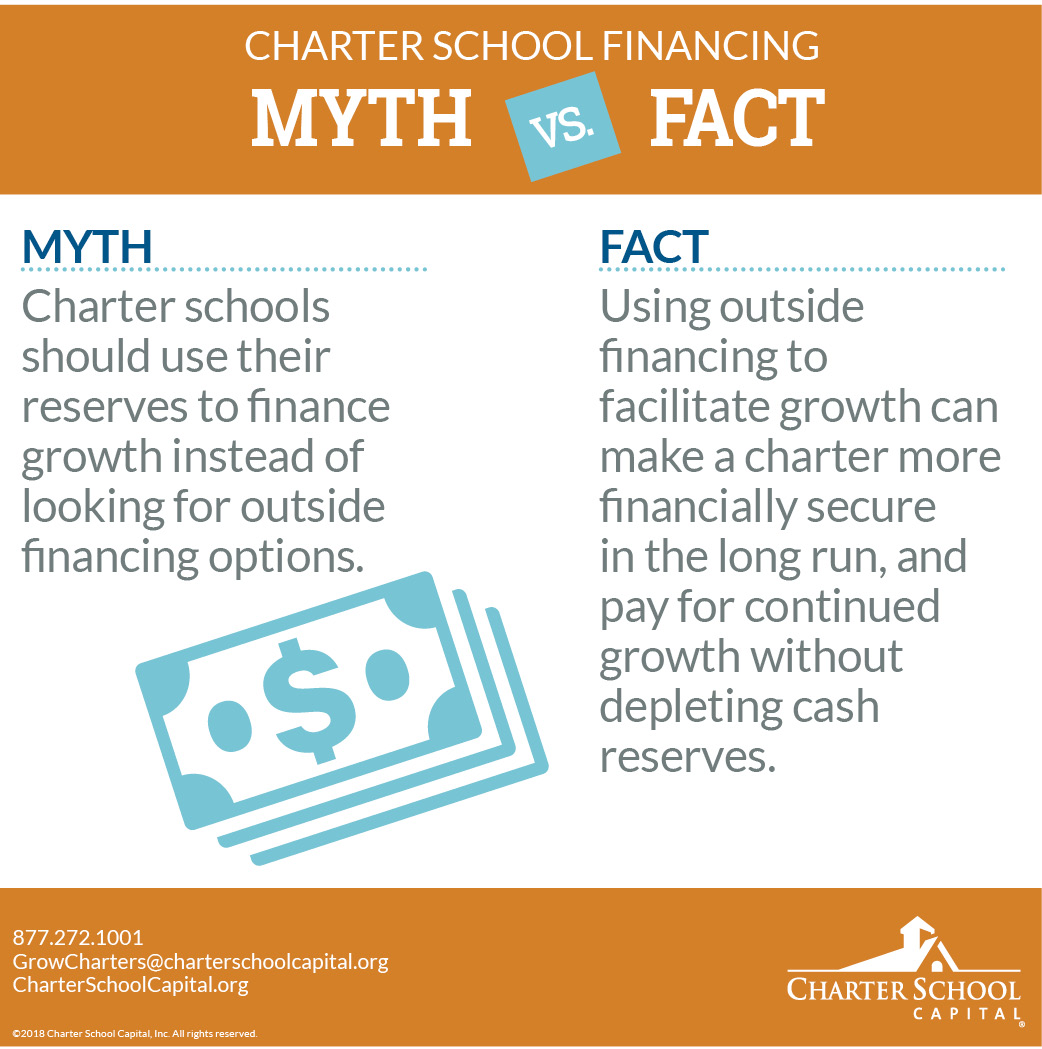
Tweet: MYTH: Charter schools should use their reserves to finance growth instead of looking for outside financing options. FACT: Using outside financing to facilitate growth can make a charter more financially secure in the long run and pay for continued growth without depleting cash reserves.

MYTH: Charter schools should use their reserves to finance growth instead of looking for outside financing options.
FACT: Using outside financing to facilitate growth can make a charter more financially secure in the long run and pay for continued growth without depleting cash reserves.


charter school financing
 
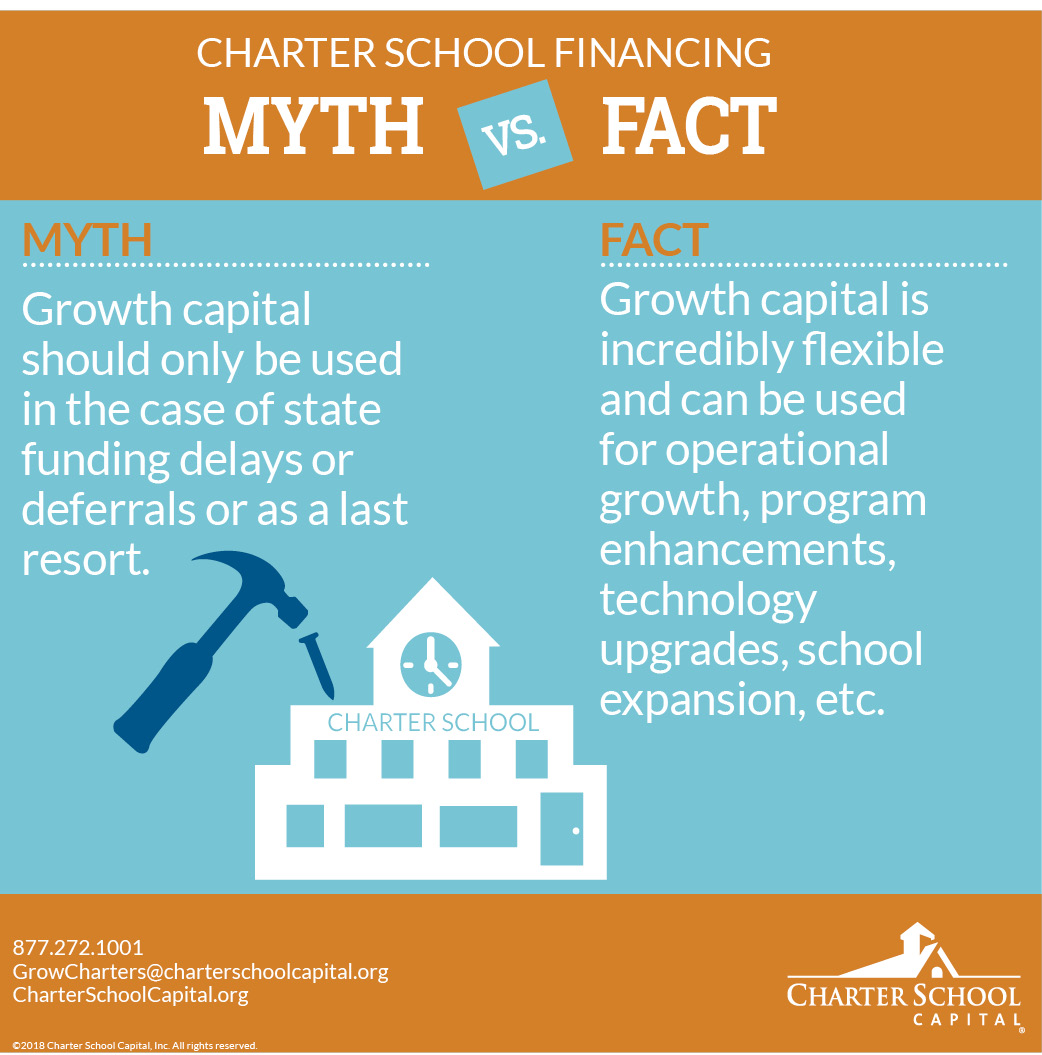
Tweet: MYTH: Growth capital should only be used in the case of state funding delays or deferrals or as a last resort. FACT: Growth capital is incredibly flexible and can be used for operational growth, program enhancements, technology upgrades, school expansion, etc. MYTH: Growth capital should only be used in the case of state funding delays or deferrals or as a last resort.
FACT: Growth capital is incredibly flexible and can be used for operational growth, program enhancements, technology upgrades, school expansion, etc.


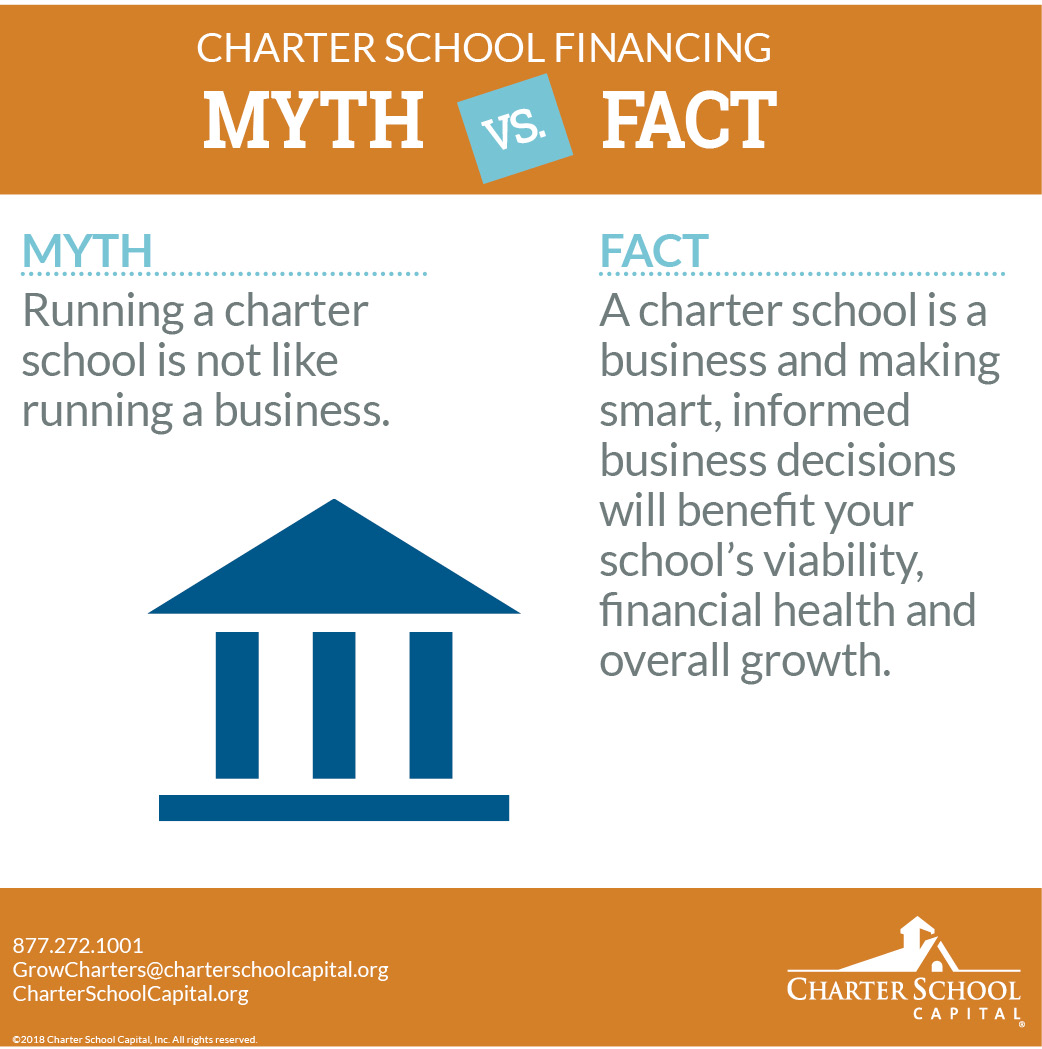
Tweet: MYTH: Running a charter school is not like running a business. FACT: A charter school is a business and making smart, informed business decisions will benefit your school’s viability, financial health and overall growth. MYTH: Running a charter school is not like running a business.
FACT: A charter school is a business and making smart, informed business decisions will benefit your school’s viability, financial health and overall growth.


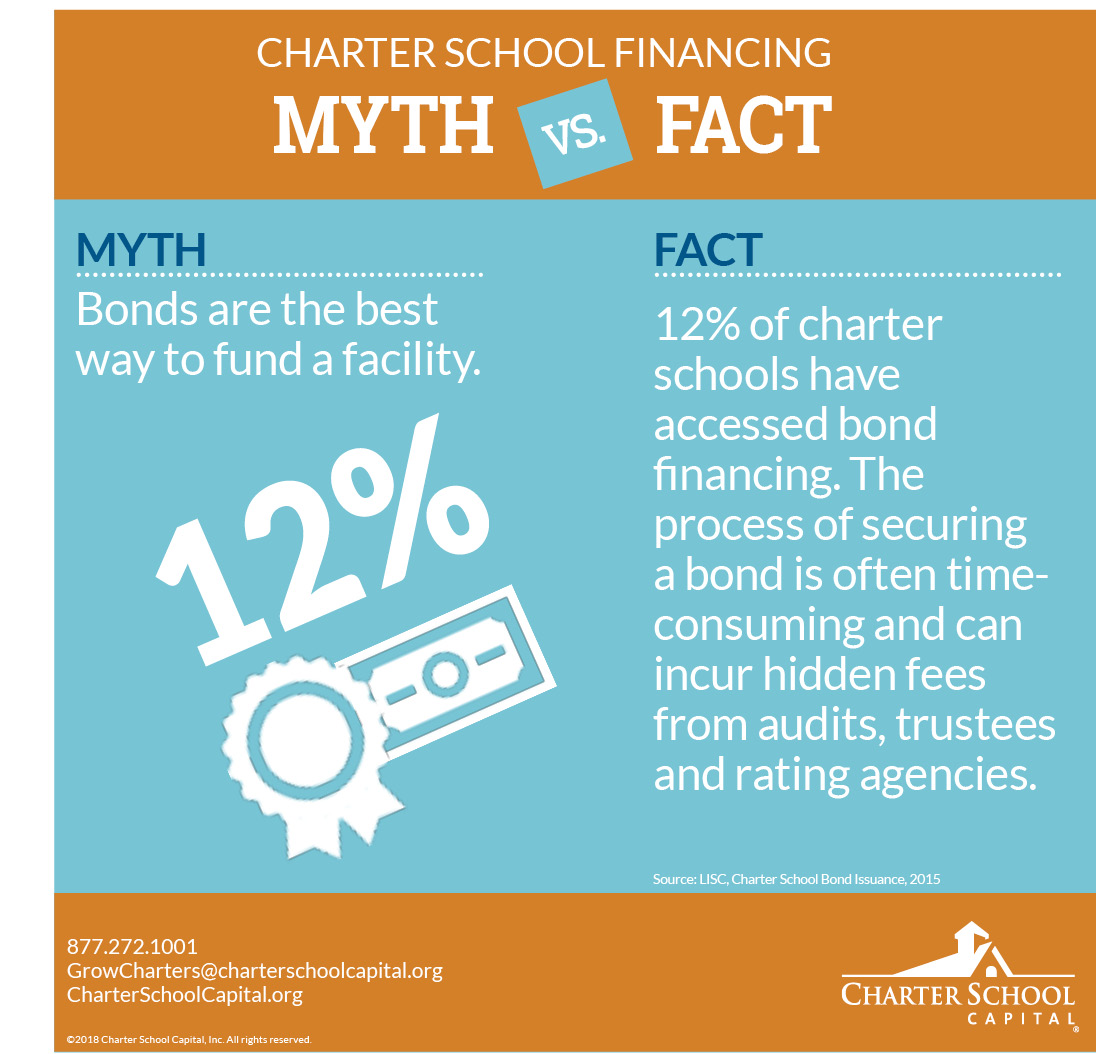
Tweet: MYTH: Bonds are the best way to fund a facility. FACT: Only 12% of charter schools have accessed bond financing. The process of securing a bond is often time-consuming and can incur hidden fees from audits, trustees and rating agencies.MYTH: Bonds are the best way to fund a facility.
FACT: Only 12% of charter schools have accessed bond financing. The process of securing a bond is often time-consuming and can incur hidden fees from audits, trustees and rating agencies.
Source: LISC, Charter School Bond Issuance, 2015


Charter School Financing
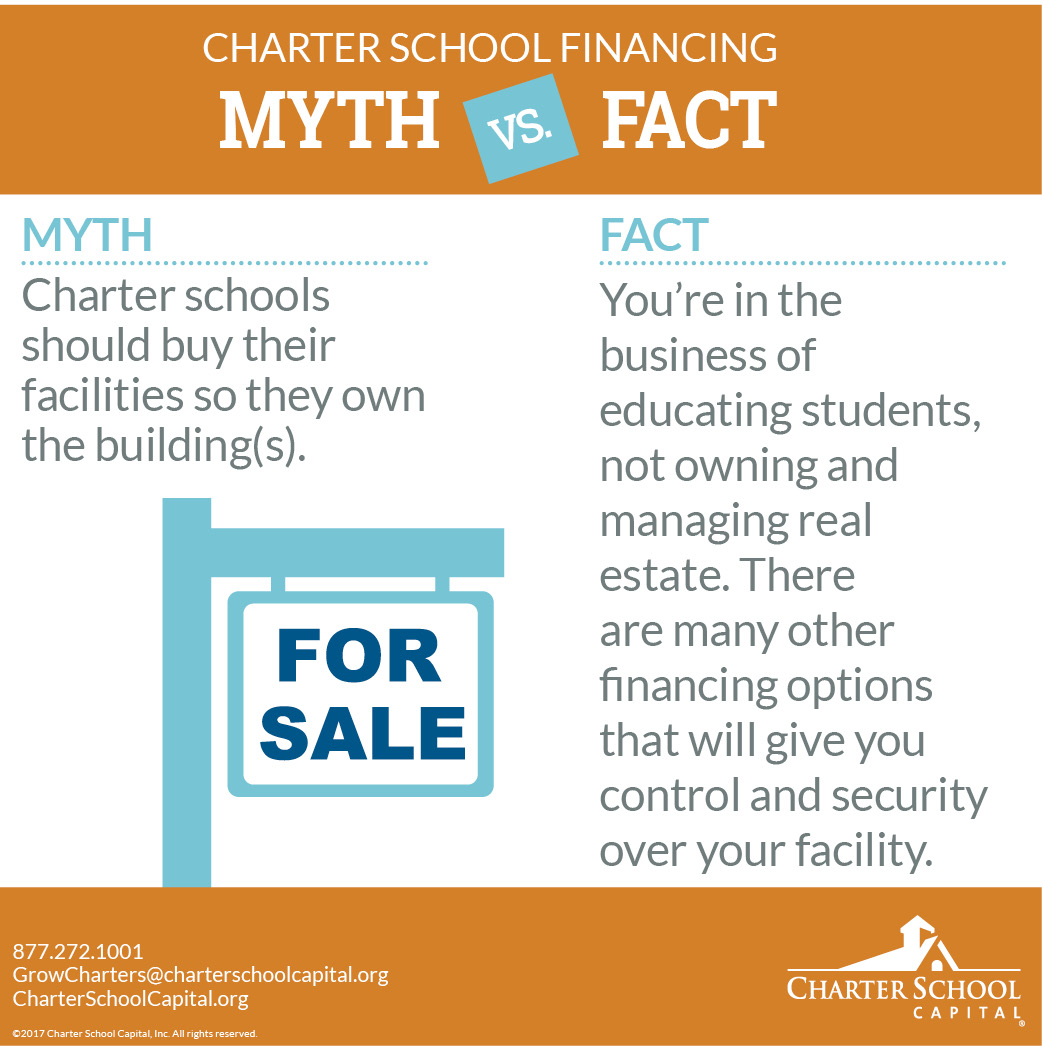
Tweet: MYTH: Charter schools should own their facilities. FACT: You’re in the business of educating students, not owning and managing real estate. There are many other financing options that will give you control and security over your facility.MYTH: Charter schools should own their facilities.
FACT: You’re in the business of educating students, not owning and managing real estate. There are many other financing options that will give you control and security over your facility.


If you’d like to download the PDF version of this infographic, click here.


Charter School Budgeting
Charter School Budgeting Best Practices: Don’t Just Survive–Thrive!
Since the opening of Charter School Capital 10 years ago, we’ve reviewed thousands of charter school budgets. Year after year, we see common mistakes many charter schools make when budgeting for their academic year. Hear from charter school finance experts as they give you a breakdown of budgeting best practices to help you have a financially successful academic year. Don’t just survive — thrive!

GET THE RESOURCE


charter school fundingCharter School Capital Funding Enables Skyline Education to Grow and Provide the Resources Needed for Their Students

Read this school spotlight to learn how Charter School Capital funding helped Skyline Education when they needed it most.


Providing a quality education to at-risk students often requires multiple resources. One-on-one instruction with teachers, access to good computers and customized lesson plans for students with special needs are just a few of the tools necessary to help children from underserved communities reach their potential. That is the formula behind the success of Skyline Education, a charter network in Arizona.
The multi-disciplined approach to education that Skyline’s six campuses provide “comes at a fairly high up-front expense,” says KJ Weihing, vice president of finance at Skyline Education. “We wanted to make purchases but didn’t have the up-front funding. That’s why we called Charter School Capital; they helped us get that short-term funding.”
Skyline opened its first campus in 2000, but it wasn’t until 2009 that the charter began to experience rapid growth. That year, the charter added two new campuses to its network, another in 2010 and two more in 2012. The network now serves more than 1,000 students in socially and economically diverse communities, including the Gila River Indian Community.
Such dramatic growth these past few years created a real need to access working capital, explains Weihing. The charter network knew that it would be receiving its funding, but given the uncertain payment schedule from the State of Arizona, they didn’t know when. School administrators knew that they needed some form of help to even out their budget throughout the year but were very wary of outside funders until they met Charter School Capital.

“We wanted to make purchases but didn’t have the up-front funding. That’s why we called Charter School Capital; they helped us get that short-term funding.”
~KJ Weighing, Vice President of Finance, Skyline Education

“I was impressed with the fee structure,” says Weihing. “A lot of times there are organizations that will lend for 20% interest because they know you can’t get funds anywhere else. Charter School Capital’s fee structure was not outrageous.”
But the relationship Skyline has developed with Charter School Capital is rooted in much more than just financial terms. Weihing would recommend to any charter school needing funds that they just “start the process,” stating that the two organizations have formed a real partnership dedicated to the success of Skyline Education.
“Last year, we wanted to make new computer purchases for one of our schools, but we didn’t have the current funding on hand to make that happen. So we used Charter School Capital to provide us with some short-term, immediate funds in order to get those computers into the classroom sooner than we would have been able to if we were waiting on funding,” concludes Weihing. The whole process has been “extremely seamless, quick and easy; I’m glad I did it.”


Since the company’s inception in 2007, Charter School Capital has been committed to the success of charter schools. We provide growth capital and facilities financing to charter schools nationwide. Our depth of experience working with charter school leaders and our knowledge of how to address charter school financial and operational needs have allowed us to provide over $1.6 billion in support of 600 charter schools that educate 800,000 students across the country. For more information on how we can support your charter school, contact us!

LEARN MORE


school choice
Editor’s Note: With the anniversary of our nation’s independence next week, I thought that addressing the idea of freedom, and more specifically freedom of choice in education was a timely topic. We understand the flexibility in the educational curriculum that public charter schools offer needs to be balanced with accountability. But there has been much debate over the effect that public charter schools have on traditional public schools. This article takes a closer look at the benefits of school choice. It also shows that no evidence or study exists supporting the argument that public charter schools harm traditional public schools. But rather, evidence has been shown to the contrary: the existence of public charters has often improved traditional public school performance in those communities.
We think it’s vital to keep tabs on the pulse of all things related to charter schools, including informational resources,  and how to support charter school growth. We hope you find this—and any other article we curate—both interesting and valuable. Please read on to learn more.

*This op-ed article on the benefits of school choice was originally posted here on February 28, 20118 by the Desert News and written by Teresa Mull (tmull@heartland.org), a research fellow in education policy at The Heartland Institute.

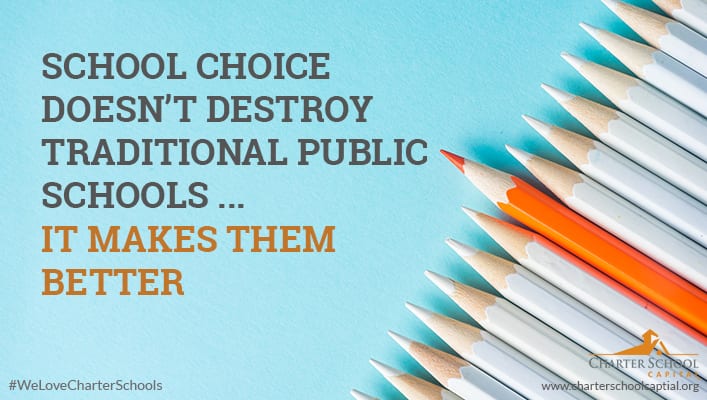
School Choice Doesn’t Destroy Traditional Public Schools; It Makes Them Better

The go-to mantra of many traditional government school advocates is that education-choice programs destroy neighborhood public schools. Their argument is flawed for a couple of reasons. The first is it shouldn’t matter if traditional public schools go the way of the dodo if children, despite public schools’ demise, are receiving a better education. And then there is the fact that their argument is simply not true.
The presence of education-choice options doesn’t “destroy” public education, but it does make existing government schools step up their game, as Sarah A. Cordes wrote in a recent EdNext study titled “ Charters and the Common Good.”
She wrote, “I find that students in district schools do better when charters open nearby: Students in these schools earn higher scores on reading and math tests and are less likely to repeat a grade. The closer the schools, the larger the effect: Co-location increases test scores by 0.08 standard deviations in math and 0.06 in reading.”
The effects are modest, as Cordes noted, but what’s equally important in the school-choice debate is that charters have “no significant negative effects on student performance at district schools nearby,” and “it may be beneficial (and certainly not harmful) to allow for further expansion in NYC.”
Cordes concluded that her findings “show that communities can expand charter schools to meet growing demand without putting district schools at risk of instability or failure. Far from an existential threat to their district-school neighbors, public charter schools can benefit not only their own students but also those in other programs down the street — or hallway.”
Cordes’ findings are a great boon to the education-choice debate. The more policymakers, and constituents who try to persuade them, are armed with evidence showing school choice works, the more likely it is good policy will come into being, right? To quote Ernest Hemingway, “Isn’t it pretty to think so?”
The reality is the free-market system of school choice has always had research on its side. EdChoice.org reported, for instance, “Thirty-one empirical studies (including all methods) have examined private school choice’s impact on academic outcomes in public schools. Within that body of research, 29 studies find that choice improved the performance of nearby public schools. One study finds no significant effects. To date, no empirical study has found that school choice harms students in public schools.”
What’s more, “The research shows that students in school-choice programs attend more integrated schools than their public school counterparts,” EdChoice reported.
There goes the false “School choice only benefits high-income, white families” narrative public school proponents have been peddling for decades. After all, how could a system that forces students to attend the school that corresponds with their ZIP code do anything but segregate by income level? The U.S. Government Accountability Office reported in 2016 that segregation in America’s public schools has actually increased in recent years.
Education choice is good for society. That’s not news to those of us who have been paying attention to the school-choice debate in recent years, and it’s no surprise that the educational elite, who remain committed to their plan to control education for everyone in America, would propagate myths about education choice to maintain their power, prestige and hefty incomes. But studies like Cordes’ are nevertheless vital for growing the school-choice movement.
The more school choice we have, the more evidence there will be supporting its value to society, and pretty soon, we’ll have so much overwhelming proof that even teachers unions and the politicians they control won’t be able to ignore it any longer.


Charter School Capital is committed to the success of charter schools and has solely focused on funding charter schools since the company’s inception in 2007. Our depth of experience working with charter school leaders and our knowledge of how to address charter school financial and operational needs have allowed us to provide over $1.6 billion in support of 600 charter schools that educate 800,000 students across the country. For more information on how we can support your charter school, contact us!

LEARN MORE


immigration and schools

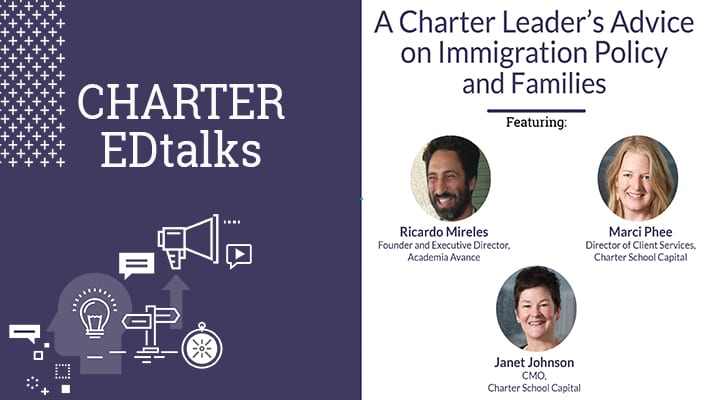
CHARTER EDtalk: A Charter Leader’s Advice on Immigration Policy and Families

With all the news of children being torn from their families, we have a story from one of our charter leaders that is more important today than ever. We realize that politics and immigration laws touch charter families in many ways, and want to share this video because hearing the stories of students we serve moved us so deeply.
Editor’s Note: On the day that the separation of children from their parents has apparently ended, we are posting this charter leader’s experience with immigration laws and policies, and their ramifications on charter school students and their families. Find the CHARTER EDtalk video and transcript below.


Janet Johnson: Hi there and welcome to CHARTER EDtalk. I’m Janet Johnson with Charter School Capital and we are delighted today to have Ricardo Morales, who is the Founder and Executive Director of Academia Avance here to speak with us along with Marci Phee, who is our Director of Client Services. We are very grateful to have you come and talk about a very important topic today. Marcie, take it away.
Marci Phee: Thanks Ricardo. Ricardo and I worked together for years, so this is a great conversation among friends.
Janet Johnson: That’s great.
Marci Phee: Would you give us a overview of the debate regarding the collaboration between school staff and immigration policy enforcement?
Ricardo Mireles: Oh yes. Obviously right now there’s a lot of attention on it, but it’s important to know that this is not new. The attempt to use public service employees to try to enforce federal immigration laws goes, goes way back. And in fact, the current attempts are building on something that was successful. So, some historians estimate that as many as file million Mexicans left the United States in the thirties in 30’s and the 40’s not because they were deported, but because they got scared and left from other efforts and so getting other people involved to try to push people out is not a new thing.
And, if we think back to, the Plyler Decision  that comes out of Texas, a constitutional position, it found that public education is a right for everybody, regardless of immigration status—that is a constitutional obligation. And so schools need to do that. And that they keep trying to get around this. This is was what prop 187 in California was,  the attempts in Arizona, and Alabama, and now in Texas. And they keep trying to come back to an issue that has already been established. And so what I try to convey to school leaders is this isn’t about trying to change a law and make things better. It is the law and we need to do it to protect families and that our attempts to reinterpret law – and in fact that’s kind of what’s happening right now, reinterpreting the rules – and now it seems it’s okay to take kids away from families. That was never okay. And so let’s not allow it. We didn’t allow it in the past, let’s not allow it now.
Marci Phee: How does this impact charter schools, specifically?
Ricardo Mireles: Well, we have an opportunity, our school, a small school—the independence, the autonomy that we have now, it’s an autonomy for how you operate the school, to the autonomy for how you designed the curriculum. But I think it’s also an autonomy for how we can interact with our families and we have to use this. Now, the traditional schools are also trying very hard on this very issue and we were very happy to – Avance together with other schools– put together a collaborative called CASAS, which is California Schools Are Sanctuaries. And we adopted the ACLU Sanctuary Toolkit early on and not as a resolution but as a specific set of operating policies and procedures. Then we advocated with schools in California and LA Unified, which has always been a champion for immigrants and all families. They adopted this statement as well. Then, we kept pushing it and now it became law. So the new AB 699 law, California law, which specifically outlines the provisions that schools must follow terms of protecting immigrants and their families, like all the other protected classes.
So, what is it that charter schools can do, is use your autonomy to be able to move quickly to address these issues. And I would add that what is the whole fundamental core, in my opinion, for education, it’s the trust that frames education, that the trust that parents have, they’re taking their most treasured – their kids – and take them to your school. So, obviously it’s based on trust. It can’t be a passive trust. You have to do something with that. It’s our responsibility as school leaders to do something with metrics and in this context with immigrant families, it’s not this kind of hands off approach that was essentially what most schools were doing and we all kind of felt, well, we’re going to be fine.The new president’s going to fix everything and we’re going to be okay.
We’re not okay. And so the tactic can be a more benign, along the sides. It has to be very active and proactive in and work with families. Are you ready? Have you had the hard conversation with your kids? The epiphany that I had when our parent, who was detained by ICE in February 2017, was ‘what could we have done before?’ If we already know, as a college prep school, what people’s immigration status is as part of their financial aid preparations. It’s going to come out, we’re gonna know senior year, then why are we waiting until the senior year? Why can’t we work with these families? Maybe not the second graders or third graders, but eighth graders, ninth graders, let’s get these kids involved. Let’s find these solutions and get people prepared way earlier not at the last minute when it’s too late. And I believe schools need to do that and the way to do that is to use the trust that you have to work with families because they won’t tell you anything if they don’t trust.
Janet Johnson: It’s almost like different kinds of security prevention, you know, protection, isn’t it?
Ricardo Mireles: Yes. And that word is used in so many different contexts. This context about security, and I know you don’t mean it that way, but also the first thing that people were responding to with this crisis is the physical security of the campus and how do we keep ICE away from campus. Well, as it turns out the Plyler decision already does that for you. Right? And the, the Department of Homeland Security already has a policy that specifically states that they’re not going to take action, for the most part, on schools. That’s already there. It’s already policy and law. So there’s a lot of concern about what do we do if ICE shows up. They’re not supposed to show up. Now, if they do show up then you’ve got other issues that we’re going to have to deal with and these AB 699 procedures are going to help you with that. But, this is about emotional security, a security which we need so that kids can stay focused on learning. We had this huge incident, right after our situation in February 2017 and all these kids saying, “I need to use the phone”, they come into the office “I need to use the phone.” And then in donned on us… [they were checking] “Is my mom still home?”
Marci Phee: Has that gotten better? Take a moment.
Ricardo Mireles: Yes, it has gotten better.
Janet Johnson: Mercy.
Editor’s Note: Our team all took a moment here to gather ourselves after Ricardo shared that poignant story. 
Janet Johnson: Thank you for sharing that. Seriously. Many of us are parents and no one should be put in this kind of place and no child should be put in this kind of place.
Ricardo Mireles: You asked me if it’s gotten better. It’s gotten better in one particular way. Many ways, but let me focus on one. especially with this family. My favorite headline was on September 2nd, right after he got released and it said that he went from a taquero [someone who makes or sells tacos] to activist. And so, this was a gentleman who was put in your most difficult situation—to be away from his family. And he comes out like I’m ready to go. I’m ready to advocate for all those other guys that are still in there … and quite strongly. And he was a big push for SB 54 in the California Senate to push for more protections. He’s the first one now at the school when we need something. So he’s super, super activated to make change and now all his kids are as well. So, it’s gotten better for him, it’s gotten better for his family, for his kids. It is kind of better for our school to realize, wait a second, we can beat this. That struggle translates in the sense of now you have a Parkland situation. Our kids were out there, they did a walkout. And we took kids to the march in DC, the march in LA, one of our students was a speaker at it, to come out on this issue. So, in Spanish, “No hay mal que por bien no venga”, or “Every cloud has a silver lining,”right? So that something happens and it should trigger a bigger response. And we’re seeing that happen.
Marci Phee: Charter schools in my experience and those I’ve been fortunate enough to get to know and visit, but that they they’re not just a community but that they strengthen communities and everything you just said reinforces that for me.
Ricardo Mireles: I would present this early on at Avance, that we’re a three-legged stool. Students, parents, and school/teachers. Not a four-legged stool, it’s a three-legged stool. And what happens is if one gets wobbly, it forces the other two to immediately reinforce. We’ve got to hang together or else the school’s going to fall over. And so it’s much more immediate, the need to to everybody be together in a charter school.
Janet Johnson: What a great way to sum it up. Seriously. I want to thank you so much for being here and sharing your, your, your wisdom with us in this day and age. Both of you.

Budget Best Practices for Charter Schools
Did you miss our live session at the National Charter Schools Conference; Budget Best Practices for Charter Schools? Not to worry! We wanted to make sure to share the highlights from this session right here on the Charter School Capital blog. We were honored to have two charter school finance experts whose depth of experience brought so much value to this presentation.
Budget Best Practices for Charter SchoolsSpencer Styles, President & CEO, Charter Impact

Budget Best Practices for Charter SchoolsMatt PercinManager of Financial Analysis and Risk, Charter School Capital

Since the opening of Charter School Capital 10 years ago, we’ve reviewed thousands of charter school budgets. Year after year, we see common mistakes many charter schools make when budgeting for their academic year. So, we’re sharing some budgeting best practices to help you have a financially successful academic year—whether your school is growing student enrollment, expanding facilities, or implementing new educational programs. Don’t just survive – thrive!


Below is an outline of our presentation, but scroll to the bottom to download the handy datasheet and you’ll also find a link to the video of the live presentation.


BUDGET BEST PRACTICES FOR CHARTER SCHOOLS

BUDGET PLANNING FOR STARTUP SCHOOLS

  1. Start with petition budget
  2. Pay close attention to your budget and then map out your priorities for the year
  3. Have a plan and show how costs frame the budget to show how parts make up the whole
  4. Build a budget that includes everything on your wishlist, then prioritize (with your stakeholders)
  5. Plan for surprises by having a budget surplus to cover unexpected costs
  6. Lay the foundation for your annual budget, but plan for regular updates along the way

BUDGET PLANNING FOR GROWTH/MATURE SCHOOLS

  1. Start with a baseline budget based on the previous year
  2. Pay attention to how enrollment projections directly affect revenue
  3. Actively manage your cash flow: financing, receivables, payables, etc.
  4. Understand your accounts payable and vendor relationships
  5. Strategically partner with external service providers and keep them in the loop

CASH FLOW PLANNING

  • What attendance metric drives your revenue?
  • What revenue is monthly, quarterly, or more variable?
  • What happened in prior years with regards to the timing of payments?
  • What costs are fixed monthly and which vary?
  • Communicate with your vendors to plan your accounts payable according to your budget ebbs and flows
  • Financing: Note timing of inflow from your financer and outflow timing for payments
  • Receivables: Map out the timing of state payments and how that affects your cash flow

REVENUE FACTORS TO CONSIDER

  1. Note the correlations of free and reduced-price lunch to your need for fundraising
  2. Track and understand your fundraising families and need for per-student fundraising goals
  3. Understand your restricted grants: how it was intended to be spent, programs reliant on the grant, etc.
  4. Have a plan for the sustainability of institutional fundraising and the programs supported by it

EXPENDITURE TRENDS

  1. Salary scale changes: your area’s unemployment rate, demand for teachers, increasing salaries, etc.
  2. Retirement benefits: Compare a defined contribution plan verus a defined benefit plan
  3. Do you need new textbooks or to renew or change your school’s technology to stay current?
  4. Be mindful of facility cost increases (interest rates, exemption laws, etc.) Plan on how to fund any needed updates or additions

BUDGET SAFEGUARDS

  • Review salary scale changes with the future in mind
  • Consider non-financial perks for your employees: recognition, flexibility, career path and professional opportunities, etc.
  • Have an equipment/technology plan to budget for upgrading or replacing your tech infrastructure
  • Facilities: Plan new construction, your maximum enrollment, and set a facilities reserve fund
  • Have an annual Board of Directors discussion on your school’s long-term initiatives, with a focus on your mission
  • Set target fund balance and target cash balance


To watch the video of the live presentation, you can find it on our Facebook page.
To download the printable one-page PDF datasheet, click here.
We hope that this has been helpful and valuable information! We’d love to read your comments and suggestions, so please add them in below.


Charter School Capital is committed to the success of charter schools and has solely focused on funding charter schools since the company’s inception in 2007. Our depth of experience working with charter school leaders and our knowledge of how to address charter school financial and operational needs have allowed us to provide over $1.6 billion in support of 600 charter schools that educate 800,000 students across the country. For more information on how we can support your charter school, contact us!

LEARN MORE


The Top Five Financial Mistakes Charter Schools Make: And How to Avoid Them

Did you miss our live session at the National Charter Schools Conference; The Top Five Financial Mistakes Charter Schools Make: And How to Avoid Them? Not to worry! We wanted to make sure to share the highlights from this session right here on the Charter School Capital blog. We were honored to have an outstanding panel of charter school experts whose depth of experience brought so much value to this presentation.

Tricia Blum Head of Business Consulting, Charter School Capital

Margie Montgomery Founder, Desert Star Academy

Sharon Thompson, Chairman of the Board, Wayne Academy

Michael LaRoche Founder/Executive Director, SALTech


The Five Mistakes

The panelists began by outlining the top five mistakes:
1. Not Recognizing Your Schools is a Businesses
2. Being Unprepared for the Unexpected
3. Underestimating the Importance of Finances
4. Losing Sight of Your Mission
5. Not Maintaining Strong Relationships


How to Avoid the Top Five Financial Mistakes Charter Schools Make

Here’s a bit more detail on each mistake and the action items you can take to avoid them:

MISTAKE #1: Not recognizing that your school is a business

ACTION STEPS
1. Be the superintendent (not a principal)

  • Not just curriculum and teachers
  • Its endless hard work
  • You will be challenged in ways you never thought possible

2. Know your customer

  • All your stakeholders are customers:
    • Parents
    • Students
    • Community
    • Authorizer
    • Staff

3. Be the boss—the buck stops with you (literally)

  • Everything impacts your financials (especially mistakes)
  • You are responsible for it all
  • Find a mentor

SOLUTION: REMEMBER, YOUR SCHOOL IS A BUSINESS


MISTAKE #2: Being Unprepared for the Unexpected

ACTION STEPS
1. Beware the lawsuit and bad actors
2. Keep a strong, updated wait list

  • Sometimes your enrollment stream dries up or decreases substantially
    • Military bases/large employers, new schools, bad PR

3. Facilities have tripped up more than one great charter schools

  • Landlords aren’t always your friend: Know and understand your lease and the numbers behind them
  • Start looking for larger or better facilities now

4. Beware the tenacity of angry employees and parents

  • Create and maintain good public perception
    • Marketing/PR

SOLUTION: PREPARE FOR THE UNEXPECTED


MISTAKE #3: Underestimating the Importance of Finances

ACTION STEPS
1. Make a plan, work the plan:

  • Budget forecast
    • Don’t underbudget
    • Don’t overspend
      *When in doubt do without
  • Cash flow
  • Budget to actuals
  • Have a contingency plan

2. Beware the claw-back

  • Forecast enrollment realistically
    • Nobody will correct you but they will take your money

3. Hire a charter school financial expert

  • Internally & externally

SOLUTION: REMEMBER, SUCCESS REQUIRES MONEY


MISTAKE #4: Losing Sight of Your Mission

ACTION STEPS
1. Know your end game—its’ your mission and vision

  • Tie all financials and operations back to your goal or consciously make new goals (redo mission/vision)

2. FAB (be Ferocious About your Boundaries)

  • Said differently, Trust but verify
    • Experts

3. Enrollment, enrollment, enrollment

SOLUTION: KEEP YOUR EYE ON THE PRIZE: YOUR MISSION


MISTAKE #5: Not Maintaining Strong Relationships

ACTION STEPS
1. Authorizers: Aren’t always your friend

  • A “fine” relationship with your Authorizer suggests no relationship with your Authorizer
    • Calendar regular contact with staff, ED/superintendent, Charter Board
    • Toot your own horn
    • Show up to Authorizer events

2. Your Board of Directors: know your governance

  • You report to them–cultivate them
  • Lean on them for good and bad—they should be involved not just aware
  • Organized and agenda-d monthly public meetings

3. Experts: find them, pay them-keep the good ones

  • Consultants, thought leaders, business partners

SOLUTION: HAVE FRIENDS IN ALL THE RIGHT PLACES


To watch the video of the live presentation, you can find it on our Facebook page.
To download a printable PDF datasheet, click here.
We hope that this has been helpful and valuable information! We’d love to read your comments and suggestions, so please add them in below.


Charter School Capital is committed to the success of charter schools and has solely focused on funding charter schools since the company’s inception in 2007. Our depth of experience working with charter school leaders and our knowledge of how to address charter school financial and operational needs have allowed us to provide over $1.6 billion in support of 600 charter schools that educate 800,000 students across the country. For more information on how we can support your charter school, contact us!

LEARN MORE