
Navigating the Most Complex Challenge Facing Charter Schools Today

Charter school facilities financing represents the single greatest challenge facing educational leaders across the United States. While your expertise lies in education—not real estate or finance—securing the right facility at the right price is critical to your school’s success and your students’ futures.

This comprehensive guide breaks down everything you need to know about facilities financing, from initial planning through final approval, helping you make informed decisions that align with both your educational mission and financial realities.

Why Charter School Facilities Financing Is So Challenging

Unlike traditional public schools that receive taxpayer-funded facilities, charter schools must navigate the complex world of private real estate markets and commercial financing. This fundamental difference creates unique challenges that can distract leadership teams from their core mission of educating students.

The facilities challenge extends beyond just finding space—it involves balancing educational requirements, aesthetic considerations, budget constraints, and long-term strategic planning while maintaining focus on academic excellence.
When Is Your School Ready For Property Ownership (2)
Critical Pitfalls That Derail Charter School Facilities Projects
Pitfall #1: Not Understanding Your True Budget

Before exploring any facility options, you must have a clear understanding of your financial capacity. This means conducting a thorough analysis of your revenue streams and existing expenses to determine realistic parameters for facility investments.

Essential Budget Analysis Steps:

  • Calculate current monthly operating expenses
  • Project future enrollment and revenue growth
  • Determine maximum affordable monthly facility payments
  • Account for one-time costs like moving, renovations, and equipment
  • Maintain adequate cash reserves for operational stability

Understanding your budget limitations early prevents costly mistakes and ensures you focus on realistic facility options that won’t compromise your educational programs.

Pitfall #2: Inadequate Planning Timelines
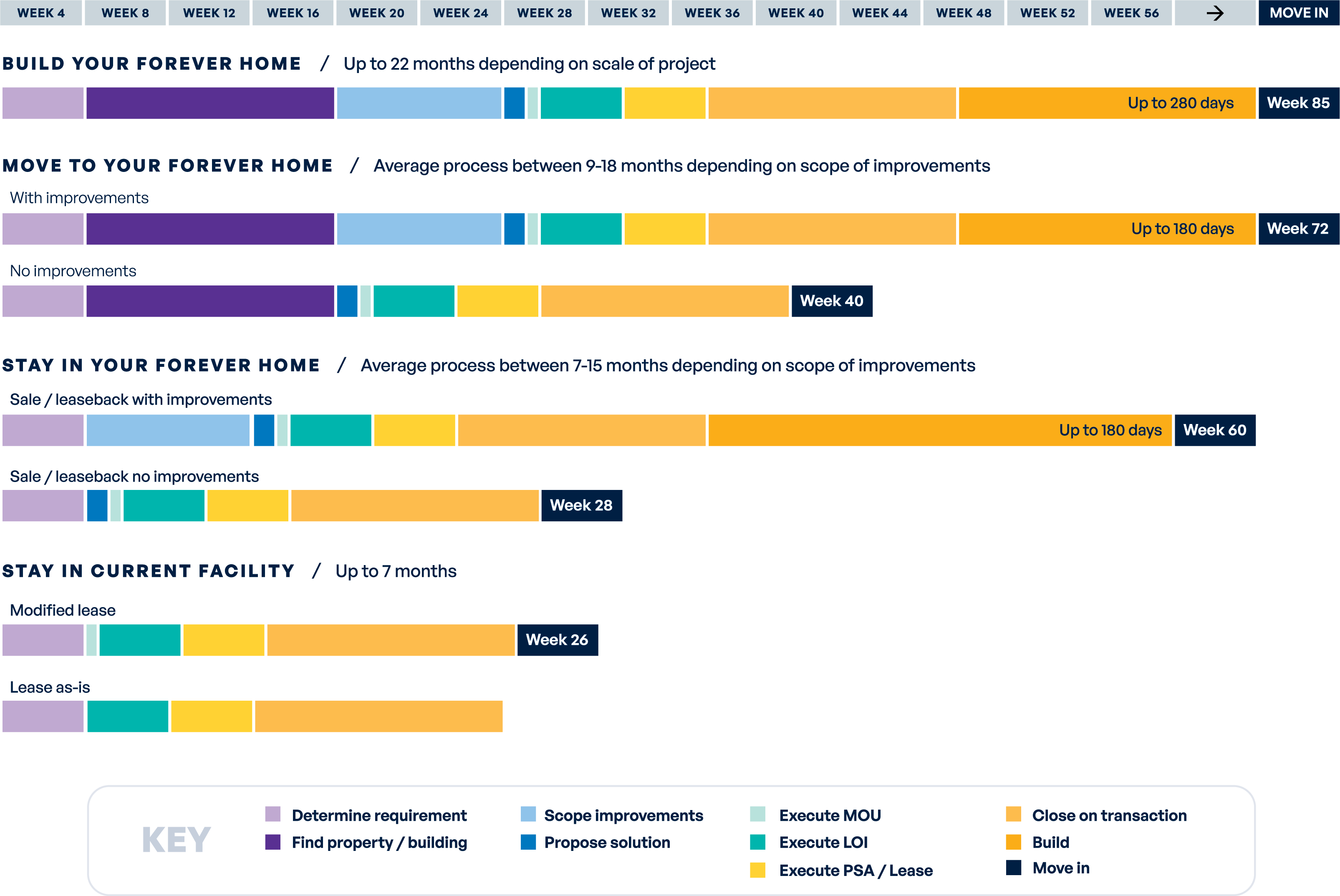
Approximate timelines for buying your school with and without renovations and improvements.

Facility projects require extensive advance planning—typically a minimum of 12 months for any significant expansion or relocation. The complexity of these undertakings affects your entire organization, from administrative staff to teachers and students.

Why Extended Planning Is Essential:

  • Legal and regulatory approval processes take time
  • Renovation and construction projects often face delays
  • Staff and student transitions require careful coordination
  • Furniture, equipment, and technology installations need scheduling
  • Program continuity must be maintained throughout transitions

Schools that underestimate these timelines often face rushed decisions, cost overruns, and disruptions to their educational programs.

The Strategic Triangle: Requirements, Aesthetics, and Budget

Successful charter school facilities decisions require balancing three critical factors that often compete with each other.

Educational Requirements: Mission-Critical Needs

Your facility must support your specific educational approach and student population. Different school models have vastly different space requirements.

Questions to Consider:

  • What specialized spaces does your educational program require?
  • Do you need state-of-the-art science laboratories for a STEM focus?
  • Does your arts program require performance spaces with specific acoustics?
  • Are you serving students with special needs requiring specialized accommodations?
  • Do you offer dropout recovery programs needing flexible classroom configurations?
Aesthetic Considerations: The Enrollment Impact

Your facility’s appearance directly affects enrollment, which drives the operating revenue that funds your academic programs. In competitive markets, aesthetics can make or break enrollment success.

Aesthetic Impact Factors:

  • First impressions for prospective families during tours
  • Competitive landscape—how does your facility compare to alternatives?
  • Community expectations and demographics
  • Impact on student pride and school culture
  • Long-term brand positioning in your market
Budget Reality: What You Can Actually Afford

Financial sustainability must guide all facility decisions. Even the most educationally perfect facility becomes a liability if it strains your budget beyond sustainable limits.

Pre-Qualification Process: Financial institutions evaluate multiple factors when determining your borrowing capacity:

  • Existing cash reserves and financial stability
  • Current and projected operating revenue
  • Charter renewal status and term length
  • Public subsidies and private funding sources
  • Grant opportunities and foundation support
Comprehensive Guide to Charter School Financing Options
Option 1: Cash Financing

Pros:

  • No interest payments or ongoing debt obligations
  • Complete ownership and control over the property
  • No collateral requirements or underwriting processes
  • Faster transaction completion

Cons:

  • Depletes cash reserves that could fund educational programs
  • Limits financial flexibility for unexpected needs
  • Opportunity cost—funds could generate returns elsewhere
  • Not feasible for most charter schools

Best For: Well-established schools with substantial reserves considering smaller facility investments.

Option 2: Investment Bank Financing

Overview: Traditional bank loans for charter school facilities typically require significant equity contributions and extensive underwriting processes.

Requirements:

  • Typically 20-40% equity contribution from the school
  • Demonstrated financial stability and enrollment trends
  • Strong leadership team with proven track record
  • Comprehensive business plan and financial projections

Pros:

  • Lower transaction costs compared to bond financing
  • More flexible terms than bond structures
  • Builds equity ownership over time

Cons:

  • Substantial upfront cash requirement
  • Extensive underwriting and approval process
  • Personal guarantees may be required
  • Limited availability for newer schools

Best For: Mature schools with substantial cash reserves undertaking major facility projects ($7+ million).

Option 3: Bond Financing

Reality Check: While many charter schools aspire to bond financing, only 12% of charter schools nationwide actually secure bond market funding. The remaining 88% rely on alternative financing methods.

Bond Financing Process:

  • Extremely thorough underwriting process
  • Hundreds of thousands in legal fees per transaction
  • Requires maintaining cash reserves for taxes and bondholder security
  • Typically 30-year terms with fixed costs

Pros:

  • No major upfront cash investment required
  • Potentially attractive interest rates for large projects
  • Fixed long-term costs provide budget predictability

Cons:

  • Complex, time-consuming approval process
  • Substantial legal and transaction costs
  • Ongoing compliance and reporting requirements
  • Reserved for larger transactions ($10+ million minimum)
  • Requires continued interest payments during cash accumulation period

Best For: Large, stable schools ready for permanent “forever home” facilities with no expansion plans.

Option 4: Long-Term Lease Financing

Overview: Long-term leases offer many benefits of ownership without the capital requirements and risks of property ownership.

Typical Structure:

  • 20-40 year lease terms available
  • Minimal upfront cash requirements
  • School maintains operational control
  • Landlord retains property ownership and maintenance responsibilities

Pros:

  • Low initial capital requirements
  • Predictable monthly costs over lease term
  • Less complex underwriting than bonds or bank loans
  • Allows financing for furniture and equipment
  • Future operating revenues not held as collateral
  • Available to schools at various maturity stages

Cons:

  • No equity building over time
  • Potential rent escalations based on lease terms
  • Less control over major property modifications

Best For: Schools at any stage seeking facility control with minimal upfront investment and predictable costs.

Https Growschools Com Article Best Practices For Charter School Facilities Financing (2)
Four Critical Factors for Financing Approval
1. Sustainable Enrollment Patterns

What Lenders Evaluate:

  • Current enrollment compared to charter capacity
  • Historical enrollment trends and stability
  • Waiting list size and demographic alignment
  • Local market demand for charter options
  • Competition analysis and market positioning

Red Flags for Lenders:

  • Enrollment significantly below projections
  • Declining enrollment trends over multiple years
  • Waiting lists that don’t support expansion plans
  • Oversaturated local charter market
2. Strong Leadership Team

Leadership Factors Lenders Consider:

  • Previous experience successfully operating schools
  • Educational leadership credentials and track record
  • Financial management experience
  • Board composition and governance experience
  • Organizational management depth

How to Strengthen Your Leadership Profile:

  • Document previous successes and achievements
  • Highlight relevant experience in education and management
  • Demonstrate board expertise and engagement
  • Show succession planning and organizational depth
3. Sound Financial Management

Financial Health Indicators:

  • Debt service coverage ratios above minimum thresholds
  • Operating margins that support debt payments
  • Facility costs representing less than 20% of operating revenue
  • Strong internal financial controls and reporting
  • Appropriate cash reserves for operational stability

Financial Documentation Requirements:

  • Multi-year audited financial statements
  • Current year budget and financial projections
  • Cash flow analysis and debt service projections
  • Enrollment and revenue modeling
  • Expense management and cost control evidence
4. Excellent Governance and Authorizer Relations

Governance Evaluation Criteria:

  • Board composition, experience, and engagement
  • Compliance with charter requirements and state regulations
  • Financial oversight and audit processes
  • Academic performance and accountability measures
  • Community relations and stakeholder engagement

Authorizer Relationship Assessment:

  • Charter renewal history and prospects
  • Compliance with authorizer requirements
  • Academic performance relative to authorizer expectations
  • Financial management and reporting quality
  • Communication and collaboration effectiveness
Strategic Planning for Long-Term Success
Aligning Facilities with Educational Vision

Https Growschools Com Article Best Practices For Charter School Facilities Financing

Your facility should support and enhance your educational approach rather than constrain it. Consider how different spaces can:

  • Support innovative teaching methodologies
  • Accommodate diverse learning styles and needs
  • Enable collaborative and project-based learning
  • Provide flexibility for program evolution
  • Create positive school culture and community
Financial Sustainability Beyond Initial Financing

Ongoing Facility Considerations:

  • Maintenance and repair costs over time
  • Utility expenses and efficiency improvements
  • Technology infrastructure and upgrades
  • ADA compliance and accessibility requirements
  • Future expansion or modification needs
Building Community Support

Strong community relationships can provide additional resources and support for facility initiatives:

  • Parent and family volunteer assistance
  • Local business partnerships and support
  • Community foundation grants and donations
  • Municipal cooperation and assistance
  • Neighborhood integration and support
Next Steps: Moving from Planning to Action
Immediate Action Items
  1. Complete Comprehensive Budget Analysis: Determine your realistic facility investment capacity
  2. Assess Current and Future Educational Needs: Define space requirements that support your mission
  3. Evaluate Market Conditions: Research available properties and competitive landscape
  4. Strengthen Financial Position: Build cash reserves and improve operational efficiency
  5. Engage Professional Support: Connect with experienced charter school facilities specialists
Building Your Facilities Team

Successful facilities projects require expertise beyond your educational leadership team:

  • Commercial Real Estate Professionals familiar with educational requirements
  • Architecture and Construction Specialists experienced with charter schools
  • Financial Advisors knowledgeable about charter school financing options
  • Legal Counsel specializing in educational and real estate transactions
  • Project Management Support to coordinate complex timelines and processes
Conclusion: Making Informed Facilities Decisions

Charter school facilities financing doesn’t have to derail your educational mission. With proper planning, realistic budgeting, and the right financing approach for your school’s stage and circumstances, you can secure facilities that support excellent education while maintaining financial sustainability.

The key is starting early, understanding your options, and choosing financing approaches that align with your long-term educational and financial goals. Whether you’re a startup school seeking your first permanent home or an established school ready for expansion, the right facilities financing solution can enhance your ability to serve students and strengthen your community.


Ready to explore charter school facilities financing options? Our team specializes in helping charter schools navigate complex facilities decisions and secure financing that supports long-term educational success. Contact us to discuss your specific needs and explore solutions tailored to your school’s unique circumstances.


CHARTER EDtalk: California Charter School Facilities

In this CHARTER EDtalk, Janet Johnson, CMO at Charter School Capital, sits down with Branché Jones, Lobbyist with the Branché Jones Lobbying Firm and Charter School Capital’s Co-Founder, President and CEO, Stuart Ellis, to discuss California charter school facilities. More specifically, they discuss the effects of Proposition 39 and SB740 on how charter schools are able to access funds for their facilities as well as how state-driven programs or laws contribute to the dynamics between the authorizers and the schools. See the video and the transcript below.


Transcript:

Janet Johnson (JJ): Hello and welcome to this edition of CHARTER EDtalk. Today we are speaking with Branché Jones, who is a California lobbyists and consultant who served for seven years as VP of Governmental Affairs for the California Charter School Association. And, we are speaking with Stewart Ellis, CEO of Charter School Capital. We’re going to be talking a little bit about facilities today and board governance.
Stuart Ellis (SE): Branché, given all of your expertise and the experience you’ve had impacting charter schools and education in California, tell us a little about – from your perspective – what an authorizer in that role has to do with charter schools and their facilities.
Branché Jones (BJ): In California, we have a unique situation where charter schools are actually authorized by their competition because the charter school is going to try to educate and work with the same students that the school district serves, so it’s a unique model that we have in the state. Under Proposition 39, the authorizer is obligated to provide facilities to the charter school for kids that would otherwise go to the school, the traditional school, so there’s a burden to authorize the school, but also the tension that develops because you have to provide facilities for those kids who actually left your traditional schools to go through a charter school. So, it’s a unique situation that creates a lot of tension between the authorizer and charter school.
SE: How does that tension reveal itself between authorizing and overseeing a charter versus providing or supporting the school for their facilities? What kind of problems arise between the district and the charter school?
BJ: Well, in a different time and place, I was actually a lobbyist for San Francisco Unified School district, and I worked for a superintendent. In that capacity, one of the things the district does is create a facility master plan. So, they look at all the buildings they have, facilities they have, where they are, which ones they need close, which ones they need to renovate, which ones that you have to spend dollars to maintain. So, they’ve got a whole list of things they do. The charter school comes and basically opens up in a part of town—there may be a closed school there—it may impact the district in another way. It’s hard for the district to figure out where the charter school fits in because they haven’t prepared for it in their facility master plan.
Additionally, one of the things that districts do – that we find problematic – is they will provide the charter school multiple sites. So, they’ll give you 60 seats over here, the room for 100 students three blocks away, and another building a mile away. Under that scenario, they have met their Prop 39 obligation, but it becomes impossible or nearly impossible for the charter school to utilize all those facilities. Although some of our folks are very, very creative and they find a way to utilize the facilities. But those are some of the issues that arise between the authorizer and the charter school facilities.
SE: You mention Proposition 39 and how it impacts the way the districts and charters work together. Talk a little bit about how SB740 or other state-driven programs or laws contribute to those dynamics either between the authorizer and the school and how that fits into the picture.
BJ: Specifically, on SB740, that actually assists the district and assists the charter school because it provides money for facilities. So, the charter school doesn’t have to go to the district. They can rent or lease somewhere else. And actually, if they meet the requirements of SB740, they receive funding for their students. The flip side of SB740, which no one talks about—it was a two-pronged approach. One side was to provide facilities for charter schools in low-income neighborhoods. That’s where it started. But the other side was actually to create regulations around non-classroom-based charter schools. So that side of SB740 has non-classroom-based charter schools filing funding determinations with the state and the state will determine how long they’re funding. It can be up to five years and what percentage they’re funded at. And so, the best thing you’d come out with is five-year funding termination with a hundred percent funding. So that’s a problem with SB740 because no one likes that side. The state doesn’t like to go through the process and charters hate going through this process because there are different bars and percentages you have to make. It becomes pretty complicated.
But you know, when, when we started out, I want to say maybe 15 years ago, maybe 17 years ago, SB740 was $7.7 million for the whole state for charter school facilities. My good friend, former superintended Jack O’Connell, was part of putting that together and helping us get facility money. Be we grew it to nine and then we worked with the speaker of the assembly at the time, president of the state Senate to grow the pot to out a $120 million. So now it’s an excess of $100 million to provide money for charters school facilities. So that actually helps, takes a burden off the district and it allows a charter school to actually be able to plan, enter into a long-term lease, figure out how these costs are going to be met from a school site level.
SE: How much money is available to charters on a per-student basis? How does that translate down at the level of the individual school that qualifies for SB740?
BJ: To be honest with you, I don’t have the number right now. I don’t remember what it is per student. It was $750 per student, they’ve changed the formula. We’re going through a budget process right now and they’re changing the formula. And the governor wants to get it up to $1,100, and I think the legislature wants to be around $900. So, I’m assuming that it’ll be somewhere around $900 this year.
SE: And the funding determination that you mentioned for a non-site-based charter learning models or whatever, do they have access to the same kind of dollar figure and dollar amount if maxed out?
BJ: They don’t because they’re non-classroom based, so they don’t have facility costs that the traditional classroom-based charter school has.
SE: So those other aspects of the laws don’t give them access to the same money. It just creates limitations on the per-student funding level they have.
BJ: It can create limitations. It doesn’t give them access to the SB740 pot. It can create limitations if they don’t spend, I think it’s 80 percent of their money on instructional materials and 40 percent of their money on certificated employees. So, there’s a whole process that the department of education staff goes through examining what you’ve spent, what your budget looks like. You can’t have a lot of money in reserve.
A long time ago, in some faraway place, there were charters that were doing things (not everybody, but some schools) that were questionable with their reserves and how they spent their money. This was the state’s answer to address that. I think it was the incorrect answer, but oftentimes when the state faces a problem, they always impose the incorrect answer. You just have to live under them. So that’s kind of where we are. And the reality is that most charters have now mastered that system. They understand how the process works so they can meet all the requirements that the state puts before you and they’re coming out – in four or five years – with a hundred percent of their funding.
SE: You mentioned some things about constraints of resources and the infrastructure that a district has allocating pieces per Prop 39 to schools – whether intended to be helpful or not – given that they’re supervising and authorizing their competition. How has the state or the district and/or charter schools, as you think about it, invest in the infrastructure necessary to support students going forward? Where’s that funding coming from? Or what kind of challenges are there to districts?
BJ: And you’re talking about it in terms of school bonds?
SE: You’ve got, across the state, existing schools that may, by law be required to be offered to charters, but often those schools are mothballed or broken down or, or really very old facilities that need significant investment to bring them up to a place where they can really serve the student population. What kind of challenges exist there and how is that being addressed?
BJ: I’ll say overall, I don’t believe the state is addressing their facility needs when it comes to K through 12 education. On top of that, you apply the pressure of transitional kindergarten programs that the state would like everyone to have. My good friends in Sacramento, at Universal Preschool, there’s a whole number of things they want, the LEAs traditional schools and school districts to do that they don’t have facilities for.
Typically, you have local bonds. The state does every other year, every four years ago, about a $9 billion K through 12 bond. When you think about the school system that has over 6 million kids, that’s not enough. It just can’t keep up with what we’re doing. Excuse me. Not what we’re doing—but [can’t keep up] with the students we’re educating.
But also, you would like to see more bonds. You’d like to see more local bonds, more state bonds, but you have to start thinking about local debt and what’s that doing the taxpayers. Maybe a decade or 15 years ago, we actually reduced the threshold to pass bonds. Local bonds used to be 66.7% or two-thirds and now we’ve reduced it to %. So, you have bonds flying everywhere because you (US political folks) can figure out how to get that 51%. That’s not hard.
But the question is what is that doing to your tax base? And, and on top of that, when you’re a district as large as Los Angeles, how do you equitably set that so all students benefit? When you’re in San Francisco when you are landlocked and there’s no buildings to buy, right? There was like nowhere to buy. You can’t build a new school. So basically, your money is for renovation. The state, when they do the K through 12 school bonds—I think Assemblyman O’Donnell has the bond bill this year for $9 billion—part of that will be for new construction, modernization … you know, you’ve got all these different pots … a charter school pot, etc. so $9 billion isn’t a lot when you’re cutting it four or five ways – so you’re not really meeting your needs.
It’s kind of like infrastructure. We never meet our infrastructure needs in the state and we pay gas tax. I really don’t know where it goes but I’m still having a fifth wheel alignment in my car. Right? Because it’s bumpy. So, I don’t have an answer but we’re not addressing our needs and we need to figure that out.
SE: You got any questions for me today?
BJ: I do have one question for you. When we talk about school facilities and the tension providing facilities for the charter causes the district, how can Charter School Capital step in there and help them ease that tension or help with growth with the charter school as they prepare to move forward. How can you be helpful with that?
SE: I think you mentioned some of the constraints and the lack of resources available when we go through taxpayers and support from the government agencies out there that are supposed to do that. And I think one of the things that Charter School Capital has been able to do over the past decade-plus that we’ve been funding charter schools, (starting here in California) is to bring private capital from outside the government and outside the taxpayer base to support the building and creation of that infrastructure necessary for schools to flourish. And, to be able to deliver that in a way that is more efficient perhaps than the way a government money is provided and customized for the solutions that the schools need to create to serve their underlying families and student populations.
So, we’ve been able to bring that to bear, particularly in California, and although it may not be enough to support all of public education, the $1.6 billion-plus that we’ve now invested in charter schools in our history is actually quite significant when combined with government funding. That allows schools to both support their long-term facilities needs and do so in a way where it’s customized. It’s not scattered across campuses. They can’t get kicked out of the facility after two or three years or see their rent or debt service rise drastically. But they also have access through us to the operational capital and growth capital they need to hire and invest in the programs, teachers, technology and things to really make their program work within whatever facility they have.
And so they have access to the funds in a reliable way. And then the expertise that comes also from our organization – outside of the money – we funded now over 600 schools supporting more than 800,000 students. That expertise really allows us to help charter school leaders utilize the money in the most efficient and effective way to deliver the best quality programs to the students and families that they serve or have picked their programs as the best thing that public education can offer in California.
BJ: We really need to figure out how to make that fact known. I think that the number of students served is an incredible number and that’s something that you should be yelling from rooftops. Making sure people are aware of that. And also, on the facilities side, we should work hard to find a way to partner with districts and say, hey, we have a solution to your Prop 39 problem. I think those are two takeaways we can have.
SE: It may be that frankly, because the capital we have available for schools to take advantage of, I think working with the districts to either pay for or acquire [facilities] so that the district can actually have more funds going in. Then we can take advantage of or acquire the underlying facilities to serve the charters and then invest money that the district or local agencies don’t have to put to work. And we can actually turn some of these aging facilities into properties and educational facilities that charter schools can leverage to really deliver customized solutions for the underlying families and where they have an investor willing to add to and enhance the underlying property.
SE: People don’t get to see you very often. You are behind the scenes working on these things, but I just want to say, having worked with you for years, and seeing the impact you’ve had on education in California, I don’t think people really appreciate the impact that you’ve personally had on the growth of charter school movement in California and across the country. And it’s always been a privilege to work with you.
BJ: I appreciate that. Appreciate those kind words. And you know, I love working with Charter School Capital. And I think that everything we can do to promote what’d you’ve done for students and the schools you’ve helped stay open when we’re going through deficits and deferrals in the state, the impact you had. I think sometimes folks don’t understand that, but it was huge, and I think a lot of charter school people who’ve worked with you and then you’ve actually helped out—they get it. But we’d always need to remember that. So, thank you.
SE: A pleasure.
JJ: And, with that, thank you, Branché, for coming in and speaking with us today and thank you, Stuart, for your time. And thank you for listening in on this latest CHARTER EDtalk.


Charter School Capital is committed to the success of charter schools and has solely focused on funding charter schools since the company’s inception in 2007. Our depth of experience working with charter school leaders and our knowledge of how to address charter school financial and operational needs have allowed us to provide over $1.6 billion in support of 600 charter schools that educate 800,000 students across the country. For more information on how we can support your charter school, contact us!

LEARN MORE

Governor Jerry Brown This week California Governor Jerry Brown released his proposed budget that invests significantly in K-12 education. The California budget update contains very good news for the education community while also storing away money in a healthy reserve. This begins the budget deliberation process, next the legislature will begin to hold hearings on the various proposals in the budget and the Governor will submit revisions to his budget in May. In this proposed budget the Governor wants to continue to restrain spending and increase budget reserves, and these dire economic predictions support his proposal to add about $3.5 billion to the Rainy Day Fund in 2016-17.  This proposal seeks to transfer $2 billion more to the Budget Stabilization Account (BSA) than what is required under Proposition 2, and would bring the BSA total to just over $8 billion.

Continued Growth in K-12 Spending and LCFF Implementation

The Governor estimates that the Proposition 98 guarantee for 2016-17 will be $71.6 billion, which he compares to the pre-recession guarantee of $56.6 billion in 2007-08 and the deep recession guarantee of $47.3 billion in 2011-12.  The increase in the guarantee for 2016-17 is sufficient to provide a fourth year investment of about $2.8 billion for LCFF implementation.  The Department of Finance calculates that this funding will eliminate about 49% of the remaining LCFF funding gap, and when combined with the roughly $12.8 billion provided over the prior three years, will bring total LCFF implementation to about 95%.  The budget proposal also provides a very modest $1.7 million increase to the county office of education LCFF to cover COLA and ADA adjustments.

One-Time Discretionary Funding

Upward adjustments of the Prop. 98 Guarantee in 2014-15 and 2015-16 allow the Governor to again propose an allocation of fully flexible, one-time funding to school districts, county offices and charter schools.  The amount proposed for 2016-17 is $1.2 billion, and builds on the $3.6 billion provided over the last two budgets.  Note that all of these funds count toward offsetting any mandate reimbursement claims filed by the LEAs receiving the funds.

California School Facilities

The Governor continues to cite “deficiencies” with the existing school facilities program and emphasizes the need for a new state program that is less complex and focuses on districts that have less local capacity to build or modernize schools.  He observes that the $9 billion bond proposed for November 2016 does not reform the existing program but, in response to a question at his press conference this morning, did not state that he is currently opposed to that measure.  The budget proposal, however, makes fairly clear that he intends to work with the Legislature and stakeholders to provide some sort of alternative to the November school bond measure.

Early Education Block Grant

The Administration proposes to consolidate Prop. 98 funding for the State Preschool Program, transitional kindergarten, and the Preschool Quality Rating and Improvement System Grant into a $1.6 billion Early Education Block Grant.  The Governor suggests that the block grant will provide greater local flexibility to address community needs and focus on the most at-risk children.  The proposal does not include many specifics, but promises further detail by the May Revision.  Many legislators, including Speaker of the Assembly Anthony Rendon, have stated that expanding early education opportunities is their top priority.  Stay tuned.

Career Technical Education

The Governor proposes to continue the commitment made in the 2015 Budget Act to provide $900 million in one-time funding over three years for competitive matching grants to support high-quality CTE programs.  Funding for 2016-17 will be $300 million.

Proposition 39 Energy Efficiency

The budget proposes $365.4 million to support school district, county office and charter school energy efficiency projects in 2016-17.  This is an increase of about $50 million over what was provided last year.

Cost-of-Living Adjustments (COLA)

The COLA is calculated at 0.47%, and the budget proposal includes $22.9 million to provide COLAs to categorical programs that remain outside of the LCFF, including Special Education, Child Nutrition, Foster Youth, Preschool, American Indian Education Centers, and the American Indian Early Childhood Education Program.
Any questions on how this may impact your charter school? Let us know at GrowCharters@charterschoolcapital.com