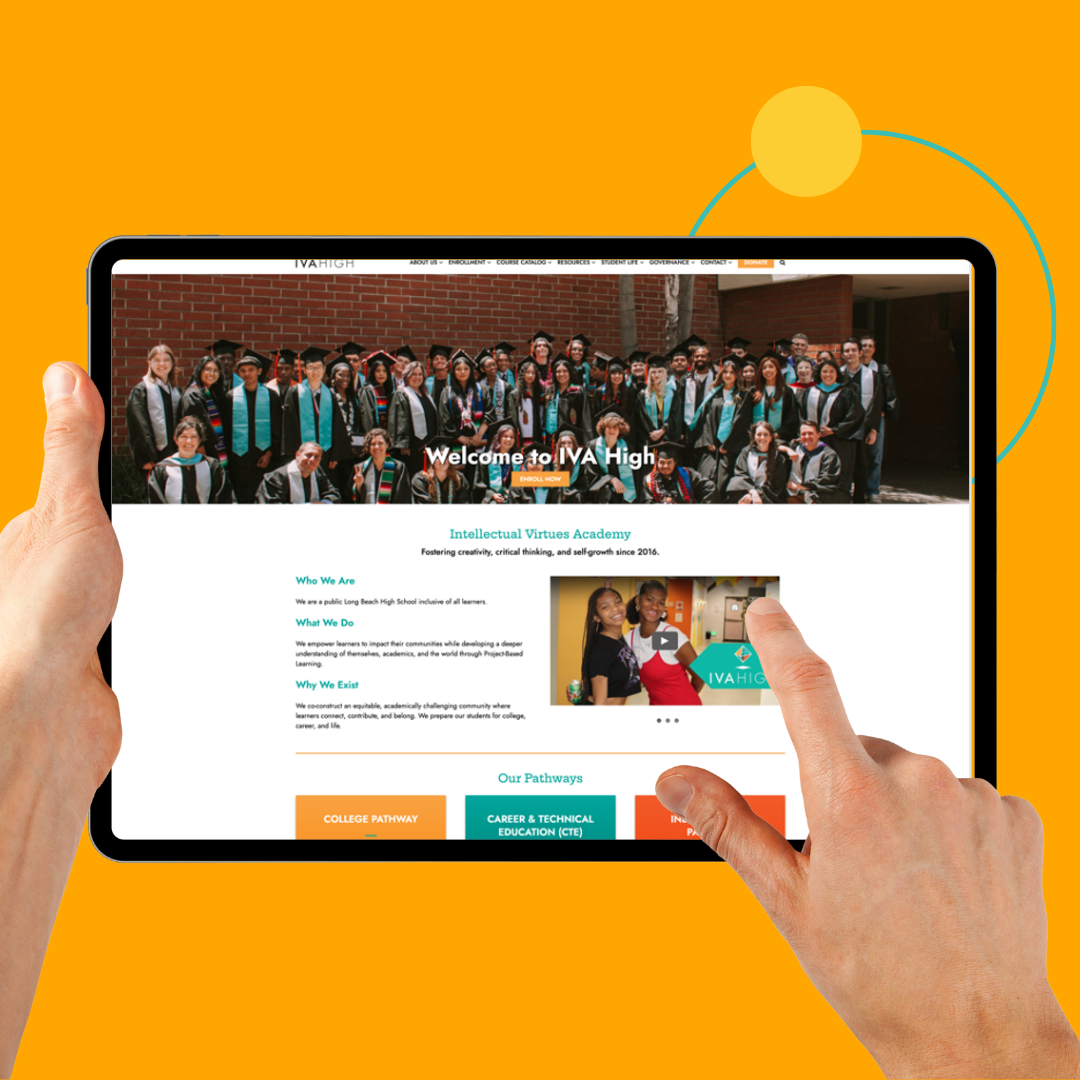
After five years helping schools tell their stories, and twenty in the classroom before that, I’ve gotten pretty good at spotting the gap between what a school is and what its homepage says it is. What most prospective families want from a homepage is to see happy kids, a real community, and enough information to answer the questions they walked in with. Most of the time, that story exists. The words just aren’t carrying it.
That’s fixable. Here’s how I think about it.
Your Headline has One Job — Make Sure It’s Doing It

The headline at the top of your homepage is the first thing a family reads. It’s also often the only thing they read before deciding whether to stick around or move on.
Most school headlines I see fall somewhere on a spectrum from generic (“Welcome to Our School”) to aspirational but vague (“Where Curious Kids Become Confident Leaders”) to specific and real (“K-8 STEM Education Preparing Tomorrow’s Innovators in [City]”). The first is a missed opportunity — any school could say it. The second is warmer, but it still could belong to almost anyone. The third is what you’re aiming for: one sentence that tells a family the grades you serve, who you are, where you are, and what you’re trying to do for kids. A simple test: could another school say your headline word for word? If yes, rewrite it.
A Simple Formula for Writing Headlines
Here’s what I try to include in every headline:
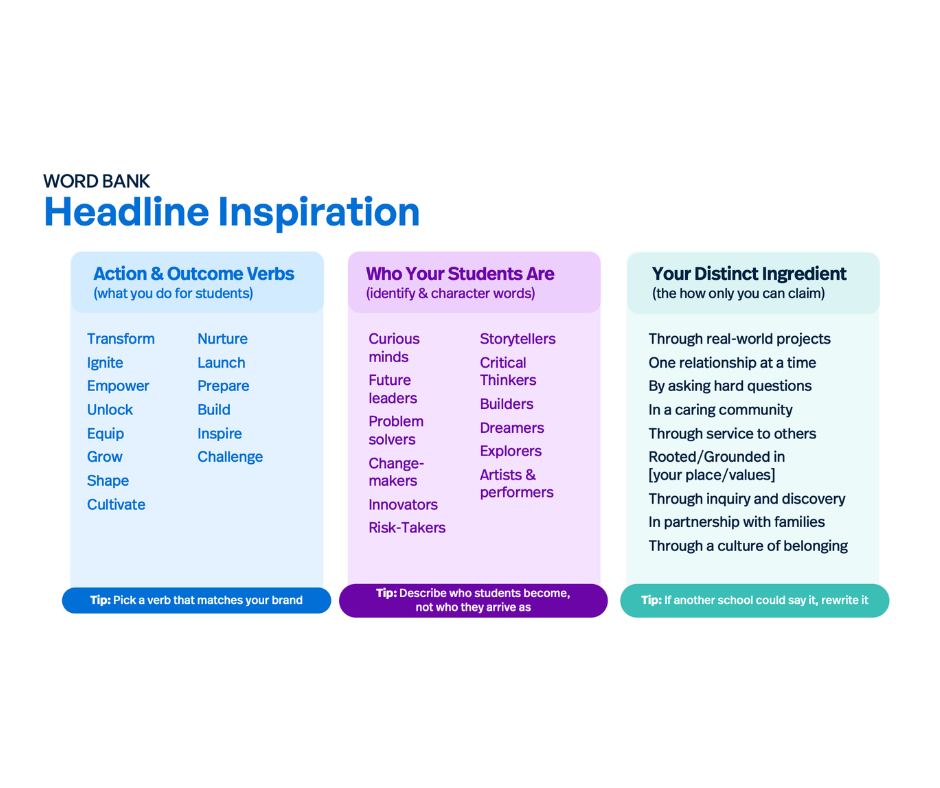
An action verb. Words like transform, prepare, cultivate, launch, shape. These imply motion. They tell a family what kind of school you are.
Identity words. Inspire your families with images of who their child will become as a result of attending your school. Critical thinkers, problem solvers, changemakers, storytellers. What fits with your mission and brand?
Your distinct ingredient. This is the part only your school can claim. Through real-world projects. Rooted in our community. In partnership with families. One relationship at a time. If another school could say it, rewrite it.
Put those three things together and you have a headline that tells a family what you do, who your kids become, and what makes you different. That’s a lot to accomplish in one sentence and it’s exactly what a great headline does.
The Subheadline is Where You Talk Directly to Families
The line underneath your main headline is your promise. It expands on what the headline said, and it speaks to what a family actually cares about.
Think about who’s coming to your homepage. If you serve families who are motivated by college prep, speak to that. If your school is a place for kids who didn’t quite fit their neighborhood school, speak to the parents who are out there looking for a place for their child to belong. The subheadline is where you say: we see you, we know what you’re looking for, and here’s how we answer that.
A strong subheadline expands on your headline, addresses a real concern or desire, and includes an outcome. Something like: our project-based curriculum builds independent thinkers ready for high school and beyond. One sentence, and a family knows exactly what to expect.
Write for the Person Who Isn’t Going to Read Your Page
Most of your visitors are skimmers. They scan before they read closely, and if the page doesn’t work for someone moving fast, a lot of them won’t make it very far.
This means your writing has to work on two levels — for the skimmer who’s moving quickly, and for the researcher who’s going to read every word.
A few things that make your homepage skimmable and informative:
- Use headers to break up your sections. If a family can read only the headers and still understand what your school is about, you’re on the right track.
- Bold the words families are scanning for. STEM. Arts-integrated. Tuition-free. Make them easy to find.
- Favor bullet points over dense paragraphs wherever the content allows it.
- Write in active voice. Instead of “students are prepared for high school by our curriculum,” try “our curriculum prepares kids for high school.” Same information, more direct, and it moves.

The Most Powerful Words on Your Page Might Not Be Yours
The words that convert hesitant families most often aren’t written by you, rather they come from other families who chose your school and want to talk about it.
Parent testimonials, especially in video form, consistently outperform almost anything else on a school homepage. Keep them short, unscripted, and genuine. A family talking honestly about their experience is far more persuasive than any copy you can write.
Other things that build trust:
- Parent quote overlays on real photos of your school
- Achievement data with context: 95% of graduates are accepted to college!
- Awards and accreditations that don’t get buried mid-scroll
- A “why choose us” section with five honest, specific reasons families pick your school
All of these are answering the question every prospective family is really asking: are you real, are you thriving, and can I trust you with my child? Your page needs to answer that with a confident yes.
A Quick Trust Audit
Pull up your homepage and run through this:
- Is there news or an event posted within the last thirty days?
- Do you have parent testimonials on the page?
- Do you have achievement data or awards?
- Are your social media links pointing to accounts that are actually active?
Each of these may feel like small items on their own, but together, they truly add up to build trust with prospective families. One note: a news section that hasn’t been updated in months can work against you. If the most recent post is from last spring, it signals that nobody’s home. Keep it current or take it down.
Your Buttons Matter More Than You Think
The words on your call-to-action buttons are doing real work, and most schools underestimate how much.
Words that work: schedule, discover, join, start, experience. I love active verbs that tell a family exactly what will happen when they click.
Words that don’t: submit, learn more, click here. These words can be vague or easy to skip past.
A simple test: read your button copy out loud and ask, what’s going to happen next? “Schedule a Tour” passes the test. “Submit” doesn’t.
One more thing about writing for mobile: keep the button text short. On a small screen, a label that wraps to two lines looks awkward and is harder to tap. Punchy and specific is the goal.
Where to Start
If you’re looking at your homepage and feeling like there’s a lot to fix, start with the headline. You may not need a developer or a designer at this point – you may just need better copy. Use your homepage to tell the story that only your school can tell.

Jesse Foss is a Content Strategist and Project Manager at Grow Schools. She spent twenty years in the classroom before joining the team. Grow Schools partners with charter schools on enrollment marketing, facilities financing, and working capital. Learn more at growschools.com.
Want to share?