
Sometimes the financial conversations nobody wants to have are usually the most important ones. Budgets, cash ratios, debt service, reserves — these aren’t glamorous topics. But they are the difference between a school that survives a rough patch and one that doesn’t.
At Grow Schools’ recent School Success Trifecta webinar, I talked about financial health not just as a compliance exercise, but as a genuine leadership tool. Here’s what I want every charter leader to take away.
The Numbers That Actually Matter
When I assess a school’s financial health, I focus on a few key indicators. The most important is your defensive interval — essentially, if no more money came in starting today, how long could you keep the lights on and make payroll? The industry standard is at least 3 months. If you’re below that, you’re operating without a safety net.
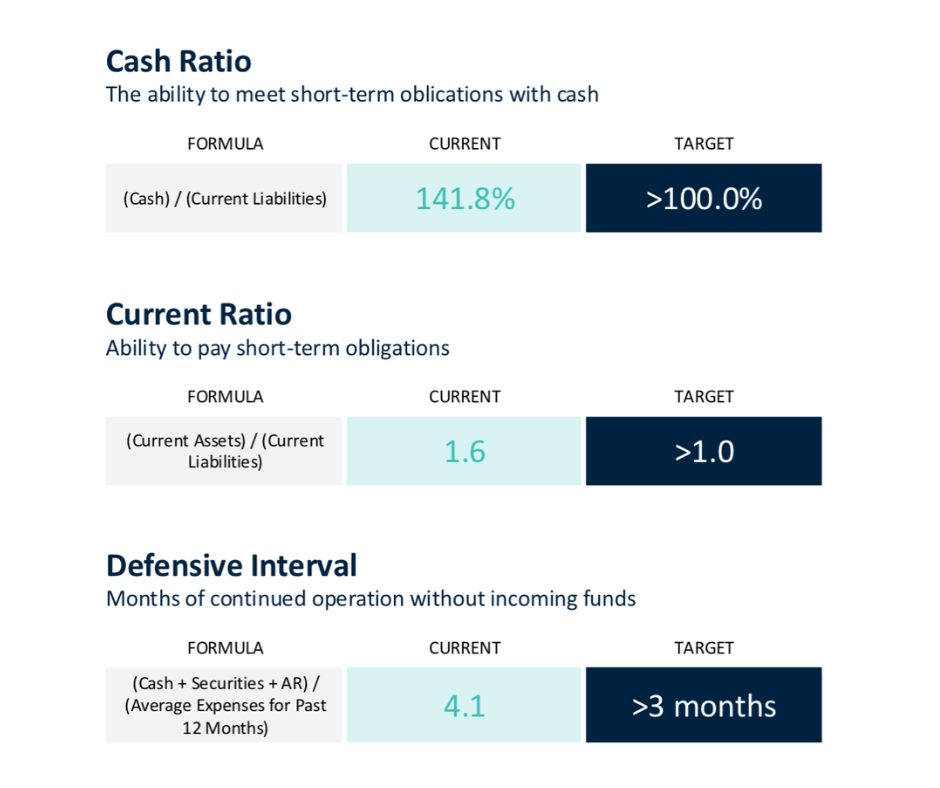
I also look at your cash ratio and how your expenses track against revenue throughout the year. In California, it’s common for expenses to outpace revenue for much of the school year. That’s not necessarily alarming — but it means you need to know when your cash crunch months are coming and plan for them. One school we worked with was caught off guard when delayed grants and tax credits collided with winter break. A short-term cash flow solution helped them through it, but the better outcome is never being surprised in the first place.
Multi-Year Budgeting Changes Everything
One of the most impactful shifts a charter leader can make is expanding from an annual budget to a multi-year budget. Most states require you to submit budget projections anyway — but there’s a difference between doing it as a compliance exercise and actually using it as a management tool.
When your board can see the financial picture across two or three years, decisions look different. That staff raises you’re considering? Across a single year, it might look manageable. Across three years, it might raise serious sustainability questions. A one-time stipend might be the smarter move. These are the kinds of conversations multi-year budgeting makes possible.
It also gives you a framework for growth planning. If you’re thinking about expanding your enrollment or your facility footprint, you need to be able to model what that looks like over time — not just in the year you make the investment.

Signs You’re Ready to Grow
Growth readiness isn’t just about enthusiasm or wait lists. It’s about financial position. Here’s what I look for:
- You have adequate cash flow to weather the costs that come with growth. Adding students means adding teachers, and depending on your state, you may need to spend before the funding catches up. You need runway for that.
- Your facility costs are proportionate. Charter schools generally shouldn’t spend more than 15% of annual revenue on rent or debt service. If you’re above that, expansion will only make it harder.
- You’re retaining the students you already have. This one surprises people, but retention is your single biggest enrollment lever. It’s far less expensive to keep a family than to replace one.

Don’t Go It Alone
Trying to lead a facilities project without experienced partners is one of the most common and costly errors in this space. At my own charter school in Colorado, we were fortunate to be included in a bond measure that funded a significant construction project. We partnered with an architect, a contractor, and an owner’s rep — and we even invited someone from our authorizer to sit on our RFP process. They felt ownership. They stayed informed. And the project went smoothly because the right people were at the table from the beginning.
There’s never a perfect time to grow. But there is a right way to do it — and it starts with knowing your numbers, building your reserves, and finding partners who’ve done it before.
About the Author

Kristin Nowak is an experienced consultant and former charter school leader with extensive experience supporting charter schools across California, Colorado, Nevada, Tennessee, and Texas since 2014. As Executive Vice President of Strategic Management at Charter School Management Corporation (CSMC), Kristin leads the organization’s sales, business development, marketing, and expansion efforts, helping to grow CSMC’s impact and reach within the charter school sector. With a strong background as a former charter leader, educator, and administrator, as well as a management consultant, Kristin leverages her financial and strategic expertise to guide schools through complex fiscal challenges and regulatory requirements.
Kristin holds a BS in Business Administration/Finance from the University of Southern California (USC), as well as an MA in Education from USC’s Rossier School of Education. She received her Administrator’s Certification through Johns Hopkins graduate certificate program and has also completed graduate-level work at Harvard’s Graduate School of Education.
Kristin’s education, leadership experience, and strategic vision make her uniquely qualified to drive growth and innovation in the charter school finance and operations space.
Want to share?