According to the National School Choice Awareness Foundation’s most recent survey, 75 percent of U.S. parents, about 46 million families, considered, searched for, or enrolled a child in a different school in 2025, and 62 percent expect to search again this year (National School Choice Awareness Foundation). Most of that search starts online, so your school’s website and online presence carry real weight. Here are five ways to show up and make a strong impression once families and caregivers find you.
How Do You Improve Search Visibility for Your School?
Google still handles the bulk of that search traffic, so paid search through Google Ads remains a solid way to reach families actively looking. Build ad content around the terms people search, like “schools near me,” “schools with enrichment programs,” or “top schools in [your city],” and Google’s free analytics will show you which terms convert so you can adjust your spend. Schools set their own budget and pay only when someone clicks, which keeps it low-risk to test.
But search has changed since keyword ads were the whole story. AI Overviews now show up on more than 20 percent of Google searches, and when they do, click-through to any website drops by nearly 60 percent, according to Similarweb clickstream data reported by Search Engine Land. ChatGPT alone reaches 900 million weekly users, and Google’s own AI Overviews reach 2.5 billion people a month, per CXL. A growing share of families never click a link at all; they get their answer straight from an AI Overview or a chatbot.
Answer engine optimization (AEO) and generative engine optimization (GEO) are about writing content so an AI system can lift a clear, direct answer and cite your school as the source when it responds to a family’s question directly, inside ChatGPT, an AI Overview, or a voice assistant. In practice, that means answering the exact questions families ask, in plain language, near the top of the page: What’s tuition? What’s the student-to-teacher ratio? When does enrollment open? The clearer and more specific your answer, the more likely an AI Overview or chatbot quotes it back with your school’s name attached.

How Do You Design a Website That Works for Families?
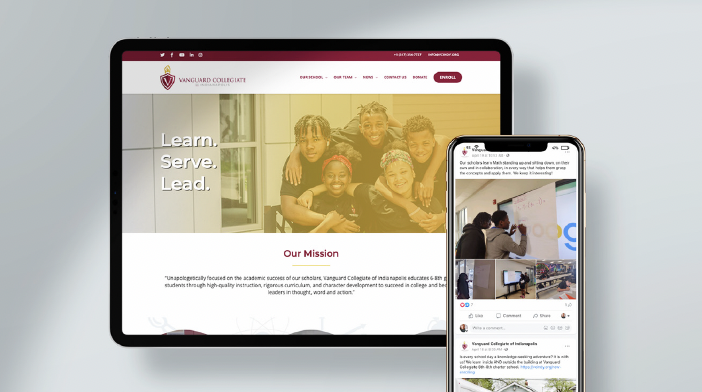
Your website is often a family’s first real look at your school, so keep the branding consistent and use authentic photos instead of generic stock images. Design it for two audiences at once, current families and prospective ones, and put enrollment information where nobody has to hunt for it: in the main navigation and as a button on your homepage. A pop-up as deadlines approach helps too.
Build your content around the questions prospective families have. Videos, photos, and testimonials from students, teachers, and families and caregivers show what your school is like day to day, and footage shot by students and teachers often reads as more genuine than a polished production. Keep your calendar, visit days, and enrollment deadlines current, and list school events that are open to the public.
Grow Schools’ free webinar, Click to Enroll: Redesign Your School’s Website for Growth, covers this in more depth if you want to rework your site.
Which Social Platforms Are Worth Your Time?
You don’t need a presence everywhere. Ask current families where they spend time online, and build your strategy around those one or two platforms instead of spreading yourself across all of them. What works on Facebook won’t necessarily work on Instagram or TikTok, so look at what other schools are posting on each platform before you commit.
Running several accounts is a lot for one person, so bring others in. A school representative approves everything before it posts, but families and caregivers, teachers, and students can supply the stories and footage. A student-run media club, with a faculty advisor keeping an eye on it, can handle a surprising amount of the day-to-day content.
How Do You Keep Your School’s Online Listings Accurate?
Sites like GreatSchools, Niche, Private School Review, and Public School Review are often a family’s first stop, and they’re increasingly a source AI Overviews and chatbots pull from directly when someone asks about schools in your area. Give someone on your team access to update enrollment numbers, course offerings, and demographics on each one, and correct errors as soon as you spot them.
These sites vet every review, so staff can’t post one on a family’s behalf, current families and students can. A little school swag as a thank-you goes a long way toward getting people to write one.
Not every review will be glowing, and a negative one will sit there for a while. Treat it the way you’d treat a phone complaint: ignoring it is the online version of hanging up, except everyone else is watching. Respond promptly, address what’s real in the complaint, and use it to show families how your school handles a problem. Updates to these profiles are moderated, so give it 2 to 3 business days to show up after you submit a change.
How Do You Showcase What’s Happening at Your School?
Blog posts are a straightforward way to show your community what your students are doing, and sharing them on LinkedIn and other social channels extends their reach past your own site. Clear, specific posts that answer a real question with real numbers are also more likely to get picked up by an AI Overview or chatbot, which is one more reason to write them well.
Your teachers have plenty worth sharing too. Beyond a guest post on your own site, outlets like Edutopia, The Educators Room, and We Are Teachers accept articles from teachers directly, and member publications of Parent Media often run how-to pieces written by educators. When someone on staff gets published, share it widely and give them credit.
A few ideas beyond blog posts: a teacher-led webinar on classroom management, a counselor’s video on helping students get organized, an administrator speaking on a topic like managing budget cuts, or a student walking through a class project on TikTok.
The more places your school shows up, online and in person, the easier it is for the families already searching to find you.
Want to share?